The diagram below show the stages in the recycling of aluminum drinks can. Summarize the information by selecting and reporting the main features, and make comparisons where relevant.
14/26
The diagram below show the stages in the recycling of aluminum drinks can. Summarize the information by selecting and reporting the main features, and make comparisons where relevant.
Hướng dẫn giải:
Gợi ý 1:
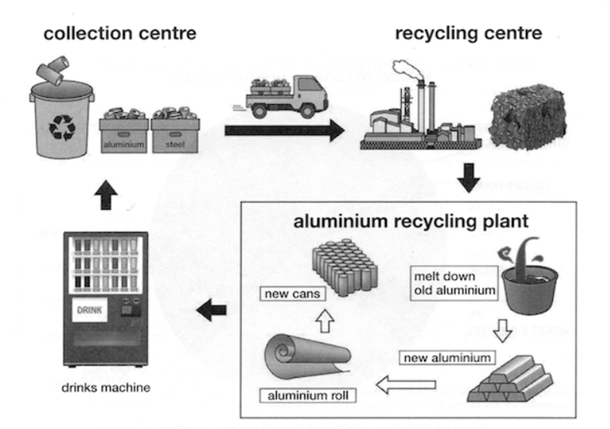
The diagram illustrates the process of recycling aluminium drink cans, showing how used cans are collected, processed, and reused to produce new ones. Overall, the recycling of aluminium cans involves three main stages: collection, processing, and reproduction, forming a continuous cycle.
In the first stage, used aluminium cans are gathered at a collection centre, where they are separated from other materials such as steel. The collected cans are then transported by truck to a recycling centre, where they are compressed into large blocks for easier handling and storage.
Next, these blocks are sent to an aluminium recycling plant, where the old aluminium is melted down. The molten metal is then converted into new aluminium, which is rolled into sheets. These aluminium rolls are used to manufacture new cans, completing the production process.
Finally, the new cans are distributed to drink machines for consumer use. Once the cans are used, they are collected again, restarting the recycling cycle.
In summary, the diagram demonstrates a closed-loop system in which aluminium cans are continuously reused through collection, melting, and remanufacturing, helping to conserve resources and reduce waste.
(Sơ đồ minh họa quy trình tái chế lon nước giải khát bằng nhôm, cho thấy cách các lon đã qua sử dụng được thu gom, xử lý và tái sử dụng để sản xuất lon mới. Nhìn chung, quá trình tái chế lon nhôm gồm ba giai đoạn chính: thu gom, xử lý và tái sản xuất, tạo thành một chu trình khép kín.
Ở giai đoạn đầu, các lon nhôm đã qua sử dụng được thu gom tại trung tâm thu gom, nơi chúng được tách khỏi các vật liệu khác như thép. Sau đó, các lon được vận chuyển bằng xe tải đến trung tâm tái chế, nơi chúng được nén thành khối lớn để dễ xử lý và lưu trữ.
Tiếp theo, các khối này được chuyển đến nhà máy tái chế nhôm, nơi nhôm cũ được nung chảy. Kim loại nóng chảy sau đó được chuyển hóa thành nhôm mới, rồi cán thành tấm. Những tấm nhôm này được dùng để sản xuất lon mới, hoàn tất quy trình sản xuất.
Cuối cùng, các lon mới được phân phối đến máy bán nước giải khát cho người tiêu dùng. Khi lon được sử dụng xong, chúng lại được thu gom, bắt đầu lại chu trình tái chế.
Tóm lại, sơ đồ cho thấy một hệ thống khép kín, trong đó lon nhôm được tái sử dụng liên tục thông qua các bước thu gom, nung chảy và tái sản xuất, giúp tiết kiệm tài nguyên và giảm chất thải.)
Gợi ý 2:
The diagram shows the stages involved in recycling aluminium drink cans. It is clear that the process is cyclical, beginning with the collection of used cans and ending with the production of new ones.
At the start of the process, aluminium cans are collected at a collection centre and sorted from other recyclable materials such as steel. The sorted cans are then loaded onto trucks and transported to a recycling centre, where they are compressed into blocks.
In the next stage, these blocks are delivered to an aluminium recycling plant. Here, the old aluminium is melted down and transformed into new aluminium. The new material is rolled into sheets, which are then used to produce new cans.
The final stage involves distributing the newly manufactured cans to drink machines for sale. After consumers use the cans, they are returned to the collection centre, and the cycle begins again.
Overall, the recycling process for aluminium cans is a sustainable system that allows materials to be reused indefinitely, reducing environmental impact and conserving energy.
(Sơ đồ cho thấy các giai đoạn trong quy trình tái chế lon nước giải khát bằng nhôm. Rõ ràng rằng quá trình này mang tính chu kỳ, bắt đầu từ việc thu gom lon đã qua sử dụng và kết thúc bằng việc sản xuất lon mới.
Ở giai đoạn đầu, các lon nhôm được thu gom tại trung tâm thu gom và tách khỏi các vật liệu tái chế khác như thép. Sau đó, các lon được chất lên xe tải và vận chuyển đến trung tâm tái chế, nơi chúng được nén thành khối.
Tiếp theo, các khối này được đưa đến nhà máy tái chế nhôm. Tại đây, nhôm cũ được nung chảy và chuyển hóa thành nhôm mới. Vật liệu mới được cán thành tấm, sau đó dùng để sản xuất lon mới.
Giai đoạn cuối cùng là phân phối các lon mới đến máy bán nước giải khát. Sau khi người tiêu dùng sử dụng, các lon lại được thu gom và chu trình bắt đầu lại.
Nhìn chung, quy trình tái chế lon nhôm là một hệ thống bền vững, cho phép vật liệu được tái sử dụng vô hạn, giảm tác động môi trường và tiết kiệm năng lượng.)