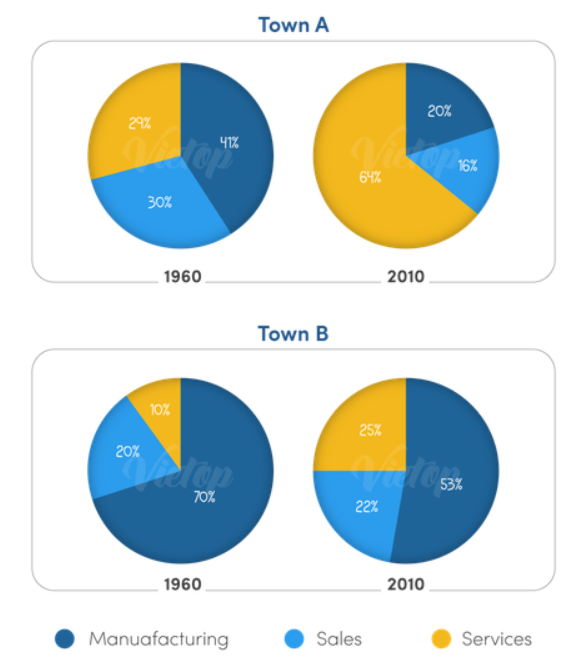
The charts below show the percentage of people working in different sectors in town A and B in 1960, 2010.
3/26
The charts below show the percentage of people working in different sectors in town A and B in 1960, 2010.
Hướng dẫn giải:
Gợi ý 1:
The pie charts compare the proportions of people working in three sectors—manufacturing, sales, and services—in Town A and Town B in 1960 and 2010. Overall, both towns experienced a decline in manufacturing employment and a rise in services over the 50-year period, though the changes were more dramatic in Town A.
In 1960, manufacturing was the largest employment sector in both towns, accounting for 41% in Town A and a much higher 70% in Town B. Sales represented 30% in Town A and 20% in Town B, while services were the smallest sector in both, at 29% and 10% respectively.
By 2010, the employment structure had shifted significantly. In Town A, services became dominant, rising sharply to 64%, while manufacturing fell to 20% and sales dropped slightly to 16%. Town B also saw a decline in manufacturing, though it remained the largest sector at 53%. Services increased to 25%, and sales rose marginally to 22%.
In summary, both towns moved away from manufacturing toward service-based employment between 1960 and 2010, with Town A showing a more pronounced transformation than Town B.
(Các biểu đồ tròn so sánh tỷ lệ người làm việc trong ba lĩnh vực — sản xuất, bán hàng và dịch vụ — ở thị trấn A và thị trấn B vào năm 1960 và 2010. Nhìn chung, cả hai thị trấn đều chứng kiến sự sụt giảm trong việc làm ngành sản xuất và sự gia tăng trong lĩnh vực dịch vụ, mặc dù sự thay đổi rõ rệt hơn ở thị trấn A.
Năm 1960, sản xuất là lĩnh vực việc làm lớn nhất ở cả hai thị trấn, chiếm 41% ở thị trấn A và cao hơn nhiều ở thị trấn B với 70%. Bán hàng chiếm 30% ở thị trấn A và 20% ở thị trấn B, trong khi dịch vụ là lĩnh vực nhỏ nhất ở cả hai, lần lượt là 29% và 10%.
Đến năm 2010, cơ cấu việc làm đã thay đổi đáng kể. Ở thị trấn A, dịch vụ trở thành lĩnh vực chủ đạo, tăng mạnh lên 64%, trong khi sản xuất giảm xuống còn 20% và bán hàng giảm nhẹ xuống 16%. Thị trấn B cũng chứng kiến sự sụt giảm trong sản xuất, mặc dù nó vẫn là lĩnh vực lớn nhất với 53%. Dịch vụ tăng lên 25% và bán hàng tăng nhẹ lên 22%.
Tóm lại, cả hai thị trấn đều chuyển từ sản xuất sang dịch vụ trong giai đoạn 1960–2010, với thị trấn A có sự chuyển đổi rõ rệt hơn thị trấn B.)
Gợi ý 2:
The charts illustrate the distribution of employment across manufacturing, sales, and services in Town A and Town B in 1960 and 2010. It is clear that the importance of manufacturing declined in both towns, while the service sector expanded considerably.
In 1960, manufacturing was the main source of employment, particularly in Town B, where it accounted for 70% of jobs. Town A had a smaller share at 41%. Sales made up 30% in Town A and 20% in Town B, whereas services were relatively minor, at 29% and 10% respectively.
By 2010, the situation had changed dramatically, especially in Town A. The proportion of people working in services rose to 64%, overtaking manufacturing, which fell to 20%. Sales also decreased slightly to 16%. In Town B, manufacturing remained the largest sector but dropped to 53%. Meanwhile, services increased to 25%, and sales grew modestly to 22%.
Overall, both towns shifted from manufacturing toward services over the 50-year period, with Town A undergoing a more significant transformation than Town B.
(Các biểu đồ minh họa sự phân bố việc làm trong ba lĩnh vực — sản xuất, bán hàng và dịch vụ — ở thị trấn A và thị trấn B vào năm 1960 và 2010. Rõ ràng rằng tầm quan trọng của ngành sản xuất đã giảm ở cả hai thị trấn, trong khi lĩnh vực dịch vụ tăng mạnh.
Năm 1960, sản xuất là nguồn việc làm chính, đặc biệt ở thị trấn B, nơi chiếm 70% tổng số việc làm. Thị trấn A có tỷ lệ thấp hơn, 41%. Bán hàng chiếm 30% ở thị trấn A và 20% ở thị trấn B, trong khi dịch vụ chỉ chiếm 29% và 10% tương ứng.
Đến năm 2010, tình hình thay đổi đáng kể, đặc biệt ở thị trấn A. Tỷ lệ người làm việc trong lĩnh vực dịch vụ tăng lên 64%, vượt qua sản xuất, vốn giảm xuống còn 20%. Bán hàng cũng giảm nhẹ xuống 16%. Ở thị trấn B, sản xuất vẫn là lĩnh vực lớn nhất nhưng giảm xuống 53%. Trong khi đó, dịch vụ tăng lên 25% và bán hàng tăng nhẹ lên 22%.
Nhìn chung, cả hai thị trấn đều chuyển dịch từ sản xuất sang dịch vụ trong 50 năm, với thị trấn A có sự thay đổi mạnh mẽ hơn thị trấn B.)