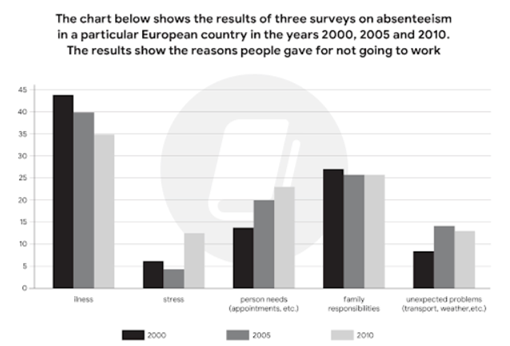
The chart below shows the results of three surveys on absenteeism in a particular European country in the years 2000, 2005 and 2010. The results show the reasons people gave for not going to
22/24
The chart below shows the results of three surveys on absenteeism in a particular European country in the years 2000, 2005 and 2010. The results show the reasons people gave for not going to work.
Summarize the information by selecting and reporting the main features, and make comparisons where relevant. Write at least 150 words.
Hướng dẫn giải:
Gợi ý 1:
The bar chart illustrates the reasons given for absenteeism from work in a European country in 2000, 2005, and 2010. Overall, illness was consistently the most common reason for not going to work, while stress and personal needs became increasingly significant over time.
In 2000, illness accounted for the highest proportion of absences, at around 45%, followed by family responsibilities at approximately 27%. Personal needs and unexpected problems were relatively minor causes, both standing at about 10%, while stress was the least common reason, at only 5%.
By 2005, the percentage of people absent due to illness fell slightly to 40%, and family responsibilities rose to 30%. Stress and personal needs increased to 10% and 15%, respectively, while unexpected problems remained unchanged at 10%.
In 2010, illness continued to decline to 35%, whereas stress and personal needs rose further to 15% and 20%. Family responsibilities dropped back to 25%, and unexpected problems increased slightly to 15%.
In summary, illness remained the leading cause of absenteeism throughout the period, but stress and personal needs showed a steady upward trend, suggesting that personal and psychological factors became more influential over time.
(Biểu đồ cột minh họa các lý do khiến người lao động nghỉ việc ở một quốc gia châu Âu trong các năm 2000, 2005 và 2010. Nhìn chung, bệnh tật luôn là nguyên nhân phổ biến nhất, trong khi căng thẳng và nhu cầu cá nhân ngày càng trở nên quan trọng hơn theo thời gian.
Năm 2000, bệnh tật chiếm tỷ lệ cao nhất, khoảng 45%, tiếp theo là trách nhiệm gia đình với khoảng 27%. Nhu cầu cá nhân và các vấn đề bất ngờ đều chiếm khoảng 10%, trong khi căng thẳng là nguyên nhân ít phổ biến nhất, chỉ 5%.
Đến năm 2005, tỷ lệ nghỉ việc do bệnh giảm nhẹ xuống 40%, còn trách nhiệm gia đình tăng lên 30%. Căng thẳng và nhu cầu cá nhân tăng lần lượt lên 10% và 15%, trong khi các vấn đề bất ngờ vẫn giữ nguyên ở mức 10%.
Năm 2010, bệnh tiếp tục giảm xuống 35%, trong khi căng thẳng và nhu cầu cá nhân tăng lên 15% và 20%. Trách nhiệm gia đình giảm xuống 25%, và các vấn đề bất ngờ tăng nhẹ lên 15%.
Tóm lại, bệnh tật vẫn là nguyên nhân chính khiến người lao động nghỉ việc trong suốt giai đoạn, nhưng các yếu tố cá nhân và tâm lý như căng thẳng và nhu cầu riêng ngày càng có ảnh hưởng lớn hơn.)
Gợi ý 2:
The chart compares the reasons for absenteeism from work in a European country across three years: 2000, 2005, and 2010. It is clear that illness was the main reason in all years, although its proportion declined, while stress and personal needs became more common causes.
In 2000, almost half of absences were due to illness, at 45%. Family responsibilities were the second most frequent reason, accounting for about 25%. Personal needs and unexpected problems each represented around 10%, and stress was the least significant factor at 5%.
Five years later, illness decreased slightly to 40%, while family responsibilities rose to 30%. Stress and personal needs increased moderately, reaching 10% and 15%, respectively. Unexpected problems remained stable at 10%.
By 2010, illness had fallen further to 35%, but stress and personal needs continued to rise, reaching 15% and 20%. Family responsibilities declined to 25%, and unexpected problems grew slightly to 15%.
Overall, although illness remained the dominant reason for absenteeism, the data show a gradual shift toward personal and emotional factors such as stress and personal needs over the decade.
(Biểu đồ so sánh các lý do khiến người lao động nghỉ việc ở một quốc gia châu Âu trong ba năm: 2000, 2005 và 2010. Rõ ràng rằng bệnh tật là nguyên nhân chính trong tất cả các năm, mặc dù tỷ lệ của nó giảm dần, trong khi căng thẳng và nhu cầu cá nhân trở nên phổ biến hơn.
Năm 2000, gần một nửa số trường hợp nghỉ việc là do bệnh, chiếm 45%. Trách nhiệm gia đình đứng thứ hai với khoảng 25%. Nhu cầu cá nhân và các vấn đề bất ngờ đều chiếm khoảng 10%, còn căng thẳng là yếu tố ít quan trọng nhất, chỉ 5%.
Năm 2005, tỷ lệ nghỉ việc do bệnh giảm nhẹ xuống 40%, trong khi trách nhiệm gia đình tăng lên 30%. Căng thẳng và nhu cầu cá nhân tăng vừa phải, đạt 10% và 15%. Các vấn đề bất ngờ vẫn ổn định ở mức 10%.
Đến năm 2010, bệnh giảm thêm xuống 35%, nhưng căng thẳng và nhu cầu cá nhân tiếp tục tăng, đạt 15% và 20%. Trách nhiệm gia đình giảm xuống 25%, và các vấn đề bất ngờ tăng nhẹ lên 15%.
Nhìn chung, mặc dù bệnh vẫn là nguyên nhân chính, dữ liệu cho thấy xu hướng chuyển dịch dần sang các yếu tố cá nhân và cảm xúc như căng thẳng và nhu cầu riêng trong thập kỷ này.)