The chart below compares the number of people per household by percentage in the UK in 1981 and 2001. Summarise the information by selecting and reporting the main features and make comparis
24/24
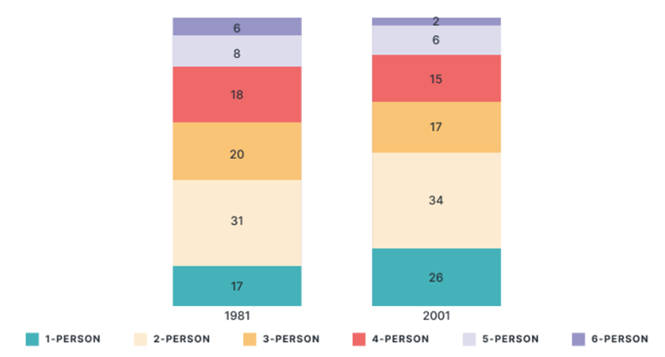
The chart below compares the number of people per household by percentage in the UK in 1981 and 2001.
Summarise the information by selecting and reporting the main features and make comparisons where relevant.
Write at least 150 words.
Hướng dẫn giải:
Gợi ý 1:
The chart compares the percentage of households of different sizes in the UK in 1981 and 2001. Overall, smaller households became more common over the period, while larger households declined.
In 1981, two-person households were the most common, accounting for 31% of the total, followed by three-person households at 20% and four-person households at 18%. Single-person households made up 17%, while five- and six-person households were relatively rare, at 8% and 6% respectively.
By 2001, the proportion of smaller households had increased noticeably. One-person households rose to 26%, and two-person households reached 34%, remaining the largest category. In contrast, the share of three- and four-person households fell slightly to 17% and 15%. Larger households became even less common, with five-person homes dropping to 6% and six-person homes to only 2%.
In summary, the data show a clear trend toward smaller households in the UK between 1981 and 2001, reflecting social changes such as an increase in single living and smaller family units.
(Biểu đồ so sánh tỷ lệ các hộ gia đình có số lượng người khác nhau ở Vương quốc Anh trong năm 1981 và 2001. Nhìn chung, các hộ nhỏ trở nên phổ biến hơn trong khi các hộ lớn giảm đi.
Năm 1981, hộ hai người là phổ biến nhất, chiếm 31% tổng số, tiếp theo là hộ ba người (20%) và hộ bốn người (18%). Hộ một người chiếm 17%, trong khi hộ năm và sáu người khá hiếm, lần lượt là 8% và 6%.
Đến năm 2001, tỷ lệ các hộ nhỏ tăng đáng kể. Hộ một người tăng lên 26%, và hộ hai người đạt 34%, vẫn là nhóm lớn nhất. Ngược lại, tỷ lệ hộ ba và bốn người giảm nhẹ xuống còn 17% và 15%. Các hộ lớn giảm mạnh, với hộ năm người còn 6% và hộ sáu người chỉ còn 2%.
Tóm lại, dữ liệu cho thấy xu hướng rõ ràng hướng tới các hộ nhỏ hơn ở Anh trong giai đoạn 1981–2001, phản ánh sự thay đổi xã hội như việc sống một mình và quy mô gia đình nhỏ hơn.)
Gợi ý 2:
The chart illustrates the proportion of households of different sizes in the UK in 1981 and 2001. It is evident that the number of smaller households increased, while larger households became less frequent over the two decades.
In 1981, two-person households were the most common, representing 31% of all households. Three-person and four-person households accounted for 20% and 18%, respectively. Single-person households made up 17%, whereas five-person and six-person households were less prevalent, at 8% and 6%.
By 2001, the proportion of one-person households had risen sharply to 26%, and two-person households increased slightly to 34%. Meanwhile, the share of three-person and four-person households declined to 17% and 15%. The percentage of five-person households fell to 6%, and six-person households dropped significantly to just 2%.
Overall, the UK experienced a shift toward smaller household sizes between 1981 and 2001, suggesting changes in lifestyle and family structure, such as more people living alone and fewer large families.
(Biểu đồ minh họa tỷ lệ các hộ gia đình có số lượng người khác nhau ở Vương quốc Anh trong năm 1981 và 2001. Rõ ràng rằng số lượng hộ nhỏ tăng lên, trong khi các hộ lớn giảm đi trong hai thập kỷ.
Năm 1981, hộ hai người là phổ biến nhất, chiếm 31% tổng số hộ. Hộ ba người và bốn người lần lượt chiếm 20% và 18%. Hộ một người chiếm 17%, trong khi hộ năm người và sáu người ít phổ biến hơn, lần lượt là 8% và 6%.
Đến năm 2001, tỷ lệ hộ một người tăng mạnh lên 26%, và hộ hai người tăng nhẹ lên 34%. Trong khi đó, tỷ lệ hộ ba và bốn người giảm xuống còn 17% và 15%. Tỷ lệ hộ năm người giảm xuống 6%, và hộ sáu người giảm mạnh chỉ còn 2%.
Nhìn chung, Vương quốc Anh chứng kiến sự chuyển dịch sang các hộ nhỏ hơn trong giai đoạn 1981–2001, cho thấy sự thay đổi trong lối sống và cấu trúc gia đình, chẳng hạn như nhiều người sống một mình và ít gia đình đông con hơn.)