Thay đổi giá trị của biến trở Rx = R thì điện áp hiệu dụng giữa hai điểm NP đạt giá trị nhỏ nhất thì hệ số công suất toàn mạch lúc này gần giá trị nào nhất sau đây?
Lời giải
Tóm tắt bài toán: MP:−−−−R−−−−−−⏟MN.−−L−C−Rx−−−⏟NPRx↗
Yêu cầu Rx→R⇒ULCRx→MIN→?cosφ=?
Ta có: \({U_{LC{R_x}}} = I\sqrt {{R_x}^2 + {{\left( {{Z_L} - {Z_C}} \right)}^2}} = \frac{U}{{\sqrt {{{\left( {R + {R_x}} \right)}^2} + {{\left( {{Z_L} - {Z_C}} \right)}^2}} }}\sqrt {{R_x}^2 + {{\left( {{Z_L} - {Z_C}} \right)}^2}} \)
\( \Rightarrow {U_{LC{R_x}}} = \frac{U}{{\sqrt {\frac{{{{\left( {R + {R_x}} \right)}^2} + {{\left( {{Z_L} - {Z_C}} \right)}^2}}}{{{R_x}^2 + {{\left( {{Z_L} - {Z_C}} \right)}^2}}}} }} = \frac{U}{{\sqrt {1 + \underbrace {\frac{{{R^2} + 2R{R_x}}}{{{R_x}^2 + {{\left( {{Z_L} - {Z_C}} \right)}^2}}}}_{f\left( {{R_x} = x} \right)}} }}\)
Vậy \({\left( {{U_{LC{R_x}}}} \right)_{\min }} \leftrightarrow f{\left( x \right)_{\max }}.\) Xét \(f\left( x \right) = \frac{{2Rx + {R^2}}}{{{x^2} + {{\left( {{Z_L} - {Z_C}} \right)}^2}}}\left( {x > 0} \right)\)
\(f'\left( x \right) = \frac{{2R\left( {{x^2} + {{\left( {{Z_L} - {Z_C}} \right)}^2}} \right) - 2x \cdot \left( {2Rx + {R^2}} \right)}}{{{{\left( {{x^2} + {{\left( {{Z_L} - {Z_C}} \right)}^2}} \right)}^2}}} = \frac{{2R\left( { - {x^2} - Rx + {{\left( {{Z_L} - {Z_C}} \right)}^2}} \right)}}{{{{\left( {{x^2} + {{\left( {{Z_L} - {Z_C}} \right)}^2}} \right)}^2}}}\).
Xét \(f'\left( x \right) = 0 \Leftrightarrow {x^2} + Rx - {\left( {{Z_L} - {Z_C}} \right)^2} = 0.\) \(\Delta = {R^2} + 4{\left( {{Z_L} - {Z_C}} \right)^2} > 0\).
Bảng biến thiên:
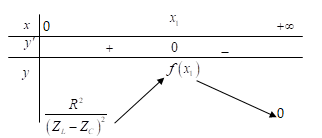
Dựa vào bảng biến thiên, ta có maxfx=fx1⇔Rx=R2+4ZL−ZC2−R2 .
Như vậy khi đó ta có \(2{R_x} + R = \sqrt {{R^2} + 4{{\left( {{Z_L} - {Z_C}} \right)}^2}} \Leftrightarrow 4{R_x}^2 + 4{R_x}R = 4{\left( {{Z_L} - {Z_C}} \right)^2}\)
⇒Rx2+RxR=ZL−ZC2.
Khi đó
\[ \Rightarrow {\left( {\cos \varphi } \right)^2} = \frac{2}{3} \Rightarrow \cos \varphi = \frac{{\sqrt 6 }}{3} \approx 0,816\]. Chọn A.