Cho tam giác ABC có BC = a , CA = b , AB = c . Gọi M là trung điểm của BC , D là chân đường phân giác trong góc A . Tính −−→ AD^2 theo a , b , c .
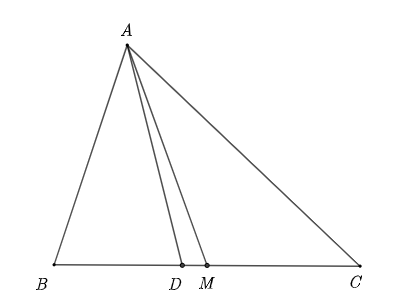
Vì M là trung điểm của BC nên \[\overrightarrow {AM} = \frac{1}{2}\left( {\overrightarrow {AB} + \overrightarrow {AC} } \right)\].
Suy ra \[AM = {\overrightarrow {AM} ^2} = \frac{1}{4}{\left( {\overrightarrow {AB} + \overrightarrow {AC} } \right)^2} = \frac{1}{4}\left( {{{\overrightarrow {AB} }^2} + 2\overrightarrow {AB} \cdot \overrightarrow {AC} + {{\overrightarrow {AC} }^2}} \right)\]
Lại có \[\overrightarrow {AB} \cdot \overrightarrow {AC} = \left| {\overrightarrow {AB} } \right| \cdot \left| {\overrightarrow {AC} } \right| \cdot \cos \left( {\overrightarrow {AB} ,\,\overrightarrow {AC} } \right) = c \cdot b.\cos A = bc \cdot \frac{{{c^2} + {b^2} - {a^2}}}{{2bc}} = \frac{1}{2}\left( {{c^2} + {b^2} - {a^2}} \right)\]
Nên \[A{M^2} = \frac{1}{4}\left( {{c^2} + 2.\frac{1}{2}\left( {{c^2} + {b^2} - {a^2}} \right) + {b^2}} \right) = \frac{{2\left( {{b^2} + {c^2}} \right) - {a^2}}}{4}\].
Theo tính chất đường phân giác thì \[\frac{{BD}}{{DC}} = \frac{{AB}}{{AC}} = \frac{c}{b}\].
Suy ra \[\overrightarrow {BD} = \frac{{BD}}{{DC}}\overrightarrow {DC} = \frac{b}{c}\overrightarrow {DC\,} \,\,\,\,\,\left( * \right)\]
Mặt khác \[\overrightarrow {BD} = \overrightarrow {AD} - \overrightarrow {AB} \] và \[\overrightarrow {DC} = \overrightarrow {AC} - \overrightarrow {AD} \] thay vào (*) ta được
\[\overrightarrow {AD} - \overrightarrow {AB} = \frac{b}{c}\left( {\overrightarrow {AC} - \overrightarrow {AD} } \right) \Leftrightarrow \left( {b + c} \right)\overrightarrow {AD} = b\overrightarrow {AB} + c\overrightarrow {AC} \]
\[ \Leftrightarrow {\left( {b + c} \right)^2}{\overrightarrow {AD} ^2} = {\left( {b\overrightarrow {AB} } \right)^2} + 2bc\overrightarrow {AB} \overrightarrow {AC} + {\left( {c\overrightarrow {AC} } \right)^2}\]
\[ \Leftrightarrow {\left( {b + c} \right)^2}{\overrightarrow {AD} ^2} = {b^2}{c^2} + 2bc.\frac{1}{2}\left( {{c^2} + {b^2} - {a^2}} \right) + {c^2}{b^2}\]
\[ \Leftrightarrow {\overrightarrow {AD} ^2} = \frac{{bc}}{{{{\left( {b + c} \right)}^2}}}\left( {b + c - a} \right)\left( {b + c + a} \right)\]
Vậy \[{\overrightarrow {AD} ^2} = \frac{{bc}}{{{{\left( {b + c} \right)}^2}}}\left( {b + c - a} \right)\left( {b + c + a} \right)\].