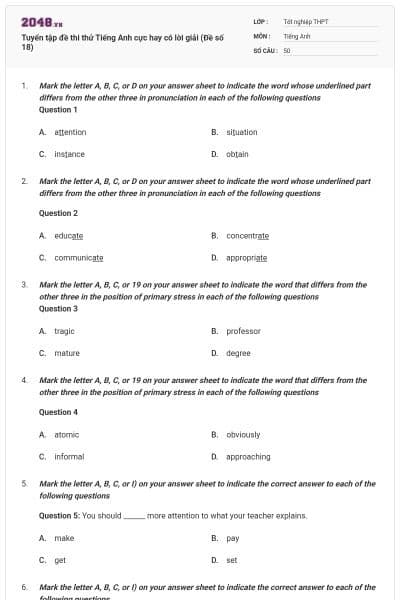
Tuyển tập đề thi thử Tiếng Anh cực hay có lời giải (Đề số 18)

50 câu hỏi
Mark the letter A, B, C, or D on your answer sheet to indicate the word whose underlined part differs from the other three in pronunciation in each of the following questions
Question 1
attention
situation
instance
obtain
Mark the letter A, B, C, or D on your answer sheet to indicate the word whose underlined part differs from the other three in pronunciation in each of the following questions
Question 2
educate
concentrate
communicate
appropriate
Mark the letter A, B, C, or 19 on your answer sheet to indicate the word that differs from the other three in the position of primary stress in each of the following questions
Question 3
tragic
professor
mature
degree
Mark the letter A, B, C, or 19 on your answer sheet to indicate the word that differs from the other three in the position of primary stress in each of the following questions
Question 4
atomic
obviously
informal
approaching
Mark the letter A, B, C, or I) on your answer sheet to indicate the correct answer to each of the following questions
Question 5: You should ______ more attention to what your teacher explains.
make
pay
get
set
Mark the letter A, B, C, or I) on your answer sheet to indicate the correct answer to each of the following questions
Question 6: The lecturer explained the problem very clearly and is always ______ in response to questions.
attention
attentive
attentively
attentiveness
Mark the letter A, B, C, or I) on your answer sheet to indicate the correct answer to each of the following questions
Question 7: Jack's mother ______a birthday cake with seventeen lighted candles on it.
brought out
showed off
turned up
took over
Mark the letter A, B, C, or I) on your answer sheet to indicate the correct answer to each of the following questions
Question 8: 1 have never seen such a beautiful dress ______ you before.
of
on
for
in
Mark the letter A, B, C, or I) on your answer sheet to indicate the correct answer to each of the following questions
Question 9: When you catch someone's ______ you do something to attract his attention so that you can talk to him.
head
hand
eye
ear
Mark the letter A, B, C, or I) on your answer sheet to indicate the correct answer to each of the following questions
Question 10: The teacher recommended that Torn _____ his composition as soon as possible.
finish writing
finished writing
should finish to write
finishes writing
Mark the letter A, B, C, or I) on your answer sheet to indicate the correct answer to each of the following questions
Question 11: Jane is going to go abroad next month and she's having a ______ party on Sunday.
birthday
farewell
wedding
anniversary
Mark the letter A, B, C, or I) on your answer sheet to indicate the correct answer to each of the following questions
Question 12: A whistle is the______for the football players to begin the match.
communication
instance
attention
signal
Mark the letter A, B, C, or I) on your answer sheet to indicate the correct answer to each of the following questions
Question 13:______advised on what and how to prepare for the interview, he might have got the job.
Had he been
If he had
Unless he had been
Were he to be
Mark the letter A, B, C, or I) on your answer sheet to indicate the correct answer to each of the following questions
Question 14: John lost the______bicycle he bought last week and his parents were very angry with his carelessness.
new beautiful blue japanses
beautiful blue Japanese new
beautiful new blue Japanese
Japanese beautiful new blue
Mark the letter A, B, C, or I) on your answer sheet to indicate the correct answer to each of the following questions
Question 15: Each of the guests ______ a bunch of flowers.
are given
is given
were given
give
Mark the letter A, B, C, or I) on your answer sheet to indicate the correct answer to each of the following questions
Question 16: Let's go to the beach this weekend, ______?
do we
shall we
will we
don't we
Mark the letter A, B, C, or I) on your answer sheet to indicate the word(s) CLOSEST in meaning to the underlined word (s) in each of the following questions.
Question 17: This is the instance where big, obvious non-verbal signals are appropriate.
situation
attention
place
matter
Mark the letter A, B, C, or I) on your answer sheet to indicate the word(s) CLOSEST in meaning to the underlined word (s) in each of the following questions.
Question 18: These anniversaries mark the milestones of a happy and lasting relationship between married couples.
signs
achievements
landmarks
progresses
Mark the letter A, B, C', or D on your answer sheet to indicate the word(s) OPPOSITE in meaning to the underlined word(s) in each of the following questions.
Question 19: As a brilliant and mature student Marie harboured the dream of a scientific career which was impossible for a woman at that time.
kept
had
abandoned
deleted
Mark the letter A, B, C', or D on your answer sheet to indicate the word(s) OPPOSITE in meaning to the underlined word(s) in each of the following questions.
Question 20: After the tragic death of Pierre Curie in 1906, she not only took charge of educating her two children but also took the position which her husband had finally obtained at the Sorbonne.
brilliant
lovely
fascinating
happy
Mark the letter A, B, C, or D on your answer sheet to indicate the sentence that best completes each of the following exchanges.
Question 21: - “I passed the TOEFL test, Mom.” - “______”
All right
Well done
Good luck
Thank you
Mark the letter A, B, C, or D on your answer sheet to indicate the sentence that best completes each of the following exchanges.
Question 22: - Roger: "Wow! You look terrific in that new dress!" - Tina: "_____”
Oh, what a pity!
I'm afraid so!
Thank you. I'm glad you think so.
Why dare you say so?
Read the following passage and mark the letter A, B, C, or D on your answer sheet to indicate the correct word or phrase that best fits each of the numbered blanks from 23 to 27.
ALFRED NOBEL
Alfred Nobel was born on October 21, 1833 in Sweden. His important invention was dynamite - a powerful (23)_____. This dynamite business made him a very rich man.
One day, Alfred Nobel read about his death in a newspaper. In fact, it was his brother's death. The mass media (24)______ him a saleman of death, "The dynamite king". Nobel was very
upset. He had invented dynamite to save lives - lives (25) ______were lost because other explosives were dangerous to use. He hated violence and war. And he did not like the world to think of him as a man of war.
He thought (26)________ the best way for people to use his fortune for years. (27) ______ he knew what to do with his fortune. Alfred Nobel established the Nobel Prize, an annual award to honour leaders of science, literature, and world peace. Alfred Nobel died on December 10, 1896. He was unmarried and had no children. His important decision changed the way the world thought of him. He was remembered the way he wanted: Alfred Nobel, man of peace.
(https://goo.gl/6x4EkU)
Question 23
explode
explosive
explosion
exploded
Read the following passage and mark the letter A, B, C, or D on your answer sheet to indicate the correct word or phrase that best fits each of the numbered blanks from 23 to 27.
ALFRED NOBEL
Alfred Nobel was born on October 21, 1833 in Sweden. His important invention was dynamite - a powerful (23)_____. This dynamite business made him a very rich man.
One day, Alfred Nobel read about his death in a newspaper. In fact, it was his brother's death. The mass media (24)______ him a saleman of death, "The dynamite king". Nobel was very
upset. He had invented dynamite to save lives - lives (25) ______were lost because other explosives were dangerous to use. He hated violence and war. And he did not like the world to think of him as a man of war.
He thought (26)________ the best way for people to use his fortune for years. (27) ______ he knew what to do with his fortune. Alfred Nobel established the Nobel Prize, an annual award to honour leaders of science, literature, and world peace. Alfred Nobel died on December 10, 1896. He was unmarried and had no children. His important decision changed the way the world thought of him. He was remembered the way he wanted: Alfred Nobel, man of peace.
Question 24
called
regarded
reminded
remembered
Read the following passage and mark the letter A, B, C, or D on your answer sheet to indicate the correct word or phrase that best fits each of the numbered blanks from 23 to 27.
ALFRED NOBEL
Alfred Nobel was born on October 21, 1833 in Sweden. His important invention was dynamite - a powerful (23)_____. This dynamite business made him a very rich man.
One day, Alfred Nobel read about his death in a newspaper. In fact, it was his brother's death. The mass media (24)______ him a saleman of death, "The dynamite king". Nobel was very
upset. He had invented dynamite to save lives - lives (25) ______were lost because other explosives were dangerous to use. He hated violence and war. And he did not like the world to think of him as a man of war.
He thought (26)________ the best way for people to use his fortune for years. (27) ______ he knew what to do with his fortune. Alfred Nobel established the Nobel Prize, an annual award to honour leaders of science, literature, and world peace. Alfred Nobel died on December 10, 1896. He was unmarried and had no children. His important decision changed the way the world thought of him. He was remembered the way he wanted: Alfred Nobel, man of peace.
Question 25
who
what
that
where
Read the following passage and mark the letter A, B, C, or D on your answer sheet to indicate the correct word or phrase that best fits each of the numbered blanks from 23 to 27.
ALFRED NOBEL
Alfred Nobel was born on October 21, 1833 in Sweden. His important invention was dynamite - a powerful (23)_____. This dynamite business made him a very rich man.
One day, Alfred Nobel read about his death in a newspaper. In fact, it was his brother's death. The mass media (24)______ him a saleman of death, "The dynamite king". Nobel was very
upset. He had invented dynamite to save lives - lives (25) ______were lost because other explosives were dangerous to use. He hated violence and war. And he did not like the world to think of him as a man of war.
He thought (26)________ the best way for people to use his fortune for years. (27) ______ he knew what to do with his fortune. Alfred Nobel established the Nobel Prize, an annual award to honour leaders of science, literature, and world peace. Alfred Nobel died on December 10, 1896. He was unmarried and had no children. His important decision changed the way the world thought of him. He was remembered the way he wanted: Alfred Nobel, man of peace.
Question 26
of
to
at
up
Read the following passage and mark the letter A, B, C, or D on your answer sheet to indicate the correct word or phrase that best fits each of the numbered blanks from 23 to 27.
ALFRED NOBEL
Alfred Nobel was born on October 21, 1833 in Sweden. His important invention was dynamite - a powerful (23)_____. This dynamite business made him a very rich man.
One day, Alfred Nobel read about his death in a newspaper. In fact, it was his brother's death. The mass media (24)______ him a saleman of death, "The dynamite king". Nobel was very
upset. He had invented dynamite to save lives - lives (25) ______were lost because other explosives were dangerous to use. He hated violence and war. And he did not like the world to think of him as a man of war.
He thought (26)________ the best way for people to use his fortune for years. (27) ______ he knew what to do with his fortune. Alfred Nobel established the Nobel Prize, an annual award to honour leaders of science, literature, and world peace. Alfred Nobel died on December 10, 1896. He was unmarried and had no children. His important decision changed the way the world thought of him. He was remembered the way he wanted: Alfred Nobel, man of peace.
Question 27
Finally
At the end
Thus
Hence
Read the following passage and mark the letter A, B, C, or D on your answer sheet to indicate the correct answer to each of the questions from 28 to 35.
In America, when dining, people consider it rude for a guest or dining partner to belch or burp, eat with an open mouth, smack, or lick your fingers. Napkins, generally provided are available at every meal and should be placed in one's lap and then used throughout the meal to clean one's fingers and mouth.
It is acceptable to refuse additional servings of food by saying "No, thank you" and the host or hostess will not be insulted if you do so. Similarly, if you leave a small amount of uneaten food on your plate at a restaurant or in a home, it is not considered an insult. If you eat everything on
the plate, a host or hostess may possibly feel that they have not prepared enough food and might be embarrassed. People in the United States serve and eat food with either hand, but never take food from a communal serving dish with their hands. Generally, a serving utensil is used.
Americans typically use forks, spoons and knives to eat, but there are some types of foods that are acceptable to eat with one's fingers, like sandwiches or pizza. When in doubt, look to see what others are doing. In formal dining situations, if you wonder whether or not it is acceptable to begin eating, you should wait until the oldest woman (or oldest man if no women are present) begins to eat. When eating, do not pick up the bowl or plate from the table to hold underneath your mouth, Even noodles, soup, and rice are eaten with the plate or bowl remaining on the table. When consuming soup and hot liquids, it is considered impolite to slurp - do not do this. When consuming noodles, twirl them around your fork and then put it in your mouth.
If you are a man taking out a woman for dinner, you are almost always expected to pay. This is for the woman to gauge your intentions and interest with her. For example, taking a woman for coffee, versus tacos, versus a fancy dinner, versus for drinks at 11:30pm, all signal many different things to them. So, the date is a -test- of many. Paying is just as important as where you take her, and how late. So, don't assume she is just trying to get a "free meal". Most girls aren't. Also, if you are going out with a friend to eat, almost always, the bill is expected to be split in half, or each person pays for themselves.
If you are eating in a restaurant, you will be expected to add a 15 to 20 % tip for the server to your bill. In America, wait staff might occasionally stop by your table to ask how your meal is, which is considered good service. They will also bring you your check when it seems reasonable that you are finished with your meal, however this is not necessarily an indication that you must leave right away (Do not be too embarrassed to ask for the check either waiters and waitresses cannot read minds.) Take your time to finish your meal, and unless there is a line of people waiting at the door, it is not considered rude to linger at your table for as long as you like.
Question 28: Which of the following could be the best title of the passage?
What should we do when being invited to the American's dinner?
Table etiquette in America.
Polite behavior at American's restaurants.
What is acceptable in dining etiquette in America?
Read the following passage and mark the letter A, B, C, or D on your answer sheet to indicate the correct answer to each of the questions from 28 to 35.
In America, when dining, people consider it rude for a guest or dining partner to belch or burp, eat with an open mouth, smack, or lick your fingers. Napkins, generally provided are available at every meal and should be placed in one's lap and then used throughout the meal to clean one's fingers and mouth.
It is acceptable to refuse additional servings of food by saying "No, thank you" and the host or hostess will not be insulted if you do so. Similarly, if you leave a small amount of uneaten food on your plate at a restaurant or in a home, it is not considered an insult. If you eat everything on
the plate, a host or hostess may possibly feel that they have not prepared enough food and might be embarrassed. People in the United States serve and eat food with either hand, but never take food from a communal serving dish with their hands. Generally, a serving utensil is used.
Americans typically use forks, spoons and knives to eat, but there are some types of foods that are acceptable to eat with one's fingers, like sandwiches or pizza. When in doubt, look to see what others are doing. In formal dining situations, if you wonder whether or not it is acceptable to begin eating, you should wait until the oldest woman (or oldest man if no women are present) begins to eat. When eating, do not pick up the bowl or plate from the table to hold underneath your mouth, Even noodles, soup, and rice are eaten with the plate or bowl remaining on the table. When consuming soup and hot liquids, it is considered impolite to slurp - do not do this. When consuming noodles, twirl them around your fork and then put it in your mouth.
If you are a man taking out a woman for dinner, you are almost always expected to pay. This is for the woman to gauge your intentions and interest with her. For example, taking a woman for coffee, versus tacos, versus a fancy dinner, versus for drinks at 11:30pm, all signal many different things to them. So, the date is a -test- of many. Paying is just as important as where you take her, and how late. So, don't assume she is just trying to get a "free meal". Most girls aren't. Also, if you are going out with a friend to eat, almost always, the bill is expected to be split in half, or each person pays for themselves.
If you are eating in a restaurant, you will be expected to add a 15 to 20 % tip for the server to your bill. In America, wait staff might occasionally stop by your table to ask how your meal is, which is considered good service. They will also bring you your check when it seems reasonable that you are finished with your meal, however this is not necessarily an indication that you must leave right away (Do not be too embarrassed to ask for the check either waiters and waitresses cannot read minds.) Take your time to finish your meal, and unless there is a line of people waiting at the door, it is not considered rude to linger at your table for as long as you like.
Question 29: According to the passage, what action may make the American unpleasant?
Refusing the supplementary food they serve.
Leaving the left-overs on the plate.
Eating food with the guests' hands.
Cleaning the food on the fingers by the tongue.
Read the following passage and mark the letter A, B, C, or D on your answer sheet to indicate the correct answer to each of the questions from 28 to 35.
In America, when dining, people consider it rude for a guest or dining partner to belch or burp, eat with an open mouth, smack, or lick your fingers. Napkins, generally provided are available at every meal and should be placed in one's lap and then used throughout the meal to clean one's fingers and mouth.
It is acceptable to refuse additional servings of food by saying "No, thank you" and the host or hostess will not be insulted if you do so. Similarly, if you leave a small amount of uneaten food on your plate at a restaurant or in a home, it is not considered an insult. If you eat everything on
the plate, a host or hostess may possibly feel that they have not prepared enough food and might be embarrassed. People in the United States serve and eat food with either hand, but never take food from a communal serving dish with their hands. Generally, a serving utensil is used.
Americans typically use forks, spoons and knives to eat, but there are some types of foods that are acceptable to eat with one's fingers, like sandwiches or pizza. When in doubt, look to see what others are doing. In formal dining situations, if you wonder whether or not it is acceptable to begin eating, you should wait until the oldest woman (or oldest man if no women are present) begins to eat. When eating, do not pick up the bowl or plate from the table to hold underneath your mouth, Even noodles, soup, and rice are eaten with the plate or bowl remaining on the table. When consuming soup and hot liquids, it is considered impolite to slurp - do not do this. When consuming noodles, twirl them around your fork and then put it in your mouth.
If you are a man taking out a woman for dinner, you are almost always expected to pay. This is for the woman to gauge your intentions and interest with her. For example, taking a woman for coffee, versus tacos, versus a fancy dinner, versus for drinks at 11:30pm, all signal many different things to them. So, the date is a -test- of many. Paying is just as important as where you take her, and how late. So, don't assume she is just trying to get a "free meal". Most girls aren't. Also, if you are going out with a friend to eat, almost always, the bill is expected to be split in half, or each person pays for themselves.
If you are eating in a restaurant, you will be expected to add a 15 to 20 % tip for the server to your bill. In America, wait staff might occasionally stop by your table to ask how your meal is, which is considered good service. They will also bring you your check when it seems reasonable that you are finished with your meal, however this is not necessarily an indication that you must leave right away (Do not be too embarrassed to ask for the check either waiters and waitresses cannot read minds.) Take your time to finish your meal, and unless there is a line of people waiting at the door, it is not considered rude to linger at your table for as long as you like.
Question 30: What sentence is NOT stated in the passage?
In formal dinners, the eldest often eat first.
In America, the dishes are expected to remain on the table.
Food is sometimes delivered from the communal serving dish with people's hands.
It is not courteous to slurp when eating soup.
Read the following passage and mark the letter A, B, C, or D on your answer sheet to indicate the correct answer to each of the questions from 28 to 35.
In America, when dining, people consider it rude for a guest or dining partner to belch or burp, eat with an open mouth, smack, or lick your fingers. Napkins, generally provided are available at every meal and should be placed in one's lap and then used throughout the meal to clean one's fingers and mouth.
It is acceptable to refuse additional servings of food by saying "No, thank you" and the host or hostess will not be insulted if you do so. Similarly, if you leave a small amount of uneaten food on your plate at a restaurant or in a home, it is not considered an insult. If you eat everything on
the plate, a host or hostess may possibly feel that they have not prepared enough food and might be embarrassed. People in the United States serve and eat food with either hand, but never take food from a communal serving dish with their hands. Generally, a serving utensil is used.
Americans typically use forks, spoons and knives to eat, but there are some types of foods that are acceptable to eat with one's fingers, like sandwiches or pizza. When in doubt, look to see what others are doing. In formal dining situations, if you wonder whether or not it is acceptable to begin eating, you should wait until the oldest woman (or oldest man if no women are present) begins to eat. When eating, do not pick up the bowl or plate from the table to hold underneath your mouth, Even noodles, soup, and rice are eaten with the plate or bowl remaining on the table. When consuming soup and hot liquids, it is considered impolite to slurp - do not do this. When consuming noodles, twirl them around your fork and then put it in your mouth.
If you are a man taking out a woman for dinner, you are almost always expected to pay. This is for the woman to gauge your intentions and interest with her. For example, taking a woman for coffee, versus tacos, versus a fancy dinner, versus for drinks at 11:30pm, all signal many different things to them. So, the date is a -test- of many. Paying is just as important as where you take her, and how late. So, don't assume she is just trying to get a "free meal". Most girls aren't. Also, if you are going out with a friend to eat, almost always, the bill is expected to be split in half, or each person pays for themselves.
If you are eating in a restaurant, you will be expected to add a 15 to 20 % tip for the server to your bill. In America, wait staff might occasionally stop by your table to ask how your meal is, which is considered good service. They will also bring you your check when it seems reasonable that you are finished with your meal, however this is not necessarily an indication that you must leave right away (Do not be too embarrassed to ask for the check either waiters and waitresses cannot read minds.) Take your time to finish your meal, and unless there is a line of people waiting at the door, it is not considered rude to linger at your table for as long as you like.
Question 31: The word "it" in paragraph 3 refers to______.
your fork
noodles
your mouth
soup
Read the following passage and mark the letter A, B, C, or D on your answer sheet to indicate the correct answer to each of the questions from 28 to 35.
In America, when dining, people consider it rude for a guest or dining partner to belch or burp, eat with an open mouth, smack, or lick your fingers. Napkins, generally provided are available at every meal and should be placed in one's lap and then used throughout the meal to clean one's fingers and mouth.
It is acceptable to refuse additional servings of food by saying "No, thank you" and the host or hostess will not be insulted if you do so. Similarly, if you leave a small amount of uneaten food on your plate at a restaurant or in a home, it is not considered an insult. If you eat everything on
the plate, a host or hostess may possibly feel that they have not prepared enough food and might be embarrassed. People in the United States serve and eat food with either hand, but never take food from a communal serving dish with their hands. Generally, a serving utensil is used.
Americans typically use forks, spoons and knives to eat, but there are some types of foods that are acceptable to eat with one's fingers, like sandwiches or pizza. When in doubt, look to see what others are doing. In formal dining situations, if you wonder whether or not it is acceptable to begin eating, you should wait until the oldest woman (or oldest man if no women are present) begins to eat. When eating, do not pick up the bowl or plate from the table to hold underneath your mouth, Even noodles, soup, and rice are eaten with the plate or bowl remaining on the table. When consuming soup and hot liquids, it is considered impolite to slurp - do not do this. When consuming noodles, twirl them around your fork and then put it in your mouth.
If you are a man taking out a woman for dinner, you are almost always expected to pay. This is for the woman to gauge your intentions and interest with her. For example, taking a woman for coffee, versus tacos, versus a fancy dinner, versus for drinks at 11:30pm, all signal many different things to them. So, the date is a -test- of many. Paying is just as important as where you take her, and how late. So, don't assume she is just trying to get a "free meal". Most girls aren't. Also, if you are going out with a friend to eat, almost always, the bill is expected to be split in half, or each person pays for themselves.
If you are eating in a restaurant, you will be expected to add a 15 to 20 % tip for the server to your bill. In America, wait staff might occasionally stop by your table to ask how your meal is, which is considered good service. They will also bring you your check when it seems reasonable that you are finished with your meal, however this is not necessarily an indication that you must leave right away (Do not be too embarrassed to ask for the check either waiters and waitresses cannot read minds.) Take your time to finish your meal, and unless there is a line of people waiting at the door, it is not considered rude to linger at your table for as long as you like.
Question 32: What could the word "gauge" in paragraph 4 best be replaced by?
determine
impress
express
estimate
Read the following passage and mark the letter A, B, C, or D on your answer sheet to indicate the correct answer to each of the questions from 28 to 35.
In America, when dining, people consider it rude for a guest or dining partner to belch or burp, eat with an open mouth, smack, or lick your fingers. Napkins, generally provided are available at every meal and should be placed in one's lap and then used throughout the meal to clean one's fingers and mouth.
It is acceptable to refuse additional servings of food by saying "No, thank you" and the host or hostess will not be insulted if you do so. Similarly, if you leave a small amount of uneaten food on your plate at a restaurant or in a home, it is not considered an insult. If you eat everything on
the plate, a host or hostess may possibly feel that they have not prepared enough food and might be embarrassed. People in the United States serve and eat food with either hand, but never take food from a communal serving dish with their hands. Generally, a serving utensil is used.
Americans typically use forks, spoons and knives to eat, but there are some types of foods that are acceptable to eat with one's fingers, like sandwiches or pizza. When in doubt, look to see what others are doing. In formal dining situations, if you wonder whether or not it is acceptable to begin eating, you should wait until the oldest woman (or oldest man if no women are present) begins to eat. When eating, do not pick up the bowl or plate from the table to hold underneath your mouth, Even noodles, soup, and rice are eaten with the plate or bowl remaining on the table. When consuming soup and hot liquids, it is considered impolite to slurp - do not do this. When consuming noodles, twirl them around your fork and then put it in your mouth.
If you are a man taking out a woman for dinner, you are almost always expected to pay. This is for the woman to gauge your intentions and interest with her. For example, taking a woman for coffee, versus tacos, versus a fancy dinner, versus for drinks at 11:30pm, all signal many different things to them. So, the date is a -test- of many. Paying is just as important as where you take her, and how late. So, don't assume she is just trying to get a "free meal". Most girls aren't. Also, if you are going out with a friend to eat, almost always, the bill is expected to be split in half, or each person pays for themselves.
If you are eating in a restaurant, you will be expected to add a 15 to 20 % tip for the server to your bill. In America, wait staff might occasionally stop by your table to ask how your meal is, which is considered good service. They will also bring you your check when it seems reasonable that you are finished with your meal, however this is not necessarily an indication that you must leave right away (Do not be too embarrassed to ask for the check either waiters and waitresses cannot read minds.) Take your time to finish your meal, and unless there is a line of people waiting at the door, it is not considered rude to linger at your table for as long as you like.
Question 33: When will the bill be divided for the people having the meal?
When a man is having a date with a woman.
When people are having meals with their friends.
When people are eating with the elderly.
When a girl is testing a boy.
Read the following passage and mark the letter A, B, C, or D on your answer sheet to indicate the correct answer to each of the questions from 28 to 35.
In America, when dining, people consider it rude for a guest or dining partner to belch or burp, eat with an open mouth, smack, or lick your fingers. Napkins, generally provided are available at every meal and should be placed in one's lap and then used throughout the meal to clean one's fingers and mouth.
It is acceptable to refuse additional servings of food by saying "No, thank you" and the host or hostess will not be insulted if you do so. Similarly, if you leave a small amount of uneaten food on your plate at a restaurant or in a home, it is not considered an insult. If you eat everything on
the plate, a host or hostess may possibly feel that they have not prepared enough food and might be embarrassed. People in the United States serve and eat food with either hand, but never take food from a communal serving dish with their hands. Generally, a serving utensil is used.
Americans typically use forks, spoons and knives to eat, but there are some types of foods that are acceptable to eat with one's fingers, like sandwiches or pizza. When in doubt, look to see what others are doing. In formal dining situations, if you wonder whether or not it is acceptable to begin eating, you should wait until the oldest woman (or oldest man if no women are present) begins to eat. When eating, do not pick up the bowl or plate from the table to hold underneath your mouth, Even noodles, soup, and rice are eaten with the plate or bowl remaining on the table. When consuming soup and hot liquids, it is considered impolite to slurp - do not do this. When consuming noodles, twirl them around your fork and then put it in your mouth.
If you are a man taking out a woman for dinner, you are almost always expected to pay. This is for the woman to gauge your intentions and interest with her. For example, taking a woman for coffee, versus tacos, versus a fancy dinner, versus for drinks at 11:30pm, all signal many different things to them. So, the date is a -test- of many. Paying is just as important as where you take her, and how late. So, don't assume she is just trying to get a "free meal". Most girls aren't. Also, if you are going out with a friend to eat, almost always, the bill is expected to be split in half, or each person pays for themselves.
If you are eating in a restaurant, you will be expected to add a 15 to 20 % tip for the server to your bill. In America, wait staff might occasionally stop by your table to ask how your meal is, which is considered good service. They will also bring you your check when it seems reasonable that you are finished with your meal, however this is not necessarily an indication that you must leave right away (Do not be too embarrassed to ask for the check either waiters and waitresses cannot read minds.) Take your time to finish your meal, and unless there is a line of people waiting at the door, it is not considered rude to linger at your table for as long as you like.
Question 34: The word "linger" in the last paragraph is closest in meaning to______.
appear
arrange
reserve
remain
Read the following passage and mark the letter A, B, C, or D on your answer sheet to indicate the correct answer to each of the questions from 28 to 35.
In America, when dining, people consider it rude for a guest or dining partner to belch or burp, eat with an open mouth, smack, or lick your fingers. Napkins, generally provided are available at every meal and should be placed in one's lap and then used throughout the meal to clean one's fingers and mouth.
It is acceptable to refuse additional servings of food by saying "No, thank you" and the host or hostess will not be insulted if you do so. Similarly, if you leave a small amount of uneaten food on your plate at a restaurant or in a home, it is not considered an insult. If you eat everything on
the plate, a host or hostess may possibly feel that they have not prepared enough food and might be embarrassed. People in the United States serve and eat food with either hand, but never take food from a communal serving dish with their hands. Generally, a serving utensil is used.
Americans typically use forks, spoons and knives to eat, but there are some types of foods that are acceptable to eat with one's fingers, like sandwiches or pizza. When in doubt, look to see what others are doing. In formal dining situations, if you wonder whether or not it is acceptable to begin eating, you should wait until the oldest woman (or oldest man if no women are present) begins to eat. When eating, do not pick up the bowl or plate from the table to hold underneath your mouth, Even noodles, soup, and rice are eaten with the plate or bowl remaining on the table. When consuming soup and hot liquids, it is considered impolite to slurp - do not do this. When consuming noodles, twirl them around your fork and then put it in your mouth.
If you are a man taking out a woman for dinner, you are almost always expected to pay. This is for the woman to gauge your intentions and interest with her. For example, taking a woman for coffee, versus tacos, versus a fancy dinner, versus for drinks at 11:30pm, all signal many different things to them. So, the date is a -test- of many. Paying is just as important as where you take her, and how late. So, don't assume she is just trying to get a "free meal". Most girls aren't. Also, if you are going out with a friend to eat, almost always, the bill is expected to be split in half, or each person pays for themselves.
If you are eating in a restaurant, you will be expected to add a 15 to 20 % tip for the server to your bill. In America, wait staff might occasionally stop by your table to ask how your meal is, which is considered good service. They will also bring you your check when it seems reasonable that you are finished with your meal, however this is not necessarily an indication that you must leave right away (Do not be too embarrassed to ask for the check either waiters and waitresses cannot read minds.) Take your time to finish your meal, and unless there is a line of people waiting at the door, it is not considered rude to linger at your table for as long as you like.
Question 35: Which of the following can he inferred from the passage?
It is impolite if you give extra money for the waiter.
Whenever you receive your bill, you should think of leaving soon.
Paying meals for another may insult them.
Imitating others if you are not sure what to do at the meal is a good idea.
Read the following passage and mark the letter A, 11, C, or D on your answer sheet to indicate the correct answer to each of the questions from 36 to 42.
Christina and James met in college and have been dating for more than five years. For the past two years, they have been living together in a condo they purchased jointly. While Christina and James were confident in their decision to enter into a commitment like a 20-year mortgage, they are unsure if they want to enter into marriage. The couple had many discussions about marriage and decided that it just did not seem necessary. Wasn't it only a piece of paper? And didn't half of all marriages end in divorce?
Neither Christina nor James had seen much success with marriage while growing up. Christina was raised by a single mother. Her parents never married, and her father has had little contact with the family since she was a toddler, Christina and her mother lived with her maternal grandmother, who often served as a surrogate parent. James grew up in a two-parent household until age seven, when his parents divorced. He lived with his mother for a few years, and then later with his mother and her boyfriend until he left for college. James remained close with his father who remarried and had a baby with his new wife.
Recently, Christina and James have been thinking about having children and the subject of marriage has resurfaced. Christina likes the idea of her children growing up in a traditional family; while James is concerned about possible marital problems down the road and negative consequences for the children should that occur. When they shared these concerns with their parents, James's mom was adamant that the couple should get married. Despite having been divorced and having a live-in boyfriend of 15 years, she believes that children are better off when their parents are married. Christina's mom believes that the couple should do whatever they want but adds that it would "be nice" if they wed. Christina and James's friends told them, married or not married; they would still be a family.
Question 36: Why did Christina and James suppose that marriage was unnecessary? Because ______
It was only a piece of paper.
Half of allmarriages ended in divorce.
Neither of them had seen much success with marriage while growing up.
They led to an independent life.
Read the following passage and mark the letter A, 11, C, or D on your answer sheet to indicate the correct answer to each of the questions from 36 to 42.
Christina and James met in college and have been dating for more than five years. For the past two years, they have been living together in a condo they purchased jointly. While Christina and James were confident in their decision to enter into a commitment like a 20-year mortgage, they are unsure if they want to enter into marriage. The couple had many discussions about marriage and decided that it just did not seem necessary. Wasn't it only a piece of paper? And didn't half of all marriages end in divorce?
Neither Christina nor James had seen much success with marriage while growing up. Christina was raised by a single mother. Her parents never married, and her father has had little contact with the family since she was a toddler, Christina and her mother lived with her maternal grandmother, who often served as a surrogate parent. James grew up in a two-parent household until age seven, when his parents divorced. He lived with his mother for a few years, and then later with his mother and her boyfriend until he left for college. James remained close with his father who remarried and had a baby with his new wife.
Recently, Christina and James have been thinking about having children and the subject of marriage has resurfaced. Christina likes the idea of her children growing up in a traditional family; while James is concerned about possible marital problems down the road and negative consequences for the children should that occur. When they shared these concerns with their parents, James's mom was adamant that the couple should get married. Despite having been divorced and having a live-in boyfriend of 15 years, she believes that children are better off when their parents are married. Christina's mom believes that the couple should do whatever they want but adds that it would "be nice" if they wed. Christina and James's friends told them, married or not married; they would still be a family.
Question 37: Which can be used as an antonym of the word "maternal"?
relative
bloody
close
paternal
Read the following passage and mark the letter A, 11, C, or D on your answer sheet to indicate the correct answer to each of the questions from 36 to 42.
Christina and James met in college and have been dating for more than five years. For the past two years, they have been living together in a condo they purchased jointly. While Christina and James were confident in their decision to enter into a commitment like a 20-year mortgage, they are unsure if they want to enter into marriage. The couple had many discussions about marriage and decided that it just did not seem necessary. Wasn't it only a piece of paper? And didn't half of all marriages end in divorce?
Neither Christina nor James had seen much success with marriage while growing up. Christina was raised by a single mother. Her parents never married, and her father has had little contact with the family since she was a toddler, Christina and her mother lived with her maternal grandmother, who often served as a surrogate parent. James grew up in a two-parent household until age seven, when his parents divorced. He lived with his mother for a few years, and then later with his mother and her boyfriend until he left for college. James remained close with his father who remarried and had a baby with his new wife.
Recently, Christina and James have been thinking about having children and the subject of marriage has resurfaced. Christina likes the idea of her children growing up in a traditional family; while James is concerned about possible marital problems down the road and negative consequences for the children should that occur. When they shared these concerns with their parents, James's mom was adamant that the couple should get married. Despite having been divorced and having a live-in boyfriend of 15 years, she believes that children are better off when their parents are married. Christina's mom believes that the couple should do whatever they want but adds that it would "be nice" if they wed. Christina and James's friends told them, married or not married; they would still be a family.
Question 38: According to the paragraph 2, which of the following statements is TRUE?
Christina lived with her parents untilshe left forcollege.
James was brought up by his father and his newwife.
Both James and Christina grew up in broken families.
James lived with his mother and her boyfriend for a year.
Read the following passage and mark the letter A, 11, C, or D on your answer sheet to indicate the correct answer to each of the questions from 36 to 42.
Christina and James met in college and have been dating for more than five years. For the past two years, they have been living together in a condo they purchased jointly. While Christina and James were confident in their decision to enter into a commitment like a 20-year mortgage, they are unsure if they want to enter into marriage. The couple had many discussions about marriage and decided that it just did not seem necessary. Wasn't it only a piece of paper? And didn't half of all marriages end in divorce?
Neither Christina nor James had seen much success with marriage while growing up. Christina was raised by a single mother. Her parents never married, and her father has had little contact with the family since she was a toddler, Christina and her mother lived with her maternal grandmother, who often served as a surrogate parent. James grew up in a two-parent household until age seven, when his parents divorced. He lived with his mother for a few years, and then later with his mother and her boyfriend until he left for college. James remained close with his father who remarried and had a baby with his new wife.
Recently, Christina and James have been thinking about having children and the subject of marriage has resurfaced. Christina likes the idea of her children growing up in a traditional family; while James is concerned about possible marital problems down the road and negative consequences for the children should that occur. When they shared these concerns with their parents, James's mom was adamant that the couple should get married. Despite having been divorced and having a live-in boyfriend of 15 years, she believes that children are better off when their parents are married. Christina's mom believes that the couple should do whatever they want but adds that it would "be nice" if they wed. Christina and James's friends told them, married or not married; they would still be a family.
Question 39: Which of the following could best replace the word "traditional" ?
old-fashioned
customary
antique
ancient
Read the following passage and mark the letter A, 11, C, or D on your answer sheet to indicate the correct answer to each of the questions from 36 to 42.
Christina and James met in college and have been dating for more than five years. For the past two years, they have been living together in a condo they purchased jointly. While Christina and James were confident in their decision to enter into a commitment like a 20-year mortgage, they are unsure if they want to enter into marriage. The couple had many discussions about marriage and decided that it just did not seem necessary. Wasn't it only a piece of paper? And didn't half of all marriages end in divorce?
Neither Christina nor James had seen much success with marriage while growing up. Christina was raised by a single mother. Her parents never married, and her father has had little contact with the family since she was a toddler, Christina and her mother lived with her maternal grandmother, who often served as a surrogate parent. James grew up in a two-parent household until age seven, when his parents divorced. He lived with his mother for a few years, and then later with his mother and her boyfriend until he left for college. James remained close with his father who remarried and had a baby with his new wife.
Recently, Christina and James have been thinking about having children and the subject of marriage has resurfaced. Christina likes the idea of her children growing up in a traditional family; while James is concerned about possible marital problems down the road and negative consequences for the children should that occur. When they shared these concerns with their parents, James's mom was adamant that the couple should get married. Despite having been divorced and having a live-in boyfriend of 15 years, she believes that children are better off when their parents are married. Christina's mom believes that the couple should do whatever they want but adds that it would "be nice" if they wed. Christina and James's friends told them, married or not married; they would still be a family.
Question 40: Why have Christina and James mentioned the subject of marriage again?
They have been thinking about having children.
Christina likes the idea of her children growing up in a traditional family.
They have been living together for a long time.
James is concerned about possible marital problems down the road and negativeconsequences for the children should that occur.
Read the following passage and mark the letter A, 11, C, or D on your answer sheet to indicate the correct answer to each of the questions from 36 to 42.
Christina and James met in college and have been dating for more than five years. For the past two years, they have been living together in a condo they purchased jointly. While Christina and James were confident in their decision to enter into a commitment like a 20-year mortgage, they are unsure if they want to enter into marriage. The couple had many discussions about marriage and decided that it just did not seem necessary. Wasn't it only a piece of paper? And didn't half of all marriages end in divorce?
Neither Christina nor James had seen much success with marriage while growing up. Christina was raised by a single mother. Her parents never married, and her father has had little contact with the family since she was a toddler, Christina and her mother lived with her maternal grandmother, who often served as a surrogate parent. James grew up in a two-parent household until age seven, when his parents divorced. He lived with his mother for a few years, and then later with his mother and her boyfriend until he left for college. James remained close with his father who remarried and had a baby with his new wife.
Recently, Christina and James have been thinking about having children and the subject of marriage has resurfaced. Christina likes the idea of her children growing up in a traditional family; while James is concerned about possible marital problems down the road and negative consequences for the children should that occur. When they shared these concerns with their parents, James's mom was adamant that the couple should get married. Despite having been divorced and having a live-in boyfriend of 15 years, she believes that children are better off when their parents are married. Christina's mom believes that the couple should do whatever they want but adds that it would "be nice" if they wed. Christina and James's friends told them, married or not married; they would still be a family.
Question 41: What is the advice of the couple's parents?
Married or not married, they would still be a family.
They should get married so that children are better off.
The couple should do whatever they want.
They can have children without entering into a commitment of marriage.
Read the following passage and mark the letter A, 11, C, or D on your answer sheet to indicate the correct answer to each of the questions from 36 to 42.
Christina and James met in college and have been dating for more than five years. For the past two years, they have been living together in a condo they purchased jointly. While Christina and James were confident in their decision to enter into a commitment like a 20-year mortgage, they are unsure if they want to enter into marriage. The couple had many discussions about marriage and decided that it just did not seem necessary. Wasn't it only a piece of paper? And didn't half of all marriages end in divorce?
Neither Christina nor James had seen much success with marriage while growing up. Christina was raised by a single mother. Her parents never married, and her father has had little contact with the family since she was a toddler, Christina and her mother lived with her maternal grandmother, who often served as a surrogate parent. James grew up in a two-parent household until age seven, when his parents divorced. He lived with his mother for a few years, and then later with his mother and her boyfriend until he left for college. James remained close with his father who remarried and had a baby with his new wife.
Recently, Christina and James have been thinking about having children and the subject of marriage has resurfaced. Christina likes the idea of her children growing up in a traditional family; while James is concerned about possible marital problems down the road and negative consequences for the children should that occur. When they shared these concerns with their parents, James's mom was adamant that the couple should get married. Despite having been divorced and having a live-in boyfriend of 15 years, she believes that children are better off when their parents are married. Christina's mom believes that the couple should do whatever they want but adds that it would "be nice" if they wed. Christina and James's friends told them, married or not married; they would still be a family.
Question 42: What does the passage mainly discuss?
Marital problems
Negative consequences of a broken family
Changes in young people's attitude to marriage
Arguments about marriage
Mark the letter A, B, C, or D on your answer sheet to indicate the underlined part that needs correction in each of the following questions.
Question 43: Bill was very young when they left, and he could not longer remember living in the house
young
left
not longer
living
Mark the letter A, B, C, or D on your answer sheet to indicate the underlined part that needs correction in each of the following questions.
Question 44: Hardly I had got onto the motorway when I saw two police cars following me.
I had
when
saw
following
Mark the letter A, B, C, or D on your answer sheet to indicate the underlined part that needs correction in each of the following questions.
Question 45: Statistics are now compulsory for all students taking a course in engineering.
are
compulsory
taking
engineering
Mark the letter A, B, C, or D on your answer sheet to indicate the sentence that is closest in meaning to each of the following questions.
Question 46: The car was very expensive and he couldn't afford it.
The car was very expensive so that he couldn't buy it.
The car was too expensive for him to buy.
He was rich enough to buy the car.
He was so poor but he bought the car.
Mark the letter A, B, C, or D on your answer sheet to indicate the sentence that is closest in meaning to each of the following questions.
Question 47: "Please send me to a warm climate" Tom said.
Torn pleaded with the boss to send him to a warm climate.
Torn begged the boss to send him to a warm climate.
Tom would rather went to a warm climate.
Tom asked his boss to go to a warm climate.
Mark the letter A, B, C, or D on your answer sheet to indicate the sentence that is closest in meaning to each of the following questions.
Question 48: He expected us to offer him the job.
We were expected to be offered him the job.
He expected to be offered the job.
He is expected that we should offer him the job.
He was offered the job without expectation.
Mark the letter A, B, C, or D on your answer sheet to indicate the sentence that best combines each pair of sentences in the following questions.
Question 49: It was not until after I got home that I realized I had not set the burglar alarm in the office.
On the way home, Isuddenly realized that I had forgotten to turn on the burglar alarm in the office.
Fortunately, I realized that I hadn't set the burglar alarm just before Ileft for home; otherwise, I would have had to travel all the way back to the office.
Ididn't turn the burglar alarm on before I left the office, but I only became aware of this after I'd arrived home.
I wish I had realized before Iarrived home that I hadn't turned on the burglar alarm in the office, then it would have been easier to go and set it.
Mark the letter A, B, C, or D on your answer sheet to indicate the sentence that best combines each pair of sentences in the following questions.
Question 50: The plan may be ingenious. It will never work in practice.
Ingenious as it may be, the plan will never work in practice.
Ingenious as may the plan, it will never work in practice.
The plan may be too ingenious to work in practice.
The plan is as impractical as it is genius.