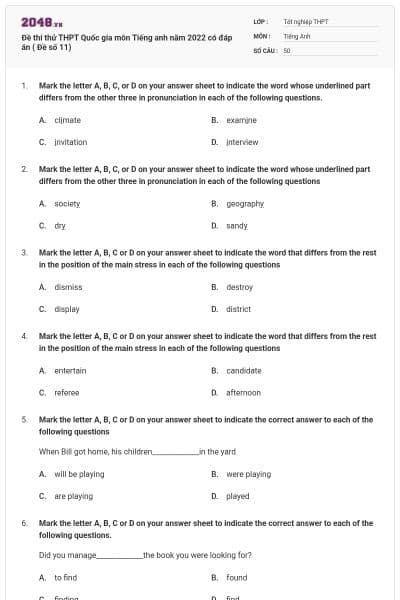
Đề thi thử THPT Quốc gia môn Tiếng anh năm 2022 có đáp án ( Đề số 11)

50 câu hỏi
Mark the letter A, B, C, or D on your answer sheet to indicate the word whose underlined part differs from the other three in pronunciation in each of the following questions.
climate
examine
invitation
interview
Mark the letter A, B, C, or D on your answer sheet to indicate the word whose underlined part differs from the other three in pronunciation in each of the following questions
society
geography
dry
sandy
Mark the letter A, B, C or D on your answer sheet to indicate the word that differs from the rest in the position of the main stress in each of the following questions
dismiss
destroy
display
district
Mark the letter A, B, C or D on your answer sheet to indicate the word that differs from the rest in the position of the main stress in each of the following questions
entertain
candidate
referee
afternoon
Mark the letter A, B, C or D on your answer sheet to indicate the correct answer to each of the following questions
When Bill got home, his children_____________in the yard
will be playing
were playing
are playing
played
Mark the letter A, B, C or D on your answer sheet to indicate the correct answer to each of the following questions.
Did you manage_____________the book you were looking for?
to find
found
finding
find
Mark the letter A, B, C or D on your answer sheet to indicate the correct answer to each of the following questions
That cannot be a true story. He_____________it up
must have made
should have made
would have made
can have made
Mark the letter A, B, C or D on your answer sheet to indicate the correct answer to each of the following questions
Beethovens Fifth Symphony_____________next weekend
is going to be performed
has been performed
will be performing
will have performed
Mark the letter A, B, C or D on your answer sheet to indicate the correct answer to each of the following questions
She said that when she_____________to school, she saw an accident
had been walking
has walked
was walking
has been walking
Mark the letter A, B, C or D on your answer sheet to indicate the correct answer to each of the following questions
She wanted Tom, _____________she liked, as a partner, but she got Jack, She didn’t like
whom/ whose
whose/ whom
whose/ whose
whom/ whom
Mark the letter A, B, C or D on your answer sheet to indicate the correct answer to each of the following questions
Scarcely_____________out of bed when_____________
had I got/ did the doorbell ring
had I got/ the doorbell rang
I had got/ did the doorbell ring
I had got/ the doorbell rang
Mark the letter A, B, C or D on your answer sheet to indicate the correct answer to each of the following questions
I think he will join us, _____________?
won’t he
don’t I
will not he
do not I
Mark the letter A, B, C or D on your answer sheet to indicate the correct answer to each of the following questions
For more than 10 years, we have seen the significant_____________in the economy
develop
developments
developers
developed
Mark the letter A, B, C or D on your answer sheet to indicate the correct answer to each of the following questions
The_____________load for this car is one ton
top
max
peak
height
Mark the letter A, B, C or D on your answer sheet to indicate the correct answer to each of the following questions
Most modern office_____________includes facsimile machines, photocopiers and telephone systems
device
tool
equipment
instrument
Mark the letter A, B, C or D on your answer sheet to indicate the correct answer to each of the following questions
I just took it_____________that he’d always be on time
into consideration
easy
into account
for granted
Mark the letter A, B, C or D on your answer sheet to indicate the correct answer to each of the following questions
That’s exactly what I mean, Tom. You’ve_____________!
put your foot in it
killed two birds with one stone
put two and two together
hit the nail on the head
Mark the letter A, B, C or D on your answer sheet to indicate the correct answer to each of the following questions
My car is getting unreliable. I think I’ll trade it_____________for a new one.
off
away
in
up
Mark the letter A, B, C, orD on your answer sheet to indicate the underlined part that needs correction in each of the following questions
I visited Mexico and United States last year.
visited
Mexico
United States
last year
Mark the letter A, B, C, orD on your answer sheet to indicate the underlined part that needs correction in each of the following questions
Yesterday he said he regretted not to have gone to the exhibition last week.
yesterday
said
regretted
not to have gone
Mark the letter A, B, C, orD on your answer sheet to indicate the underlined part that needs correction in each of the following questions
Minh’s mother would sooner not to meet her friend in person than phone her.
sooner
not to meet
in person
than
Mark the letter A, B, C or D on your answer sheet to indicate the sentence that is closest in meaning to each of the following questions
Friendly though he may seem, he’s not to he trusted
He’s too friendly to be trusted
However he seems friendly, he’s not to be trusted
He may have friends, but he’s not to be trusted
However friendly he seems, he’s not to be trusted
Mark the letter A, B, C or D on your answer sheet to indicate the sentence that is closest in meaning to each of the following questions
The last time I saw her was three years ago
I have not seen her for three years
About three years ago, I used to meet her
I have often seen her for the last three years
I saw her three years ago and will never meet her
Mark the letter A, B, C or D on your answer sheet to indicate the sentence that is closest in meaning to each of the following questions
Calling Odyse is pointless because his phone is out of order
It’s worth not calling Odyse since his phone is out of order
It’s no use to call Odyse since his phone is out of order.
It’s useless call Odyse as his phone is out of order
There is no point in calling odyse as his phone is out of order
Mark the letter A, B, C or D on your answer sheet to indicate the sentence that best combines each pair of sentences in the following questions
Randy doesn’t play rugby. Neither does Lucy
Neither Randy nor Lucy doesn’t play rugby
Neither Randy nor Lucy play rugby
Neither Randy nor Lucy plays rugby
Either Randy or Lucy plays rugby
Mark the letter A, B, C or D on your answer sheet to indicate the sentence that best combines each pair of sentences in the following questions
Nguyen Huu Kim Son broke the SEA Games record in the men’s 400-metre individual medley event. He is very proud of it.
He is very proud of what he broke the SEA Games record
He takes pride in breaking the SEA Games record
He is interested in the SEA Games record
He is very proud of he broke the SEA Games record
Mark the letter A, B, C or D on your answer sheet to indicate the most suitable response to complete each of the following exchanges
This situation happened in a restaurant
- Customer: “Excuse me!”
- Waiter: “Yes, sir. How can I help you?”
- Customer: “I don’t want to make a scene but there’s a fly in my soup.”
- Waiter: “_____________”
I’m so sorry! I will get you another one
What can I do to help?
You are right. I will get you another one
You could be right but I don’t think it is a fly
Mark the letter A, B, C or D on your answer sheet to indicate the most suitable response to complete each of the following exchanges
Alice and Mary have just finished watching a movie.
- Alice: “Endgame is such a wonderful movie”
- Mary: “_____________”
I couldn’t agree more
I don’t like your saying
I didn’t say anything
I’m a huge fan of Marvel
Mark the letter A, B, C, or D on your answer sheet to indicate the word or phrase that is CLOSEST in meaning to the underlined part in each of the following questions
One of the biggest issues that many victims of negligent behavior encounter is difficulty in determining whether or not an action had foreseeable consequences
predictable
unpredictable
ascertainable
computable
Mark the letter A, B, C, or D on your answer sheet to indicate the word or phrase that is CLOSEST in meaning to the underlined part in each of the following questions
We’re really close friends but we just cannot see eye to eye on politics.
not see well
not share the same views about
not understand
not care for
Mark the letter A, B, C, or D on your answer sheet to indicate the word or phrase that is OPPOSITE in meaning to the underlined part in each of the following questions
The research findings were reliable since modern technology was used to increase the precision of the sampling procedure
inaccuracy
exactness
insecurity
flexibility
Mark the letter A, B, C, or D on your answer sheet to indicate the word or phrase that is OPPOSITE in meaning to the underlined part in each of the following questions
Despite the traffic hold-ups, we were able to arrive at the airport in the nick of the time just before the check-in counter closed
in a terrible condition
with all out luggage
at the very last moment
with much time to spare
Read the following passage and mark the letter A, B, C or D on your answer sheet to indicate the correct word for each of the blanks from 33 to 37.
The knock-on effect of volunteering on the lives of individuals can be profound. Voluntary work helps foster independence and imparts the ability to deal with different situations, often simultaneously, thus teaching people how to (33) _____________their way through different systems. It therefore brings people into touch with the real world; and, hence, equips them for the future.
Initially, young adults in their late teens might not seem to have the expertise or knowledge to impart to others that say a teacher or agriculturalist or nurse would have, (34) _____________they do have many skills that can help others. And in the absence of any particular talent, their energy and enthusiasm can be harnessed for the benefit of their fellow human beings, and ultimately themselves. From (35) _____________this, the gain to any community no matter how many volunteers are involved is (36) _____________.
Employers will generally look favorably on people (37) _____________have shown an ability to work as part of a team. It demonstrates a willingness to learn and an independent spirit, which would be desirable qualities in any employee
give
work
put
take
Read the following passage and mark the letter A, B, C or D on your answer sheet to indicate the correct word for each of the blanks from 33 to 37.
The knock-on effect of volunteering on the lives of individuals can be profound. Voluntary work helps foster independence and imparts the ability to deal with different situations, often simultaneously, thus teaching people how to (33) _____________their way through different systems. It therefore brings people into touch with the real world; and, hence, equips them for the future.
Initially, young adults in their late teens might not seem to have the expertise or knowledge to impart to others that say a teacher or agriculturalist or nurse would have, (34) _____________they do have many skills that can help others. And in the absence of any particular talent, their energy and enthusiasm can be harnessed for the benefit of their fellow human beings, and ultimately themselves. From (35) _____________this, the gain to any community no matter how many volunteers are involved is (36) _____________.
Employers will generally look favorably on people (37) _____________have shown an ability to work as part of a team. It demonstrates a willingness to learn and an independent spirit, which would be desirable qualities in any employee.
so
but
or
for
Read the following passage and mark the letter A, B, C or D on your answer sheet to indicate the correct word for each of the blanks from 33 to 37. The knock-on effect of volunteering on the lives of individuals can be profound. Voluntary work helps foster independence and imparts the ability to deal with different situations, often simultaneously, thus teaching people how to (33) _____________their way through different systems. It therefore brings people into touch with the real world; and, hence, equips them for the future. Initially, young adults in their late teens might not seem to have the expertise or knowledge to impart to others that say a teacher or agriculturalist or nurse would have, (34) _____________they do have many skills that can help others. And in the absence of any particular talent, their energy and enthusiasm can be harnessed for the benefit of their fellow human beings, and ultimately themselves. From (35) _____________this, the gain to any community no matter how many volunteers are involved is (36) _____________. Employers will generally look favorably on people (37) _____________have shown an ability to work as part of a team. It demonstrates a willingness to learn and an independent spirit, which would be desirable qualities in any employee.
all
none
above
both
Read the following passage and mark the letter A, B, C or D on your answer sheet to indicate the correct word for each of the blanks from 33 to 37. The knock-on effect of volunteering on the lives of individuals can be profound. Voluntary work helps foster independence and imparts the ability to deal with different situations, often simultaneously, thus teaching people how to (33) _____________their way through different systems. It therefore brings people into touch with the real world; and, hence, equips them for the future. Initially, young adults in their late teens might not seem to have the expertise or knowledge to impart to others that say a teacher or agriculturalist or nurse would have, (34) _____________they do have many skills that can help others. And in the absence of any particular talent, their energy and enthusiasm can be harnessed for the benefit of their fellow human beings, and ultimately themselves. From (35) _____________this, the gain to any community no matter how many volunteers are involved is (36) _____________. Employers will generally look favorably on people (37) _____________have shown an ability to work as part of a team. It demonstrates a willingness to learn and an independent spirit, which would be desirable qualities in any employee.
unattainable
immeasurable
undetectable
impassible
Read the following passage and mark the letter A, B, C or D on your answer sheet to indicate the correct word for each of the blanks from 33 to 37. The knock-on effect of volunteering on the lives of individuals can be profound. Voluntary work helps foster independence and imparts the ability to deal with different situations, often simultaneously, thus teaching people how to (33) _____________their way through different systems. It therefore brings people into touch with the real world; and, hence, equips them for the future. Initially, young adults in their late teens might not seem to have the expertise or knowledge to impart to others that say a teacher or agriculturalist or nurse would have, (34) _____________they do have many skills that can help others. And in the absence of any particular talent, their energy and enthusiasm can be harnessed for the benefit of their fellow human beings, and ultimately themselves. From (35) _____________this, the gain to any community no matter how many volunteers are involved is (36) _____________. Employers will generally look favorably on people (37) _____________have shown an ability to work as part of a team. It demonstrates a willingness to learn and an independent spirit, which would be desirable qualities in any employee.
which
whose
who
what
what is the main idea of the passage?
Caterpillars that live in trees
The feeding habits of insects
How some insects imitate plants to survive
Insects that are threatened with extinction
Read the following passage and mark the letter A, B, C, or D on your answer sheet to indicate the correct answer to each of the questions from 38 to 42.
Insects’ lives are very short and they have many enemies, but they must survive long enough to breed and perpetuate their kind. The less insect-like they look, the better their chance of survival. To look "inedible" by imitating plants is a way frequently used by insects to survive. Mammals rarely imitate plants, but many fish and invertebrates do.
The stick caterpillar is well named. It is hardly distinguishable from a brown or green twig. This caterpillar is quite common and can be found almost anywhere in North America. It is also called "measuring worm" or "inchworm." It walks by arching its body, then stretching out and grasping the branch with its front feet then looping its body again to bring the hind fed forward, when danger threatens, the stick caterpillar stretches its body away from the branch at an angle and remains rigid and still, like a twig, until the danger has passed.
Walking sticks, or stick insects, do not have to assume a rigid, twig-like pose to find protection: they look like inedible twigs in any position. There are many kinds of walking sticks, ranging in size from the few inches of the North American variety to some tropical species that may be over a foot long, when at rest their front legs are stretched out, heightening their camouflage. Some of the tropical species are adorned with spines or ridges, imitating the thorny bushes or trees in which they live.
Leaves also seem to be a favorite object for insects to imitate. Many butterflies can suddenly disappear from view by folding their wings and sitting quietly among the plants that they resemble.
which of the following does the word “enemies” in line 1 refer to?
plants looking like insects
extreme weather conditions
creatures that eat insects
insects looking like plants
Read the following passage and mark the letter A, B, C, or D on your answer sheet to indicate the correct answer to each of the questions from 38 to 42.
Insects’ lives are very short and they have many enemies, but they must survive long enough to breed and perpetuate their kind. The less insect-like they look, the better their chance of survival. To look "inedible" by imitating plants is a way frequently used by insects to survive. Mammals rarely imitate plants, but many fish and invertebrates do.
The stick caterpillar is well named. It is hardly distinguishable from a brown or green twig. This caterpillar is quite common and can be found almost anywhere in North America. It is also called "measuring worm" or "inchworm." It walks by arching its body, then stretching out and grasping the branch with its front feet then looping its body again to bring the hind fed forward, when danger threatens, the stick caterpillar stretches its body away from the branch at an angle and remains rigid and still, like a twig, until the danger has passed.
Walking sticks, or stick insects, do not have to assume a rigid, twig-like pose to find protection: they look like inedible twigs in any position. There are many kinds of walking sticks, ranging in size from the few inches of the North American variety to some tropical species that may be over a foot long, when at rest their front legs are stretched out, heightening their camouflage. Some of the tropical species are adorned with spines or ridges, imitating the thorny bushes or trees in which they live.
Leaves also seem to be a favorite object for insects to imitate. Many butterflies can suddenly disappear from view by folding their wings and sitting quietly among the plants that they resemble.
According to the passage, how does a stick caterpillar make itself look like a twig?
By holding its body stiff and motionless
By looping itself around a stick
By changing the colour of its skin
By laying its body flat against a branch
Read the following passage and mark the letter A, B, C, or D on your answer sheet to indicate the correct answer to each of the questions from 38 to 42.
Insects’ lives are very short and they have many enemies, but they must survive long enough to breed and perpetuate their kind. The less insect-like they look, the better their chance of survival. To look "inedible" by imitating plants is a way frequently used by insects to survive. Mammals rarely imitate plants, but many fish and invertebrates do.
The stick caterpillar is well named. It is hardly distinguishable from a brown or green twig. This caterpillar is quite common and can be found almost anywhere in North America. It is also called "measuring worm" or "inchworm." It walks by arching its body, then stretching out and grasping the branch with its front feet then looping its body again to bring the hind fed forward, when danger threatens, the stick caterpillar stretches its body away from the branch at an angle and remains rigid and still, like a twig, until the danger has passed.
Walking sticks, or stick insects, do not have to assume a rigid, twig-like pose to find protection: they look like inedible twigs in any position. There are many kinds of walking sticks, ranging in size from the few inches of the North American variety to some tropical species that may be over a foot long, when at rest their front legs are stretched out, heightening their camouflage. Some of the tropical species are adorned with spines or ridges, imitating the thorny bushes or trees in which they live.
Leaves also seem to be a favorite object for insects to imitate. Many butterflies can suddenly disappear from view by folding their wings and sitting quietly among the plants that they resemble.
. Which of the following is the antonym of the word “inedible” in paragraph 3?
eatable
colourful
beautiful
moving
Read the following passage and mark the letter A, B, C, or D on your answer sheet to indicate the correct answer to each of the questions from 38 to 42.
Insects’ lives are very short and they have many enemies, but they must survive long enough to breed and perpetuate their kind. The less insect-like they look, the better their chance of survival. To look "inedible" by imitating plants is a way frequently used by insects to survive. Mammals rarely imitate plants, but many fish and invertebrates do.
The stick caterpillar is well named. It is hardly distinguishable from a brown or green twig. This caterpillar is quite common and can be found almost anywhere in North America. It is also called "measuring worm" or "inchworm." It walks by arching its body, then stretching out and grasping the branch with its front feet then looping its body again to bring the hind fed forward, when danger threatens, the stick caterpillar stretches its body away from the branch at an angle and remains rigid and still, like a twig, until the danger has passed.
Walking sticks, or stick insects, do not have to assume a rigid, twig-like pose to find protection: they look like inedible twigs in any position. There are many kinds of walking sticks, ranging in size from the few inches of the North American variety to some tropical species that may be over a foot long, when at rest their front legs are stretched out, heightening their camouflage. Some of the tropical species are adorned with spines or ridges, imitating the thorny bushes or trees in which they live.
Leaves also seem to be a favorite object for insects to imitate. Many butterflies can suddenly disappear from view by folding their wings and sitting quietly among the plants that they resemble
How can butterflies make themselves invisible
By hiding under the leaves
By disappearing from the view
By folding wings and sitting still among the leaves with similar colours
By flying among colourful flowers
Read the following passage and mark the letter A, B, C, or D on your answer sheet to indicate the correct answer to each of the questions from 43 to 50.
There are two basic types of glaciers, those that flow outward in all directions with little regard for any underlying terrain and those that are confined by terrain to a particular path.
The first category of glaciers includes those massive blankets that cover whole continents, appropriately called ice sheets. There must be over 50,000 square kilometers of land covered with ice for the glacier to qualify as an ice sheet, when portions of an ice sheet spread out over the ocean, they form ice shelves.
About 20,000 years ago the Cordilleran Ice sheet covered nearly all the mountains in southern Alaska, western Canada, and the western United States. It was about 3 kilometers deep at its thickest point in northern Alberta. Now there are only two sheets left on Earth, those covering Greenland and Antarctica.
Any domelike body of ice that also flows out in all directions but covers less than 50,000 square kilometers is called an ice cap. Although ice caps are rare nowadays, there are a number in northeastern Canada, on Baffin Island, and on the Queen Elizabeth Islands.
The second category of glaciers includes those of a variety of shapes and sizes generally called mountain or alpine glaciers. Mountain glaciers are typically identified by the landform that controls their flow. One form of mountain glacier that resembles an ice cap in that it flows outward in several directions is called an ice field. The difference between an ice field and an ice cap is subtle. Essentially, the flow of an ice field is somewhat controlled by surrounding terrain and thus does not have the domelike shape of a cap. There are several ice fields in the Wrangell. St. Elias, and Chugach mountains of Alaska and northern British Columbia.
Less spectacular than large ice fields are the most common types of mountain glaciers: the cirque and valley glaciers. Cirque glaciers are found in depressions in the surface of the land and have a characteristic circular shape. The ice of valley glaciers, bound by terrain, flows down valleys, curves around their corners, and falls over cliffs.
what does the passage mainly discuss?
Where major glaciers are located
How glaciers shape the land
The different kinds of glaciers
How glaciers are formed
Read the following passage and mark the letter A, B, C, or D on your answer sheet to indicate the correct answer to each of the questions from 43 to 50.
There are two basic types of glaciers, those that flow outward in all directions with little regard for any underlying terrain and those that are confined by terrain to a particular path.
The first category of glaciers includes those massive blankets that cover whole continents, appropriately called ice sheets. There must be over 50,000 square kilometers of land covered with ice for the glacier to qualify as an ice sheet, when portions of an ice sheet spread out over the ocean, they form ice shelves.
About 20,000 years ago the Cordilleran Ice sheet covered nearly all the mountains in southern Alaska, western Canada, and the western United States. It was about 3 kilometers deep at its thickest point in northern Alberta. Now there are only two sheets left on Earth, those covering Greenland and Antarctica.
Any domelike body of ice that also flows out in all directions but covers less than 50,000 square kilometers is called an ice cap. Although ice caps are rare nowadays, there are a number in northeastern Canada, on Baffin Island, and on the Queen Elizabeth Islands.
The second category of glaciers includes those of a variety of shapes and sizes generally called mountain or alpine glaciers. Mountain glaciers are typically identified by the landform that controls their flow. One form of mountain glacier that resembles an ice cap in that it flows outward in several directions is called an ice field. The difference between an ice field and an ice cap is subtle. Essentially, the flow of an ice field is somewhat controlled by surrounding terrain and thus does not have the domelike shape of a cap. There are several ice fields in the Wrangell. St. Elias, and Chugach mountains of Alaska and northern British Columbia.
Less spectacular than large ice fields are the most common types of mountain glaciers: the cirque and valley glaciers. Cirque glaciers are found in depressions in the surface of the land and have a characteristic circular shape. The ice of valley glaciers, bound by terrain, flows down valleys, curves around their corners, and falls over cliffs
The word “terrain” in paragraph 1 could best be replaced by____________
the seabed
area of land
countryside
prairie
Read the following passage and mark the letter A, B, C, or D on your answer sheet to indicate the correct answer to each of the questions from 43 to 50.
There are two basic types of glaciers, those that flow outward in all directions with little regard for any underlying terrain and those that are confined by terrain to a particular path.
The first category of glaciers includes those massive blankets that cover whole continents, appropriately called ice sheets. There must be over 50,000 square kilometers of land covered with ice for the glacier to qualify as an ice sheet, when portions of an ice sheet spread out over the ocean, they form ice shelves.
About 20,000 years ago the Cordilleran Ice sheet covered nearly all the mountains in southern Alaska, western Canada, and the western United States. It was about 3 kilometers deep at its thickest point in northern Alberta. Now there are only two sheets left on Earth, those covering Greenland and Antarctica.
Any domelike body of ice that also flows out in all directions but covers less than 50,000 square kilometers is called an ice cap. Although ice caps are rare nowadays, there are a number in northeastern Canada, on Baffin Island, and on the Queen Elizabeth Islands.
The second category of glaciers includes those of a variety of shapes and sizes generally called mountain or alpine glaciers. Mountain glaciers are typically identified by the landform that controls their flow. One form of mountain glacier that resembles an ice cap in that it flows outward in several directions is called an ice field. The difference between an ice field and an ice cap is subtle. Essentially, the flow of an ice field is somewhat controlled by surrounding terrain and thus does not have the domelike shape of a cap. There are several ice fields in the Wrangell. St. Elias, and Chugach mountains of Alaska and northern British Columbia.
Less spectacular than large ice fields are the most common types of mountain glaciers: the cirque and valley glaciers. Cirque glaciers are found in depressions in the surface of the land and have a characteristic circular shape. The ice of valley glaciers, bound by terrain, flows down valleys, curves around their corners, and falls over cliffs.
It can be inferred from paragraph 2 that ice sheets are so named because____________
they are thicker in some areas than the others
they are identified by the landform that controls their flow
they cover large areas of land
they are confined to cirque glaciers
Read the following passage and mark the letter A, B, C, or D on your answer sheet to indicate the correct answer to each of the questions from 43 to 50.
There are two basic types of glaciers, those that flow outward in all directions with little regard for any underlying terrain and those that are confined by terrain to a particular path.
The first category of glaciers includes those massive blankets that cover whole continents, appropriately called ice sheets. There must be over 50,000 square kilometers of land covered with ice for the glacier to qualify as an ice sheet, when portions of an ice sheet spread out over the ocean, they form ice shelves.
About 20,000 years ago the Cordilleran Ice sheet covered nearly all the mountains in southern Alaska, western Canada, and the western United States. It was about 3 kilometers deep at its thickest point in northern Alberta. Now there are only two sheets left on Earth, those covering Greenland and Antarctica.
Any domelike body of ice that also flows out in all directions but covers less than 50,000 square kilometers is called an ice cap. Although ice caps are rare nowadays, there are a number in northeastern Canada, on Baffin Island, and on the Queen Elizabeth Islands.
The second category of glaciers includes those of a variety of shapes and sizes generally called mountain or alpine glaciers. Mountain glaciers are typically identified by the landform that controls their flow. One form of mountain glacier that resembles an ice cap in that it flows outward in several directions is called an ice field. The difference between an ice field and an ice cap is subtle. Essentially, the flow of an ice field is somewhat controlled by surrounding terrain and thus does not have the domelike shape of a cap. There are several ice fields in the Wrangell. St. Elias, and Chugach mountains of Alaska and northern British Columbia.
Less spectacular than large ice fields are the most common types of mountain glaciers: the cirque and valley glaciers. Cirque glaciers are found in depressions in the surface of the land and have a characteristic circular shape. The ice of valley glaciers, bound by terrain, flows down valleys, curves around their corners, and falls over cliffs.
According to the passage, where was the Cordilleran Ice Sheet thickest?
Alaska
Antarctica
Greenland
Alberta
Read the following passage and mark the letter A, B, C, or D on your answer sheet to indicate the correct answer to each of the questions from 43 to 50.
There are two basic types of glaciers, those that flow outward in all directions with little regard for any underlying terrain and those that are confined by terrain to a particular path.
The first category of glaciers includes those massive blankets that cover whole continents, appropriately called ice sheets. There must be over 50,000 square kilometers of land covered with ice for the glacier to qualify as an ice sheet, when portions of an ice sheet spread out over the ocean, they form ice shelves.
About 20,000 years ago the Cordilleran Ice sheet covered nearly all the mountains in southern Alaska, western Canada, and the western United States. It was about 3 kilometers deep at its thickest point in northern Alberta. Now there are only two sheets left on Earth, those covering Greenland and Antarctica.
Any domelike body of ice that also flows out in all directions but covers less than 50,000 square kilometers is called an ice cap. Although ice caps are rare nowadays, there are a number in northeastern Canada, on Baffin Island, and on the Queen Elizabeth Islands.
The second category of glaciers includes those of a variety of shapes and sizes generally called mountain or alpine glaciers. Mountain glaciers are typically identified by the landform that controls their flow. One form of mountain glacier that resembles an ice cap in that it flows outward in several directions is called an ice field. The difference between an ice field and an ice cap is subtle. Essentially, the flow of an ice field is somewhat controlled by surrounding terrain and thus does not have the domelike shape of a cap. There are several ice fields in the Wrangell. St. Elias, and Chugach mountains of Alaska and northern British Columbia.
Less spectacular than large ice fields are the most common types of mountain glaciers: the cirque and valley glaciers. Cirque glaciers are found in depressions in the surface of the land and have a characteristic circular shape. The ice of valley glaciers, bound by terrain, flows down valleys, curves around their corners, and falls over cliffs.
According to paragraph 5, ice fields resemble ice caps in which of the following ways?
Their flow
Their texture
Their location
Their shape
Read the following passage and mark the letter A, B, C, or D on your answer sheet to indicate the correct answer to each of the questions from 43 to 50.
There are two basic types of glaciers, those that flow outward in all directions with little regard for any underlying terrain and those that are confined by terrain to a particular path.
The first category of glaciers includes those massive blankets that cover whole continents, appropriately called ice sheets. There must be over 50,000 square kilometers of land covered with ice for the glacier to qualify as an ice sheet, when portions of an ice sheet spread out over the ocean, they form ice shelves.
About 20,000 years ago the Cordilleran Ice sheet covered nearly all the mountains in southern Alaska, western Canada, and the western United States. It was about 3 kilometers deep at its thickest point in northern Alberta. Now there are only two sheets left on Earth, those covering Greenland and Antarctica.
Any domelike body of ice that also flows out in all directions but covers less than 50,000 square kilometers is called an ice cap. Although ice caps are rare nowadays, there are a number in northeastern Canada, on Baffin Island, and on the Queen Elizabeth Islands.
The second category of glaciers includes those of a variety of shapes and sizes generally called mountain or alpine glaciers. Mountain glaciers are typically identified by the landform that controls their flow. One form of mountain glacier that resembles an ice cap in that it flows outward in several directions is called an ice field. The difference between an ice field and an ice cap is subtle. Essentially, the flow of an ice field is somewhat controlled by surrounding terrain and thus does not have the domelike shape of a cap. There are several ice fields in the Wrangell. St. Elias, and Chugach mountains of Alaska and northern British Columbia.
Less spectacular than large ice fields are the most common types of mountain glaciers: the cirque and valley glaciers. Cirque glaciers are found in depressions in the surface of the land and have a characteristic circular shape. The ice of valley glaciers, bound by terrain, flows down valleys, curves around their corners, and falls over cliffs.
The word “subtle” in paragraph 5 could best be replaced by____________.
slight
substantial
regional
obvious
Read the following passage and mark the letter A, B, C, or D on your answer sheet to indicate the correct answer to each of the questions from 43 to 50.
There are two basic types of glaciers, those that flow outward in all directions with little regard for any underlying terrain and those that are confined by terrain to a particular path.
The first category of glaciers includes those massive blankets that cover whole continents, appropriately called ice sheets. There must be over 50,000 square kilometers of land covered with ice for the glacier to qualify as an ice sheet, when portions of an ice sheet spread out over the ocean, they form ice shelves.
About 20,000 years ago the Cordilleran Ice sheet covered nearly all the mountains in southern Alaska, western Canada, and the western United States. It was about 3 kilometers deep at its thickest point in northern Alberta. Now there are only two sheets left on Earth, those covering Greenland and Antarctica.
Any domelike body of ice that also flows out in all directions but covers less than 50,000 square kilometers is called an ice cap. Although ice caps are rare nowadays, there are a number in northeastern Canada, on Baffin Island, and on the Queen Elizabeth Islands.
The second category of glaciers includes those of a variety of shapes and sizes generally called mountain or alpine glaciers. Mountain glaciers are typically identified by the landform that controls their flow. One form of mountain glacier that resembles an ice cap in that it flows outward in several directions is called an ice field. The difference between an ice field and an ice cap is subtle. Essentially, the flow of an ice field is somewhat controlled by surrounding terrain and thus does not have the domelike shape of a cap. There are several ice fields in the Wrangell. St. Elias, and Chugach mountains of Alaska and northern British Columbia.
Less spectacular than large ice fields are the most common types of mountain glaciers: the cirque and valley glaciers. Cirque glaciers are found in depressions in the surface of the land and have a characteristic circular shape. The ice of valley glaciers, bound by terrain, flows down valleys, curves around their corners, and falls over cliffs.
The word “their” in last paragraph refers to____________.
ice fields
cirque glaciers
valley glaciers
valleys
Read the following passage and mark the letter A, B, C, or D on your answer sheet to indicate the correct answer to each of the questions from 43 to 50.
There are two basic types of glaciers, those that flow outward in all directions with little regard for any underlying terrain and those that are confined by terrain to a particular path.
The first category of glaciers includes those massive blankets that cover whole continents, appropriately called ice sheets. There must be over 50,000 square kilometers of land covered with ice for the glacier to qualify as an ice sheet, when portions of an ice sheet spread out over the ocean, they form ice shelves.
About 20,000 years ago the Cordilleran Ice sheet covered nearly all the mountains in southern Alaska, western Canada, and the western United States. It was about 3 kilometers deep at its thickest point in northern Alberta. Now there are only two sheets left on Earth, those covering Greenland and Antarctica.
Any domelike body of ice that also flows out in all directions but covers less than 50,000 square kilometers is called an ice cap. Although ice caps are rare nowadays, there are a number in northeastern Canada, on Baffin Island, and on the Queen Elizabeth Islands.
The second category of glaciers includes those of a variety of shapes and sizes generally called mountain or alpine glaciers. Mountain glaciers are typically identified by the landform that controls their flow. One form of mountain glacier that resembles an ice cap in that it flows outward in several directions is called an ice field. The difference between an ice field and an ice cap is subtle. Essentially, the flow of an ice field is somewhat controlled by surrounding terrain and thus does not have the domelike shape of a cap. There are several ice fields in the Wrangell. St. Elias, and Chugach mountains of Alaska and northern British Columbia.
Less spectacular than large ice fields are the most common types of mountain glaciers: the cirque and valley glaciers. Cirque glaciers are found in depressions in the surface of the land and have a characteristic circular shape. The ice of valley glaciers, bound by terrain, flows down valleys, curves around their corners, and falls over cliffs.
All of the following are alpine glaciers EXCEPT____________.
cirque glaciers
ice capsC. ice fields
ice fields
Valley glaciers