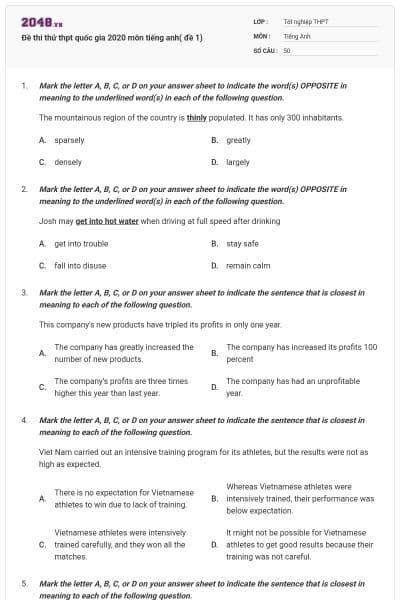
Đề thi thử thpt quốc gia 2020 môn tiếng anh( đề 1)

50 câu hỏi
Mark the letter A, B, C, or D on your answer sheet to indicate the word(s) OPPOSITE in meaning to the underlined word(s) in each of the following question.
The mountainous region of the country is thinly populated. It has only 300 inhabitants.
sparsely
greatly
densely
largely
Mark the letter A, B, C, or D on your answer sheet to indicate the word(s) OPPOSITE in meaning to the underlined word(s) in each of the following question.
Josh may get into hot water when driving at full speed after drinking
get into trouble
stay safe
fall into disuse
remain calm
Mark the letter A, B, C, or D on your answer sheet to indicate the sentence that is closest in meaning to each of the following question.
This company's new products have tripled its profits in only one year.
The company has greatly increased the number of new products.
The company has increased its profits 100 percent
The company’s profits are three times higher this year than last year.
The company has had an unprofitable year.
Mark the letter A, B, C, or D on your answer sheet to indicate the sentence that is closest in meaning to each of the following question.
Viet Nam carried out an intensive training program for its athletes, but the results were not as high as expected.
There is no expectation for Vietnamese athletes to win due to lack of training.
Whereas Vietnamese athletes were intensively trained, their performance was below expectation.
Vietnamese athletes were intensively trained carefully, and they won all the matches.
It might not be possible for Vietnamese athletes to get good results because their training was not careful.
Mark the letter A, B, C, or D on your answer sheet to indicate the sentence that is closest in meaning to each of the following question.
Though he had known about it well in advance, he pretended to be surprised at having a birthday party.
He acted surprised about being given a birthday party, but he had known about it a long time before
Despite only pretending to be surprised at the birthday party, he had actually been completely unaware of it.
He knew about the birthday party a long time before, yet he wasn't pretending when he acted surprised.
He was quite surprised at their throwing him a birthday party, though he could have found out it well before
Mark the letter A, B, C, or D on your answer sheet to indicate the sentence that best combines each pair of sentences in the following questions.
Smallpox is a dangerous disease. Malaria is a dangerous disease.
Smallpox is a dangerous disease, and so is malaria.
Malaria is a dangerous disease, but smallpox is not.
Neither smallpox nor malaria is a dangerous disease.
Either smallpox or malaria is a dangerous disease.
Mark the letter A, B, C, or D on your answer sheet to indicate the sentence that best combines each pair of sentences in the following questions.
The dogs watch the chicken coop. The dogs protect the chickens from wolves.
Protecting the chickens from wolves, the dogs watch the chicken coop from them.
They protect the chickens from wolves as the dogs watch the chicken coop.
The dogs watch the chicken coop to protect the chickens from wolves.
Watching the chicken coop because the dogs protect chickens from wolves.
Read the following pasage and mark the letter A, B, C or D on your answer sheet to indicate the correct answer to each of the questions
Any list of the greatest thinkers in history contains the name of the brilliant physicist Albert Einstein. His theories of relativity led to entirely new ways of thinking about time, space, matter, energy, and gravity. Einstein's work led to such scientific advances as the control of atomic energy, even television as a practical application of Einstein's work.
In 1902 Einstein became an examiner in the Swiss patent office at Bern. In 1905, at age 26, he published the first of five major research papers. The first one provided a theory explaining Brownian movement, the zig-zag motion of microscopic particles in suspension. The second paper laid the foundation for the photon, or quantum, theory of light. In it he proposed that light is composed of separate packets of energy, called quanta or photons, that have some of the properties of particles and some of the properties of waves. A third paper contained the "special theory of relativity" which showed that time and motion are relative to the observer, if the speed of light is constant and the natural laws are the same everywhere in the universe. The fourth paper was a mathematical addition to the special theory of relativity. Here Einstein presented his famous formula, E = m(cc), known as the energy mass equivalence. In 1916, Einstein published his general theory of relativity. In it he proposed that gravity is not a force, but a curve in the space-time continuum, created by the presence of mass.
Einstein spoke out frequently against nationalism, the exalting of one nation above all others. He opposed war and violence and supported Zionism, the movement to establish a Jewish homeland in Palestine. When the Nazis came to power in 1933, they denounced his ideas. He then moved to the United States. In 1939 Einstein learned that two German chemists had split the uranium atom. Einstein wrote to President Franklind. Roosevelt warning him that this scientific knowledge could lead to Germany developing an atomic bomb. He suggested the United States begin its own atomic bomb research.
According to the passage l, Einstein's primary work was in the area of
chemistryB. biology
biology
physics
math
Read the following pasage and mark the letter A, B, C or D on your answer sheet to indicate the correct answer to each of the questions
Any list of the greatest thinkers in history contains the name of the brilliant physicist Albert Einstein. His theories of relativity led to entirely new ways of thinking about time, space, matter, energy, and gravity. Einstein's work led to such scientific advances as the control of atomic energy, even television as a practical application of Einstein's work.
In 1902 Einstein became an examiner in the Swiss patent office at Bern. In 1905, at age 26, he published the first of five major research papers. The first one provided a theory explaining Brownian movement, the zig-zag motion of microscopic particles in suspension. The second paper laid the foundation for the photon, or quantum, theory of light. In it he proposed that light is composed of separate packets of energy, called quanta or photons, that have some of the properties of particles and some of the properties of waves. A third paper contained the "special theory of relativity" which showed that time and motion are relative to the observer, if the speed of light is constant and the natural laws are the same everywhere in the universe. The fourth paper was a mathematical addition to the special theory of relativity. Here Einstein presented his famous formula, E = m(cc), known as the energy mass equivalence. In 1916, Einstein published his general theory of relativity. In it he proposed that gravity is not a force, but a curve in the space-time continuum, created by the presence of mass.
Einstein spoke out frequently against nationalism, the exalting of one nation above all others. He opposed war and violence and supported Zionism, the movement to establish a Jewish homeland in Palestine. When the Nazis came to power in 1933, they denounced his ideas. He then moved to the United States. In 1939 Einstein learned that two German chemists had split the uranium atom. Einstein wrote to President Franklind. Roosevelt warning him that this scientific knowledge could lead to Germany developing an atomic bomb. He suggested the United States begin its own atomic bomb research.
Which of the following inventions is mentioned in the passage as a practical application of Einstein's discoveries?
Radio
Television
Automobiles
Computer
Read the following pasage and mark the letter A, B, C or D on your answer sheet to indicate the correct answer to each of the questions
Any list of the greatest thinkers in history contains the name of the brilliant physicist Albert Einstein. His theories of relativity led to entirely new ways of thinking about time, space, matter, energy, and gravity. Einstein's work led to such scientific advances as the control of atomic energy, even television as a practical application of Einstein's work.
In 1902 Einstein became an examiner in the Swiss patent office at Bern. In 1905, at age 26, he published the first of five major research papers. The first one provided a theory explaining Brownian movement, the zig-zag motion of microscopic particles in suspension. The second paper laid the foundation for the photon, or quantum, theory of light. In it he proposed that light is composed of separate packets of energy, called quanta or photons, that have some of the properties of particles and some of the properties of waves. A third paper contained the "special theory of relativity" which showed that time and motion are relative to the observer, if the speed of light is constant and the natural laws are the same everywhere in the universe. The fourth paper was a mathematical addition to the special theory of relativity. Here Einstein presented his famous formula, E = m(cc), known as the energy mass equivalence. In 1916, Einstein published his general theory of relativity. In it he proposed that gravity is not a force, but a curve in the space-time continuum, created by the presence of mass.
Einstein spoke out frequently against nationalism, the exalting of one nation above all others. He opposed war and violence and supported Zionism, the movement to establish a Jewish homeland in Palestine. When the Nazis came to power in 1933, they denounced his ideas. He then moved to the United States. In 1939 Einstein learned that two German chemists had split the uranium atom. Einstein wrote to President Franklind. Roosevelt warning him that this scientific knowledge could lead to Germany developing an atomic bomb. He suggested the United States begin its own atomic bomb research.
According to the passage, Einstein supported all of the following except
nationalism
the establishment of a Jewish homeland in Palestine
atomic bomb research in the United States.
the defeat of the Nazis.
Read the following pasage and mark the letter A, B, C or D on your answer sheet to indicate the correct answer to each of the questions
Any list of the greatest thinkers in history contains the name of the brilliant physicist Albert Einstein. His theories of relativity led to entirely new ways of thinking about time, space, matter, energy, and gravity. Einstein's work led to such scientific advances as the control of atomic energy, even television as a practical application of Einstein's work.
In 1902 Einstein became an examiner in the Swiss patent office at Bern. In 1905, at age 26, he published the first of five major research papers. The first one provided a theory explaining Brownian movement, the zig-zag motion of microscopic particles in suspension. The second paper laid the foundation for the photon, or quantum, theory of light. In it he proposed that light is composed of separate packets of energy, called quanta or photons, that have some of the properties of particles and some of the properties of waves. A third paper contained the "special theory of relativity" which showed that time and motion are relative to the observer, if the speed of light is constant and the natural laws are the same everywhere in the universe. The fourth paper was a mathematical addition to the special theory of relativity. Here Einstein presented his famous formula, E = m(cc), known as the energy mass equivalence. In 1916, Einstein published his general theory of relativity. In it he proposed that gravity is not a force, but a curve in the space-time continuum, created by the presence of mass.
Einstein spoke out frequently against nationalism, the exalting of one nation above all others. He opposed war and violence and supported Zionism, the movement to establish a Jewish homeland in Palestine. When the Nazis came to power in 1933, they denounced his ideas. He then moved to the United States. In 1939 Einstein learned that two German chemists had split the uranium atom. Einstein wrote to President Franklind. Roosevelt warning him that this scientific knowledge could lead to Germany developing an atomic bomb. He suggested the United States begin its own atomic bomb research.
According to the passage in which country did Einstein live in 1930s?
Switzerland
the United States
Germany
Israel
Read the following pasage and mark the letter A, B, C or D on your answer sheet to indicate the correct answer to each of the questions
Any list of the greatest thinkers in history contains the name of the brilliant physicist Albert Einstein. His theories of relativity led to entirely new ways of thinking about time, space, matter, energy, and gravity. Einstein's work led to such scientific advances as the control of atomic energy, even television as a practical application of Einstein's work.
In 1902 Einstein became an examiner in the Swiss patent office at Bern. In 1905, at age 26, he published the first of five major research papers. The first one provided a theory explaining Brownian movement, the zig-zag motion of microscopic particles in suspension. The second paper laid the foundation for the photon, or quantum, theory of light. In it he proposed that light is composed of separate packets of energy, called quanta or photons, that have some of the properties of particles and some of the properties of waves. A third paper contained the "special theory of relativity" which showed that time and motion are relative to the observer, if the speed of light is constant and the natural laws are the same everywhere in the universe. The fourth paper was a mathematical addition to the special theory of relativity. Here Einstein presented his famous formula, E = m(cc), known as the energy mass equivalence. In 1916, Einstein published his general theory of relativity. In it he proposed that gravity is not a force, but a curve in the space-time continuum, created by the presence of mass.
Einstein spoke out frequently against nationalism, the exalting of one nation above all others. He opposed war and violence and supported Zionism, the movement to establish a Jewish homeland in Palestine. When the Nazis came to power in 1933, they denounced his ideas. He then moved to the United States. In 1939 Einstein learned that two German chemists had split the uranium atom. Einstein wrote to President Franklind. Roosevelt warning him that this scientific knowledge could lead to Germany developing an atomic bomb. He suggested the United States begin its own atomic bomb research.
The word “exalting” in the passage is closest in meaning to
criticism
elimination
support
elevation
Read the following pasage and mark the letter A, B, C or D on your answer sheet to indicate the correct answer to each of the questions
Any list of the greatest thinkers in history contains the name of the brilliant physicist Albert Einstein. His theories of relativity led to entirely new ways of thinking about time, space, matter, energy, and gravity. Einstein's work led to such scientific advances as the control of atomic energy, even television as a practical application of Einstein's work.
In 1902 Einstein became an examiner in the Swiss patent office at Bern. In 1905, at age 26, he published the first of five major research papers. The first one provided a theory explaining Brownian movement, the zig-zag motion of microscopic particles in suspension. The second paper laid the foundation for the photon, or quantum, theory of light. In it he proposed that light is composed of separate packets of energy, called quanta or photons, that have some of the properties of particles and some of the properties of waves. A third paper contained the "special theory of relativity" which showed that time and motion are relative to the observer, if the speed of light is constant and the natural laws are the same everywhere in the universe. The fourth paper was a mathematical addition to the special theory of relativity. Here Einstein presented his famous formula, E = m(cc), known as the energy mass equivalence. In 1916, Einstein published his general theory of relativity. In it he proposed that gravity is not a force, but a curve in the space-time continuum, created by the presence of mass.
Einstein spoke out frequently against nationalism, the exalting of one nation above all others. He opposed war and violence and supported Zionism, the movement to establish a Jewish homeland in Palestine. When the Nazis came to power in 1933, they denounced his ideas. He then moved to the United States. In 1939 Einstein learned that two German chemists had split the uranium atom. Einstein wrote to President Franklind. Roosevelt warning him that this scientific knowledge could lead to Germany developing an atomic bomb. He suggested the United States begin its own atomic bomb research.
It is clear from the tone of the passage that the author feels
Einstein's work in physics was somewhat tarnished by his conservative political views
Einstein's work in physics, though theoretically impressive, led to few practical applications.
Albert Einstein was one of the most brilliant thinkers in history.
Einstein's theories have been consistently proven incorrect.
Read the following pasage and mark the letter A, B, C or D on your answer sheet to indicate the correct answer to each of the questions
Any list of the greatest thinkers in history contains the name of the brilliant physicist Albert Einstein. His theories of relativity led to entirely new ways of thinking about time, space, matter, energy, and gravity. Einstein's work led to such scientific advances as the control of atomic energy, even television as a practical application of Einstein's work.
In 1902 Einstein became an examiner in the Swiss patent office at Bern. In 1905, at age 26, he published the first of five major research papers. The first one provided a theory explaining Brownian movement, the zig-zag motion of microscopic particles in suspension. The second paper laid the foundation for the photon, or quantum, theory of light. In it he proposed that light is composed of separate packets of energy, called quanta or photons, that have some of the properties of particles and some of the properties of waves. A third paper contained the "special theory of relativity" which showed that time and motion are relative to the observer, if the speed of light is constant and the natural laws are the same everywhere in the universe. The fourth paper was a mathematical addition to the special theory of relativity. Here Einstein presented his famous formula, E = m(cc), known as the energy mass equivalence. In 1916, Einstein published his general theory of relativity. In it he proposed that gravity is not a force, but a curve in the space-time continuum, created by the presence of mass.
Einstein spoke out frequently against nationalism, the exalting of one nation above all others. He opposed war and violence and supported Zionism, the movement to establish a Jewish homeland in Palestine. When the Nazis came to power in 1933, they denounced his ideas. He then moved to the United States. In 1939 Einstein learned that two German chemists had split the uranium atom. Einstein wrote to President Franklind. Roosevelt warning him that this scientific knowledge could lead to Germany developing an atomic bomb. He suggested the United States begin its own atomic bomb research.
According to Einstein, light is composed of separate packets of energy called
electrons
photoelectrons
gamma rays
quanta
Thomas knows Paris like the back of his_____. He used to be a taxi driver there for 2 years.
head
mind
hand
life
Despite playing under strength, our football team, U23 Viet Nam, _______ beat their rivals such as Qatar and Iraq.
could
couldn't
weren't able to
were able to
Neil Armstrong was the first man _______ on the moon.
walking
has walked
to walk
walked
When the light _______, we couldn’t see anything.
came off
put out
switched off
went out
I will manage to _______ the problems and find the solution for you as soon as possible.
take out
bring out
get out
sort out
It was not until he took off his dark glasses _______ I realized he was a famous film star.
as
that
though
since
I only tell my secrets to my _______ friend as she never reveals them to anyone.
creative
enthusiastic
trustworthy
unrealizable
Everyone thinks that the concert last night was extremely successful, _______?
don’t they
doesn’t he
was it
wasn’t it
In developed world, there are hardly _______ jobs left which don’t use computers to carry out many daily tasks.
some
any
none
much
Graham was disappointed because he _______ for the bus for an hour.
was waiting
waited
has been waiting
had been waiting
Attempts must be made to _______ the barriers of fear and hostility which divide the two communities.
break down
set up
get off
pass over
Quang Hai’s _______ in the final match between Vietnam and Uzbekistan was voted the most beautiful goal on AFC’s website.
corner kick
free kick
penalty
goal kick
Mark the letter A, B, C or D on your answer sheet to indicate the most suitable response to complete each of the following exchanges.
A: “Help yourselves to the beef and chicken, children!” – B: “______.”
Yes. Why not?
Yes, please
Oh. thank you!
Just feel at home
Mark the letter A, B, C or D on your answer sheet to indicate the most suitable response to complete each of the following exchanges.
A: “Would you mind closing the window?” – B: “______.”
Yes, of course. Are you tired?
No, not at all. I'll do it now
Yes, I do. You can close it.
Don't worry. Go ahead!
Mark the letter A, B, C, or D on your answer sheet to indicate the word(s) CLOSEST in meaning to the underlined word(s) in each of the following question.
The experimented vaccine seems to have both desirable and detrimental effects on the subject’s immune system.
beneficial
neutral
needy
harmful
Mark the letter A, B, C, or D on your answer sheet to indicate the word(s) CLOSEST in meaning to the underlined word(s) in each of the following question.
The fact that space exploration has increased dramatically in the past thirty years indicates that we are very eager to learn all we can about our solar system.
seriously
gradually
significantly
doubtfully
Mark the letter A, B, C or D on your answer sheet to indicate the word whose underlined part differs from the other three in the pronunciation in each of the following questions.
towed
towel
vowel
crowded
Mark the letter A, B, C or D on your answer sheet to indicate the word whose underlined part differs from the other three in the pronunciation in each of the following questions.
ocean
commercial
necessary
technician
Mark the letter A, B, C or D on your answer sheet to indicate the word that differs from the other three in the position of primary stress in each of the following questions.
invention
obstacle
discover
bacteria
Mark the letter A, B, C or D on your answer sheet to indicate the word that differs from the other three in the position of primary stress in each of the following questions.
continental
alternative
revolution
explanation
Diamonds are graded according to weigh, color, and cut.
Diamonds
are graded
weigh
color
Almost medical doctors have had some training in psychology and psychiatry.
Almost
have had
training
and
In a process called as photosynthesis, plants use the sunlight energy to produce nutrients.
In
as
the
produce
Read the following passage and mark the letter A, B,C or D on your answer sheet to indicate the correct word or phrase that best first each of the numbered blanks
Humans are destroying the earth’s tropical rain forests. About 80,000 square kilometers are being destroyed every year. About a quarter of the (38)_____ comes from people cutting trees for fuel. Another quarter is to make grassland for their cattle. The (39)______ trees are cut down to sell the wood to start farms.
The population in cities all over the world is growing, and more and more wood is needed to build huge new buildings. For example, 5,000 trees from Sarawak rain forest in Malaysia were used to build just one tall building. (40)_______ people continue cutting down that many trees in Sarawak rain forest, all the trees could be gone in eight years.
The world needs more food, and it (41)______ like a good idea to clear the rain forests and use the land for agriculture. Many people think that the land under these huge, thick forests must be in rich nutrients, but it isn't. This is another surprising thing about rain forests. Most of the land in tropical rain forest is very (42)________.
Điền vào ô 38
destruction
destroying
destroy
destructive
Read the following passage and mark the letter A, B,C or D on your answer sheet to indicate the correct word or phrase that best first each of the numbered blanks
Humans are destroying the earth’s tropical rain forests. About 80,000 square kilometers are being destroyed every year. About a quarter of the (38)_____ comes from people cutting trees for fuel. Another quarter is to make grassland for their cattle. The (39)______ trees are cut down to sell the wood to start farms.
The population in cities all over the world is growing, and more and more wood is needed to build huge new buildings. For example, 5,000 trees from Sarawak rain forest in Malaysia were used to build just one tall building. (40)_______ people continue cutting down that many trees in Sarawak rain forest, all the trees could be gone in eight years.
The world needs more food, and it (41)______ like a good idea to clear the rain forests and use the land for agriculture. Many people think that the land under these huge, thick forests must be in rich nutrients, but it isn't. This is another surprising thing about rain forests. Most of the land in tropical rain forest is very (42)________.
Điền bào ô 39
staying
remaining
standing
dwelling
Read the following passage and mark the letter A, B,C or D on your answer sheet to indicate the correct word or phrase that best first each of the numbered blanks
Humans are destroying the earth’s tropical rain forests. About 80,000 square kilometers are being destroyed every year. About a quarter of the (38)_____ comes from people cutting trees for fuel. Another quarter is to make grassland for their cattle. The (39)______ trees are cut down to sell the wood to start farms.
The population in cities all over the world is growing, and more and more wood is needed to build huge new buildings. For example, 5,000 trees from Sarawak rain forest in Malaysia were used to build just one tall building. (40)_______ people continue cutting down that many trees in Sarawak rain forest, all the trees could be gone in eight years.
The world needs more food, and it (41)______ like a good idea to clear the rain forests and use the land for agriculture. Many people think that the land under these huge, thick forests must be in rich nutrients, but it isn't. This is another surprising thing about rain forests. Most of the land in tropical rain forest is very (42)________.
Điền vào ô 40
Unless
If
While
Although
Read the following passage and mark the letter A, B,C or D on your answer sheet to indicate the correct word or phrase that best first each of the numbered blanks
Humans are destroying the earth’s tropical rain forests. About 80,000 square kilometers are being destroyed every year. About a quarter of the (38)_____ comes from people cutting trees for fuel. Another quarter is to make grassland for their cattle. The (39)______ trees are cut down to sell the wood to start farms.
The population in cities all over the world is growing, and more and more wood is needed to build huge new buildings. For example, 5,000 trees from Sarawak rain forest in Malaysia were used to build just one tall building. (40)_______ people continue cutting down that many trees in Sarawak rain forest, all the trees could be gone in eight years.
The world needs more food, and it (41)______ like a good idea to clear the rain forests and use the land for agriculture. Many people think that the land under these huge, thick forests must be in rich nutrients, but it isn't. This is another surprising thing about rain forests. Most of the land in tropical rain forest is very (42)________.
Điền vào ô 41
seems
looks
tastes
sounds
Read the following passage and mark the letter A, B,C or D on your answer sheet to indicate the correct word or phrase that best first each of the numbered blanks
Humans are destroying the earth’s tropical rain forests. About 80,000 square kilometers are being destroyed every year. About a quarter of the (38)_____ comes from people cutting trees for fuel. Another quarter is to make grassland for their cattle. The (39)______ trees are cut down to sell the wood to start farms.
The population in cities all over the world is growing, and more and more wood is needed to build huge new buildings. For example, 5,000 trees from Sarawak rain forest in Malaysia were used to build just one tall building. (40)_______ people continue cutting down that many trees in Sarawak rain forest, all the trees could be gone in eight years.
The world needs more food, and it (41)______ like a good idea to clear the rain forests and use the land for agriculture. Many people think that the land under these huge, thick forests must be in rich nutrients, but it isn't. This is another surprising thing about rain forests. Most of the land in tropical rain forest is very (42)________.
Điền vào ô 42
short
poor
unfortunate
ill
Read the following pasage and mark the letter A, B, C or D on your answer sheet to indicate the correct answer to each of the questions
Garbage cans are not magical portals. Trash does not disappear when you toss it in a can. Yet, the average American throws away an estimated 1,600 pounds of waste each year. If there are no magic garbage fairies, where does all that trash go? There are four methods to managing waste: recycling, landfilling, composting, and incinerating. Each method has its strengths and weaknesses. Let's take a quick look at each.
Recycling is the process of turning waste into new materials. For example, used paper can be turned into paperboard, which can be used to make book covers. Recycling can reduce pollution, save materials, and lower energy use. Yet, some argue that recycling wastes energy. They believe that collecting, processing, and converting waste uses more energy than it saves. Still, most people agree that recycling is better for the planet
than landfilling.
Landfilling is the oldest method of managing waste. In its simplest form, landfilling is when people bury garbage in a hole. Over time the practice of landfilling has advanced. Garbage is compacted before it is thrown into the hole. In this way more garbage can fit in each landfill. Large liners are placed in the bottom of landfills so that toxic garbage juice doesn't get into the ground water. Sadly, these liners don't always work. Landfills may pollute the local water supply. Not to mention that all of that garbage stinks. Nobody wants to live next to a landfill. This makes it hard to find new locations for landfills.
Compositing is when people pile up organic matter, such as food waste, and allow it to decompose. The product of this decomposition is compost. Compost can be added to the soil to make the soil richer and better for growing crops. While composting is easy to do onsite somewhere, like home or school, it's hard to do after the garbage gets all mixed up. This is because plastic and other inorganic materials must be removed from the compost pile or they will pollute the soil. There's a lot of plastic in garbage, which makes it hard to compost on a large scale.
One thing that is easier to do is burning garbage. There are two main ways to incinerate waste. The first is to create or harvest a fuel from the waste, such as methane gas, and burn the fuel. The second is to burn the waste directly. The heat from the incineration process can boil water, which can power steam generators. Unfortunately, burning garbage pollutes the air. Also, some critics worry that incinerators destroy valuable resources that could be recycled.
Usually, the community in which you live manages waste. Once you put your garbage in that can, what happens to it is beyond your control. But you can make choices while it is still in your possession. You can choose to recycle, you can choose to compost, or you can choose to let someone else deal with it. The choice is yours.
Which of the following serves as the best title for this passage?
The Magic of Recycling: Bringing Back What Was Once Lost
Recycling, Landfilling or Composing: Which is Best for You?
Do Your Part How to Save the Earth by Recycling and Composting.
Methods of Waste Management: Advantages and Disadvantages
Read the following pasage and mark the letter A, B, C or D on your answer sheet to indicate the correct answer to each of the questions
Garbage cans are not magical portals. Trash does not disappear when you toss it in a can. Yet, the average American throws away an estimated 1,600 pounds of waste each year. If there are no magic garbage fairies, where does all that trash go? There are four methods to managing waste: recycling, landfilling, composting, and incinerating. Each method has its strengths and weaknesses. Let's take a quick look at each.
Recycling is the process of turning waste into new materials. For example, used paper can be turned into paperboard, which can be used to make book covers. Recycling can reduce pollution, save materials, and lower energy use. Yet, some argue that recycling wastes energy. They believe that collecting, processing, and converting waste uses more energy than it saves. Still, most people agree that recycling is better for the planet
than landfilling.
Landfilling is the oldest method of managing waste. In its simplest form, landfilling is when people bury garbage in a hole. Over time the practice of landfilling has advanced. Garbage is compacted before it is thrown into the hole. In this way more garbage can fit in each landfill. Large liners are placed in the bottom of landfills so that toxic garbage juice doesn't get into the ground water. Sadly, these liners don't always work. Landfills may pollute the local water supply. Not to mention that all of that garbage stinks. Nobody wants to live next to a landfill. This makes it hard to find new locations for landfills.
Compositing is when people pile up organic matter, such as food waste, and allow it to decompose. The product of this decomposition is compost. Compost can be added to the soil to make the soil richer and better for growing crops. While composting is easy to do onsite somewhere, like home or school, it's hard to do after the garbage gets all mixed up. This is because plastic and other inorganic materials must be removed from the compost pile or they will pollute the soil. There's a lot of plastic in garbage, which makes it hard to compost on a large scale.
One thing that is easier to do is burning garbage. There are two main ways to incinerate waste. The first is to create or harvest a fuel from the waste, such as methane gas, and burn the fuel. The second is to burn the waste directly. The heat from the incineration process can boil water, which can power steam generators. Unfortunately, burning garbage pollutes the air. Also, some critics worry that incinerators destroy valuable resources that could be recycled.
Usually, the community in which you live manages waste. Once you put your garbage in that can, what happens to it is beyond your control. But you can make choices while it is still in your possession. You can choose to recycle, you can choose to compost, or you can choose to let someone else deal with it. The choice is yours.
According to the passage all of the following are mentioned as an issue with landfilling EXCEPT that
landfills are smelly
landfills may pollute the water supply
it is difficult to find locations for landfills
usable materials are wasted in landfills
Read the following pasage and mark the letter A, B, C or D on your answer sheet to indicate the correct answer to each of the questions
Garbage cans are not magical portals. Trash does not disappear when you toss it in a can. Yet, the average American throws away an estimated 1,600 pounds of waste each year. If there are no magic garbage fairies, where does all that trash go? There are four methods to managing waste: recycling, landfilling, composting, and incinerating. Each method has its strengths and weaknesses. Let's take a quick look at each.
Recycling is the process of turning waste into new materials. For example, used paper can be turned into paperboard, which can be used to make book covers. Recycling can reduce pollution, save materials, and lower energy use. Yet, some argue that recycling wastes energy. They believe that collecting, processing, and converting waste uses more energy than it saves. Still, most people agree that recycling is better for the planet
than landfilling.
Landfilling is the oldest method of managing waste. In its simplest form, landfilling is when people bury garbage in a hole. Over time the practice of landfilling has advanced. Garbage is compacted before it is thrown into the hole. In this way more garbage can fit in each landfill. Large liners are placed in the bottom of landfills so that toxic garbage juice doesn't get into the ground water. Sadly, these liners don't always work. Landfills may pollute the local water supply. Not to mention that all of that garbage stinks. Nobody wants to live next to a landfill. This makes it hard to find new locations for landfills.
Compositing is when people pile up organic matter, such as food waste, and allow it to decompose. The product of this decomposition is compost. Compost can be added to the soil to make the soil richer and better for growing crops. While composting is easy to do onsite somewhere, like home or school, it's hard to do after the garbage gets all mixed up. This is because plastic and other inorganic materials must be removed from the compost pile or they will pollute the soil. There's a lot of plastic in garbage, which makes it hard to compost on a large scale.
One thing that is easier to do is burning garbage. There are two main ways to incinerate waste. The first is to create or harvest a fuel from the waste, such as methane gas, and burn the fuel. The second is to burn the waste directly. The heat from the incineration process can boil water, which can power steam generators. Unfortunately, burning garbage pollutes the air. Also, some critics worry that incinerators destroy valuable resources that could be recycled.
Usually, the community in which you live manages waste. Once you put your garbage in that can, what happens to it is beyond your control. But you can make choices while it is still in your possession. You can choose to recycle, you can choose to compost, or you can choose to let someone else deal with it. The choice is yours.
What does the word “stinks” in paragraph 3 mean?
smells unpleasant
seems dirty
looks attractive
feels soft
Read the following pasage and mark the letter A, B, C or D on your answer sheet to indicate the correct answer to each of the questions
Garbage cans are not magical portals. Trash does not disappear when you toss it in a can. Yet, the average American throws away an estimated 1,600 pounds of waste each year. If there are no magic garbage fairies, where does all that trash go? There are four methods to managing waste: recycling, landfilling, composting, and incinerating. Each method has its strengths and weaknesses. Let's take a quick look at each.
Recycling is the process of turning waste into new materials. For example, used paper can be turned into paperboard, which can be used to make book covers. Recycling can reduce pollution, save materials, and lower energy use. Yet, some argue that recycling wastes energy. They believe that collecting, processing, and converting waste uses more energy than it saves. Still, most people agree that recycling is better for the planet
than landfilling.
Landfilling is the oldest method of managing waste. In its simplest form, landfilling is when people bury garbage in a hole. Over time the practice of landfilling has advanced. Garbage is compacted before it is thrown into the hole. In this way more garbage can fit in each landfill. Large liners are placed in the bottom of landfills so that toxic garbage juice doesn't get into the ground water. Sadly, these liners don't always work. Landfills may pollute the local water supply. Not to mention that all of that garbage stinks. Nobody wants to live next to a landfill. This makes it hard to find new locations for landfills.
Compositing is when people pile up organic matter, such as food waste, and allow it to decompose. The product of this decomposition is compost. Compost can be added to the soil to make the soil richer and better for growing crops. While composting is easy to do onsite somewhere, like home or school, it's hard to do after the garbage gets all mixed up. This is because plastic and other inorganic materials must be removed from the compost pile or they will pollute the soil. There's a lot of plastic in garbage, which makes it hard to compost on a large scale.
One thing that is easier to do is burning garbage. There are two main ways to incinerate waste. The first is to create or harvest a fuel from the waste, such as methane gas, and burn the fuel. The second is to burn the waste directly. The heat from the incineration process can boil water, which can power steam generators. Unfortunately, burning garbage pollutes the air. Also, some critics worry that incinerators destroy valuable resources that could be recycled.
Usually, the community in which you live manages waste. Once you put your garbage in that can, what happens to it is beyond your control. But you can make choices while it is still in your possession. You can choose to recycle, you can choose to compost, or you can choose to let someone else deal with it. The choice is yours.
Which of the following best explains why composting is not feasible on a large scale?
People wouldn't want to touch all of that gross rotting food.
Plastic would get into the compost and turn it into a pollutant
It would smell too bad in densely populated cities.
It would attract rodents that would spread disease.
Read the following pasage and mark the letter A, B, C or D on your answer sheet to indicate the correct answer to each of the questions
Garbage cans are not magical portals. Trash does not disappear when you toss it in a can. Yet, the average American throws away an estimated 1,600 pounds of waste each year. If there are no magic garbage fairies, where does all that trash go? There are four methods to managing waste: recycling, landfilling, composting, and incinerating. Each method has its strengths and weaknesses. Let's take a quick look at each.
Recycling is the process of turning waste into new materials. For example, used paper can be turned into paperboard, which can be used to make book covers. Recycling can reduce pollution, save materials, and lower energy use. Yet, some argue that recycling wastes energy. They believe that collecting, processing, and converting waste uses more energy than it saves. Still, most people agree that recycling is better for the planet
than landfilling.
Landfilling is the oldest method of managing waste. In its simplest form, landfilling is when people bury garbage in a hole. Over time the practice of landfilling has advanced. Garbage is compacted before it is thrown into the hole. In this way more garbage can fit in each landfill. Large liners are placed in the bottom of landfills so that toxic garbage juice doesn't get into the ground water. Sadly, these liners don't always work. Landfills may pollute the local water supply. Not to mention that all of that garbage stinks. Nobody wants to live next to a landfill. This makes it hard to find new locations for landfills.
Compositing is when people pile up organic matter, such as food waste, and allow it to decompose. The product of this decomposition is compost. Compost can be added to the soil to make the soil richer and better for growing crops. While composting is easy to do onsite somewhere, like home or school, it's hard to do after the garbage gets all mixed up. This is because plastic and other inorganic materials must be removed from the compost pile or they will pollute the soil. There's a lot of plastic in garbage, which makes it hard to compost on a large scale.
One thing that is easier to do is burning garbage. There are two main ways to incinerate waste. The first is to create or harvest a fuel from the waste, such as methane gas, and burn the fuel. The second is to burn the waste directly. The heat from the incineration process can boil water, which can power steam generators. Unfortunately, burning garbage pollutes the air. Also, some critics worry that incinerators destroy valuable resources that could be recycled.
Usually, the community in which you live manages waste. Once you put your garbage in that can, what happens to it is beyond your control. But you can make choices while it is still in your possession. You can choose to recycle, you can choose to compost, or you can choose to let someone else deal with it. The choice is yours.
According to the passage which of the following best defines “incineration”?
buying waste materials in a large hole
allowing waste products to decompose and become fertilizer
turning waste materials into products like book covers
burning waste materials and harvesting the energy
Read the following pasage and mark the letter A, B, C or D on your answer sheet to indicate the correct answer to each of the questions
Garbage cans are not magical portals. Trash does not disappear when you toss it in a can. Yet, the average American throws away an estimated 1,600 pounds of waste each year. If there are no magic garbage fairies, where does all that trash go? There are four methods to managing waste: recycling, landfilling, composting, and incinerating. Each method has its strengths and weaknesses. Let's take a quick look at each.
Recycling is the process of turning waste into new materials. For example, used paper can be turned into paperboard, which can be used to make book covers. Recycling can reduce pollution, save materials, and lower energy use. Yet, some argue that recycling wastes energy. They believe that collecting, processing, and converting waste uses more energy than it saves. Still, most people agree that recycling is better for the planet
than landfilling.
Landfilling is the oldest method of managing waste. In its simplest form, landfilling is when people bury garbage in a hole. Over time the practice of landfilling has advanced. Garbage is compacted before it is thrown into the hole. In this way more garbage can fit in each landfill. Large liners are placed in the bottom of landfills so that toxic garbage juice doesn't get into the ground water. Sadly, these liners don't always work. Landfills may pollute the local water supply. Not to mention that all of that garbage stinks. Nobody wants to live next to a landfill. This makes it hard to find new locations for landfills.
Compositing is when people pile up organic matter, such as food waste, and allow it to decompose. The product of this decomposition is compost. Compost can be added to the soil to make the soil richer and better for growing crops. While composting is easy to do onsite somewhere, like home or school, it's hard to do after the garbage gets all mixed up. This is because plastic and other inorganic materials must be removed from the compost pile or they will pollute the soil. There's a lot of plastic in garbage, which makes it hard to compost on a large scale.
One thing that is easier to do is burning garbage. There are two main ways to incinerate waste. The first is to create or harvest a fuel from the waste, such as methane gas, and burn the fuel. The second is to burn the waste directly. The heat from the incineration process can boil water, which can power steam generators. Unfortunately, burning garbage pollutes the air. Also, some critics worry that incinerators destroy valuable resources that could be recycled.
Usually, the community in which you live manages waste. Once you put your garbage in that can, what happens to it is beyond your control. But you can make choices while it is still in your possession. You can choose to recycle, you can choose to compost, or you can choose to let someone else deal with it. The choice is yours.
The word “it” in the last paragraph refers to
community
garbage
waste
possession
Read the following pasage and mark the letter A, B, C or D on your answer sheet to indicate the correct answer to each of the questions
Garbage cans are not magical portals. Trash does not disappear when you toss it in a can. Yet, the average American throws away an estimated 1,600 pounds of waste each year. If there are no magic garbage fairies, where does all that trash go? There are four methods to managing waste: recycling, landfilling, composting, and incinerating. Each method has its strengths and weaknesses. Let's take a quick look at each.
Recycling is the process of turning waste into new materials. For example, used paper can be turned into paperboard, which can be used to make book covers. Recycling can reduce pollution, save materials, and lower energy use. Yet, some argue that recycling wastes energy. They believe that collecting, processing, and converting waste uses more energy than it saves. Still, most people agree that recycling is better for the planet
than landfilling.
Landfilling is the oldest method of managing waste. In its simplest form, landfilling is when people bury garbage in a hole. Over time the practice of landfilling has advanced. Garbage is compacted before it is thrown into the hole. In this way more garbage can fit in each landfill. Large liners are placed in the bottom of landfills so that toxic garbage juice doesn't get into the ground water. Sadly, these liners don't always work. Landfills may pollute the local water supply. Not to mention that all of that garbage stinks. Nobody wants to live next to a landfill. This makes it hard to find new locations for landfills.
Compositing is when people pile up organic matter, such as food waste, and allow it to decompose. The product of this decomposition is compost. Compost can be added to the soil to make the soil richer and better for growing crops. While composting is easy to do onsite somewhere, like home or school, it's hard to do after the garbage gets all mixed up. This is because plastic and other inorganic materials must be removed from the compost pile or they will pollute the soil. There's a lot of plastic in garbage, which makes it hard to compost on a large scale.
One thing that is easier to do is burning garbage. There are two main ways to incinerate waste. The first is to create or harvest a fuel from the waste, such as methane gas, and burn the fuel. The second is to burn the waste directly. The heat from the incineration process can boil water, which can power steam generators. Unfortunately, burning garbage pollutes the air. Also, some critics worry that incinerators destroy valuable resources that could be recycled.
Usually, the community in which you live manages waste. Once you put your garbage in that can, what happens to it is beyond your control. But you can make choices while it is still in your possession. You can choose to recycle, you can choose to compost, or you can choose to let someone else deal with it. The choice is yours.
According to the passage how many main ways to incinerate waste?
one
three
two
four
Read the following pasage and mark the letter A, B, C or D on your answer sheet to indicate the correct answer to each of the questions
Garbage cans are not magical portals. Trash does not disappear when you toss it in a can. Yet, the average American throws away an estimated 1,600 pounds of waste each year. If there are no magic garbage fairies, where does all that trash go? There are four methods to managing waste: recycling, landfilling, composting, and incinerating. Each method has its strengths and weaknesses. Let's take a quick look at each.
Recycling is the process of turning waste into new materials. For example, used paper can be turned into paperboard, which can be used to make book covers. Recycling can reduce pollution, save materials, and lower energy use. Yet, some argue that recycling wastes energy. They believe that collecting, processing, and converting waste uses more energy than it saves. Still, most people agree that recycling is better for the planet
than landfilling.
Landfilling is the oldest method of managing waste. In its simplest form, landfilling is when people bury garbage in a hole. Over time the practice of landfilling has advanced. Garbage is compacted before it is thrown into the hole. In this way more garbage can fit in each landfill. Large liners are placed in the bottom of landfills so that toxic garbage juice doesn't get into the ground water. Sadly, these liners don't always work. Landfills may pollute the local water supply. Not to mention that all of that garbage stinks. Nobody wants to live next to a landfill. This makes it hard to find new locations for landfills.
Compositing is when people pile up organic matter, such as food waste, and allow it to decompose. The product of this decomposition is compost. Compost can be added to the soil to make the soil richer and better for growing crops. While composting is easy to do onsite somewhere, like home or school, it's hard to do after the garbage gets all mixed up. This is because plastic and other inorganic materials must be removed from the compost pile or they will pollute the soil. There's a lot of plastic in garbage, which makes it hard to compost on a large scale.
One thing that is easier to do is burning garbage. There are two main ways to incinerate waste. The first is to create or harvest a fuel from the waste, such as methane gas, and burn the fuel. The second is to burn the waste directly. The heat from the incineration process can boil water, which can power steam generators. Unfortunately, burning garbage pollutes the air. Also, some critics worry that incinerators destroy valuable resources that could be recycled.
Usually, the community in which you live manages waste. Once you put your garbage in that can, what happens to it is beyond your control. But you can make choices while it is still in your possession. You can choose to recycle, you can choose to compost, or you can choose to let someone else deal with it. The choice is yours.
Which conclusion could be drawn from the passage?
Recycling is without a doubt the best way to handle waste.
Each method of waste management has its drawbacks.
Incineration is the best way to process waste.
All large cities should create massive compost piles.