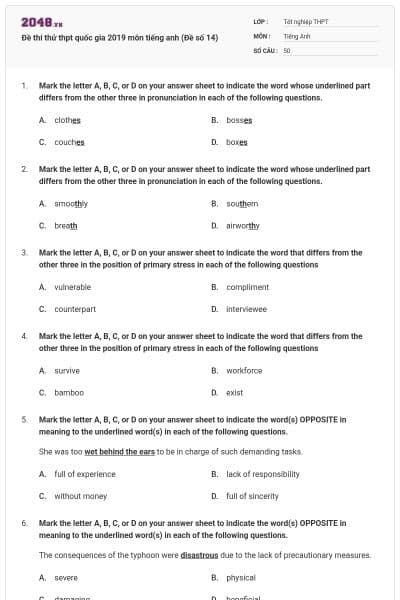
Đề thi thử thpt quốc gia 2019 môn tiếng anh (Đề số 14)

50 câu hỏi
Mark the letter A, B, C, or D on your answer sheet to indicate the word whose underlined part differs from the other three in pronunciation in each of the following questions.
clothes
bosses
couches
boxes
Mark the letter A, B, C, or D on your answer sheet to indicate the word whose underlined part differs from the other three in pronunciation in each of the following questions.
smoothly
southern
breath
airworthy
Mark the letter A, B, C, or D on your answer sheet to indicate the word that differs from the other three in the position of primary stress in each of the following questions
vulnerable
compliment
counterpart
interviewee
Mark the letter A, B, C, or D on your answer sheet to indicate the word that differs from the other three in the position of primary stress in each of the following questions
survive
workforce
bamboo
exist
Mark the letter A, B, C, or D on your answer sheet to indicate the word(s) OPPOSITE in meaning to the underlined word(s) in each of the following questions.
She was too wet behind the ears to be in charge of such demanding tasks.
full of experience
lack of responsibility
without money
full of sincerity
Mark the letter A, B, C, or D on your answer sheet to indicate the word(s) OPPOSITE in meaning to the underlined word(s) in each of the following questions.
The consequences of the typhoon were disastrous due to the lack of precautionary measures.
severe
physical
damaging
beneficial
Mark the letter A, B, C, or D on your answer sheet to indicate the word(s) CLOSEST in meaning to the underlined word(s) in each of the following questions.
I see Tim boasting again. I’ve heard him telling everyone he’s the best tennis player in the County.
blowing his own trumpet
holding his tongue
speaking too much
pulling my leg
Mark the letter A, B, C, or D on your answer sheet to indicate the word(s) CLOSEST in meaning to the underlined word(s) in each of the following questions.
In order to enjoy fine wine, one should drink it slowly, a little at a time.
sip it
smell it
spill it
stir it
Mark the letter A, B, C, or D on your answer sheet to indicate the sentence that best completes each of the following exchanges.
- Mike : “ My first English test was not as good as I expected.” - Thomas “ ____________”
Good Heavens !
That’s brilliant enough!
It’s okay, don’t worry.
Never mind, better job next time!
Mark the letter A, B, C, or D on your answer sheet to indicate the sentence that best completes each of the following exchanges.
Tom: “Can I have another cup of tea?” - Lisa: “ _____________ .”
Allow yourself
Do it yourself
Help yourself
Be yourself
Mark the letter A, B, C, or D on your answer sheet to indicate the correct answer to each of the following questions
Vietnam is playing its part in the worldwide trend of fostering a/an attitude to the LGBT community with several steps toward marriage equality.
strong-minded
like-minded
absent-minded
open-minded
Mark the letter A, B, C, or D on your answer sheet to indicate the correct answer to each of the following questions
The thieves _____________ by car but we can’t be sure.
must have escaped
needn’t have escaped
should have escaped
might have escaped
Mark the letter A, B, C, or D on your answer sheet to indicate the correct answer to each of the following questions
_____________ ten minutes earlier, you would have got a better seat.
Had you arrived
If you arrived
Were you arrived
If you hadn’t arrived
Mark the letter A, B, C, or D on your answer sheet to indicate the correct answer to each of the following questions
Parents in Vietnam arc on tenterhooks over the growing _____________ of an Internet challenge known as Blue Whale, where ‘players’ arc asked to complete a series of tasks, the final being suicide.
popular
popularity
popularize
popularly
Mark the letter A, B, C, or D on your answer sheet to indicate the correct answer to each of the following questions
The annual production of household wastewater makes up over 30 percent of all wastewater _____________ into the environment in Vietnam
be discharged
which discharged
was discharged
discharged
Mark the letter A, B, C, or D on your answer sheet to indicate the correct answer to each of the following questions
The 19th Asian Physics Olympiad, an annual contest in physics for high school students, _____________ on Sunday at the Hanoi-based University of Science and Technology.
made out
picked up
kicked off
held up
Mark the letter A, B, C, or D on your answer sheet to indicate the correct answer to each of the following questions
The Credit Institution Law which took _____________ on January 15, 2018 stipulates that Chairs and CEOs of credit institutions must not be chairs and members of board of management.
enforcement
effect
result
charge
Mark the letter A, B, C, or D on your answer sheet to indicate the correct answer to each of the following questions.
He _____________ as many boxes of cigars as he could carry home if regulations were tightened on visitors to Cuba again.
would have bought
will buy
had bought
would buy
Mark the letter A, B, C, or D on your answer sheet to indicate the correct answer to each of the following questions.
They agreed _____________ implementing signed cooperation agreement.
to continuing
to continue
continue
continuing
Mark the letter A, B, C, or D on your answer sheet to indicate the correct answer to each of the following questions.
While he was composing the song, he imagined the story in his head. He _____________ this music video to the audience for better understanding about his compositions.
added
dedicated
committed
admitted
Mark the letter A, B, C, or D on your answer sheet to indicate the correct answer to each of the following questions.
When Mark comes home, tell him I’m out a bit, _____________ ?
does he
do you
aren’t I
will you
Mark the letter A, B, C, or D on your answer sheet to indicate the correct answer to each of the following questions.
If we had finished it before we went on the tour, I think it _____________ a much better record.
would have been
would be
will have been
will be
Read the following passage and mark the letter A, B, C, or D on your answer sheet to indicate the correct word or phrase that best fits each of the numbered blanks from 23 to 27.
Almost 90 percent of American students below the college level attend public elementary and secondary schools, which do not charge tuition but rely on local and state taxes for funding. Traditionally, elementary school includes kindergarten through the eighth grade. In some places, (23) _____________ , elementary school ends after the sixth grade, and students attend middle school, or junior high school, from grades seven through nine. Similarly, secondary school, or high school, traditionally comprises grades nine through twelve, but in some places begins (24) _____________ the tenth grade.
Most of the students who do not attend public elementary and secondary schools attend private schools, for which their families pay (25) _____________ . Four out of five private schools are run by religious groups. In these schools religious instruction is part of the curriculum, (26) _____________ also includes the traditional academic courses. There is also a small but growing number of parents who educate their children themselves, a practice known as home schooling.
The United States does not have a national school system. Nor, with the exception of the military academies, are there schools run by the federal government. But the government (27) _____________ guidance and funding for federal educational programs in which both public and private schools take part and the U.S. Department of Education oversees these programs.
Điền vào ô 23
whereas
therefore
however
moreover
Read the following passage and mark the letter A, B, C, or D on your answer sheet to indicate the correct word or phrase that best fits each of the numbered blanks from 23 to 27.
Almost 90 percent of American students below the college level attend public elementary and secondary schools, which do not charge tuition but rely on local and state taxes for funding. Traditionally, elementary school includes kindergarten through the eighth grade. In some places, (23) _____________ , elementary school ends after the sixth grade, and students attend middle school, or junior high school, from grades seven through nine. Similarly, secondary school, or high school, traditionally comprises grades nine through twelve, but in some places begins (24) _____________ the tenth grade.
Most of the students who do not attend public elementary and secondary schools attend private schools, for which their families pay (25) _____________ . Four out of five private schools are run by religious groups. In these schools religious instruction is part of the curriculum, (26) _____________ also includes the traditional academic courses. There is also a small but growing number of parents who educate their children themselves, a practice known as home schooling.
The United States does not have a national school system. Nor, with the exception of the military academies, are there schools run by the federal government. But the government (27) _____________ guidance and funding for federal educational programs in which both public and private schools take part and the U.S. Department of Education oversees these programs.
Điền vào ô 24
with
of
on
at
Read the following passage and mark the letter A, B, C, or D on your answer sheet to indicate the correct word or phrase that best fits each of the numbered blanks from 23 to 27.
Almost 90 percent of American students below the college level attend public elementary and secondary schools, which do not charge tuition but rely on local and state taxes for funding. Traditionally, elementary school includes kindergarten through the eighth grade. In some places, (23) _____________ , elementary school ends after the sixth grade, and students attend middle school, or junior high school, from grades seven through nine. Similarly, secondary school, or high school, traditionally comprises grades nine through twelve, but in some places begins (24) _____________ the tenth grade.
Most of the students who do not attend public elementary and secondary schools attend private schools, for which their families pay (25) _____________ . Four out of five private schools are run by religious groups. In these schools religious instruction is part of the curriculum, (26) _____________ also includes the traditional academic courses. There is also a small but growing number of parents who educate their children themselves, a practice known as home schooling.
The United States does not have a national school system. Nor, with the exception of the military academies, are there schools run by the federal government. But the government (27) _____________ guidance and funding for federal educational programs in which both public and private schools take part and the U.S. Department of Education oversees these programs.
Điền vào ô 25
money
tuition
cost
expense
Read the following passage and mark the letter A, B, C, or D on your answer sheet to indicate the correct word or phrase that best fits each of the numbered blanks from 23 to 27.
Almost 90 percent of American students below the college level attend public elementary and secondary schools, which do not charge tuition but rely on local and state taxes for funding. Traditionally, elementary school includes kindergarten through the eighth grade. In some places, (23) _____________ , elementary school ends after the sixth grade, and students attend middle school, or junior high school, from grades seven through nine. Similarly, secondary school, or high school, traditionally comprises grades nine through twelve, but in some places begins (24) _____________ the tenth grade.
Most of the students who do not attend public elementary and secondary schools attend private schools, for which their families pay (25) _____________ . Four out of five private schools are run by religious groups. In these schools religious instruction is part of the curriculum, (26) _____________ also includes the traditional academic courses. There is also a small but growing number of parents who educate their children themselves, a practice known as home schooling.
The United States does not have a national school system. Nor, with the exception of the military academies, are there schools run by the federal government. But the government (27) _____________ guidance and funding for federal educational programs in which both public and private schools take part and the U.S. Department of Education oversees these programs.
Điền vào ô 26
where
what
which
that
Read the following passage and mark the letter A, B, C, or D on your answer sheet to indicate the correct word or phrase that best fits each of the numbered blanks from 23 to 27.
Almost 90 percent of American students below the college level attend public elementary and secondary schools, which do not charge tuition but rely on local and state taxes for funding. Traditionally, elementary school includes kindergarten through the eighth grade. In some places, (23) _____________ , elementary school ends after the sixth grade, and students attend middle school, or junior high school, from grades seven through nine. Similarly, secondary school, or high school, traditionally comprises grades nine through twelve, but in some places begins (24) _____________ the tenth grade.
Most of the students who do not attend public elementary and secondary schools attend private schools, for which their families pay (25) _____________ . Four out of five private schools are run by religious groups. In these schools religious instruction is part of the curriculum, (26) _____________ also includes the traditional academic courses. There is also a small but growing number of parents who educate their children themselves, a practice known as home schooling.
The United States does not have a national school system. Nor, with the exception of the military academies, are there schools run by the federal government. But the government (27) _____________ guidance and funding for federal educational programs in which both public and private schools take part and the U.S. Department of Education oversees these programs.
Điền vào ô 27
provide
give
make
offer
Read the following passage and mark the letter A, B, C, or D on your answer sheet to indicate the correct answer to each of the questions from 28 to 34.
Scientists do not yet thoroughly understand just how the body of an individual becomes sensitive to a substance that is harmless or even wholesome for the average person. Milk, wheat, and egg, for example, rank among the most healthful and widely used foods. Yet these foods can cause persons sensitive to them to suffer greatly. At first, the body of the individual is not harmed by coming into contact with the substance. After a varying interval of time, usually longer than a few weeks, the body becomes sensitive to it, and an allergy has begun to develop. Sometimes it’s hard to figure out if you have a food allergy, since it can show up so many different ways. Your symptoms could be caused by many other problems. You may have rashes, hives, joint pains mimicking arthritis, headaches, irritability, or depression. The most common food allergies are to milk, eggs, seafood, wheat, nuts, seeds, chocolate, oranges, and tomatoes. Many of these allergies will not develop if these foods are not fed to an infant until her or his intestines mature at around seven months. Breast milk also tends to be protective. Migraines can be set off by foods containing tyramine, phenathylamine, monosodium glutamate, or sodium nitrate. Common foods which contain these are chocolate, aged cheeses, sour cream, red wine, pickled herring, chicken livers, avocados, ripe bananas, cured meats, many Oriental and prepared foods (read the labels!). Some people have been successful in treating their migraines with supplements of B-vitamins, particularly B6 and niacin. Children who are hyperactive may benefit from eliminating food additives, especially colorings, and foods high in salicylates from their diets.
The topic of this passage is _____________
reactions to foods
food and nutrition
infants and allergies
a good diet
Read the following passage and mark the letter A, B, C, or D on your answer sheet to indicate the correct answer to each of the questions from 28 to 34.
Scientists do not yet thoroughly understand just how the body of an individual becomes sensitive to a substance that is harmless or even wholesome for the average person. Milk, wheat, and egg, for example, rank among the most healthful and widely used foods. Yet these foods can cause persons sensitive to them to suffer greatly. At first, the body of the individual is not harmed by coming into contact with the substance. After a varying interval of time, usually longer than a few weeks, the body becomes sensitive to it, and an allergy has begun to develop. Sometimes it’s hard to figure out if you have a food allergy, since it can show up so many different ways. Your symptoms could be caused by many other problems. You may have rashes, hives, joint pains mimicking arthritis, headaches, irritability, or depression. The most common food allergies are to milk, eggs, seafood, wheat, nuts, seeds, chocolate, oranges, and tomatoes. Many of these allergies will not develop if these foods are not fed to an infant until her or his intestines mature at around seven months. Breast milk also tends to be protective. Migraines can be set off by foods containing tyramine, phenathylamine, monosodium glutamate, or sodium nitrate. Common foods which contain these are chocolate, aged cheeses, sour cream, red wine, pickled herring, chicken livers, avocados, ripe bananas, cured meats, many Oriental and prepared foods (read the labels!). Some people have been successful in treating their migraines with supplements of B-vitamins, particularly B6 and niacin. Children who are hyperactive may benefit from eliminating food additives, especially colorings, and foods high in salicylates from their diets.
According to the passage, the difficulty in diagnosing allergies to foods is due to _______ .
the vast number of different foods we eat
lack of a proper treatment plan
the similarity of symptoms of the allergy to other problems
the use of prepared formula to feed babies
Read the following passage and mark the letter A, B, C, or D on your answer sheet to indicate the correct answer to each of the questions from 28 to 34.
Scientists do not yet thoroughly understand just how the body of an individual becomes sensitive to a substance that is harmless or even wholesome for the average person. Milk, wheat, and egg, for example, rank among the most healthful and widely used foods. Yet these foods can cause persons sensitive to them to suffer greatly. At first, the body of the individual is not harmed by coming into contact with the substance. After a varying interval of time, usually longer than a few weeks, the body becomes sensitive to it, and an allergy has begun to develop. Sometimes it’s hard to figure out if you have a food allergy, since it can show up so many different ways. Your symptoms could be caused by many other problems. You may have rashes, hives, joint pains mimicking arthritis, headaches, irritability, or depression. The most common food allergies are to milk, eggs, seafood, wheat, nuts, seeds, chocolate, oranges, and tomatoes. Many of these allergies will not develop if these foods are not fed to an infant until her or his intestines mature at around seven months. Breast milk also tends to be protective. Migraines can be set off by foods containing tyramine, phenathylamine, monosodium glutamate, or sodium nitrate. Common foods which contain these are chocolate, aged cheeses, sour cream, red wine, pickled herring, chicken livers, avocados, ripe bananas, cured meats, many Oriental and prepared foods (read the labels!). Some people have been successful in treating their migraines with supplements of B-vitamins, particularly B6 and niacin. Children who are hyperactive may benefit from eliminating food additives, especially colorings, and foods high in salicylates from their diets.
The word “symptoms” is closest in meaning to _____________.
indications
diet
diagnosis
prescriptions
Read the following passage and mark the letter A, B, C, or D on your answer sheet to indicate the correct answer to each of the questions from 28 to 34.
Scientists do not yet thoroughly understand just how the body of an individual becomes sensitive to a substance that is harmless or even wholesome for the average person. Milk, wheat, and egg, for example, rank among the most healthful and widely used foods. Yet these foods can cause persons sensitive to them to suffer greatly. At first, the body of the individual is not harmed by coming into contact with the substance. After a varying interval of time, usually longer than a few weeks, the body becomes sensitive to it, and an allergy has begun to develop. Sometimes it’s hard to figure out if you have a food allergy, since it can show up so many different ways. Your symptoms could be caused by many other problems. You may have rashes, hives, joint pains mimicking arthritis, headaches, irritability, or depression. The most common food allergies are to milk, eggs, seafood, wheat, nuts, seeds, chocolate, oranges, and tomatoes. Many of these allergies will not develop if these foods are not fed to an infant until her or his intestines mature at around seven months. Breast milk also tends to be protective. Migraines can be set off by foods containing tyramine, phenathylamine, monosodium glutamate, or sodium nitrate. Common foods which contain these are chocolate, aged cheeses, sour cream, red wine, pickled herring, chicken livers, avocados, ripe bananas, cured meats, many Oriental and prepared foods (read the labels!). Some people have been successful in treating their migraines with supplements of B-vitamins, particularly B6 and niacin. Children who are hyperactive may benefit from eliminating food additives, especially colorings, and foods high in salicylates from their diets.
The phrase “set off’ is closest in meaning to _____________.
relieved
identifid
avoided
triggered
Read the following passage and mark the letter A, B, C, or D on your answer sheet to indicate the correct answer to each of the questions from 28 to 34.
Scientists do not yet thoroughly understand just how the body of an individual becomes sensitive to a substance that is harmless or even wholesome for the average person. Milk, wheat, and egg, for example, rank among the most healthful and widely used foods. Yet these foods can cause persons sensitive to them to suffer greatly. At first, the body of the individual is not harmed by coming into contact with the substance. After a varying interval of time, usually longer than a few weeks, the body becomes sensitive to it, and an allergy has begun to develop. Sometimes it’s hard to figure out if you have a food allergy, since it can show up so many different ways. Your symptoms could be caused by many other problems. You may have rashes, hives, joint pains mimicking arthritis, headaches, irritability, or depression. The most common food allergies are to milk, eggs, seafood, wheat, nuts, seeds, chocolate, oranges, and tomatoes. Many of these allergies will not develop if these foods are not fed to an infant until her or his intestines mature at around seven months. Breast milk also tends to be protective. Migraines can be set off by foods containing tyramine, phenathylamine, monosodium glutamate, or sodium nitrate. Common foods which contain these are chocolate, aged cheeses, sour cream, red wine, pickled herring, chicken livers, avocados, ripe bananas, cured meats, many Oriental and prepared foods (read the labels!). Some people have been successful in treating their migraines with supplements of B-vitamins, particularly B6 and niacin. Children who are hyperactive may benefit from eliminating food additives, especially colorings, and foods high in salicylates from their diets.
What can be inferred about babies from this passage?
They can eat almost anything.
They should have a carefully restricted diet as infants.
They gain little benefit from being breast fed.
They may become hyperactive if fed solid food too early.
Read the following passage and mark the letter A, B, C, or D on your answer sheet to indicate the correct answer to each of the questions from 28 to 34.
Scientists do not yet thoroughly understand just how the body of an individual becomes sensitive to a substance that is harmless or even wholesome for the average person. Milk, wheat, and egg, for example, rank among the most healthful and widely used foods. Yet these foods can cause persons sensitive to them to suffer greatly. At first, the body of the individual is not harmed by coming into contact with the substance. After a varying interval of time, usually longer than a few weeks, the body becomes sensitive to it, and an allergy has begun to develop. Sometimes it’s hard to figure out if you have a food allergy, since it can show up so many different ways. Your symptoms could be caused by many other problems. You may have rashes, hives, joint pains mimicking arthritis, headaches, irritability, or depression. The most common food allergies are to milk, eggs, seafood, wheat, nuts, seeds, chocolate, oranges, and tomatoes. Many of these allergies will not develop if these foods are not fed to an infant until her or his intestines mature at around seven months. Breast milk also tends to be protective. Migraines can be set off by foods containing tyramine, phenathylamine, monosodium glutamate, or sodium nitrate. Common foods which contain these are chocolate, aged cheeses, sour cream, red wine, pickled herring, chicken livers, avocados, ripe bananas, cured meats, many Oriental and prepared foods (read the labels!). Some people have been successful in treating their migraines with supplements of B-vitamins, particularly B6 and niacin. Children who are hyperactive may benefit from eliminating food additives, especially colorings, and foods high in salicylates from their diets.
The word “hyperactive” is closest in meaning to _____________.
overly active
unusually low activity
excited
inquisitive
Read the following passage and mark the letter A, B, C, or D on your answer sheet to indicate the correct answer to each of the questions from 28 to 34.
Scientists do not yet thoroughly understand just how the body of an individual becomes sensitive to a substance that is harmless or even wholesome for the average person. Milk, wheat, and egg, for example, rank among the most healthful and widely used foods. Yet these foods can cause persons sensitive to them to suffer greatly. At first, the body of the individual is not harmed by coming into contact with the substance. After a varying interval of time, usually longer than a few weeks, the body becomes sensitive to it, and an allergy has begun to develop. Sometimes it’s hard to figure out if you have a food allergy, since it can show up so many different ways. Your symptoms could be caused by many other problems. You may have rashes, hives, joint pains mimicking arthritis, headaches, irritability, or depression. The most common food allergies are to milk, eggs, seafood, wheat, nuts, seeds, chocolate, oranges, and tomatoes. Many of these allergies will not develop if these foods are not fed to an infant until her or his intestines mature at around seven months. Breast milk also tends to be protective. Migraines can be set off by foods containing tyramine, phenathylamine, monosodium glutamate, or sodium nitrate. Common foods which contain these are chocolate, aged cheeses, sour cream, red wine, pickled herring, chicken livers, avocados, ripe bananas, cured meats, many Oriental and prepared foods (read the labels!). Some people have been successful in treating their migraines with supplements of B-vitamins, particularly B6 and niacin. Children who are hyperactive may benefit from eliminating food additives, especially colorings, and foods high in salicylates from their diets.
The author states that the reason that infants need to avoid certain foods related to allergies has to do with the infant’s _____________.
lack of teeth
poor metabolism
underdeveloped intestinal tract
inability to swallow solid foods
Read the following passage and mark the letter A, B, C, or D on your answer sheet to indicate the correct answer to each of the questions from 35 to 42.
Non-verbal communication is a wordless form of communication. It is mainly a silent form of communication that does not involve speech or words. Non-verbal communication is done through eye contact, hand movement, touch, facial expressions, bodily postures and non-lexical components, etc. At times, silence is said to the best form of non-verbal communication.
One example of non-verbal communication is dancing. When we dance, we can express so many different emotions. From passion to religious devotion, dancing either alone, writh another person as part of a couple or in a synchronized group, can communicate so much. Dancing is something that many of us engage in from childhood and it becomes an important way of socializing and expressing ourselves at the same time.
Body language including bodily movement and postures is a language all of its own. Our posture, and the way that we lean forward or back or cross or uncross our legs can speak volumes about us. Very often, we are not even aware that we are communication our thoughts via our body language. That is the reason why, in job interviews and other situations in which we are under scrutiny, it is a good idea to pay attention to our body language. For example, leaning forward can be a sign of positivity, whilst sitting with our arms folded can make us look closed off - as if we have something to hide.
What we wear can often communicate things. For example, if we dress up in academic robes, it is clear that we want to communicate to everyone who sees us that we have attained a certain level of academic achievement. We should never judge people by what they wear - however, some types of official garments (such as a judge’s wig, a scholar’s gown or a soldier’s medal) are designed to communicate something about the wearer.
Silence is also a type of non-verbal communication. Sometimes, staying silent can communicate much more than words can. Silence can be powerful, sad, happy or it can simply communicate to other people that we do not want to engage with them. Good communicators are able to listen, and to use comfortable silences, to connect with other people. There is no need to think that communication is all about words!
Effective communication, as is abundantly clear from the discussion above, involves not just listening to other people’s words and expressing ourselves in words. It also means picking up on other people’s non-verbal cues. Why not go through the list above and think about which forms of non-verbal communication you are adept at understanding. Are there any ways in which you might improve your non-verbal communication skills? We could all benefit from a little improvement in this area, as it enables us to enjoy deeper and more meaningful connections with other people.
(Source: http://www.importantindia.com)
What does the passage mainly discuss?
Some types of wordless form of communication
Some types of effective form of communication
Communication and its effective forms
Non-verbal communication and its benefits
Read the following passage and mark the letter A, B, C, or D on your answer sheet to indicate the correct answer to each of the questions from 35 to 42.
Non-verbal communication is a wordless form of communication. It is mainly a silent form of communication that does not involve speech or words. Non-verbal communication is done through eye contact, hand movement, touch, facial expressions, bodily postures and non-lexical components, etc. At times, silence is said to the best form of non-verbal communication.
One example of non-verbal communication is dancing. When we dance, we can express so many different emotions. From passion to religious devotion, dancing either alone, writh another person as part of a couple or in a synchronized group, can communicate so much. Dancing is something that many of us engage in from childhood and it becomes an important way of socializing and expressing ourselves at the same time.
Body language including bodily movement and postures is a language all of its own. Our posture, and the way that we lean forward or back or cross or uncross our legs can speak volumes about us. Very often, we are not even aware that we are communication our thoughts via our body language. That is the reason why, in job interviews and other situations in which we are under scrutiny, it is a good idea to pay attention to our body language. For example, leaning forward can be a sign of positivity, whilst sitting with our arms folded can make us look closed off - as if we have something to hide.
What we wear can often communicate things. For example, if we dress up in academic robes, it is clear that we want to communicate to everyone who sees us that we have attained a certain level of academic achievement. We should never judge people by what they wear - however, some types of official garments (such as a judge’s wig, a scholar’s gown or a soldier’s medal) are designed to communicate something about the wearer.
Silence is also a type of non-verbal communication. Sometimes, staying silent can communicate much more than words can. Silence can be powerful, sad, happy or it can simply communicate to other people that we do not want to engage with them. Good communicators are able to listen, and to use comfortable silences, to connect with other people. There is no need to think that communication is all about words!
Effective communication, as is abundantly clear from the discussion above, involves not just listening to other people’s words and expressing ourselves in words. It also means picking up on other people’s non-verbal cues. Why not go through the list above and think about which forms of non-verbal communication you are adept at understanding. Are there any ways in which you might improve your non-verbal communication skills? We could all benefit from a little improvement in this area, as it enables us to enjoy deeper and more meaningful connections with other people.
(Source: http://www.importantindia.com)
The word “engage” in paragraph 2 is closest in meaning to ____________.
attract
participate
occupy
employ
Read the following passage and mark the letter A, B, C, or D on your answer sheet to indicate the correct answer to each of the questions from 35 to 42.
Non-verbal communication is a wordless form of communication. It is mainly a silent form of communication that does not involve speech or words. Non-verbal communication is done through eye contact, hand movement, touch, facial expressions, bodily postures and non-lexical components, etc. At times, silence is said to the best form of non-verbal communication.
One example of non-verbal communication is dancing. When we dance, we can express so many different emotions. From passion to religious devotion, dancing either alone, writh another person as part of a couple or in a synchronized group, can communicate so much. Dancing is something that many of us engage in from childhood and it becomes an important way of socializing and expressing ourselves at the same time.
Body language including bodily movement and postures is a language all of its own. Our posture, and the way that we lean forward or back or cross or uncross our legs can speak volumes about us. Very often, we are not even aware that we are communication our thoughts via our body language. That is the reason why, in job interviews and other situations in which we are under scrutiny, it is a good idea to pay attention to our body language. For example, leaning forward can be a sign of positivity, whilst sitting with our arms folded can make us look closed off - as if we have something to hide.
What we wear can often communicate things. For example, if we dress up in academic robes, it is clear that we want to communicate to everyone who sees us that we have attained a certain level of academic achievement. We should never judge people by what they wear - however, some types of official garments (such as a judge’s wig, a scholar’s gown or a soldier’s medal) are designed to communicate something about the wearer.
Silence is also a type of non-verbal communication. Sometimes, staying silent can communicate much more than words can. Silence can be powerful, sad, happy or it can simply communicate to other people that we do not want to engage with them. Good communicators are able to listen, and to use comfortable silences, to connect with other people. There is no need to think that communication is all about words!
Effective communication, as is abundantly clear from the discussion above, involves not just listening to other people’s words and expressing ourselves in words. It also means picking up on other people’s non-verbal cues. Why not go through the list above and think about which forms of non-verbal communication you are adept at understanding. Are there any ways in which you might improve your non-verbal communication skills? We could all benefit from a little improvement in this area, as it enables us to enjoy deeper and more meaningful connections with other people.
(Source: http://www.importantindia.com)
The word “them" in paragraph 5 refers to _____________.
words
silences
good communicators
other people
Read the following passage and mark the letter A, B, C, or D on your answer sheet to indicate the correct answer to each of the questions from 35 to 42.
Non-verbal communication is a wordless form of communication. It is mainly a silent form of communication that does not involve speech or words. Non-verbal communication is done through eye contact, hand movement, touch, facial expressions, bodily postures and non-lexical components, etc. At times, silence is said to the best form of non-verbal communication.
One example of non-verbal communication is dancing. When we dance, we can express so many different emotions. From passion to religious devotion, dancing either alone, writh another person as part of a couple or in a synchronized group, can communicate so much. Dancing is something that many of us engage in from childhood and it becomes an important way of socializing and expressing ourselves at the same time.
Body language including bodily movement and postures is a language all of its own. Our posture, and the way that we lean forward or back or cross or uncross our legs can speak volumes about us. Very often, we are not even aware that we are communication our thoughts via our body language. That is the reason why, in job interviews and other situations in which we are under scrutiny, it is a good idea to pay attention to our body language. For example, leaning forward can be a sign of positivity, whilst sitting with our arms folded can make us look closed off - as if we have something to hide.
What we wear can often communicate things. For example, if we dress up in academic robes, it is clear that we want to communicate to everyone who sees us that we have attained a certain level of academic achievement. We should never judge people by what they wear - however, some types of official garments (such as a judge’s wig, a scholar’s gown or a soldier’s medal) are designed to communicate something about the wearer.
Silence is also a type of non-verbal communication. Sometimes, staying silent can communicate much more than words can. Silence can be powerful, sad, happy or it can simply communicate to other people that we do not want to engage with them. Good communicators are able to listen, and to use comfortable silences, to connect with other people. There is no need to think that communication is all about words!
Effective communication, as is abundantly clear from the discussion above, involves not just listening to other people’s words and expressing ourselves in words. It also means picking up on other people’s non-verbal cues. Why not go through the list above and think about which forms of non-verbal communication you are adept at understanding. Are there any ways in which you might improve your non-verbal communication skills? We could all benefit from a little improvement in this area, as it enables us to enjoy deeper and more meaningful connections with other people.
(Source: http://www.importantindia.com)
Which of the following is considered as a positive sign ofbody language at a job interview?
uncrossing legs
paying attention to volumes
leaning forward
sitting with folded arms
Read the following passage and mark the letter A, B, C, or D on your answer sheet to indicate the correct answer to each of the questions from 35 to 42.
Non-verbal communication is a wordless form of communication. It is mainly a silent form of communication that does not involve speech or words. Non-verbal communication is done through eye contact, hand movement, touch, facial expressions, bodily postures and non-lexical components, etc. At times, silence is said to the best form of non-verbal communication.
One example of non-verbal communication is dancing. When we dance, we can express so many different emotions. From passion to religious devotion, dancing either alone, writh another person as part of a couple or in a synchronized group, can communicate so much. Dancing is something that many of us engage in from childhood and it becomes an important way of socializing and expressing ourselves at the same time.
Body language including bodily movement and postures is a language all of its own. Our posture, and the way that we lean forward or back or cross or uncross our legs can speak volumes about us. Very often, we are not even aware that we are communication our thoughts via our body language. That is the reason why, in job interviews and other situations in which we are under scrutiny, it is a good idea to pay attention to our body language. For example, leaning forward can be a sign of positivity, whilst sitting with our arms folded can make us look closed off - as if we have something to hide.
What we wear can often communicate things. For example, if we dress up in academic robes, it is clear that we want to communicate to everyone who sees us that we have attained a certain level of academic achievement. We should never judge people by what they wear - however, some types of official garments (such as a judge’s wig, a scholar’s gown or a soldier’s medal) are designed to communicate something about the wearer.
Silence is also a type of non-verbal communication. Sometimes, staying silent can communicate much more than words can. Silence can be powerful, sad, happy or it can simply communicate to other people that we do not want to engage with them. Good communicators are able to listen, and to use comfortable silences, to connect with other people. There is no need to think that communication is all about words!
Effective communication, as is abundantly clear from the discussion above, involves not just listening to other people’s words and expressing ourselves in words. It also means picking up on other people’s non-verbal cues. Why not go through the list above and think about which forms of non-verbal communication you are adept at understanding. Are there any ways in which you might improve your non-verbal communication skills? We could all benefit from a little improvement in this area, as it enables us to enjoy deeper and more meaningful connections with other people.
(Source: http://www.importantindia.com)Which of the following is NOT mentioned as types of official clothes?
a judge’s wig
a scholar’s dress
a trooper’s medal
a doll’s gown
Read the following passage and mark the letter A, B, C, or D on your answer sheet to indicate the correct answer to each of the questions from 35 to 42.
Non-verbal communication is a wordless form of communication. It is mainly a silent form of communication that does not involve speech or words. Non-verbal communication is done through eye contact, hand movement, touch, facial expressions, bodily postures and non-lexical components, etc. At times, silence is said to the best form of non-verbal communication.
One example of non-verbal communication is dancing. When we dance, we can express so many different emotions. From passion to religious devotion, dancing either alone, writh another person as part of a couple or in a synchronized group, can communicate so much. Dancing is something that many of us engage in from childhood and it becomes an important way of socializing and expressing ourselves at the same time.
Body language including bodily movement and postures is a language all of its own. Our posture, and the way that we lean forward or back or cross or uncross our legs can speak volumes about us. Very often, we are not even aware that we are communication our thoughts via our body language. That is the reason why, in job interviews and other situations in which we are under scrutiny, it is a good idea to pay attention to our body language. For example, leaning forward can be a sign of positivity, whilst sitting with our arms folded can make us look closed off - as if we have something to hide.
What we wear can often communicate things. For example, if we dress up in academic robes, it is clear that we want to communicate to everyone who sees us that we have attained a certain level of academic achievement. We should never judge people by what they wear - however, some types of official garments (such as a judge’s wig, a scholar’s gown or a soldier’s medal) are designed to communicate something about the wearer.
Silence is also a type of non-verbal communication. Sometimes, staying silent can communicate much more than words can. Silence can be powerful, sad, happy or it can simply communicate to other people that we do not want to engage with them. Good communicators are able to listen, and to use comfortable silences, to connect with other people. There is no need to think that communication is all about words!
Effective communication, as is abundantly clear from the discussion above, involves not just listening to other people’s words and expressing ourselves in words. It also means picking up on other people’s non-verbal cues. Why not go through the list above and think about which forms of non-verbal communication you are adept at understanding. Are there any ways in which you might improve your non-verbal communication skills? We could all benefit from a little improvement in this area, as it enables us to enjoy deeper and more meaningful connections with other people.
(Source: http://www.importantindia.com)Which of the following statement is TRUE about silence according to paragraph 5?
Silent communication is always much more effective than speech.
Silence can have more than one meaning.
Silence is one of the ways people use to communicate to others.
Good communicators are able to use comfortable silences to contact with other people.
Read the following passage and mark the letter A, B, C, or D on your answer sheet to indicate the correct answer to each of the questions from 35 to 42.
Non-verbal communication is a wordless form of communication. It is mainly a silent form of communication that does not involve speech or words. Non-verbal communication is done through eye contact, hand movement, touch, facial expressions, bodily postures and non-lexical components, etc. At times, silence is said to the best form of non-verbal communication.
One example of non-verbal communication is dancing. When we dance, we can express so many different emotions. From passion to religious devotion, dancing either alone, writh another person as part of a couple or in a synchronized group, can communicate so much. Dancing is something that many of us engage in from childhood and it becomes an important way of socializing and expressing ourselves at the same time.
Body language including bodily movement and postures is a language all of its own. Our posture, and the way that we lean forward or back or cross or uncross our legs can speak volumes about us. Very often, we are not even aware that we are communication our thoughts via our body language. That is the reason why, in job interviews and other situations in which we are under scrutiny, it is a good idea to pay attention to our body language. For example, leaning forward can be a sign of positivity, whilst sitting with our arms folded can make us look closed off - as if we have something to hide.
What we wear can often communicate things. For example, if we dress up in academic robes, it is clear that we want to communicate to everyone who sees us that we have attained a certain level of academic achievement. We should never judge people by what they wear - however, some types of official garments (such as a judge’s wig, a scholar’s gown or a soldier’s medal) are designed to communicate something about the wearer.
Silence is also a type of non-verbal communication. Sometimes, staying silent can communicate much more than words can. Silence can be powerful, sad, happy or it can simply communicate to other people that we do not want to engage with them. Good communicators are able to listen, and to use comfortable silences, to connect with other people. There is no need to think that communication is all about words!
Effective communication, as is abundantly clear from the discussion above, involves not just listening to other people’s words and expressing ourselves in words. It also means picking up on other people’s non-verbal cues. Why not go through the list above and think about which forms of non-verbal communication you are adept at understanding. Are there any ways in which you might improve your non-verbal communication skills? We could all benefit from a little improvement in this area, as it enables us to enjoy deeper and more meaningful connections with other people.
(Source: http://www.importantindia.com)
The word “picking up on” in paragraph 6 is closest in meaning to _____________.
understanding
giving attention to
improving
increasing
Read the following passage and mark the letter A, B, C, or D on your answer sheet to indicate the correct answer to each of the questions from 35 to 42.
Non-verbal communication is a wordless form of communication. It is mainly a silent form of communication that does not involve speech or words. Non-verbal communication is done through eye contact, hand movement, touch, facial expressions, bodily postures and non-lexical components, etc. At times, silence is said to the best form of non-verbal communication.
One example of non-verbal communication is dancing. When we dance, we can express so many different emotions. From passion to religious devotion, dancing either alone, writh another person as part of a couple or in a synchronized group, can communicate so much. Dancing is something that many of us engage in from childhood and it becomes an important way of socializing and expressing ourselves at the same time.
Body language including bodily movement and postures is a language all of its own. Our posture, and the way that we lean forward or back or cross or uncross our legs can speak volumes about us. Very often, we are not even aware that we are communication our thoughts via our body language. That is the reason why, in job interviews and other situations in which we are under scrutiny, it is a good idea to pay attention to our body language. For example, leaning forward can be a sign of positivity, whilst sitting with our arms folded can make us look closed off - as if we have something to hide.
What we wear can often communicate things. For example, if we dress up in academic robes, it is clear that we want to communicate to everyone who sees us that we have attained a certain level of academic achievement. We should never judge people by what they wear - however, some types of official garments (such as a judge’s wig, a scholar’s gown or a soldier’s medal) are designed to communicate something about the wearer.
Silence is also a type of non-verbal communication. Sometimes, staying silent can communicate much more than words can. Silence can be powerful, sad, happy or it can simply communicate to other people that we do not want to engage with them. Good communicators are able to listen, and to use comfortable silences, to connect with other people. There is no need to think that communication is all about words!
Effective communication, as is abundantly clear from the discussion above, involves not just listening to other people’s words and expressing ourselves in words. It also means picking up on other people’s non-verbal cues. Why not go through the list above and think about which forms of non-verbal communication you are adept at understanding. Are there any ways in which you might improve your non-verbal communication skills? We could all benefit from a little improvement in this area, as it enables us to enjoy deeper and more meaningful connections with other people.
(Source: http://www.importantindia.com)Which of the following can be inferred from the passage?
Body language is the most useful form of communication.
When people cannot speak, they can use non-verbal communication
It’s impossible to think that communication is all about words.
Communication is done through not only words but also non-verbal cues.
Mark the letter A, B, C, or D on your answer sheet to indicate the sentence that is closest in meaning to each of the following questions.
I’d hardly unpacked in my hotel room when my phone rang.
Had I hardly unpacked in my hotel room, my phone rang.
I was unpacking in my hotel hard when my phone rang.
Hardly had I unpacked in my hotel room when my phone rang.
It was hard for me to unpack in my hotel when my phone rang.
Mark the letter A, B, C, or D on your answer sheet to indicate the sentence that is closest in meaning to each of the following questions.
The local people are in no way to blame for the destruction of the forest.
In no way are the local people to blame for the destruction of the forest.
The local people have no way to blame for the destruction of the forest.
It no use to blame the local people for the destruction of the forest.
There is no way for the local people to blame for the destruction of the forest.
Mark the letter A, B, C, or D on your answer sheet to indicate the sentence that is closest in meaning to each of the following questions.
“Don’t forget to hand in the report, Peter!” said Kate.
Kate reminded Peter to handing in the report.
Kate said that Peter had forgotten to hand in the report.
Kate forgot to hand in the report to Peter.
Kate reminded Peter to hand in the report.
Mark the letter A, B, C, or D on your answer sheet to indicate the underlined part that needs correction in each of the following questions.
It is (A) common knowledge that solar heating for a (B) large office building is (C) technically different (D) from a single-family home.
common knowledge
large office
technically
from a single-family home
Mark the letter A, B, C, or D on your answer sheet to indicate the underlined part that needs correction in each of the following questions.
All members (A) shall give the United Nations (B) every assistance in any action (C) it does in accordance with (D) the present Charter.
shall
every
it does
the
Mark the letter A, B, C, or D on your answer sheet to indicate the underlined part that needs correction in each of the following questions.
(A) Reminding not to miss (B) the 15:20 train, the manager set out (C) for the station (D) in a hurry.
Reminding
the 15:20 train
for
in a hurry
Mark the letter A, B, C, or D on your answer sheet to indicate the sentence that best combines each pair of sentences in the following questions.
Michael missed his flight because he had not been informed of the change in flight schedule.
Not having been informed of the change in flight schedule, Michael missed his flight.
Not having missed his flight, Michael was informed of the change in flight schedule.
Michael missed his flight, though he had been informed of the change in flight schedule.
Michael had been informed of his flight delay, which was due to the change in flight schedule
Mark the letter A, B, C, or D on your answer sheet to indicate the sentence that best combines each pair of sentences in the following questions.
Most scientists know him well. However, very few ordinary people have heard of him.
Although he is well known to scientists, he is little known to the general public.
He is the only scientist that is not known to the general public.
Many ordinary people know him better than most scientists do.
Not only scientists but also the general public know him as a big name.