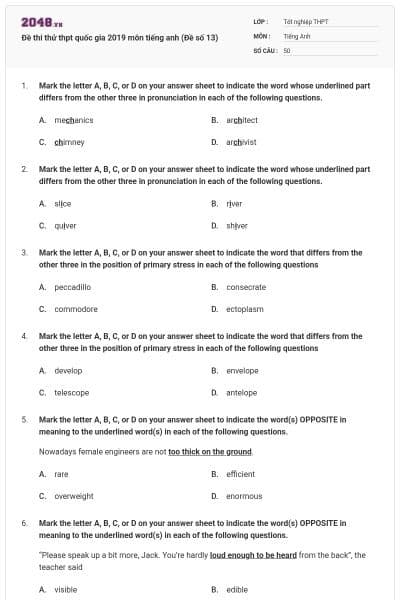
Đề thi thử thpt quốc gia 2019 môn tiếng anh (Đề số 13)

50 câu hỏi
Mark the letter A, B, C, or D on your answer sheet to indicate the word whose underlined part differs from the other three in pronunciation in each of the following questions.
mechanics
architect
chimney
archivist
Mark the letter A, B, C, or D on your answer sheet to indicate the word whose underlined part differs from the other three in pronunciation in each of the following questions.
slice
river
quiver
shiver
Mark the letter A, B, C, or D on your answer sheet to indicate the word that differs from the other three in the position of primary stress in each of the following questions
peccadillo
consecrate
commodore
ectoplasm
Mark the letter A, B, C, or D on your answer sheet to indicate the word that differs from the other three in the position of primary stress in each of the following questions
develop
envelope
telescope
antelope
Mark the letter A, B, C, or D on your answer sheet to indicate the word(s) OPPOSITE in meaning to the underlined word(s) in each of the following questions.
Nowadays female engineers are not too thick on the ground.
rare
efficient
overweight
enormous
Mark the letter A, B, C, or D on your answer sheet to indicate the word(s) OPPOSITE in meaning to the underlined word(s) in each of the following questions.
“Please speak up a bit more, Jack. You’re hardly loud enough to be heard from the back”, the teacher said
visible
edible
eligible
inaudible
Mark the letter A, B, C, or D on your answer sheet to indicate the word(s) CLOSEST in meaning to the underlined word(s) in each of the following questions.
After many years of unsuccessfully endeavoring to form his own orchestra, Glenn Miller finally achieved world fame in 1939 as a big band leader.
offering
deciding
requesting
trying
Mark the letter A, B, C, or D on your answer sheet to indicate the word(s) CLOSEST in meaning to the underlined word(s) in each of the following questions.
Few businesses are flourishing in the present economic climate.
taking off
setting up
growing well
closing down
Mark the letter A, B, C, or D on your answer sheet to indicate the sentence that best completes each of the following exchanges.
John: “Do you think that we should use public transportation to protect our
environment?” - Linda: “_____________.”
Of course not. You bet
There is no doubt about it
Well, that’s very surprising
Yes, it’s an absurd idea
Two friends are talking about their schoolwork.
- Jennifer: “I’m giving a presentation on global warming on Friday and I’m so nervous.”
Mary: “_____________ ”
You should think more about how to present the subject matter effectively.
There are a lot of things you can do to make you feel more confident.
It is easier to convince the audience and to hold their attention with actual data.
In order for you to succeed, you need to keep the audience interested and involved.
Mark the letter A, B, C, or D on your answer sheet to indicate the correct answer to each of the following questions.
She wasn’t feeling very well; otherwise, she _____________ the meeting so early.
wouldn’t leave
didn’t leave
wouldn’t have left
hadn’t left
Mark the letter A, B, C, or D on your answer sheet to indicate the correct answer to each of the following questions.
The teacher told the pupils that salt water _____________ at a lower temperature than fresh water.
froze
would freeze
freeze
freezes
Mark the letter A, B, C, or D on your answer sheet to indicate the correct answer to each of the following questions.
I’d just as soon _____________ to another restaurant as wait for a table here.
go
going
to go
have gone
Mark the letter A, B, C, or D on your answer sheet to indicate the correct answer to each of the following questions.
I wish to pay a visit to the beach this summer, _____________ ?
do I
don’t I
may I
am I
Mark the letter A, B, C, or D on your answer sheet to indicate the correct answer to each of the following questions.
_____________ cthe rise in unemployment, people still seem to be spending more.
Despite
Although
Because
Because of
Mark the letter A, B, C, or D on your answer sheet to indicate the correct answer to each of the following questions.
A teacher’s _____________ to education is worth great respect of the whole society because it brings benefits to the development of society.
guidance
principle
identity
devotion
Mark the letter A, B, C, or D on your answer sheet to indicate the correct answer to each of the following questions.
Cultural diversity supports the idea that every person can _____________ a unique and positive contribution to the larger society because of, rather than in spite of, their differences.
take
make
pay
lead
Mark the letter A, B, C, or D on your answer sheet to indicate the correct answer to each of the following questions.
Air pollution poses a _____________ to both human health and our environment.
jeopardy
threat
difficulty
problem
Mark the letter A, B, C, or D on your answer sheet to indicate the correct answer to each of the following questions.
The Pyeongchang 2018 Winter Olympics is getting _____________ and it marks the first time that South Korea has hosted the Winter Olympics.
grounded
underway
bearings
comeuppance
Mark the letter A, B, C, or D on your answer sheet to indicate the correct answer to each of the following questions.
He _____________ for an international company before he became a teacher.
has been working
has worked
was working
had worked
Mark the letter A, B, C, or D on your answer sheet to indicate the correct answer to each of the following questions.
She decided _____________ up yoga to help her to lose weight and escape from her hectic lifestyle as a graphic designer.
to taking
to take
take
taking
Mark the letter A, B, C, or D on your answer sheet to indicate the correct answer to each of the following questions.
In the modem Western world parents rarely expect their children to support them financially, _____________?
does it
doesn’t it
do they
don’t they
Read the following passage and mark the letter A, B, C, or D on your answer sheet to indicate the correct word or phrase that best fits each of the numbered blanks from 23 to 27.
In a small village in North Yorkshire, there is a big old farmhouse (23) _____________ three families live together. Alice and George and their three children, Joe and Pam and their two children, and Sue and her baby daughter. The adults divide up the work between them. George does the cooking, Joe and Sue do almost the housework. Pam looks after the shopping and (24) _____________ the repairs, and Alice takes care of the garden.
Alice, George and Sue go out to work. Joe works at home (25) _____________ computer systems, and Pam, who is a painter, looks after the baby during the day. Two of the children go to school in the village, but the three oldest ones go by bus to the secondary school in the nearest town, ten miles away.
The three families get (26) _____________ well, and enjoy their way of life. There are a few difficulties, of course. Their biggest worry at the moment is money - one of the cars needs replacing, and the roof needs some expensive repairs. But this isn’t too serious the bank has agreed to a loan, which they expect to be able to pay back in three years. And they all say they would much rather go on living in their old farmhouse (27) _____________ move to a luxury flat in a big city.
Điền vào ô 23
that
where
in where
which
Read the following passage and mark the letter A, B, C, or D on your answer sheet to indicate the correct word or phrase that best fits each of the numbered blanks from 23 to 27.
In a small village in North Yorkshire, there is a big old farmhouse (23) _____________ three families live together. Alice and George and their three children, Joe and Pam and their two children, and Sue and her baby daughter. The adults divide up the work between them. George does the cooking, Joe and Sue do almost the housework. Pam looks after the shopping and (24) _____________ the repairs, and Alice takes care of the garden.
Alice, George and Sue go out to work. Joe works at home (25) _____________ computer systems, and Pam, who is a painter, looks after the baby during the day. Two of the children go to school in the village, but the three oldest ones go by bus to the secondary school in the nearest town, ten miles away.
The three families get (26) _____________ well, and enjoy their way of life. There are a few difficulties, of course. Their biggest worry at the moment is money - one of the cars needs replacing, and the roof needs some expensive repairs. But this isn’t too serious the bank has agreed to a loan, which they expect to be able to pay back in three years. And they all say they would much rather go on living in their old farmhouse (27) _____________ move to a luxury flat in a big city.
Điền vào ô 24
does
has
prepares
fulfils
Read the following passage and mark the letter A, B, C, or D on your answer sheet to indicate the correct word or phrase that best fits each of the numbered blanks from 23 to 27.
In a small village in North Yorkshire, there is a big old farmhouse (23) _____________ three families live together. Alice and George and their three children, Joe and Pam and their two children, and Sue and her baby daughter. The adults divide up the work between them. George does the cooking, Joe and Sue do almost the housework. Pam looks after the shopping and (24) _____________ the repairs, and Alice takes care of the garden.
Alice, George and Sue go out to work. Joe works at home (25) _____________ computer systems, and Pam, who is a painter, looks after the baby during the day. Two of the children go to school in the village, but the three oldest ones go by bus to the secondary school in the nearest town, ten miles away.
The three families get (26) _____________ well, and enjoy their way of life. There are a few difficulties, of course. Their biggest worry at the moment is money - one of the cars needs replacing, and the roof needs some expensive repairs. But this isn’t too serious the bank has agreed to a loan, which they expect to be able to pay back in three years. And they all say they would much rather go on living in their old farmhouse (27) _____________ move to a luxury flat in a big city.
Điền vào ô 25
designs
and design
designing
who designs
Read the following passage and mark the letter A, B, C, or D on your answer sheet to indicate the correct word or phrase that best fits each of the numbered blanks from 23 to 27.
In a small village in North Yorkshire, there is a big old farmhouse (23) _____________ three families live together. Alice and George and their three children, Joe and Pam and their two children, and Sue and her baby daughter. The adults divide up the work between them. George does the cooking, Joe and Sue do almost the housework. Pam looks after the shopping and (24) _____________ the repairs, and Alice takes care of the garden.
Alice, George and Sue go out to work. Joe works at home (25) _____________ computer systems, and Pam, who is a painter, looks after the baby during the day. Two of the children go to school in the village, but the three oldest ones go by bus to the secondary school in the nearest town, ten miles away.
The three families get (26) _____________ well, and enjoy their way of life. There are a few difficulties, of course. Their biggest worry at the moment is money - one of the cars needs replacing, and the roof needs some expensive repairs. But this isn’t too serious the bank has agreed to a loan, which they expect to be able to pay back in three years. And they all say they would much rather go on living in their old farmhouse (27) _____________ move to a luxury flat in a big city.
Điền vào ô 26
on
of
with
in
Read the following passage and mark the letter A, B, C, or D on your answer sheet to indicate the correct word or phrase that best fits each of the numbered blanks from 23 to 27.
In a small village in North Yorkshire, there is a big old farmhouse (23) _____________ three families live together. Alice and George and their three children, Joe and Pam and their two children, and Sue and her baby daughter. The adults divide up the work between them. George does the cooking, Joe and Sue do almost the housework. Pam looks after the shopping and (24) _____________ the repairs, and Alice takes care of the garden.
Alice, George and Sue go out to work. Joe works at home (25) _____________ computer systems, and Pam, who is a painter, looks after the baby during the day. Two of the children go to school in the village, but the three oldest ones go by bus to the secondary school in the nearest town, ten miles away.
The three families get (26) _____________ well, and enjoy their way of life. There are a few difficulties, of course. Their biggest worry at the moment is money - one of the cars needs replacing, and the roof needs some expensive repairs. But this isn’t too serious the bank has agreed to a loan, which they expect to be able to pay back in three years. And they all say they would much rather go on living in their old farmhouse (27) _____________ move to a luxury flat in a big city.
Điền vào ô 27
then
than
to
therefore
Read the following passage and mark the letter A, B, C, or D on your answer sheet to indicate the correct answer to each of the questions from 28 to 34.
What drives moderately intelligent persons to put themselves up for acceptance or disparagement? In short, what sort of individual wants to be a comedian? When we hear the very word, what does the label suggest? Other professions, callings and occupations attract separate and distinct types of practitioner. Some stereotypes are so familiar as to be cheaply laughable examples from the world of travesty, among them absent-minded professors, venal lawyers, gloomy detectives and cynical reporters. But what corny characteristics do we attribute to comedians? To a man or woman, are they generally parsimonious, vulgar, shallow, arrogant, introspective, hysterically insecure, smug, autocratic, amoral, and selfish? Read their superficial stories in the tabloids and so they would appear.
Rather than look at the complete image, perhaps we need to explore the initial motives behind a choice of career. Consider first those who prefer a sort of anonymity in life, the ones who’d rather wear a uniform. The psychological make-up of individuals who actively seek to resign their individuality is apparent among those who surrender to the discipline of a military life. The emotional and intellectual course taken by those who are drawn to anonymity is easily observed but not easily deflected. They want to be told what to do and then be required to do it over and over again in the safety of a routine, often behind the disguises of a number of livery. If their egos ache with the need for recognition and praise, it’s a pain that must be contained, frustrated or satisfied within the rut they occupy. The mere idea of standing up in front of an audience and demanding attention is abhorrent.
Nor will we find our comics among the doormats and dormice, the meek. There's precious little comedy in the lives of quiet hobbyists, bashful scholars, hermits, anchorites and recluses, the discreet and the modest, ones who deliberately select a position of obscurity and seclusion. Abiding quietly in this stratum of society, somewhere well below public attention level, there is humour, yes, since humour can endure in the least favourable circumstances, persisting like lichen in Antarctica. And jokes. Many lesser-known comedy writers compose their material in the secret comers of an unassuming existence. I know of two, both content to be minor figures in the civil service, who send in topical jokes to radio and TV shows on condition that their real names are not revealed.
In both cases I’ve noticed that their comic invention, though clever, is based upon wordplay, puns and similar equivoques, never an aggressive comic observation of life. Just as there may be a certain sterility in the self-effacement of a humble life, so it seems feasible that the selection process of what’s funny is emasculated before it even commences. If you have no ginger and snap in your daily round, with little familiarity with strong emotions, it seems likely that your sense of fun will be limited by timidity to a simple juggling with language.
If the comedian’s genesis is unlikely to be founded in social submission, it’s also improbable among the top echelons of our civilisation. Once again, humour can be found among the majestic. Nobles and royals, statesmen and lawmakers, have their wits. Jokes and jokers circulate at the loftiest level of every advanced nation, but being high-born seems to carry no compulsion to make the hoi polloi laugh.
Some of our rulers do make us laugh but that’s not what they’re paid to do. And, so with the constricted comedy of those who live a constricted life, that which amuses them may lack the common touch.
Having eliminated the parts of society unlikely to breed funnymen, it’s to the middle ranks of humanity, beneath the exalted and above the invisible, that we must look to see where comics come from and why. And are they, like nurses and nuns, called to their vocation? As the mountain calls to the mountaineer and the pentameter to the poet, does the need of the mirthless masses summon forth funsters, ready to administer relief as their sole raison d’etre? We've often heard it said that someone’s a ’bom comedian’ but will it do for all of them or even most of them? Perhaps we like to think of our greatest jesters as we do our greatest painters and composers, preferring to believe that their gifts are inescapably driven to expression. But in our exploration of the comedy mind, hopefully finding some such, we are sure to find some quite otherwise.
[Source: PROFICIENCY TESTBUILDER 4 Edition, Macmillan, 2013]
In the fourth paragraph, the writer criticises the kind of comedy he describes for its lack of _____________.
spirit
originality
sophistication
coherence
Read the following passage and mark the letter A, B, C, or D on your answer sheet to indicate the correct answer to each of the questions from 28 to 34.
What drives moderately intelligent persons to put themselves up for acceptance or disparagement? In short, what sort of individual wants to be a comedian? When we hear the very word, what does the label suggest? Other professions, callings and occupations attract separate and distinct types of practitioner. Some stereotypes are so familiar as to be cheaply laughable examples from the world of travesty, among them absent-minded professors, venal lawyers, gloomy detectives and cynical reporters. But what corny characteristics do we attribute to comedians? To a man or woman, are they generally parsimonious, vulgar, shallow, arrogant, introspective, hysterically insecure, smug, autocratic, amoral, and selfish? Read their superficial stories in the tabloids and so they would appear.
Rather than look at the complete image, perhaps we need to explore the initial motives behind a choice of career. Consider first those who prefer a sort of anonymity in life, the ones who’d rather wear a uniform. The psychological make-up of individuals who actively seek to resign their individuality is apparent among those who surrender to the discipline of a military life. The emotional and intellectual course taken by those who are drawn to anonymity is easily observed but not easily deflected. They want to be told what to do and then be required to do it over and over again in the safety of a routine, often behind the disguises of a number of livery. If their egos ache with the need for recognition and praise, it’s a pain that must be contained, frustrated or satisfied within the rut they occupy. The mere idea of standing up in front of an audience and demanding attention is abhorrent.
Nor will we find our comics among the doormats and dormice, the meek. There's precious little comedy in the lives of quiet hobbyists, bashful scholars, hermits, anchorites and recluses, the discreet and the modest, ones who deliberately select a position of obscurity and seclusion. Abiding quietly in this stratum of society, somewhere well below public attention level, there is humour, yes, since humour can endure in the least favourable circumstances, persisting like lichen in Antarctica. And jokes. Many lesser-known comedy writers compose their material in the secret comers of an unassuming existence. I know of two, both content to be minor figures in the civil service, who send in topical jokes to radio and TV shows on condition that their real names are not revealed.
In both cases I’ve noticed that their comic invention, though clever, is based upon wordplay, puns and similar equivoques, never an aggressive comic observation of life. Just as there may be a certain sterility in the self-effacement of a humble life, so it seems feasible that the selection process of what’s funny is emasculated before it even commences. If you have no ginger and snap in your daily round, with little familiarity with strong emotions, it seems likely that your sense of fun will be limited by timidity to a simple juggling with language.
If the comedian’s genesis is unlikely to be founded in social submission, it’s also improbable among the top echelons of our civilisation. Once again, humour can be found among the majestic. Nobles and royals, statesmen and lawmakers, have their wits. Jokes and jokers circulate at the loftiest level of every advanced nation, but being high-born seems to carry no compulsion to make the hoi polloi laugh.
Some of our rulers do make us laugh but that’s not what they’re paid to do. And, so with the constricted comedy of those who live a constricted life, that which amuses them may lack the common touch.
Having eliminated the parts of society unlikely to breed funnymen, it’s to the middle ranks of humanity, beneath the exalted and above the invisible, that we must look to see where comics come from and why. And are they, like nurses and nuns, called to their vocation? As the mountain calls to the mountaineer and the pentameter to the poet, does the need of the mirthless masses summon forth funsters, ready to administer relief as their sole raison d’etre? We've often heard it said that someone’s a ’bom comedian’ but will it do for all of them or even most of them? Perhaps we like to think of our greatest jesters as we do our greatest painters and composers, preferring to believe that their gifts are inescapably driven to expression. But in our exploration of the comedy mind, hopefully finding some such, we are sure to find some quite otherwise.
[Source: PROFICIENCY TESTBUILDER 4 Edition, Macmillan, 2013]
What does the writer wonder in the last paragraph?
whether comedians can be considered great in the way that other people in the arts can
whether people’s expectations of comedians are too high
whether comedians realise how significant they are in the lives of ordinary people
whether it is inevitable that some people will become comedians
Read the following passage and mark the letter A, B, C, or D on your answer sheet to indicate the correct answer to each of the questions from 28 to 34.
What drives moderately intelligent persons to put themselves up for acceptance or disparagement? In short, what sort of individual wants to be a comedian? When we hear the very word, what does the label suggest? Other professions, callings and occupations attract separate and distinct types of practitioner. Some stereotypes are so familiar as to be cheaply laughable examples from the world of travesty, among them absent-minded professors, venal lawyers, gloomy detectives and cynical reporters. But what corny characteristics do we attribute to comedians? To a man or woman, are they generally parsimonious, vulgar, shallow, arrogant, introspective, hysterically insecure, smug, autocratic, amoral, and selfish? Read their superficial stories in the tabloids and so they would appear.
Rather than look at the complete image, perhaps we need to explore the initial motives behind a choice of career. Consider first those who prefer a sort of anonymity in life, the ones who’d rather wear a uniform. The psychological make-up of individuals who actively seek to resign their individuality is apparent among those who surrender to the discipline of a military life. The emotional and intellectual course taken by those who are drawn to anonymity is easily observed but not easily deflected. They want to be told what to do and then be required to do it over and over again in the safety of a routine, often behind the disguises of a number of livery. If their egos ache with the need for recognition and praise, it’s a pain that must be contained, frustrated or satisfied within the rut they occupy. The mere idea of standing up in front of an audience and demanding attention is abhorrent.
Nor will we find our comics among the doormats and dormice, the meek. There's precious little comedy in the lives of quiet hobbyists, bashful scholars, hermits, anchorites and recluses, the discreet and the modest, ones who deliberately select a position of obscurity and seclusion. Abiding quietly in this stratum of society, somewhere well below public attention level, there is humour, yes, since humour can endure in the least favourable circumstances, persisting like lichen in Antarctica. And jokes. Many lesser-known comedy writers compose their material in the secret comers of an unassuming existence. I know of two, both content to be minor figures in the civil service, who send in topical jokes to radio and TV shows on condition that their real names are not revealed.
In both cases I’ve noticed that their comic invention, though clever, is based upon wordplay, puns and similar equivoques, never an aggressive comic observation of life. Just as there may be a certain sterility in the self-effacement of a humble life, so it seems feasible that the selection process of what’s funny is emasculated before it even commences. If you have no ginger and snap in your daily round, with little familiarity with strong emotions, it seems likely that your sense of fun will be limited by timidity to a simple juggling with language.
If the comedian’s genesis is unlikely to be founded in social submission, it’s also improbable among the top echelons of our civilisation. Once again, humour can be found among the majestic. Nobles and royals, statesmen and lawmakers, have their wits. Jokes and jokers circulate at the loftiest level of every advanced nation, but being high-born seems to carry no compulsion to make the hoi polloi laugh.
Some of our rulers do make us laugh but that’s not what they’re paid to do. And, so with the constricted comedy of those who live a constricted life, that which amuses them may lack the common touch.
Having eliminated the parts of society unlikely to breed funnymen, it’s to the middle ranks of humanity, beneath the exalted and above the invisible, that we must look to see where comics come from and why. And are they, like nurses and nuns, called to their vocation? As the mountain calls to the mountaineer and the pentameter to the poet, does the need of the mirthless masses summon forth funsters, ready to administer relief as their sole raison d’etre? We've often heard it said that someone’s a ’bom comedian’ but will it do for all of them or even most of them? Perhaps we like to think of our greatest jesters as we do our greatest painters and composers, preferring to believe that their gifts are inescapably driven to expression. But in our exploration of the comedy mind, hopefully finding some such, we are sure to find some quite otherwise.
[Source: PROFICIENCY TESTBUILDER 4 Edition, Macmillan, 2013]
What does the writer imply about comedians in the first paragraph?
People in certain other professions generally have a better image than them.
It is harder to generalise about them than about people in other professions.
They often cannot understand why people make negative judgements of them.
It is possible that they are seen as possessing only negative characteristics.
The writer says that people at the top of society _____________.
are unaware of how ridiculous they appear to others.
would not be capable of becoming comedians even if they wanted to.
take themselves too seriously to wish to amuse anybody.
have contempt for the humour of those at lower levels of society.
Read the following passage and mark the letter A, B, C, or D on your answer sheet to indicate the correct answer to each of the questions from 28 to 34.
What drives moderately intelligent persons to put themselves up for acceptance or disparagement? In short, what sort of individual wants to be a comedian? When we hear the very word, what does the label suggest? Other professions, callings and occupations attract separate and distinct types of practitioner. Some stereotypes are so familiar as to be cheaply laughable examples from the world of travesty, among them absent-minded professors, venal lawyers, gloomy detectives and cynical reporters. But what corny characteristics do we attribute to comedians? To a man or woman, are they generally parsimonious, vulgar, shallow, arrogant, introspective, hysterically insecure, smug, autocratic, amoral, and selfish? Read their superficial stories in the tabloids and so they would appear.
Rather than look at the complete image, perhaps we need to explore the initial motives behind a choice of career. Consider first those who prefer a sort of anonymity in life, the ones who’d rather wear a uniform. The psychological make-up of individuals who actively seek to resign their individuality is apparent among those who surrender to the discipline of a military life. The emotional and intellectual course taken by those who are drawn to anonymity is easily observed but not easily deflected. They want to be told what to do and then be required to do it over and over again in the safety of a routine, often behind the disguises of a number of livery. If their egos ache with the need for recognition and praise, it’s a pain that must be contained, frustrated or satisfied within the rut they occupy. The mere idea of standing up in front of an audience and demanding attention is abhorrent.
Nor will we find our comics among the doormats and dormice, the meek. There's precious little comedy in the lives of quiet hobbyists, bashful scholars, hermits, anchorites and recluses, the discreet and the modest, ones who deliberately select a position of obscurity and seclusion. Abiding quietly in this stratum of society, somewhere well below public attention level, there is humour, yes, since humour can endure in the least favourable circumstances, persisting like lichen in Antarctica. And jokes. Many lesser-known comedy writers compose their material in the secret comers of an unassuming existence. I know of two, both content to be minor figures in the civil service, who send in topical jokes to radio and TV shows on condition that their real names are not revealed.
In both cases I’ve noticed that their comic invention, though clever, is based upon wordplay, puns and similar equivoques, never an aggressive comic observation of life. Just as there may be a certain sterility in the self-effacement of a humble life, so it seems feasible that the selection process of what’s funny is emasculated before it even commences. If you have no ginger and snap in your daily round, with little familiarity with strong emotions, it seems likely that your sense of fun will be limited by timidity to a simple juggling with language.
If the comedian’s genesis is unlikely to be founded in social submission, it’s also improbable among the top echelons of our civilisation. Once again, humour can be found among the majestic. Nobles and royals, statesmen and lawmakers, have their wits. Jokes and jokers circulate at the loftiest level of every advanced nation, but being high-born seems to carry no compulsion to make the hoi polloi laugh.
Some of our rulers do make us laugh but that’s not what they’re paid to do. And, so with the constricted comedy of those who live a constricted life, that which amuses them may lack the common touch.
Having eliminated the parts of society unlikely to breed funnymen, it’s to the middle ranks of humanity, beneath the exalted and above the invisible, that we must look to see where comics come from and why. And are they, like nurses and nuns, called to their vocation? As the mountain calls to the mountaineer and the pentameter to the poet, does the need of the mirthless masses summon forth funsters, ready to administer relief as their sole raison d’etre? We've often heard it said that someone’s a ’bom comedian’ but will it do for all of them or even most of them? Perhaps we like to think of our greatest jesters as we do our greatest painters and composers, preferring to believe that their gifts are inescapably driven to expression. But in our exploration of the comedy mind, hopefully finding some such, we are sure to find some quite otherwise.
[Source: PROFICIENCY TESTBUILDER 4 Edition, Macmillan, 2013]
Which word/phrase can be a substitution for “the hoi polloi”?
the elite
the mass media
ordinary people
the showbiz
Read the following passage and mark the letter A, B, C, or D on your answer sheet to indicate the correct answer to each of the questions from 28 to 34.
What drives moderately intelligent persons to put themselves up for acceptance or disparagement? In short, what sort of individual wants to be a comedian? When we hear the very word, what does the label suggest? Other professions, callings and occupations attract separate and distinct types of practitioner. Some stereotypes are so familiar as to be cheaply laughable examples from the world of travesty, among them absent-minded professors, venal lawyers, gloomy detectives and cynical reporters. But what corny characteristics do we attribute to comedians? To a man or woman, are they generally parsimonious, vulgar, shallow, arrogant, introspective, hysterically insecure, smug, autocratic, amoral, and selfish? Read their superficial stories in the tabloids and so they would appear.
Rather than look at the complete image, perhaps we need to explore the initial motives behind a choice of career. Consider first those who prefer a sort of anonymity in life, the ones who’d rather wear a uniform. The psychological make-up of individuals who actively seek to resign their individuality is apparent among those who surrender to the discipline of a military life. The emotional and intellectual course taken by those who are drawn to anonymity is easily observed but not easily deflected. They want to be told what to do and then be required to do it over and over again in the safety of a routine, often behind the disguises of a number of livery. If their egos ache with the need for recognition and praise, it’s a pain that must be contained, frustrated or satisfied within the rut they occupy. The mere idea of standing up in front of an audience and demanding attention is abhorrent.
Nor will we find our comics among the doormats and dormice, the meek. There's precious little comedy in the lives of quiet hobbyists, bashful scholars, hermits, anchorites and recluses, the discreet and the modest, ones who deliberately select a position of obscurity and seclusion. Abiding quietly in this stratum of society, somewhere well below public attention level, there is humour, yes, since humour can endure in the least favourable circumstances, persisting like lichen in Antarctica. And jokes. Many lesser-known comedy writers compose their material in the secret comers of an unassuming existence. I know of two, both content to be minor figures in the civil service, who send in topical jokes to radio and TV shows on condition that their real names are not revealed.
In both cases I’ve noticed that their comic invention, though clever, is based upon wordplay, puns and similar equivoques, never an aggressive comic observation of life. Just as there may be a certain sterility in the self-effacement of a humble life, so it seems feasible that the selection process of what’s funny is emasculated before it even commences. If you have no ginger and snap in your daily round, with little familiarity with strong emotions, it seems likely that your sense of fun will be limited by timidity to a simple juggling with language.
If the comedian’s genesis is unlikely to be founded in social submission, it’s also improbable among the top echelons of our civilisation. Once again, humour can be found among the majestic. Nobles and royals, statesmen and lawmakers, have their wits. Jokes and jokers circulate at the loftiest level of every advanced nation, but being high-born seems to carry no compulsion to make the hoi polloi laugh.
Some of our rulers do make us laugh but that’s not what they’re paid to do. And, so with the constricted comedy of those who live a constricted life, that which amuses them may lack the common touch.
Having eliminated the parts of society unlikely to breed funnymen, it’s to the middle ranks of humanity, beneath the exalted and above the invisible, that we must look to see where comics come from and why. And are they, like nurses and nuns, called to their vocation? As the mountain calls to the mountaineer and the pentameter to the poet, does the need of the mirthless masses summon forth funsters, ready to administer relief as their sole raison d’etre? We've often heard it said that someone’s a ’bom comedian’ but will it do for all of them or even most of them? Perhaps we like to think of our greatest jesters as we do our greatest painters and composers, preferring to believe that their gifts are inescapably driven to expression. But in our exploration of the comedy mind, hopefully finding some such, we are sure to find some quite otherwise.
[Source: PROFICIENCY TESTBUILDER 4 Edition, Macmillan, 2013]
The writer says in the third paragraph that shy people _____________
fear that what they find humorous would not amuse others.
are capable of being more humorous than they realise.
may be able to write humorous material but could not perform it
do not get the recognition they deserve even if they are good at comedy
Read the following passage and mark the letter A, B, C, or D on your answer sheet to indicate the correct answer to each of the questions from 28 to 34.
What drives moderately intelligent persons to put themselves up for acceptance or disparagement? In short, what sort of individual wants to be a comedian? When we hear the very word, what does the label suggest? Other professions, callings and occupations attract separate and distinct types of practitioner. Some stereotypes are so familiar as to be cheaply laughable examples from the world of travesty, among them absent-minded professors, venal lawyers, gloomy detectives and cynical reporters. But what corny characteristics do we attribute to comedians? To a man or woman, are they generally parsimonious, vulgar, shallow, arrogant, introspective, hysterically insecure, smug, autocratic, amoral, and selfish? Read their superficial stories in the tabloids and so they would appear.
Rather than look at the complete image, perhaps we need to explore the initial motives behind a choice of career. Consider first those who prefer a sort of anonymity in life, the ones who’d rather wear a uniform. The psychological make-up of individuals who actively seek to resign their individuality is apparent among those who surrender to the discipline of a military life. The emotional and intellectual course taken by those who are drawn to anonymity is easily observed but not easily deflected. They want to be told what to do and then be required to do it over and over again in the safety of a routine, often behind the disguises of a number of livery. If their egos ache with the need for recognition and praise, it’s a pain that must be contained, frustrated or satisfied within the rut they occupy. The mere idea of standing up in front of an audience and demanding attention is abhorrent.
Nor will we find our comics among the doormats and dormice, the meek. There's precious little comedy in the lives of quiet hobbyists, bashful scholars, hermits, anchorites and recluses, the discreet and the modest, ones who deliberately select a position of obscurity and seclusion. Abiding quietly in this stratum of society, somewhere well below public attention level, there is humour, yes, since humour can endure in the least favourable circumstances, persisting like lichen in Antarctica. And jokes. Many lesser-known comedy writers compose their material in the secret comers of an unassuming existence. I know of two, both content to be minor figures in the civil service, who send in topical jokes to radio and TV shows on condition that their real names are not revealed.
In both cases I’ve noticed that their comic invention, though clever, is based upon wordplay, puns and similar equivoques, never an aggressive comic observation of life. Just as there may be a certain sterility in the self-effacement of a humble life, so it seems feasible that the selection process of what’s funny is emasculated before it even commences. If you have no ginger and snap in your daily round, with little familiarity with strong emotions, it seems likely that your sense of fun will be limited by timidity to a simple juggling with language.
If the comedian’s genesis is unlikely to be founded in social submission, it’s also improbable among the top echelons of our civilisation. Once again, humour can be found among the majestic. Nobles and royals, statesmen and lawmakers, have their wits. Jokes and jokers circulate at the loftiest level of every advanced nation, but being high-born seems to carry no compulsion to make the hoi polloi laugh.
Some of our rulers do make us laugh but that’s not what they’re paid to do. And, so with the constricted comedy of those who live a constricted life, that which amuses them may lack the common touch.
Having eliminated the parts of society unlikely to breed funnymen, it’s to the middle ranks of humanity, beneath the exalted and above the invisible, that we must look to see where comics come from and why. And are they, like nurses and nuns, called to their vocation? As the mountain calls to the mountaineer and the pentameter to the poet, does the need of the mirthless masses summon forth funsters, ready to administer relief as their sole raison d’etre? We've often heard it said that someone’s a ’bom comedian’ but will it do for all of them or even most of them? Perhaps we like to think of our greatest jesters as we do our greatest painters and composers, preferring to believe that their gifts are inescapably driven to expression. But in our exploration of the comedy mind, hopefully finding some such, we are sure to find some quite otherwise.
[Source: PROFICIENCY TESTBUILDER 4 Edition, Macmillan, 2013]
What does the writer say about people who wear uniforms?
The desires they have are never met when they are at work.
They are more aware of their inadequacies than others may think
They criticise performers for craving attention.
It is unusual for them to break their normal patterns of thought.
Read the follow passage and mark the letter A, B, C, or D on your answer sheet to indicate the correct answer to each of the questions from 35 to 42.
In my experience, freshmen today are different from those I knew when I started as a counsellor and professor 25 years ago. College has always been demanding both academically and socially. But students now are less mature and often not ready for the responsibility of being in college.
It is really too easy to point the finger at parents who protect their children from life’s obstacle. Parents, who handle every difficulty and every other responsibility for their children writing admission essays to picking college courses, certainly may contribute to their children’s lack of coping strategies. But we can look even more broadly to the social trends of today.
How many people do you know who are on medication to prevent anxiety or depression? The number of students who arrive at college already medicated for unwanted emotions has increased dramatically in the past 10 years. We, as a society, don’t want to “feel” anything unpleasant and we certainly don’t want our children to “suffer”.
The resulting problem is that by not experiencing negative emotions, one does not learn the necessary skills to tolerate and negotiate adversity. As a psychologist, I am well aware of the fact that some individuals suffer from depression and anxiety and can benefit from treatment, but I question the growing number of medicated adolescents today.
Our world is more stressful in general because of the current economic and political realities, but I don’t believe that the college experience itself is more intense today than that of the past 10 years. What I do think is that many students are often not prepared to be young “adults” with all the responsibilities of life.
What does this mean for college faculty and staff? We are required to assist in the basic parenting of these students - the student who complains that the professor didn’t remind her of the due date for an assignment that was clearly listed on the syllabus and the student who cheats on an assignment in spite of careful instructions about plagiarism.
As college professors, we have to explain what it means to be an independent college student before we can even begin to teach. As parents and teachers we should expect young people to meet challenges. To encourage them in this direction, we have to step back and let them fail and pick themselves up and move forward. This approach needs to begin at an early age so that college can actually be a passage to independent adulthood.
According to the writer, students today are different from those she knew in that they are.
too ready for college
not as mature
not so academic
responsible for their work
Read the follow passage and mark the letter A, B, C, or D on your answer sheet to indicate the correct answer to each of the questions from 35 to 42.
In my experience, freshmen today are different from those I knew when I started as a counsellor and professor 25 years ago. College has always been demanding both academically and socially. But students now are less mature and often not ready for the responsibility of being in college.
It is really too easy to point the finger at parents who protect their children from life’s obstacle. Parents, who handle every difficulty and every other responsibility for their children writing admission essays to picking college courses, certainly may contribute to their children’s lack of coping strategies. But we can look even more broadly to the social trends of today.
How many people do you know who are on medication to prevent anxiety or depression? The number of students who arrive at college already medicated for unwanted emotions has increased dramatically in the past 10 years. We, as a society, don’t want to “feel” anything unpleasant and we certainly don’t want our children to “suffer”.
The resulting problem is that by not experiencing negative emotions, one does not learn the necessary skills to tolerate and negotiate adversity. As a psychologist, I am well aware of the fact that some individuals suffer from depression and anxiety and can benefit from treatment, but I question the growing number of medicated adolescents today.
Our world is more stressful in general because of the current economic and political realities, but I don’t believe that the college experience itself is more intense today than that of the past 10 years. What I do think is that many students are often not prepared to be young “adults” with all the responsibilities of life.
What does this mean for college faculty and staff? We are required to assist in the basic parenting of these students - the student who complains that the professor didn’t remind her of the due date for an assignment that was clearly listed on the syllabus and the student who cheats on an assignment in spite of careful instructions about plagiarism.
As college professors, we have to explain what it means to be an independent college student before we can even begin to teach. As parents and teachers we should expect young people to meet challenges. To encourage them in this direction, we have to step back and let them fail and pick themselves up and move forward. This approach needs to begin at an early age so that college can actually be a passage to independent adulthood.
The word “handle” in paragraph 2 mostly means _____________.
deal with
gain benefits from
lend a hand to
point at
Read the follow passage and mark the letter A, B, C, or D on your answer sheet to indicate the correct answer to each of the questions from 35 to 42.
In my experience, freshmen today are different from those I knew when I started as a counsellor and professor 25 years ago. College has always been demanding both academically and socially. But students now are less mature and often not ready for the responsibility of being in college.
It is really too easy to point the finger at parents who protect their children from life’s obstacle. Parents, who handle every difficulty and every other responsibility for their children writing admission essays to picking college courses, certainly may contribute to their children’s lack of coping strategies. But we can look even more broadly to the social trends of today.
How many people do you know who are on medication to prevent anxiety or depression? The number of students who arrive at college already medicated for unwanted emotions has increased dramatically in the past 10 years. We, as a society, don’t want to “feel” anything unpleasant and we certainly don’t want our children to “suffer”.
The resulting problem is that by not experiencing negative emotions, one does not learn the necessary skills to tolerate and negotiate adversity. As a psychologist, I am well aware of the fact that some individuals suffer from depression and anxiety and can benefit from treatment, but I question the growing number of medicated adolescents today.
Our world is more stressful in general because of the current economic and political realities, but I don’t believe that the college experience itself is more intense today than that of the past 10 years. What I do think is that many students are often not prepared to be young “adults” with all the responsibilities of life.
What does this mean for college faculty and staff? We are required to assist in the basic parenting of these students - the student who complains that the professor didn’t remind her of the due date for an assignment that was clearly listed on the syllabus and the student who cheats on an assignment in spite of careful instructions about plagiarism.
As college professors, we have to explain what it means to be an independent college student before we can even begin to teach. As parents and teachers we should expect young people to meet challenges. To encourage them in this direction, we have to step back and let them fail and pick themselves up and move forward. This approach needs to begin at an early age so that college can actually be a passage to independent adulthood.
According to the writer, students’ difficulties to cope with college life are partly due to _____________,
the absence of parents’ protection
the lack of parental support
the over - parenting from parents
the lack of financial support
Read the follow passage and mark the letter A, B, C, or D on your answer sheet to indicate the correct answer to each of the questions from 35 to 42.
In my experience, freshmen today are different from those I knew when I started as a counsellor and professor 25 years ago. College has always been demanding both academically and socially. But students now are less mature and often not ready for the responsibility of being in college.
It is really too easy to point the finger at parents who protect their children from life’s obstacle. Parents, who handle every difficulty and every other responsibility for their children writing admission essays to picking college courses, certainly may contribute to their children’s lack of coping strategies. But we can look even more broadly to the social trends of today.
How many people do you know who are on medication to prevent anxiety or depression? The number of students who arrive at college already medicated for unwanted emotions has increased dramatically in the past 10 years. We, as a society, don’t want to “feel” anything unpleasant and we certainly don’t want our children to “suffer”.
The resulting problem is that by not experiencing negative emotions, one does not learn the necessary skills to tolerate and negotiate adversity. As a psychologist, I am well aware of the fact that some individuals suffer from depression and anxiety and can benefit from treatment, but I question the growing number of medicated adolescents today.
Our world is more stressful in general because of the current economic and political realities, but I don’t believe that the college experience itself is more intense today than that of the past 10 years. What I do think is that many students are often not prepared to be young “adults” with all the responsibilities of life.
What does this mean for college faculty and staff? We are required to assist in the basic parenting of these students - the student who complains that the professor didn’t remind her of the due date for an assignment that was clearly listed on the syllabus and the student who cheats on an assignment in spite of careful instructions about plagiarism.
As college professors, we have to explain what it means to be an independent college student before we can even begin to teach. As parents and teachers we should expect young people to meet challenges. To encourage them in this direction, we have to step back and let them fail and pick themselves up and move forward. This approach needs to begin at an early age so that college can actually be a passage to independent adulthood.
The phrase “on medication” in paragraph 3 is similar in meaning to _____________.
studying medicine at college
doing medical research
receiving medical treatment
suffering anxiety or depression
Read the follow passage and mark the letter A, B, C, or D on your answer sheet to indicate the correct answer to each of the questions from 35 to 42.
In my experience, freshmen today are different from those I knew when I started as a counsellor and professor 25 years ago. College has always been demanding both academically and socially. But students now are less mature and often not ready for the responsibility of being in college.
It is really too easy to point the finger at parents who protect their children from life’s obstacle. Parents, who handle every difficulty and every other responsibility for their children writing admission essays to picking college courses, certainly may contribute to their children’s lack of coping strategies. But we can look even more broadly to the social trends of today.
How many people do you know who are on medication to prevent anxiety or depression? The number of students who arrive at college already medicated for unwanted emotions has increased dramatically in the past 10 years. We, as a society, don’t want to “feel” anything unpleasant and we certainly don’t want our children to “suffer”.
The resulting problem is that by not experiencing negative emotions, one does not learn the necessary skills to tolerate and negotiate adversity. As a psychologist, I am well aware of the fact that some individuals suffer from depression and anxiety and can benefit from treatment, but I question the growing number of medicated adolescents today.
Our world is more stressful in general because of the current economic and political realities, but I don’t believe that the college experience itself is more intense today than that of the past 10 years. What I do think is that many students are often not prepared to be young “adults” with all the responsibilities of life.
What does this mean for college faculty and staff? We are required to assist in the basic parenting of these students - the student who complains that the professor didn’t remind her of the due date for an assignment that was clearly listed on the syllabus and the student who cheats on an assignment in spite of careful instructions about plagiarism.
As college professors, we have to explain what it means to be an independent college student before we can even begin to teach. As parents and teachers we should expect young people to meet challenges. To encourage them in this direction, we have to step back and let them fail and pick themselves up and move forward. This approach needs to begin at an early age so that college can actually be a passage to independent adulthood.
Which of the following is NOT TRUE according to the passage?
College faculty and staff are required to help in the parenting of problematic students.
The college experience itself is more intense today than that of the past 10 years.
Our world is more stressful because of the current economic and political situation.
Our society certainly doesn’t want our children to experience unpleasant things.
Read the follow passage and mark the letter A, B, C, or D on your answer sheet to indicate the correct answer to each of the questions from 35 to 42.
In my experience, freshmen today are different from those I knew when I started as a counsellor and professor 25 years ago. College has always been demanding both academically and socially. But students now are less mature and often not ready for the responsibility of being in college.
It is really too easy to point the finger at parents who protect their children from life’s obstacle. Parents, who handle every difficulty and every other responsibility for their children writing admission essays to picking college courses, certainly may contribute to their children’s lack of coping strategies. But we can look even more broadly to the social trends of today.
How many people do you know who are on medication to prevent anxiety or depression? The number of students who arrive at college already medicated for unwanted emotions has increased dramatically in the past 10 years. We, as a society, don’t want to “feel” anything unpleasant and we certainly don’t want our children to “suffer”.
The resulting problem is that by not experiencing negative emotions, one does not learn the necessary skills to tolerate and negotiate adversity. As a psychologist, I am well aware of the fact that some individuals suffer from depression and anxiety and can benefit from treatment, but I question the growing number of medicated adolescents today.
Our world is more stressful in general because of the current economic and political realities, but I don’t believe that the college experience itself is more intense today than that of the past 10 years. What I do think is that many students are often not prepared to be young “adults” with all the responsibilities of life.
What does this mean for college faculty and staff? We are required to assist in the basic parenting of these students - the student who complains that the professor didn’t remind her of the due date for an assignment that was clearly listed on the syllabus and the student who cheats on an assignment in spite of careful instructions about plagiarism.
As college professors, we have to explain what it means to be an independent college student before we can even begin to teach. As parents and teachers we should expect young people to meet challenges. To encourage them in this direction, we have to step back and let them fail and pick themselves up and move forward. This approach needs to begin at an early age so that college can actually be a passage to independent adulthood.
Students who are not well - prepared to be young “adults” with all the responsibilities of life will need _____________.
to be assigned more housework from adults
to be given more social responsibilities
to be encouraged to meet challenges
daily coaching from their teachers
Read the follow passage and mark the letter A, B, C, or D on your answer sheet to indicate the correct answer to each of the questions from 35 to 42.
In my experience, freshmen today are different from those I knew when I started as a counsellor and professor 25 years ago. College has always been demanding both academically and socially. But students now are less mature and often not ready for the responsibility of being in college.
It is really too easy to point the finger at parents who protect their children from life’s obstacle. Parents, who handle every difficulty and every other responsibility for their children writing admission essays to picking college courses, certainly may contribute to their children’s lack of coping strategies. But we can look even more broadly to the social trends of today.
How many people do you know who are on medication to prevent anxiety or depression? The number of students who arrive at college already medicated for unwanted emotions has increased dramatically in the past 10 years. We, as a society, don’t want to “feel” anything unpleasant and we certainly don’t want our children to “suffer”.
The resulting problem is that by not experiencing negative emotions, one does not learn the necessary skills to tolerate and negotiate adversity. As a psychologist, I am well aware of the fact that some individuals suffer from depression and anxiety and can benefit from treatment, but I question the growing number of medicated adolescents today.
Our world is more stressful in general because of the current economic and political realities, but I don’t believe that the college experience itself is more intense today than that of the past 10 years. What I do think is that many students are often not prepared to be young “adults” with all the responsibilities of life.
What does this mean for college faculty and staff? We are required to assist in the basic parenting of these students - the student who complains that the professor didn’t remind her of the due date for an assignment that was clearly listed on the syllabus and the student who cheats on an assignment in spite of careful instructions about plagiarism.
As college professors, we have to explain what it means to be an independent college student before we can even begin to teach. As parents and teachers we should expect young people to meet challenges. To encourage them in this direction, we have to step back and let them fail and pick themselves up and move forward. This approach needs to begin at an early age so that college can actually be a passage to independent adulthood.
According to the writer, failure in life and less support from parents will _____________ .
help students to leam to stand on their own feet
allow students to leam the first lesson in their lives
defeat students from the very beginning
discourage students and let them down forever
Read the follow passage and mark the letter A, B, C, or D on your answer sheet to indicate the correct answer to each of the questions from 35 to 42.
In my experience, freshmen today are different from those I knew when I started as a counsellor and professor 25 years ago. College has always been demanding both academically and socially. But students now are less mature and often not ready for the responsibility of being in college.
It is really too easy to point the finger at parents who protect their children from life’s obstacle. Parents, who handle every difficulty and every other responsibility for their children writing admission essays to picking college courses, certainly may contribute to their children’s lack of coping strategies. But we can look even more broadly to the social trends of today.
How many people do you know who are on medication to prevent anxiety or depression? The number of students who arrive at college already medicated for unwanted emotions has increased dramatically in the past 10 years. We, as a society, don’t want to “feel” anything unpleasant and we certainly don’t want our children to “suffer”.
The resulting problem is that by not experiencing negative emotions, one does not learn the necessary skills to tolerate and negotiate adversity. As a psychologist, I am well aware of the fact that some individuals suffer from depression and anxiety and can benefit from treatment, but I question the growing number of medicated adolescents today.
Our world is more stressful in general because of the current economic and political realities, but I don’t believe that the college experience itself is more intense today than that of the past 10 years. What I do think is that many students are often not prepared to be young “adults” with all the responsibilities of life.
What does this mean for college faculty and staff? We are required to assist in the basic parenting of these students - the student who complains that the professor didn’t remind her of the due date for an assignment that was clearly listed on the syllabus and the student who cheats on an assignment in spite of careful instructions about plagiarism.
As college professors, we have to explain what it means to be an independent college student before we can even begin to teach. As parents and teachers we should expect young people to meet challenges. To encourage them in this direction, we have to step back and let them fail and pick themselves up and move forward. This approach needs to begin at an early age so that college can actually be a passage to independent adulthood.
What is probably the writer’s attitude in the passage?
Praising
Indifferent
Humorous
Critical
Mark the letter A, B, C, or D on your answer sheet to indicate the sentence that is closest in meaning to each of the following questions.
My decision to get up to dance coincided with the band’s decision to stop playing.
I couldn’t dance because the band stopped playing.
The moment I got up to dance the band stopped playing.
If the band played, I would dance.
The band stopped playing, which prevented me from dancing.
Mark the letter A, B, C, or D on your answer sheet to indicate the sentence that is closest in meaning to each of the following questions.
The head teacher was at a loss to understand the girl’s behavior.
The girl’s behavior was nothing but a shock to the head teacher.
The head teacher thought that the girl’s behavior was contemptible.
The girl’s behavior was incomprehensible to the head teacher.
The head teacher treated the girl with suspicion because she didn’t understand her.
Mark the letter A, B, C, or D on your answer sheet to indicate the sentence that is closest in meaning to each of the following questions.
People say that he was bom in London.
That is said he was bom in London
He was said to be bom in London
He is said to have been bom in London
It was said that he was bom in London
Mark the letter A, B, C, or D on your answer sheet to indicate the underlined part that needs correction in each of the following questions.
Tom’s jokes are (A) inappropriate but we have to put up with (B) it just (C) because he’s (D) the boss.
inappropriate
it
because
the
Mark the letter A, B, C, or D on your answer sheet to indicate the underlined part that needs correction in each of the following questions.
There were (A) inconsiderate (B) amounts of money (C) wasted on large (D) building projects.
inconsiderate
amounts
wasted
building
Mark the letter A, B, C, or D on your answer sheet to indicate the underlined part that needs correction in each of the following questions.
The exam to (A) become a lawyer is (B) on far the (C) most difficult he (D) has taken.
become
on
most
has
Mark the letter A, B, C, or D on your answer sheet to indicate the sentence that best combines each pair of sentences in the following questions.
He is always talking foolishly when everybody talks about something in a serious way. I can’t bear that.
Everybody talks seriously when he talks foolishly.
I don’t mind his talking foolishly when everybody talks seriously.
I can’t understand what he talks when people talk foolishly.
I hate him talking foolishly when people talk seriously.
Mark the letter A, B, C, or D on your answer sheet to indicate the sentence that best combines each pair of sentences in the following questions.
I had known that my mother was sick as a result of a failing kidney, but I had not realized how much trouble my parents were having in dealing with that sickness.
Although I had known that my mother was suffering from a failing kidney, I had not realized my parents’ problems caused by this illness.
In my childhood I didn’t know my mother’s sickness, so I couldn’t realize how much trouble my parents had.
When I learned my mother’s sickness which was the result of a failing kidney, I realized the pain my mother had.
I hadn’t realized the problems they had to deal with until my parents told me about my mother’s illness.