Bộ đề thi Tiếng anh THPT Quốc gia năm 2022 có lời giải ( Đề số 28 )

50 câu hỏi
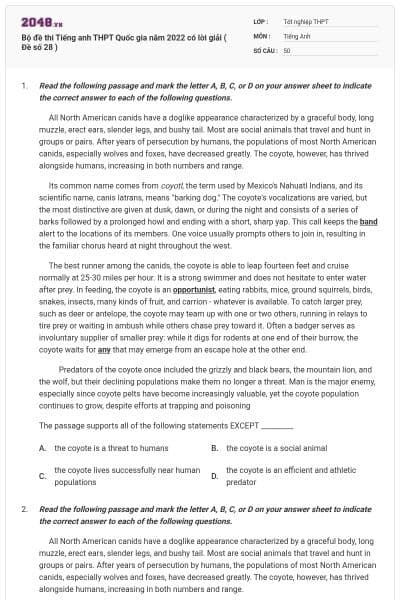
Read the following passage and mark the letter A, B, C, or D on your answer sheet to indicate the correct answer to each of the following questions.
All North American canids have a doglike appearance characterized by a graceful body, long muzzle, erect ears, slender legs, and bushy tail. Most are social animals that travel and hunt in groups or pairs. After years of persecution by humans, the populations of most North American canids, especially wolves and foxes, have decreased greatly. The coyote, however, has thrived alongside humans, increasing in both numbers and range.
Its common name comes from coyotl, the term used by Mexico's Nahuatl Indians, and its scientific name, canis latrans, means "barking dog." The coyote's vocalizations are varied, but the most distinctive are given at dusk, dawn, or during the night and consists of a series of barks followed by a prolonged howl and ending with a short, sharp yap. This call keeps the band alert to the locations of its members. One voice usually prompts others to join in, resulting in the familiar chorus heard at night throughout the west.
The best runner among the canids, the coyote is able to leap fourteen feet and cruise normally at 25-30 miles per hour. It is a strong swimmer and does not hesitate to enter water after prey. In feeding, the coyote is an opportunist, eating rabbits, mice, ground squirrels, birds, snakes, insects, many kinds of fruit, and carrion - whatever is available. To catch larger prey, such as deer or antelope, the coyote may team up with one or two others, running in relays to tire prey or waiting in ambush while others chase prey toward it. Often a badger serves as involuntary supplier of smaller prey: while it digs for rodents at one end of their burrow, the coyote waits for any that may emerge from an escape hole at the other end.
Predators of the coyote once included the grizzly and black bears, the mountain lion, and the wolf, but their declining populations make them no longer a threat. Man is the major enemy, especially since coyote pelts have become increasingly valuable, yet the coyote population continues to grow, despite efforts at trapping and poisoning
The passage supports all of the following statements EXCEPT _________
the coyote is a threat to humans
the coyote is a social animal
the coyote lives successfully near human populations
the coyote is an efficient and athletic predator
Read the following passage and mark the letter A, B, C, or D on your answer sheet to indicate the correct answer to each of the following questions.
All North American canids have a doglike appearance characterized by a graceful body, long muzzle, erect ears, slender legs, and bushy tail. Most are social animals that travel and hunt in groups or pairs. After years of persecution by humans, the populations of most North American canids, especially wolves and foxes, have decreased greatly. The coyote, however, has thrived alongside humans, increasing in both numbers and range.
Its common name comes from coyotl, the term used by Mexico's Nahuatl Indians, and its scientific name, canis latrans, means "barking dog." The coyote's vocalizations are varied, but the most distinctive are given at dusk, dawn, or during the night and consists of a series of barks followed by a prolonged howl and ending with a short, sharp yap. This call keeps the band alert to the locations of its members. One voice usually prompts others to join in, resulting in the familiar chorus heard at night throughout the west.
The best runner among the canids, the coyote is able to leap fourteen feet and cruise normally at 25-30 miles per hour. It is a strong swimmer and does not hesitate to enter water after prey. In feeding, the coyote is an opportunist, eating rabbits, mice, ground squirrels, birds, snakes, insects, many kinds of fruit, and carrion - whatever is available. To catch larger prey, such as deer or antelope, the coyote may team up with one or two others, running in relays to tire prey or waiting in ambush while others chase prey toward it. Often a badger serves as involuntary supplier of smaller prey: while it digs for rodents at one end of their burrow, the coyote waits for any that may emerge from an escape hole at the other end.
Predators of the coyote once included the grizzly and black bears, the mountain lion, and the wolf, but their declining populations make them no longer a threat. Man is the major enemy, especially since coyote pelts have become increasingly valuable, yet the coyote population continues to grow, despite efforts at trapping and poisoning
The author mentions wolves and foxes as examples of _________
prey
canids
rodent
coyote
Read the following passage and mark the letter A, B, C, or D on your answer sheet to indicate the correct answer to each of the following questions.
All North American canids have a doglike appearance characterized by a graceful body, long muzzle, erect ears, slender legs, and bushy tail. Most are social animals that travel and hunt in groups or pairs. After years of persecution by humans, the populations of most North American canids, especially wolves and foxes, have decreased greatly. The coyote, however, has thrived alongside humans, increasing in both numbers and range.
Its common name comes from coyotl, the term used by Mexico's Nahuatl Indians, and its scientific name, canis latrans, means "barking dog." The coyote's vocalizations are varied, but the most distinctive are given at dusk, dawn, or during the night and consists of a series of barks followed by a prolonged howl and ending with a short, sharp yap. This call keeps the band alert to the locations of its members. One voice usually prompts others to join in, resulting in the familiar chorus heard at night throughout the west.
The best runner among the canids, the coyote is able to leap fourteen feet and cruise normally at 25-30 miles per hour. It is a strong swimmer and does not hesitate to enter water after prey. In feeding, the coyote is an opportunist, eating rabbits, mice, ground squirrels, birds, snakes, insects, many kinds of fruit, and carrion - whatever is available. To catch larger prey, such as deer or antelope, the coyote may team up with one or two others, running in relays to tire prey or waiting in ambush while others chase prey toward it. Often a badger serves as involuntary supplier of smaller prey: while it digs for rodents at one end of their burrow, the coyote waits for any that may emerge from an escape hole at the other end.
Predators of the coyote once included the grizzly and black bears, the mountain lion, and the wolf, but their declining populations make them no longer a threat. Man is the major enemy, especially since coyote pelts have become increasingly valuable, yet the coyote population continues to grow, despite efforts at trapping and poisoning
The word "band" in paragraph 2 could best be replaced by __________.
group
leader
orchestra
choir
Read the following passage and mark the letter A, B, C, or D on your answer sheet to indicate the correct answer to each of the following questions.
All North American canids have a doglike appearance characterized by a graceful body, long muzzle, erect ears, slender legs, and bushy tail. Most are social animals that travel and hunt in groups or pairs. After years of persecution by humans, the populations of most North American canids, especially wolves and foxes, have decreased greatly. The coyote, however, has thrived alongside humans, increasing in both numbers and range.
Its common name comes from coyotl, the term used by Mexico's Nahuatl Indians, and its scientific name, canis latrans, means "barking dog." The coyote's vocalizations are varied, but the most distinctive are given at dusk, dawn, or during the night and consists of a series of barks followed by a prolonged howl and ending with a short, sharp yap. This call keeps the band alert to the locations of its members. One voice usually prompts others to join in, resulting in the familiar chorus heard at night throughout the west.
The best runner among the canids, the coyote is able to leap fourteen feet and cruise normally at 25-30 miles per hour. It is a strong swimmer and does not hesitate to enter water after prey. In feeding, the coyote is an opportunist, eating rabbits, mice, ground squirrels, birds, snakes, insects, many kinds of fruit, and carrion - whatever is available. To catch larger prey, such as deer or antelope, the coyote may team up with one or two others, running in relays to tire prey or waiting in ambush while others chase prey toward it. Often a badger serves as involuntary supplier of smaller prey: while it digs for rodents at one end of their burrow, the coyote waits for any that may emerge from an escape hole at the other end.
Predators of the coyote once included the grizzly and black bears, the mountain lion, and the wolf, but their declining populations make them no longer a threat. Man is the major enemy, especially since coyote pelts have become increasingly valuable, yet the coyote population continues to grow, despite efforts at trapping and poisoning
The word "opportunist" in paragraph 3 means the one who __________.
always has good luck
likes to team up with others
is very narrow in his interests
takes advantage of circumstances
Read the following passage and mark the letter A, B, C, or D on your answer sheet to indicate the correct answer to each of the following questions.
All North American canids have a doglike appearance characterized by a graceful body, long muzzle, erect ears, slender legs, and bushy tail. Most are social animals that travel and hunt in groups or pairs. After years of persecution by humans, the populations of most North American canids, especially wolves and foxes, have decreased greatly. The coyote, however, has thrived alongside humans, increasing in both numbers and range.
Its common name comes from coyotl, the term used by Mexico's Nahuatl Indians, and its scientific name, canis latrans, means "barking dog." The coyote's vocalizations are varied, but the most distinctive are given at dusk, dawn, or during the night and consists of a series of barks followed by a prolonged howl and ending with a short, sharp yap. This call keeps the band alert to the locations of its members. One voice usually prompts others to join in, resulting in the familiar chorus heard at night throughout the west.
The best runner among the canids, the coyote is able to leap fourteen feet and cruise normally at 25-30 miles per hour. It is a strong swimmer and does not hesitate to enter water after prey. In feeding, the coyote is an opportunist, eating rabbits, mice, ground squirrels, birds, snakes, insects, many kinds of fruit, and carrion - whatever is available. To catch larger prey, such as deer or antelope, the coyote may team up with one or two others, running in relays to tire prey or waiting in ambush while others chase prey toward it. Often a badger serves as involuntary supplier of smaller prey: while it digs for rodents at one end of their burrow, the coyote waits for any that may emerge from an escape hole at the other end.
Predators of the coyote once included the grizzly and black bears, the mountain lion, and the wolf, but their declining populations make them no longer a threat. Man is the major enemy, especially since coyote pelts have become increasingly valuable, yet the coyote population continues to grow, despite efforts at trapping and poisoning
The word "any” in paragraph 3 refers to __________.
badgers
coyotes
rodents
burrows
Read the following passage and mark the letter A, B, C, or D on your answer sheet to indicate the correct answer to each of the following questions.
All North American canids have a doglike appearance characterized by a graceful body, long muzzle, erect ears, slender legs, and bushy tail. Most are social animals that travel and hunt in groups or pairs. After years of persecution by humans, the populations of most North American canids, especially wolves and foxes, have decreased greatly. The coyote, however, has thrived alongside humans, increasing in both numbers and range.
Its common name comes from coyotl, the term used by Mexico's Nahuatl Indians, and its scientific name, canis latrans, means "barking dog." The coyote's vocalizations are varied, but the most distinctive are given at dusk, dawn, or during the night and consists of a series of barks followed by a prolonged howl and ending with a short, sharp yap. This call keeps the band alert to the locations of its members. One voice usually prompts others to join in, resulting in the familiar chorus heard at night throughout the west.
The best runner among the canids, the coyote is able to leap fourteen feet and cruise normally at 25-30 miles per hour. It is a strong swimmer and does not hesitate to enter water after prey. In feeding, the coyote is an opportunist, eating rabbits, mice, ground squirrels, birds, snakes, insects, many kinds of fruit, and carrion - whatever is available. To catch larger prey, such as deer or antelope, the coyote may team up with one or two others, running in relays to tire prey or waiting in ambush while others chase prey toward it. Often a badger serves as involuntary supplier of smaller prey: while it digs for rodents at one end of their burrow, the coyote waits for any that may emerge from an escape hole at the other end.
Predators of the coyote once included the grizzly and black bears, the mountain lion, and the wolf, but their declining populations make them no longer a threat. Man is the major enemy, especially since coyote pelts have become increasingly valuable, yet the coyote population continues to grow, despite efforts at trapping and poisoning
The author makes the point that the chief predator of the coyote is __________
the human being
the wolf
the grizzly bear
the mountain lion
Read the following passage and mark the letter A, B, C, or D on your answer sheet to indicate the correct answer to each of the following questions.
All North American canids have a doglike appearance characterized by a graceful body, long muzzle, erect ears, slender legs, and bushy tail. Most are social animals that travel and hunt in groups or pairs. After years of persecution by humans, the populations of most North American canids, especially wolves and foxes, have decreased greatly. The coyote, however, has thrived alongside humans, increasing in both numbers and range.
Its common name comes from coyotl, the term used by Mexico's Nahuatl Indians, and its scientific name, canis latrans, means "barking dog." The coyote's vocalizations are varied, but the most distinctive are given at dusk, dawn, or during the night and consists of a series of barks followed by a prolonged howl and ending with a short, sharp yap. This call keeps the band alert to the locations of its members. One voice usually prompts others to join in, resulting in the familiar chorus heard at night throughout the west.
The best runner among the canids, the coyote is able to leap fourteen feet and cruise normally at 25-30 miles per hour. It is a strong swimmer and does not hesitate to enter water after prey. In feeding, the coyote is an opportunist, eating rabbits, mice, ground squirrels, birds, snakes, insects, many kinds of fruit, and carrion - whatever is available. To catch larger prey, such as deer or antelope, the coyote may team up with one or two others, running in relays to tire prey or waiting in ambush while others chase prey toward it. Often a badger serves as involuntary supplier of smaller prey: while it digs for rodents at one end of their burrow, the coyote waits for any that may emerge from an escape hole at the other end.
Predators of the coyote once included the grizzly and black bears, the mountain lion, and the wolf, but their declining populations make them no longer a threat. Man is the major enemy, especially since coyote pelts have become increasingly valuable, yet the coyote population continues to grow, despite efforts at trapping and poisoning
It can be inferred from the passage that _________.
efforts to trap and poison the coyote will increase
the coyote is an intelligent and adaptable creature
people will continue to fear the coyote
the coyote is an endangered species
Mark the letter A, B, C, or D on your answer sheet to indicate the option that best completes each of the following exchanges
- Jenny: "Are you going to see the movie "Kieu" today?"
- Jack: “____________”
Yes, I'm going to stay in
Yes, I enjoyed it very much
I think so
Maybe I'll be out
Mark the letter A, B, C, or D on your answer sheet to indicate the option that best completes each of the following exchanges
- Jim: "Would you like to do something interesting tomorrow?"
- Jane: “___________”
Yes, I do
No, I hate it
Yes, it's very expensive
Sure, I'd love to
Mark the letter A, B, C, or D on your answer sheet to indicate the correct answer to each of the following questions
Certain groups of people are not given work ________ their race or religion.
in spite of
because of
although
because
Mark the letter A, B, C, or D on your answer sheet to indicate the correct answer to each of the following questions
While many people choose to watch films at ________ home, I prefer going to _______ cinema
the/the
x/the
the/x
x/a
Mark the letter A, B, C, or D on your answer sheet to indicate the correct answer to each of the following questions
Jack was ___________ envy when his colleagues drove up in a brand-new BMV
black with
pale with
green with
red with
Mark the letter A, B, C, or D on your answer sheet to indicate the correct answer to each of the following questions
The officer __________ Linda on the highway gave her a ticket for speeding.
whom stopped
which stopped
who stopped
stopped
Mark the letter A, B, C, or D on answer sheet to indicate the correct answer to each of the following questions
At the centre of the Earth's solar system ________.
is where the Sun lies
lies the Sun
the Sun lies
does the Sun lie
Mark the letter A, B, C, or D on your answer sheet to indicate the correct answer to each of the following questions
Contagious diseases like Covid-19 _________ big problem facing human beings
is a
is
are
are a
Mark the letter A, B, C, or D on your answer sheet to indicate the correct answer to each of the following questions
__________ tired, you should go to bed early
So as not to feel
In order for not feeling
In order to feel
So as to not feel
Mark the letter A, B, C, or D on your answer sheet to indicate the correct answer to each of the following questions
If Joan had done as I told her, I think she ___________
would have succeeded
had succeeded
would succeed
could succeed
Mark the letter A, B, C, or D on your answer sheet to indicate the correct answer to each of the following questions
Even though she was _________ the other girls, Jenny didn't win the beauty contest
more prettier than
the prettiest than
the prettiest among
much prettier than
Mark the letter A, B, C, or D on your answer sheet to indicate the correct answer to each of the following questions
Like many countryside people, I __________ a glass of green tea every morning
am used to drink
used to drinking
am used to drinking
use to drink
Mark the letter A, B, C, or D on your answer sheet to indicate the correct answer to each of the following questions
: I can't _________ what James is doing because it is so dark down there.
turn up
look into
see through
make out
Mark the letter A, B, C, or D on your answer sheet to indicate the correct answer to each of the following questions
Melisa works hard _________ her brother is very lazy
when
even if
whereas
unless
Mark the letter A, B, C, or D on your answer sheet to indicate the correct answer to each of the following questions
Charles is very keen __________ collecting stamps in his leisure time.
of
on
about
of
Mark the letter A, B, C, or D on your answer sheet to indicate the correct answer to each of the following questions
What _______ at 8 o'clock last night? I phoned you but couldn't get through to you
had you done
would you do
were you doing
did you do
Mark the letter A, B, C, or D on your answer sheet to indicate the correct answer to each of the following questions
They were fortunate ___________ from the fire before the building collapsed
rescuing
to have rescued
to have been rescued
to rescue
Mark the letter A, B, C, or D on your answer sheet to indicate the sentence that is closest in meaning to each of the following questions
It is essential that you attend the class regularly
You must have attended the class regula
You must attend the class regularly
You will ought to attend the class regularly
You might attend the class regularly
Mark the letter A, B, C, or D on your answer sheet to indicate the sentence that is closest in meaning to each of the following questions
Many people believe that doing sports is a good way to lose weight.
Doing sports is believed to be a good way to lose weight
It is believed that doing sports be a good way to lose weight
A good way to lose weight is to be doing sports
Doing sports is believed that it is a good way to lose weight
Mark the letter A, B, C, or D on your answer sheet to indicate the sentence that is closest in meaning to each of the following questions
"Get away now or I will call the police", shouted the girl to the man.
The girl said that she would call the police if the man didn't get away
The girl promised to call the police if he didn't get away
The girl informed the man that she would call the police if he didn't get away
The girl threatened to call the police if the man didn't get away
Read the following passage and mark the letter A, B, C or D on your answer sheet to indicate the correct word or phrase that best fits each of the following numbered blanks.
Development economics is the branch of economics that focuses on the special (28) ________ problems faced (29) _________ poor and underdeveloped countries. (30) ________ classical economics, development economics studies the social and political factors that affect economic growth. It addresses the problem of the Third World debt and the role of the World Bank and International Monetary Fund in continuing that debt with strict repayment rules. Scholars in the field have proposed that the best long-term solution (31) __________ to excuse much of the debt. Debtor nations also must be helped to establish stable governments and self-sustaining economies. The goal is to help them become trading partners with creditor nations. An important means to that end is to (32) _________ the growth of a strong middle class. Some ways to do that include guaranteeing education for all, allowing free trade, and providing medical care. Governments must allow for elected representatives and independent court systems
economize
economy
economic
economical
Read the following passage and mark the letter A, B, C or D on your answer sheet to indicate the correct word or phrase that best fits each of the following numbered blanks. Development economics is the branch of economics that focuses on the special (28) ________ problems faced (29) _________ poor and underdeveloped countries. (30) ________ classical economics, development economics studies the social and political factors that affect economic growth. It addresses the problem of the Third World debt and the role of the World Bank and International Monetary Fund in continuing that debt with strict repayment rules. Scholars in the field have proposed that the best long-term solution (31) __________ to excuse much of the debt. Debtor nations also must be helped to establish stable governments and self-sustaining economies. The goal is to help them become trading partners with creditor nations. An important means to that end is to (32) _________ the growth of a strong middle class. Some ways to do that include guaranteeing education for all, allowing free trade, and providing medical care. Governments must allow for elected representatives and independent court systems
of
by
down
for
Read the following passage and mark the letter A, B, C or D on your answer sheet to indicate the correct word or phrase that best fits each of the following numbered blanks.
Development economics is the branch of economics that focuses on the special (28) ________ problems faced (29) _________ poor and underdeveloped countries. (30) ________ classical economics, development economics studies the social and political factors that affect economic growth. It addresses the problem of the Third World debt and the role of the World Bank and International Monetary Fund in continuing that debt with strict repayment rules. Scholars in the field have proposed that the best long-term solution (31) __________ to excuse much of the debt. Debtor nations also must be helped to establish stable governments and self-sustaining economies. The goal is to help them become trading partners with creditor nations. An important means to that end is to (32) _________ the growth of a strong middle class. Some ways to do that include guaranteeing education for all, allowing free trade, and providing medical care. Governments must allow for elected representatives and independent court systems
Unlike
Dislike
Unlikely
Dissimilar
Read the following passage and mark the letter A, B, C or D on your answer sheet to indicate the correct word or phrase that best fits each of the following numbered blanks. Development economics is the branch of economics that focuses on the special (28) ________ problems faced (29) _________ poor and underdeveloped countries. (30) ________ classical economics, development economics studies the social and political factors that affect economic growth. It addresses the problem of the Third World debt and the role of the World Bank and International Monetary Fund in continuing that debt with strict repayment rules. Scholars in the field have proposed that the best long-term solution (31) __________ to excuse much of the debt. Debtor nations also must be helped to establish stable governments and self-sustaining economies. The goal is to help them become trading partners with creditor nations. An important means to that end is to (32) _________ the growth of a strong middle class. Some ways to do that include guaranteeing education for all, allowing free trade, and providing medical care. Governments must allow for elected representatives and independent court systems
is
are
was
were
Read the following passage and mark the letter A, B, C or D on your answer sheet to indicate the correct word or phrase that best fits each of the following numbered blanks. Development economics is the branch of economics that focuses on the special (28) ________ problems faced (29) _________ poor and underdeveloped countries. (30) ________ classical economics, development economics studies the social and political factors that affect economic growth. It addresses the problem of the Third World debt and the role of the World Bank and International Monetary Fund in continuing that debt with strict repayment rules. Scholars in the field have proposed that the best long-term solution (31) __________ to excuse much of the debt. Debtor nations also must be helped to establish stable governments and self-sustaining economies. The goal is to help them become trading partners with creditor nations. An important means to that end is to (32) _________ the growth of a strong middle class. Some ways to do that include guaranteeing education for all, allowing free trade, and providing medical care. Governments must allow for elected representatives and independent court systems
encourage
discourage
weaken
popularize
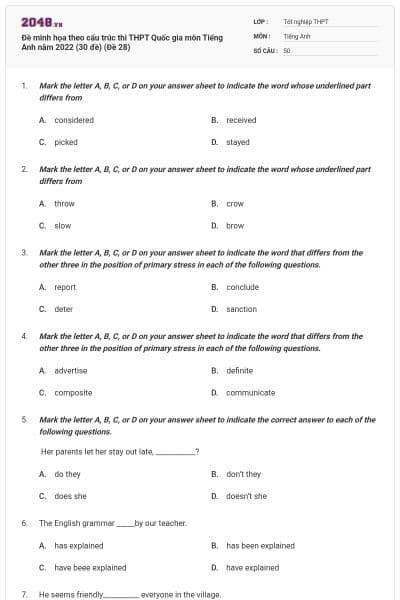
Mark the letter A, B, C, or D on your answer sheet to indicate the word whose underlined part is pronounced differently from that of the rest in each of the following questions
likes
boys
wants
heaps
Mark the letter A, B, C, or D on your answer sheet to indicate the word whose underlined part is pronounced differently from that of the rest in each of the following questions
technician
commercial
machine
necessary
Mark the letter A, B, C, or D on your answer sheet to indicate the sentence that best combines each pair of sentences in the following questions
I thought they might be thirsty. I offered them something to drink
They might be thirsty as I thought, but offered them something to drink
Although they were thirsty, I offered them something to drink
They might be thirsty, so I thought I would offer them something to drink
Thinking they might be thirsty, I offered them something to drink
Mark the letter A, B, C, or D on your answer sheet to indicate the sentence that best combines each pair of sentences in the following questions
Jim's mother was very busy. She still played with him
Jim's mother was busy enough to play with him
Jim's mother was so busy that she could not play with him
Busy as Jim's mother was, she still played with him
Because of playing with Jim, her mother was very busy
Mark the letter A, B, C, or D on you answer sheet to indicate the word that differs from the rest in the position of the main stress in each of the following questions
impressive
advocate
bacteria
computer
Mark the letter A, B, C, or D on you answer sheet to indicate the word that differs from the rest in the position of the main stress in each of the following questions
Vietnamese
preferential
calculation
accompany
Read the following passage and mark the letter A, B, C, or D on your answer sheet to indicate the correct answer to each of the following questions.
At the turn of the twentieth century, people's attitudes toward money were far more conservative than they are today. Borrowing and being in debt were viewed as a moral failing, almost as a disgrace. Thrift and saving were highly prized, and people who needed to borrow to make ends meet were seen as careless, unreliable, or extravagant. The focus in the economy as a whole was on developing large corporations like railroads, oil companies, and other companies that produced basic goods and services.
Then, in the 1920s, the economy changed. A huge network of banks and financial institutions developed, helping money to move more quickly and easily through the economy. At the same time, the economy was increasing its focus on consumer goods-clothing, cars, household appliances, and other things that individuals buy. To help promote the sale of these items, consumers were encouraged to buy on credit. If they could not afford an item right away, a store or a bank might lend them the money, which they could pay back in installments.
With the development of consumer credit and installment purchases, people's attitudes toward debt and spending changed. The model citizen was no longer someone who was thrifty, buying only what he or she needed. People were respected less for being thrifty than for knowing how to use their money to buy as many things as possible - an attitude that persists at the turn of the twenty-first century
What is the main point the author makes in the passage?
Being thrifty is a value that persists at the turn of the twentieth century
In the 1920s, the economy focused more on consumer goods than on corporations
Changes in the economy and consumer credit have altered attitudes toward money
People are generally less conservative than they were in the past
Read the following passage and mark the letter A, B, C, or D on your answer sheet to indicate the correct answer to each of the following questions.
At the turn of the twentieth century, people's attitudes toward money were far more conservative than they are today. Borrowing and being in debt were viewed as a moral failing, almost as a disgrace. Thrift and saving were highly prized, and people who needed to borrow to make ends meet were seen as careless, unreliable, or extravagant. The focus in the economy as a whole was on developing large corporations like railroads, oil companies, and other companies that produced basic goods and services.
Then, in the 1920s, the economy changed. A huge network of banks and financial institutions developed, helping money to move more quickly and easily through the economy. At the same time, the economy was increasing its focus on consumer goods-clothing, cars, household appliances, and other things that individuals buy. To help promote the sale of these items, consumers were encouraged to buy on credit. If they could not afford an item right away, a store or a bank might lend them the money, which they could pay back in installments.
With the development of consumer credit and installment purchases, people's attitudes toward debt and spending changed. The model citizen was no longer someone who was thrifty, buying only what he or she needed. People were respected less for being thrifty than for knowing how to use their money to buy as many things as possible - an attitude that persists at the turn of the twenty-first century
According to the passage, which of the following is NOT a belief that was commonly held in the early twentieth century?
People who buy as many things as possible are respectable
Owing someone's money is a moral failing
People who save their money are respectable
People who borrow money for necessities are careless and unreliable
Read the following passage and mark the letter A, B, C, or D on your answer sheet to indicate the correct answer to each of the following questions.
At the turn of the twentieth century, people's attitudes toward money were far more conservative than they are today. Borrowing and being in debt were viewed as a moral failing, almost as a disgrace. Thrift and saving were highly prized, and people who needed to borrow to make ends meet were seen as careless, unreliable, or extravagant. The focus in the economy as a whole was on developing large corporations like railroads, oil companies, and other companies that produced basic goods and services.
Then, in the 1920s, the economy changed. A huge network of banks and financial institutions developed, helping money to move more quickly and easily through the economy. At the same time, the economy was increasing its focus on consumer goods-clothing, cars, household appliances, and other things that individuals buy. To help promote the sale of these items, consumers were encouraged to buy on credit. If they could not afford an item right away, a store or a bank might lend them the money, which they could pay back in installments.
With the development of consumer credit and installment purchases, people's attitudes toward debt and spending changed. The model citizen was no longer someone who was thrifty, buying only what he or she needed. People were respected less for being thrifty than for knowing how to use their money to buy as many things as possible - an attitude that persists at the turn of the twenty-first century
What helped money move more quickly through the economy in the 1920s?
The rate of loan repayment
The growth of railroads
The increase in installment purchases
The growth of banks and financial institutions
Read the following passage and mark the letter A, B, C, or D on your answer sheet to indicate the correct answer to each of the following questions.
At the turn of the twentieth century, people's attitudes toward money were far more conservative than they are today. Borrowing and being in debt were viewed as a moral failing, almost as a disgrace. Thrift and saving were highly prized, and people who needed to borrow to make ends meet were seen as careless, unreliable, or extravagant. The focus in the economy as a whole was on developing large corporations like railroads, oil companies, and other companies that produced basic goods and services.
Then, in the 1920s, the economy changed. A huge network of banks and financial institutions developed, helping money to move more quickly and easily through the economy. At the same time, the economy was increasing its focus on consumer goods-clothing, cars, household appliances, and other things that individuals buy. To help promote the sale of these items, consumers were encouraged to buy on credit. If they could not afford an item right away, a store or a bank might lend them the money, which they could pay back in installments.
With the development of consumer credit and installment purchases, people's attitudes toward debt and spending changed. The model citizen was no longer someone who was thrifty, buying only what he or she needed. People were respected less for being thrifty than for knowing how to use their money to buy as many things as possible - an attitude that persists at the turn of the twenty-first century
The author mentions cars as an example of __________.
an extravagant purchase
a consumer goods
a household appliance
a new invention
Read the following passage and mark the letter A, B, C, or D on your answer sheet to indicate the correct answer to each of the following questions.
At the turn of the twentieth century, people's attitudes toward money were far more conservative than they are today. Borrowing and being in debt were viewed as a moral failing, almost as a disgrace. Thrift and saving were highly prized, and people who needed to borrow to make ends meet were seen as careless, unreliable, or extravagant. The focus in the economy as a whole was on developing large corporations like railroads, oil companies, and other companies that produced basic goods and services.
Then, in the 1920s, the economy changed. A huge network of banks and financial institutions developed, helping money to move more quickly and easily through the economy. At the same time, the economy was increasing its focus on consumer goods-clothing, cars, household appliances, and other things that individuals buy. To help promote the sale of these items, consumers were encouraged to buy on credit. If they could not afford an item right away, a store or a bank might lend them the money, which they could pay back in installments.
With the development of consumer credit and installment purchases, people's attitudes toward debt and spending changed. The model citizen was no longer someone who was thrifty, buying only what he or she needed. People were respected less for being thrifty than for knowing how to use their money to buy as many things as possible - an attitude that persists at the turn of the twenty-first century
According to the passage, how did the rise of consumer credit change people's attitudes toward debt and spending?
Attitudes toward debt and spending became more conservative
Extravagant borrowing and spending became highly prized
Spending wisely became more respectable than being thrifty
People used credit to buy only what they needed
Mark the letter A, B, C, or D on your answer sheet to indicate the word(s) OPPOSITE in meaning to the underlined word(s) in each of the following questions
The couple got divorced because they found they were incompatible
able to share an apartment or a house
able to budget their money
capable of having children
capable of living harmoniously
Mark the letter A, B, C, or D on your answer sheet to indicate the word(s) OPPOSITE in meaning to the underlined word(s) in each of the following questions
While looking for the dictionary, the boy came across some of the childhood photos
took by mistake
discovered by accident
looked for a reason
found on purpose
Mark the letter A, B, C, or D on your answer sheet to indicate the underlined part that needs correction in each of the following questions
Neither the boss nor all the members of the staff is working overtime today
Neither
nor all
is
overtime
Mark the letter A, B, C, or D on your answer sheet to indicate the part that needs correction in each of the following questions
Nadine fancies watching TV, reading books and hang out with her classmates after school
fancies
reading
hang out
her
Mark the letter A, B, C, or D on your answer sheet to indicate the underlined part that needs correction in each of the following questions
Ambitious parents often feel disappointing if their children do not meet their expectations
Ambitious
disappointing
do not
their expectations
Mark the letter A, B, C, or D on your answer sheet to indicate the word(s) CLOSEST in meaning to the underlined word(s) in each of the following questions
Everyone hopes that the Covid-19 vaccine will be mass-produced soon.
produced in great numbers
produced with high cost
produced in small numbers
produced with low cost
Mark the letter A, B, C, or D on your answer sheet to indicate the word(s) CLOSEST in meaning to the underlined word(s) in each of the following questions
Jack gave a detailed chronology of the events of the World War I in his essay.
discrepancy
time sequence
disaster
catastrophe