Bộ đề thi Tiếng anh THPT Quốc gia năm 2022 có lời giải ( Đề số 27 )

50 câu hỏi
Read the following passage and mark the letter A, B, C, or D on your answer sheet to indicate the correct word or phrase that best fits each of the numbered blanks.
Part of what makes summers so hot is also what causes thunderstorms. As heat from the sun beats down on Earth, the heat evaporates some of the water in lakes and oceans. The evaporated water stays in the air. This evaporated water makes the air feel heavy and humid. Humid air is what makes you feel hot and sticky (1) _______ the summer.
Warm humid air usually does not stay in one place. The wind can move it higher in the sky (2) _______ it will cool off. When warm humid air cools, it forms clouds. As more water is moved from lakes and oceans to the airs, the clouds get bigger and bigger.
Since summer, the air near the ground is hotter than it is during other seasons of the year. When this hot air mixes with cool air from (3) _______ area, there will be changes in the weather. Greater differences between the (4) _______ of the hot and cold air will cause greater changes in the weather. Imagine putting an ice (5) _______ in a warm drink. As soon as the ice hits the warm drink, it will crack and pop. But if you put the ice cube in a cool drink, it will not crack or pop as much. When warmer and cooler clouds get close to one another, there may be some popping and cracking as the weather changes. There may be more clouds or storms. A thunderstorm may be on its way
for
while
on
during
Read the following passage and mark the letter A, B, C, or D on your answer sheet to indicate the correct word or phrase that best fits each of the numbered blanks. Part of what makes summers so hot is also what causes thunderstorms. As heat from the sun beats down on Earth, the heat evaporates some of the water in lakes and oceans. The evaporated water stays in the air. This evaporated water makes the air feel heavy and humid. Humid air is what makes you feel hot and sticky (1) _______ the summer. Warm humid air usually does not stay in one place. The wind can move it higher in the sky (2) _______ it will cool off. When warm humid air cools, it forms clouds. As more water is moved from lakes and oceans to the airs, the clouds get bigger and bigger. Since summer, the air near the ground is hotter than it is during other seasons of the year. When this hot air mixes with cool air from (3) _______ area, there will be changes in the weather. Greater differences between the (4) _______ of the hot and cold air will cause greater changes in the weather. Imagine putting an ice (5) _______ in a warm drink. As soon as the ice hits the warm drink, it will crack and pop. But if you put the ice cube in a cool drink, it will not crack or pop as much. When warmer and cooler clouds get close to one another, there may be some popping and cracking as the weather changes. There may be more clouds or storms. A thunderstorm may be on its way
where
who
which
that
Read the following passage and mark the letter A, B, C, or D on your answer sheet to indicate the correct word or phrase that best fits each of the numbered blanks. Part of what makes summers so hot is also what causes thunderstorms. As heat from the sun beats down on Earth, the heat evaporates some of the water in lakes and oceans. The evaporated water stays in the air. This evaporated water makes the air feel heavy and humid. Humid air is what makes you feel hot and sticky (1) _______ the summer. Warm humid air usually does not stay in one place. The wind can move it higher in the sky (2) _______ it will cool off. When warm humid air cools, it forms clouds. As more water is moved from lakes and oceans to the airs, the clouds get bigger and bigger. Since summer, the air near the ground is hotter than it is during other seasons of the year. When this hot air mixes with cool air from (3) _______ area, there will be changes in the weather. Greater differences between the (4) _______ of the hot and cold air will cause greater changes in the weather. Imagine putting an ice (5) _______ in a warm drink. As soon as the ice hits the warm drink, it will crack and pop. But if you put the ice cube in a cool drink, it will not crack or pop as much. When warmer and cooler clouds get close to one another, there may be some popping and cracking as the weather changes. There may be more clouds or storms. A thunderstorm may be on its way
another
much
others
other
Read the following passage and mark the letter A, B, C, or D on your answer sheet to indicate the correct word or phrase that best fits each of the numbered blanks.
Part of what makes summers so hot is also what causes thunderstorms. As heat from the sun beats down on Earth, the heat evaporates some of the water in lakes and oceans. The evaporated water stays in the air. This evaporated water makes the air feel heavy and humid. Humid air is what makes you feel hot and sticky (1) _______ the summer.
Warm humid air usually does not stay in one place. The wind can move it higher in the sky (2) _______ it will cool off. When warm humid air cools, it forms clouds. As more water is moved from lakes and oceans to the airs, the clouds get bigger and bigger.
Since summer, the air near the ground is hotter than it is during other seasons of the year. When this hot air mixes with cool air from (3) _______ area, there will be changes in the weather. Greater differences between the (4) _______ of the hot and cold air will cause greater changes in the weather. Imagine putting an ice (5) _______ in a warm drink. As soon as the ice hits the warm drink, it will crack and pop. But if you put the ice cube in a cool drink, it will not crack or pop as much. When warmer and cooler clouds get close to one another, there may be some popping and cracking as the weather changes. There may be more clouds or storms. A thunderstorm may be on its way
climates
temperatures
latitudes
atmospheres
Read the following passage and mark the letter A, B, C, or D on your answer sheet to indicate the correct word or phrase that best fits each of the numbered blanks. Part of what makes summers so hot is also what causes thunderstorms. As heat from the sun beats down on Earth, the heat evaporates some of the water in lakes and oceans. The evaporated water stays in the air. This evaporated water makes the air feel heavy and humid. Humid air is what makes you feel hot and sticky (1) _______ the summer. Warm humid air usually does not stay in one place. The wind can move it higher in the sky (2) _______ it will cool off. When warm humid air cools, it forms clouds. As more water is moved from lakes and oceans to the airs, the clouds get bigger and bigger. Since summer, the air near the ground is hotter than it is during other seasons of the year. When this hot air mixes with cool air from (3) _______ area, there will be changes in the weather. Greater differences between the (4) _______ of the hot and cold air will cause greater changes in the weather. Imagine putting an ice (5) _______ in a warm drink. As soon as the ice hits the warm drink, it will crack and pop. But if you put the ice cube in a cool drink, it will not crack or pop as much. When warmer and cooler clouds get close to one another, there may be some popping and cracking as the weather changes. There may be more clouds or storms. A thunderstorm may be on its way
cubic
cubicle
cubical
cube
Mark the letter A, B, C, or D on your answer sheet to indicate the correct answer to each of the following questions
Those two pictures hanging on the gallery wall_________ in France, and they are very well known.
were painted
were paint
were painting
painted
Mark the letter A, B, C, or D on your answer sheet to indicate the correct answer to each of the following questions
_______, she often wears in red and black
After I have met my beloved teacher
Until I will meet my beloved teacher
By the time I meet my beloved teacher
Whenever I meet my beloved teacher
Mark the letter A, B, C, or D on your answer sheet to indicate the correct answer to each of the following questions
_______ you study for these exams, _______ you will do
The hardest / the best
The more / the much
The harder / the better
The more hard / the more good
Mark the letter A, B, C, or D on your answer sheet to indicate the correct answer to each of the following questions
He was pleased that things in his university were going on __________.
satisfying
satisfactorily
satisfactory
satisfied
Mark the letter A, B, C, or D on your answer sheet to indicate the correct answer to each of the following questions
I’m taking an intensive 2 day _______ course in computing. I want to learn the basics quickly before I start my new job
splash
smash
flash
crash
Mark the letter A, B, C, or D on your answer sheet to indicate the correct answer to each of the following questions
James could no longer bear the _______ surroundings of the decrepit old house
domineering
oppressive
overbearing
pressing
Mark the letter A, B, C, or D on your answer sheet to indicate the correct answer to each of the following questions
My mother bought a ___________belt from a shop on Ba Dinh street.
nice brown le
brown nice leather
nice leather brown
leather brown nice
Mark the letter A, B, C, or D on your answer sheet to indicate the correct answer to each of the following questions
I agreed that the shop treated you very badly. But just write a polite letter of complaint. It’s not worth making a _______ about it
song and dance
tooth and nail
pins and needles
length and breadth
Mark the letter A, B, C, or D on your answer sheet to indicate the correct answer to each of the following questions
Those cars are very expensive, _______?
are they
are cars
aren't they
aren't cars
Mark the letter A, B, C, or D on your answer sheet to indicate the correct answer to each of the following questions
She applied for training as a pilot, but they turned her down _______ her poor eyesight
because of
in spite of
although
because
Mark the letter A, B, C, or D on your answer sheet to indicate the correct answer to each of the following questions
Many young people travel all over the world, and then do all kinds of jobs before they _______.
settle down
put down
go down
touch down
Mark the letter A, B, C, or D on your answer sheet to indicate the correct answer to each of the following questions
He came when I ________ the film “Man from the star”
was watching
watched
am watching
has watched
Mark the letter A, B, C, or D on your answer sheet to indicate the correct answer to each of the following questions
Would you kindly inform me who is responsible __________the travel arrangements?
to
in
for
on
Mark the letter A, B, C, or D on your answer sheet to indicate the correct answer to each of the following questions
If the work-force respected you, you wouldn't need to ______ your authority so often
assert
inflict
affirm
maintain
Mark the letter A, B, C, or D on your answer sheet to indicate the correct answer to each of the following questions
___________ the book, I wrote down some notes
Being read
Read
To read
Having read
Mark the letter A, B, C, or D on your answer sheet to indicate the word(s) OPPOSITE in meaning to the underlined word(s) in each of the following questions
Both universities speak highly of the programme of student exchange and hope to cooperate more in the future
resolve a conflict over
voice opinions on
find favor with
express disapproval of
Mark the letter A, B, C, or D on your answer sheet to indicate the word(s) OPPOSITE in meaning to the underlined word(s) in each of the following questions
Never punish your children by hitting them. This might teach them to become hitters
accept
give
reward
bring
Mark the letter A, B, C, or D on your answer sheet to indicate the word(s) CLOSEST in meaning to the underlined word(s) in each of the following questions
A living cell is a marvel of detailed and complex structure
wonder
magnification
invention
swiftness
Mark the letter A, B, C, or D on your answer sheet to indicate the word(s) CLOSEST in meaning to the underlined word(s) in each of the following questions
When two people get married, it is with the assumption that their feelings for each other are immutable and will never alter
constantly
alterable
everlasting
unchangeable
Mark the letter A, B, C, or D on your answer sheet to indicate the sentence that is closest in meaning to each of the following questions
I don’t think Max broke your vase because he wasn’t here then
Max was likely to break your vase because he wasn’t here then
Max wouldn’t have broken your vase because he wasn’t here then
Max wasn’t able to break your vase because he wasn’t here then
Max can’t have broken your vase because he wasn’t here then
Mark the letter A, B, C, or D on your answer sheet to indicate the sentence that is closest in meaning to each of the following questions
Eating Korean food is new to me
I did not use to eating Korean food
I used to eat Korean food
I have never eaten Korean food before
I no longer eat Korean food.
Mark the letter A, B, C, or D on your answer sheet to indicate the sentence that is closest in meaning to each of the following questions
“Would you like some more beer?” he asked
He asked me would I like some more beer
He offered me some more beer.
He asked me if I liked some more beer
He wanted to invite me for a glass of beer.
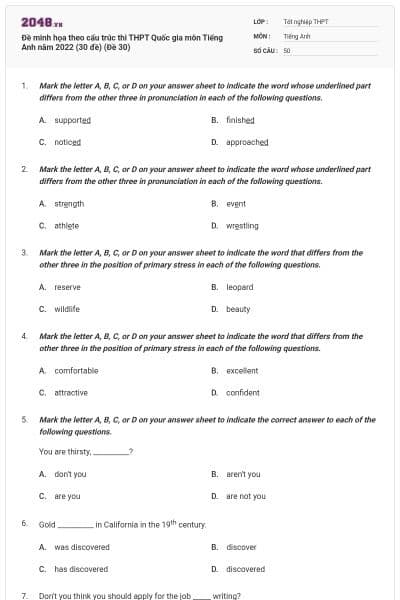
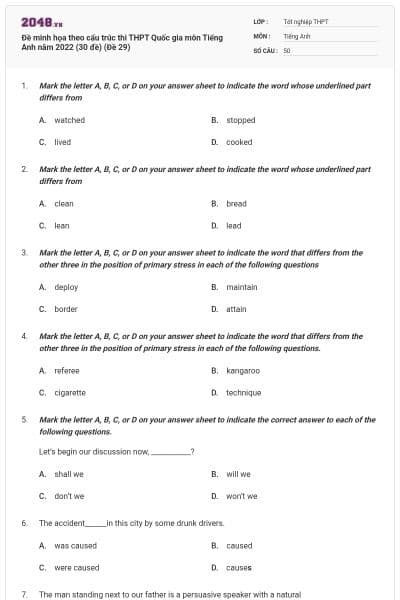
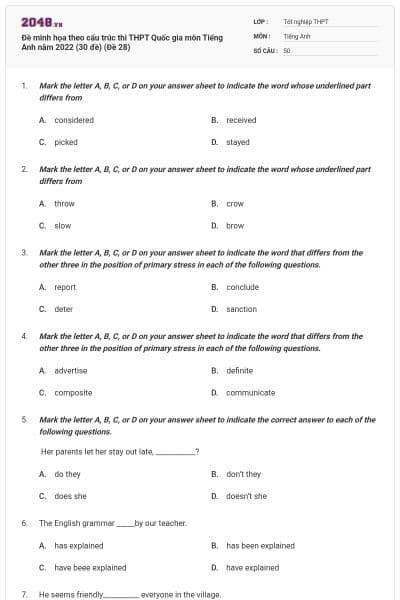
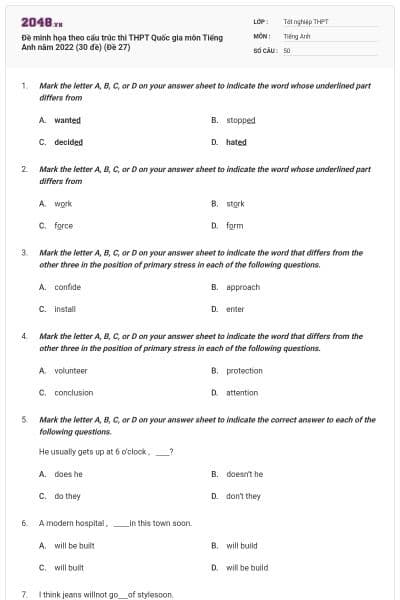
Mark the letter A, B, C, or D on your answer sheet to indicate the word whose underlined part differs from the other three in pronunciation in each of the following questions
final
survival
liberty
reliable
Mark the letter A, B, C, or D on your answer sheet to indicate the word whose underlined part differs from the other three in pronunciation in each of the following questions
received
concealed
attached
concerned
Mark the letter A, B, C, or D on your answer sheet to indicate the underlined part that needs correction in each of the following questions
After John eats dinner, he wrote several letters and went to bed
eats
letters
went
he wrote
Mark the letter A, B, C, or D on your answer sheet to indicate the underlined part that needs correction in each of the following questions
Their children learn primarily by directly experiencing the world around it.
primarily
it
experiencing
world
Mark the letter A, B, C, or D on your answer sheet to indicate the underlined part that needs correction in each of the following questions
If you have some sufficient knowledge of English, you can make yourself understand almost everywhere
almost
of
some
understand
Read the following passage and mark the letter A, B, C, or D on your answer sheet to indicate the correct answer to each of the questions.
It is estimated that by 2050 more than two-thirds of the world's population will live in cities, up from about 54 percent today. While the many benefits of organized and efficient cities are well understood, we need to recognize that this rapid, often unplanned urbanization brings risks of profound social instability, risks to critical infrastructure, potential water crises and the potential for devastating spread of disease. These risks can only be further exacerbated as this unprecedented transition from rural to urban areas continues.
How effectively these risks can be addressed will increasingly be determined by how well cities are governed. The increased concentration of people, physical assets, infrastructure and economic activities mean that the risks materializing at the city level will have far greater potential to disrupt society than ever before.
Urbanization is by no means bad by itself. It brings important benefits for economic, cultural and societal development. Well managed cities are both efficient and effective, enabling economies of scale and network effects while reducing the impact on the climate of transportation. As such, an urban model can make economic activity more environmentally-friendly. Further, the proximity and diversity of people can spark innovation and create employment as exchanging ideas breeds new ideas. But these utopian concepts are threatened by some of the factors driving rapid urbanization. For example, one of the main factors is rural urban migration, driven by the prospect of greater employment opportunities and the hope of a better life in cities. But rapidly increasing population density can create severe problems, especially if planning efforts are not sufficient to cope with the influx of new inhabitants. The result may, in extreme cases, be widespread poverty. Estimates suggest that 40% of the world's urban expansion is taking place in slums, exacerbating socio-economic disparities and creating unsanitary conditions that facilitate the spread of disease.
The Global Risks 2015 Report looks at four areas that face particularly daunting challenges in the face of rapid and unplanned urbanization: infrastructure, health, climate change, and social instability. In each of these areas we find new risks that can best be managed or, in some cases, transferred through the mechanism of insurance
The word “that" in paragraph 4 refers to __________
unsanitary conditions
urban expansion
socio-economic disparities
disease
Read the following passage and mark the letter A, B, C, or D on your answer sheet to indicate the correct answer to each of the questions.
It is estimated that by 2050 more than two-thirds of the world's population will live in cities, up from about 54 percent today. While the many benefits of organized and efficient cities are well understood, we need to recognize that this rapid, often unplanned urbanization brings risks of profound social instability, risks to critical infrastructure, potential water crises and the potential for devastating spread of disease. These risks can only be further exacerbated as this unprecedented transition from rural to urban areas continues.
How effectively these risks can be addressed will increasingly be determined by how well cities are governed. The increased concentration of people, physical assets, infrastructure and economic activities mean that the risks materializing at the city level will have far greater potential to disrupt society than ever before.
Urbanization is by no means bad by itself. It brings important benefits for economic, cultural and societal development. Well managed cities are both efficient and effective, enabling economies of scale and network effects while reducing the impact on the climate of transportation. As such, an urban model can make economic activity more environmentally-friendly. Further, the proximity and diversity of people can spark innovation and create employment as exchanging ideas breeds new ideas. But these utopian concepts are threatened by some of the factors driving rapid urbanization. For example, one of the main factors is rural urban migration, driven by the prospect of greater employment opportunities and the hope of a better life in cities. But rapidly increasing population density can create severe problems, especially if planning efforts are not sufficient to cope with the influx of new inhabitants. The result may, in extreme cases, be widespread poverty. Estimates suggest that 40% of the world's urban expansion is taking place in slums, exacerbating socio-economic disparities and creating unsanitary conditions that facilitate the spread of disease.
The Global Risks 2015 Report looks at four areas that face particularly daunting challenges in the face of rapid and unplanned urbanization: infrastructure, health, climate change, and social instability. In each of these areas we find new risks that can best be managed or, in some cases, transferred through the mechanism of insurance
According to paragraph 3, what is one of the advantages of urbanization?
It makes water supply system both efficient and effective
It minimizes risks for economic, cultural and societal development
People may come up with new ideas for innovation
Weather and climate in the city will be much improved
Read the following passage and mark the letter A, B, C, or D on your answer sheet to indicate the correct answer to each of the questions.
It is estimated that by 2050 more than two-thirds of the world's population will live in cities, up from about 54 percent today. While the many benefits of organized and efficient cities are well understood, we need to recognize that this rapid, often unplanned urbanization brings risks of profound social instability, risks to critical infrastructure, potential water crises and the potential for devastating spread of disease. These risks can only be further exacerbated as this unprecedented transition from rural to urban areas continues.
How effectively these risks can be addressed will increasingly be determined by how well cities are governed. The increased concentration of people, physical assets, infrastructure and economic activities mean that the risks materializing at the city level will have far greater potential to disrupt society than ever before.
Urbanization is by no means bad by itself. It brings important benefits for economic, cultural and societal development. Well managed cities are both efficient and effective, enabling economies of scale and network effects while reducing the impact on the climate of transportation. As such, an urban model can make economic activity more environmentally-friendly. Further, the proximity and diversity of people can spark innovation and create employment as exchanging ideas breeds new ideas. But these utopian concepts are threatened by some of the factors driving rapid urbanization. For example, one of the main factors is rural urban migration, driven by the prospect of greater employment opportunities and the hope of a better life in cities. But rapidly increasing population density can create severe problems, especially if planning efforts are not sufficient to cope with the influx of new inhabitants. The result may, in extreme cases, be widespread poverty. Estimates suggest that 40% of the world's urban expansion is taking place in slums, exacerbating socio-economic disparities and creating unsanitary conditions that facilitate the spread of disease.
The Global Risks 2015 Report looks at four areas that face particularly daunting challenges in the face of rapid and unplanned urbanization: infrastructure, health, climate change, and social instability. In each of these areas we find new risks that can best be managed or, in some cases, transferred through the mechanism of insurance
Which statement is TRUE, according to the passage?
Rapidly increasing population density can help solve poverty
54% of the world's population will live in cities by 2050
Risks cannot be addressed effectively no matter how well cities are governed
Urbanization brings important benefits for development as well
Read the following passage and mark the letter A, B, C, or D on your answer sheet to indicate the correct answer to each of the questions.
It is estimated that by 2050 more than two-thirds of the world's population will live in cities, up from about 54 percent today. While the many benefits of organized and efficient cities are well understood, we need to recognize that this rapid, often unplanned urbanization brings risks of profound social instability, risks to critical infrastructure, potential water crises and the potential for devastating spread of disease. These risks can only be further exacerbated as this unprecedented transition from rural to urban areas continues.
How effectively these risks can be addressed will increasingly be determined by how well cities are governed. The increased concentration of people, physical assets, infrastructure and economic activities mean that the risks materializing at the city level will have far greater potential to disrupt society than ever before.
Urbanization is by no means bad by itself. It brings important benefits for economic, cultural and societal development. Well managed cities are both efficient and effective, enabling economies of scale and network effects while reducing the impact on the climate of transportation. As such, an urban model can make economic activity more environmentally-friendly. Further, the proximity and diversity of people can spark innovation and create employment as exchanging ideas breeds new ideas. But these utopian concepts are threatened by some of the factors driving rapid urbanization. For example, one of the main factors is rural urban migration, driven by the prospect of greater employment opportunities and the hope of a better life in cities. But rapidly increasing population density can create severe problems, especially if planning efforts are not sufficient to cope with the influx of new inhabitants. The result may, in extreme cases, be widespread poverty. Estimates suggest that 40% of the world's urban expansion is taking place in slums, exacerbating socio-economic disparities and creating unsanitary conditions that facilitate the spread of disease.
The Global Risks 2015 Report looks at four areas that face particularly daunting challenges in the face of rapid and unplanned urbanization: infrastructure, health, climate change, and social instability. In each of these areas we find new risks that can best be managed or, in some cases, transferred through the mechanism of insurance
The word "addressed" in paragraph 2 is closest in meaning to _________.
aimed at
agreed on
dealt with
added to
Read the following passage and mark the letter A, B, C, or D on your answer sheet to indicate the correct answer to each of the questions.
It is estimated that by 2050 more than two-thirds of the world's population will live in cities, up from about 54 percent today. While the many benefits of organized and efficient cities are well understood, we need to recognize that this rapid, often unplanned urbanization brings risks of profound social instability, risks to critical infrastructure, potential water crises and the potential for devastating spread of disease. These risks can only be further exacerbated as this unprecedented transition from rural to urban areas continues.
How effectively these risks can be addressed will increasingly be determined by how well cities are governed. The increased concentration of people, physical assets, infrastructure and economic activities mean that the risks materializing at the city level will have far greater potential to disrupt society than ever before.
Urbanization is by no means bad by itself. It brings important benefits for economic, cultural and societal development. Well managed cities are both efficient and effective, enabling economies of scale and network effects while reducing the impact on the climate of transportation. As such, an urban model can make economic activity more environmentally-friendly. Further, the proximity and diversity of people can spark innovation and create employment as exchanging ideas breeds new ideas. But these utopian concepts are threatened by some of the factors driving rapid urbanization. For example, one of the main factors is rural urban migration, driven by the prospect of greater employment opportunities and the hope of a better life in cities. But rapidly increasing population density can create severe problems, especially if planning efforts are not sufficient to cope with the influx of new inhabitants. The result may, in extreme cases, be widespread poverty. Estimates suggest that 40% of the world's urban expansion is taking place in slums, exacerbating socio-economic disparities and creating unsanitary conditions that facilitate the spread of disease.
The Global Risks 2015 Report looks at four areas that face particularly daunting challenges in the face of rapid and unplanned urbanization: infrastructure, health, climate change, and social instability. In each of these areas we find new risks that can best be managed or, in some cases, transferred through the mechanism of insurance
What can be inferred from the passage?
Poverty may be a foregone conclusion of unplanned urbanization
The increasing number of people in cities can create more employment
Urbanization can solve the problem of environmental pollution in cities
Diseases are caused by people migrating to cities
Read the following passage and mark the letter A, B, C, or D on your answer sheet to indicate the correct answer to each of the questions.
It is estimated that by 2050 more than two-thirds of the world's population will live in cities, up from about 54 percent today. While the many benefits of organized and efficient cities are well understood, we need to recognize that this rapid, often unplanned urbanization brings risks of profound social instability, risks to critical infrastructure, potential water crises and the potential for devastating spread of disease. These risks can only be further exacerbated as this unprecedented transition from rural to urban areas continues.
How effectively these risks can be addressed will increasingly be determined by how well cities are governed. The increased concentration of people, physical assets, infrastructure and economic activities mean that the risks materializing at the city level will have far greater potential to disrupt society than ever before.
Urbanization is by no means bad by itself. It brings important benefits for economic, cultural and societal development. Well managed cities are both efficient and effective, enabling economies of scale and network effects while reducing the impact on the climate of transportation. As such, an urban model can make economic activity more environmentally-friendly. Further, the proximity and diversity of people can spark innovation and create employment as exchanging ideas breeds new ideas. But these utopian concepts are threatened by some of the factors driving rapid urbanization. For example, one of the main factors is rural urban migration, driven by the prospect of greater employment opportunities and the hope of a better life in cities. But rapidly increasing population density can create severe problems, especially if planning efforts are not sufficient to cope with the influx of new inhabitants. The result may, in extreme cases, be widespread poverty. Estimates suggest that 40% of the world's urban expansion is taking place in slums, exacerbating socio-economic disparities and creating unsanitary conditions that facilitate the spread of disease.
The Global Risks 2015 Report looks at four areas that face particularly daunting challenges in the face of rapid and unplanned urbanization: infrastructure, health, climate change, and social instability. In each of these areas we find new risks that can best be managed or, in some cases, transferred through the mechanism of insurance
Which is the most suitable title for the passage?
The Risks of Rapid Urbanization in Developing Countries
The Global Risks 2015 Report on Developing Urban Areas
Infrastructure and Economic Activities in Cities
Rapid Urbanization Put Cities in Jeopardy
Read the following passage and mark the letter A, B, C, or D on your answer sheet to indicate the correct answer to each of the questions.
It is estimated that by 2050 more than two-thirds of the world's population will live in cities, up from about 54 percent today. While the many benefits of organized and efficient cities are well understood, we need to recognize that this rapid, often unplanned urbanization brings risks of profound social instability, risks to critical infrastructure, potential water crises and the potential for devastating spread of disease. These risks can only be further exacerbated as this unprecedented transition from rural to urban areas continues.
How effectively these risks can be addressed will increasingly be determined by how well cities are governed. The increased concentration of people, physical assets, infrastructure and economic activities mean that the risks materializing at the city level will have far greater potential to disrupt society than ever before.
Urbanization is by no means bad by itself. It brings important benefits for economic, cultural and societal development. Well managed cities are both efficient and effective, enabling economies of scale and network effects while reducing the impact on the climate of transportation. As such, an urban model can make economic activity more environmentally-friendly. Further, the proximity and diversity of people can spark innovation and create employment as exchanging ideas breeds new ideas. But these utopian concepts are threatened by some of the factors driving rapid urbanization. For example, one of the main factors is rural urban migration, driven by the prospect of greater employment opportunities and the hope of a better life in cities. But rapidly increasing population density can create severe problems, especially if planning efforts are not sufficient to cope with the influx of new inhabitants. The result may, in extreme cases, be widespread poverty. Estimates suggest that 40% of the world's urban expansion is taking place in slums, exacerbating socio-economic disparities and creating unsanitary conditions that facilitate the spread of disease.
The Global Risks 2015 Report looks at four areas that face particularly daunting challenges in the face of rapid and unplanned urbanization: infrastructure, health, climate change, and social instability. In each of these areas we find new risks that can best be managed or, in some cases, transferred through the mechanism of insurance
The word “spark” in paragraph 3 is closest in meaning to ___________.
encourage
design
need
start
Mark the letter A, B, C, or D on your answer sheet to indicate the sentence that best combines each pair of sentences in the following questions
The basketball team knew they lost the match. They soon started to blame each other
As soon as they blamed each other, the basketball team knew they lost the match
No sooner had the basketball team started to blame each other than they knew they lost the match
Not only did the basketball team lose the match but they blamed each other as well
Hardly had the basketball team known they lost the match when they started to blame each other
Mark the letter A, B, C, or D on your answer sheet to indicate the sentence that best combines each pair of sentences in the following questions
I did not see Susan off at the airport. I feel bad about it now
It suddenly dawns on me that I should have seen Susan off at the airport
I could have seen Susan off at the airport
If only I had seen Susan off at the airport
That I did not see Susan off at the airport escapes me now
Read the following passage and mark the letter A, B, C, or D on your answer sheet to indicate the correct answer to each of the questions.
During times of crisis, people find themselves faced with lifestyle changes. One of the earliest and most noticeable changes seen during the Covid-19 lockdown was how we consume media-and especially how we read.
People tend to find comfort in certain books, and reading habits and genre preferences can change during periods of stress. This helps to explain why much genre fiction has roots in times of significant social, political or economic upheaval. Gothic literature is, in part, a British Protestant response to the French Revolution.
Respondents generally reported that they were reading more than usual. This was largely due to having more free time (due to being furloughed, or not having a commute or the usual social obligation or leisure activities). This increased reading volume was complicated for those with caring responsibilities. Many people with children reported that their reading time had increased generally because of their shared reading with children, but had less time than normal for personal reading. Reading frequency was further complicated by a quality vs. quantity snag. People spent more time reading and seeking escape, but an inability to concentrate meant they made less progress than usual. In short, people spent more time reading but the volume they read was less.
Unsurprisingly, lockdown also made re-reading a physical necessity for some. Some respondents noted how they were unable to visit the library or browse at the bookshop for new books. Others reported that they simply wished to save money. On the other hand, the participants who reported re- reading less than normal during the lockdown period wanted to use their newfound time to seek out new topics and genres
What does the passage mainly discuss?
Different kinds of people
Different types of books
Changing in reading habits
Different types of reading
Read the following passage and mark the letter A, B, C, or D on your answer sheet to indicate the correct answer to each of the questions.
During times of crisis, people find themselves faced with lifestyle changes. One of the earliest and most noticeable changes seen during the Covid-19 lockdown was how we consume media-and especially how we read.
People tend to find comfort in certain books, and reading habits and genre preferences can change during periods of stress. This helps to explain why much genre fiction has roots in times of significant social, political or economic upheaval. Gothic literature is, in part, a British Protestant response to the French Revolution.
Respondents generally reported that they were reading more than usual. This was largely due to having more free time (due to being furloughed, or not having a commute or the usual social obligation or leisure activities). This increased reading volume was complicated for those with caring responsibilities. Many people with children reported that their reading time had increased generally because of their shared reading with children, but had less time than normal for personal reading. Reading frequency was further complicated by a quality vs. quantity snag. People spent more time reading and seeking escape, but an inability to concentrate meant they made less progress than usual. In short, people spent more time reading but the volume they read was less.
Unsurprisingly, lockdown also made re-reading a physical necessity for some. Some respondents noted how they were unable to visit the library or browse at the bookshop for new books. Others reported that they simply wished to save money. On the other hand, the participants who reported re- reading less than normal during the lockdown period wanted to use their newfound time to seek out new topics and genres
According to paragraph 2, which of the following is NOT true?
Reading is unable to help people find comfort during stress time
Many great fiction books have been born in times of significant social upheaval
Gothic literature was born during the French Revolution
Reading habits can change during periods of stress
Read the following passage and mark the letter A, B, C, or D on your answer sheet to indicate the correct answer to each of the questions.
During times of crisis, people find themselves faced with lifestyle changes. One of the earliest and most noticeable changes seen during the Covid-19 lockdown was how we consume media-and especially how we read.
People tend to find comfort in certain books, and reading habits and genre preferences can change during periods of stress. This helps to explain why much genre fiction has roots in times of significant social, political or economic upheaval. Gothic literature is, in part, a British Protestant response to the French Revolution.
Respondents generally reported that they were reading more than usual. This was largely due to having more free time (due to being furloughed, or not having a commute or the usual social obligation or leisure activities). This increased reading volume was complicated for those with caring responsibilities. Many people with children reported that their reading time had increased generally because of their shared reading with children, but had less time than normal for personal reading. Reading frequency was further complicated by a quality vs. quantity snag. People spent more time reading and seeking escape, but an inability to concentrate meant they made less progress than usual. In short, people spent more time reading but the volume they read was less.
Unsurprisingly, lockdown also made re-reading a physical necessity for some. Some respondents noted how they were unable to visit the library or browse at the bookshop for new books. Others reported that they simply wished to save money. On the other hand, the participants who reported re- reading less than normal during the lockdown period wanted to use their newfound time to seek out new topics and genres
The word “commute” in paragraph 3 is closet in meaning to _______.
retirement
a talk to other people
unemployed person
road to go to work
Read the following passage and mark the letter A, B, C, or D on your answer sheet to indicate the correct answer to each of the questions.
During times of crisis, people find themselves faced with lifestyle changes. One of the earliest and most noticeable changes seen during the Covid-19 lockdown was how we consume media-and especially how we read.
People tend to find comfort in certain books, and reading habits and genre preferences can change during periods of stress. This helps to explain why much genre fiction has roots in times of significant social, political or economic upheaval. Gothic literature is, in part, a British Protestant response to the French Revolution.
Respondents generally reported that they were reading more than usual. This was largely due to having more free time (due to being furloughed, or not having a commute or the usual social obligation or leisure activities). This increased reading volume was complicated for those with caring responsibilities. Many people with children reported that their reading time had increased generally because of their shared reading with children, but had less time than normal for personal reading. Reading frequency was further complicated by a quality vs. quantity snag. People spent more time reading and seeking escape, but an inability to concentrate meant they made less progress than usual. In short, people spent more time reading but the volume they read was less.
Unsurprisingly, lockdown also made re-reading a physical necessity for some. Some respondents noted how they were unable to visit the library or browse at the bookshop for new books. Others reported that they simply wished to save money. On the other hand, the participants who reported re- reading less than normal during the lockdown period wanted to use their newfound time to seek out new topics and genres
The word “they” in paragraph 3 refers to ________.
reading habit and reading time
progresses in reading
reading time and ability to concentrate
people spent time reading
Read the following passage and mark the letter A, B, C, or D on your answer sheet to indicate the correct answer to each of the questions.
During times of crisis, people find themselves faced with lifestyle changes. One of the earliest and most noticeable changes seen during the Covid-19 lockdown was how we consume media-and especially how we read.
People tend to find comfort in certain books, and reading habits and genre preferences can change during periods of stress. This helps to explain why much genre fiction has roots in times of significant social, political or economic upheaval. Gothic literature is, in part, a British Protestant response to the French Revolution.
Respondents generally reported that they were reading more than usual. This was largely due to having more free time (due to being furloughed, or not having a commute or the usual social obligation or leisure activities). This increased reading volume was complicated for those with caring responsibilities. Many people with children reported that their reading time had increased generally because of their shared reading with children, but had less time than normal for personal reading. Reading frequency was further complicated by a quality vs. quantity snag. People spent more time reading and seeking escape, but an inability to concentrate meant they made less progress than usual. In short, people spent more time reading but the volume they read was less.
Unsurprisingly, lockdown also made re-reading a physical necessity for some. Some respondents noted how they were unable to visit the library or browse at the bookshop for new books. Others reported that they simply wished to save money. On the other hand, the participants who reported re- reading less than normal during the lockdown period wanted to use their newfound time to seek out new topics and genres
According to paragraph 4, which of the following is the reason why people re-read more during lockdown?
They love books so much
They want to save money
They think it is necessary
They try to seek out new topics in books.
Mark the letter A, B, C, or D on your answer sheet to indicate the option that best completes each of the following exchanges
Mai: “Don’t forget to send your parents my regards.” - Nga: “________”
Good idea, thanks
It’s my pleasure
Thanks, I will
Never mind
Mark the letter A, B, C, or D on your answer sheet to indicate the option that best completes each of the following exchanges
Mary: “Why are there generally so few women in top positions?” - Peter: “ ________
I guess men tend to make better leaders
Women also want to climb to top positions
Top positions are the highest in the career ladder
Top positions are high to climb to
Mark the letter A, B, C, or D on your answer sheet to indicate the word that differs from the other three in the position of primary stress in each of the following questions
popular
beautiful
favourite
effective
Mark the letter A, B, C, or D on your answer sheet to indicate the word that differs from the other three in the position of primary stress in each of the following questions
pressure
cancel
level
respect