Bộ đề thi Tiếng anh THPT Quốc gia năm 2022 có lời giải ( Đề số 26 )

50 câu hỏi
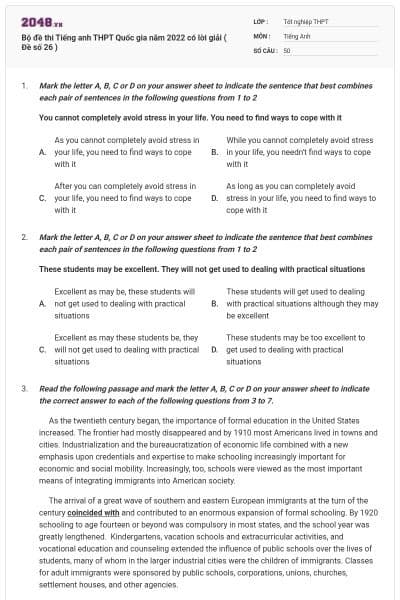
Mark the letter A, B, C or D on your answer sheet to indicate the sentence that best combines each pair of sentences in the following questions from 1 to 2
You cannot completely avoid stress in your life. You need to find ways to cope with it
As you cannot completely avoid stress in your life, you need to find ways to cope with it
While you cannot completely avoid stress in your life, you needn't find ways to cope with it
After you can completely avoid stress in your life, you need to find ways to cope with it
As long as you can completely avoid stress in your life, you need to find ways to cope with it
Mark the letter A, B, C or D on your answer sheet to indicate the sentence that best combines each pair of sentences in the following questions from 1 to 2
These students may be excellent. They will not get used to dealing with practical situations
Excellent as may be, these students will not get used to dealing with practical situations
These students will get used to dealing with practical situations although they may be excellent
Excellent as may these students be, they will not get used to dealing with practical situations
These students may be too excellent to get used to dealing with practical situations
Read the following passage and mark the letter A, B, C or D on your answer sheet to indicate the correct answer to each of the following questions from 3 to 7.
As the twentieth century began, the importance of formal education in the United States increased. The frontier had mostly disappeared and by 1910 most Americans lived in towns and cities. Industrialization and the bureaucratization of economic life combined with a new emphasis upon credentials and expertise to make schooling increasingly important for economic and social mobility. Increasingly, too, schools were viewed as the most important means of integrating immigrants into American society.
The arrival of a great wave of southern and eastern European immigrants at the turn of the century coincided with and contributed to an enormous expansion of formal schooling. By 1920 schooling to age fourteen or beyond was compulsory in most states, and the school year was greatly lengthened. Kindergartens, vacation schools and extracurricular activities, and vocational education and counseling extended the influence of public schools over the lives of students, many of whom in the larger industrial cities were the children of immigrants. Classes for adult immigrants were sponsored by public schools, corporations, unions, churches, settlement houses, and other agencies.
Reformers early in the twentieth century suggested that education programs should suit the needs of specific populations. Immigrant women were once such population. Schools tried to educate young women so they could occupy productive places in the urban industrial economy, and one place many educators considered appropriate for women was the home. Although looking after the house and family was familiar to immigrant women, American education gave homemaking a new definition. In preindustrial economies, homemaking had meant the production as well as the consumption of goods, and it commonly included income-producing activities both inside and outside the home, in the highly industrialized early-twentieth century United States, however, overproduction rather than scarcity was becoming a problem. Thus, the ideal American homemaker was viewed as a consumer rather than a producer. Schools trained women to be consumer homemakers cooking, shopping, decorating, and caring for children "efficiently" in their own homes, or if economic necessity demanded, as employees in the homes of others. Subsequent reforms have made these notions seem quite out-of-date
Women were trained to be consumer homemakers as a result of __________.
income-producing activities in the highly industrialized early-twentieth-century United States
economic necessity in the highly industrialized early-twentieth-century United States
scarcity in the highly industrialized early-twentieth-century United States
overproduction in the highly industrialized early-twentieth-century United States
Read the following passage and mark the letter A, B, C or D on your answer sheet to indicate the correct answer to each of the following questions from 3 to 7.
As the twentieth century began, the importance of formal education in the United States increased. The frontier had mostly disappeared and by 1910 most Americans lived in towns and cities. Industrialization and the bureaucratization of economic life combined with a new emphasis upon credentials and expertise to make schooling increasingly important for economic and social mobility. Increasingly, too, schools were viewed as the most important means of integrating immigrants into American society.
The arrival of a great wave of southern and eastern European immigrants at the turn of the century coincided with and contributed to an enormous expansion of formal schooling. By 1920 schooling to age fourteen or beyond was compulsory in most states, and the school year was greatly lengthened. Kindergartens, vacation schools and extracurricular activities, and vocational education and counseling extended the influence of public schools over the lives of students, many of whom in the larger industrial cities were the children of immigrants. Classes for adult immigrants were sponsored by public schools, corporations, unions, churches, settlement houses, and other agencies.
Reformers early in the twentieth century suggested that education programs should suit the needs of specific populations. Immigrant women were once such population. Schools tried to educate young women so they could occupy productive places in the urban industrial economy, and one place many educators considered appropriate for women was the home. Although looking after the house and family was familiar to immigrant women, American education gave homemaking a new definition. In preindustrial economies, homemaking had meant the production as well as the consumption of goods, and it commonly included income-producing activities both inside and outside the home, in the highly industrialized early-twentieth century United States, however, overproduction rather than scarcity was becoming a problem. Thus, the ideal American homemaker was viewed as a consumer rather than a producer. Schools trained women to be consumer homemakers cooking, shopping, decorating, and caring for children "efficiently" in their own homes, or if economic necessity demanded, as employees in the homes of others. Subsequent reforms have made these notions seem quite out-of-date
The word "it" in paragraph 3 refers to __________.
production
consumption
education
homemaking
Read the following passage and mark the letter A, B, C or D on your answer sheet to indicate the correct answer to each of the following questions from 3 to 7.
As the twentieth century began, the importance of formal education in the United States increased. The frontier had mostly disappeared and by 1910 most Americans lived in towns and cities. Industrialization and the bureaucratization of economic life combined with a new emphasis upon credentials and expertise to make schooling increasingly important for economic and social mobility. Increasingly, too, schools were viewed as the most important means of integrating immigrants into American society.
The arrival of a great wave of southern and eastern European immigrants at the turn of the century coincided with and contributed to an enormous expansion of formal schooling. By 1920 schooling to age fourteen or beyond was compulsory in most states, and the school year was greatly lengthened. Kindergartens, vacation schools and extracurricular activities, and vocational education and counseling extended the influence of public schools over the lives of students, many of whom in the larger industrial cities were the children of immigrants. Classes for adult immigrants were sponsored by public schools, corporations, unions, churches, settlement houses, and other agencies.
Reformers early in the twentieth century suggested that education programs should suit the needs of specific populations. Immigrant women were once such population. Schools tried to educate young women so they could occupy productive places in the urban industrial economy, and one place many educators considered appropriate for women was the home. Although looking after the house and family was familiar to immigrant women, American education gave homemaking a new definition. In preindustrial economies, homemaking had meant the production as well as the consumption of goods, and it commonly included income-producing activities both inside and outside the home, in the highly industrialized early-twentieth century United States, however, overproduction rather than scarcity was becoming a problem. Thus, the ideal American homemaker was viewed as a consumer rather than a producer. Schools trained women to be consumer homemakers cooking, shopping, decorating, and caring for children "efficiently" in their own homes, or if economic necessity demanded, as employees in the homes of others. Subsequent reforms have made these notions seem quite out-of-date
The phrase "coincided with" in paragraph 2 is closest in meaning to __________.
ensured the success of
was influenced by
began to grow rapidly
happened at the same time as
Read the following passage and mark the letter A, B, C or D on your answer sheet to indicate the correct answer to each of the following questions from 3 to 7.
As the twentieth century began, the importance of formal education in the United States increased. The frontier had mostly disappeared and by 1910 most Americans lived in towns and cities. Industrialization and the bureaucratization of economic life combined with a new emphasis upon credentials and expertise to make schooling increasingly important for economic and social mobility. Increasingly, too, schools were viewed as the most important means of integrating immigrants into American society.
The arrival of a great wave of southern and eastern European immigrants at the turn of the century coincided with and contributed to an enormous expansion of formal schooling. By 1920 schooling to age fourteen or beyond was compulsory in most states, and the school year was greatly lengthened. Kindergartens, vacation schools and extracurricular activities, and vocational education and counseling extended the influence of public schools over the lives of students, many of whom in the larger industrial cities were the children of immigrants. Classes for adult immigrants were sponsored by public schools, corporations, unions, churches, settlement houses, and other agencies.
Reformers early in the twentieth century suggested that education programs should suit the needs of specific populations. Immigrant women were once such population. Schools tried to educate young women so they could occupy productive places in the urban industrial economy, and one place many educators considered appropriate for women was the home. Although looking after the house and family was familiar to immigrant women, American education gave homemaking a new definition. In preindustrial economies, homemaking had meant the production as well as the consumption of goods, and it commonly included income-producing activities both inside and outside the home, in the highly industrialized early-twentieth century United States, however, overproduction rather than scarcity was becoming a problem. Thus, the ideal American homemaker was viewed as a consumer rather than a producer. Schools trained women to be consumer homemakers cooking, shopping, decorating, and caring for children "efficiently" in their own homes, or if economic necessity demanded, as employees in the homes of others. Subsequent reforms have made these notions seem quite out-of-date
It can be inferred from paragraph 1 that one important factor in the increasing importance of education in the United States was __________.
an increase in the number of trained teachers
the expanding economic problems of schools
the growing number of schools in frontier communities
the increased urbanization of the entire country
Read the following passage and mark the letter A, B, C or D on your answer sheet to indicate the correct answer to each of the following questions from 3 to 7.
As the twentieth century began, the importance of formal education in the United States increased. The frontier had mostly disappeared and by 1910 most Americans lived in towns and cities. Industrialization and the bureaucratization of economic life combined with a new emphasis upon credentials and expertise to make schooling increasingly important for economic and social mobility. Increasingly, too, schools were viewed as the most important means of integrating immigrants into American society.
The arrival of a great wave of southern and eastern European immigrants at the turn of the century coincided with and contributed to an enormous expansion of formal schooling. By 1920 schooling to age fourteen or beyond was compulsory in most states, and the school year was greatly lengthened. Kindergartens, vacation schools and extracurricular activities, and vocational education and counseling extended the influence of public schools over the lives of students, many of whom in the larger industrial cities were the children of immigrants. Classes for adult immigrants were sponsored by public schools, corporations, unions, churches, settlement houses, and other agencies.
Reformers early in the twentieth century suggested that education programs should suit the needs of specific populations. Immigrant women were once such population. Schools tried to educate young women so they could occupy productive places in the urban industrial economy, and one place many educators considered appropriate for women was the home. Although looking after the house and family was familiar to immigrant women, American education gave homemaking a new definition. In preindustrial economies, homemaking had meant the production as well as the consumption of goods, and it commonly included income-producing activities both inside and outside the home, in the highly industrialized early-twentieth century United States, however, overproduction rather than scarcity was becoming a problem. Thus, the ideal American homemaker was viewed as a consumer rather than a producer. Schools trained women to be consumer homemakers cooking, shopping, decorating, and caring for children "efficiently" in their own homes, or if economic necessity demanded, as employees in the homes of others. Subsequent reforms have made these notions seem quite out-of-date
According to the passage, early-twentieth-century education reformers believed that _______
different groups needed different kinds of education
more women should be involved in education and industry
special programs should be set up in frontier communities to modernize them
corporations and other organizations damaged educational progress
Mark the letter A, B, C or D on your answer sheet to indicate the sentence that is closest in meaning to the following questions from 8 to 10
It is now obligatory for visitors to leave umbrellas and sticks in the cloakroom.
Visitors can't leave umbrellas and sticks in the cloakroom
Visitors needn't leave umbrellas and sticks in the cloakroom
Visitors may leave umbrellas and sticks in the cloakroom
Visitors must leave umbrellas and sticks in the cloakroom
Mark the letter A, B, C or D on your answer sheet to indicate the sentence that is closest in meaning to the following questions from 8 to 10
“You are a newcomer here, aren't you?" she asked me
She wanted to know why I was a newcomer here
She said that I was a newcomer here.
She asked me whether I was a newcomer there
She told me that she was a newcomer there.
Mark the letter A, B, C or D on your answer sheet to indicate the sentence that is closest in meaning to the following questions from 8 to 10
As Keanu Reeves became more famous, it was more difficult for him to avoid newspaper reporters
The more famous Keanu Reeves became, the more difficult it was for him to avoid newspaper reporters
The more famous Keanu Reeves became, the more difficult for him it was to avoid newspaper reporters
The more difficult it was for Keanu Reeves to avoid newspaper reporters, the more famous he became
The more Keanu Reeves became famous, the more difficult for him to avoid newspaper reporters it was
Mark the letter A, B, C, or D on your answer sheet to indicate the word(s) OPPOSITE in meaning to the underlined word(s) in each of the following questions from 11 to 12
She was a woman of great courage and she will long be remembered by her grief-stricken family and friends
becoming thoroughly miserable
being financially insecure
feeling extremely happy
getting much involved
Mark the letter A, B, C, or D on your answer sheet to indicate the word(s) OPPOSITE in meaning to the underlined word(s) in each of the following questions from 11 to 12
It was the first time that we had been reunited since I had all my heart and soul upon her
integrated
separated
repeated
stabilized
Mark the letter A, B, C or D on your answer sheet to indicate the underlined part that needs correction in each of the following questions from 13 to 15
The number of nature reserves have increased dramatically so as to protect endangered species
have increased
nature reserves
dramatically
endangered species
Mark the letter A, B, C or D on your answer sheet to indicate the underlined part that needs correction in each of the following questions from 13 to 15
According to most medical experts, massage relieves pain and anxiety, cases depression and speeding up recovery from illnesses
relieves
illnesses
most medical experts
speeding up
Mark the letter A, B, C or D on your answer sheet to indicate the underlined part that needs correction in each of the following questions from 13 to 15
We have conducted exhausting research into the effects of wearing masks on slowing the spread of the coronavirus that causes COVID-19
into
the spread
exhausting
causes
Read the following passage and mark the letter A, B, C or D on your answer sheet to indicate the correct answer to each of the following questions from 16 to 22.
The term "folk song" has been current for over a hundred years, but there is still a good deal of disagreement as to what it actually means. The definition provided by the International Folk Music Council states that folk music is the music of ordinary people, which is passed on from person to person by being listened to rather than learned from the printed page. Other factors that help shape a folk song include: continuity (many performances over a number of years): variation (changes in words and melodies either through artistic interpretation or failure of memory); and selection (the acceptance of a song by the community in which it evolves).
When songs have been subjected to these processes, their origin is usually impossible to trace. For instance, if a farm laborer were to make up a song and sing it to a couple of friends who like it and memorize it, possibly when the friends come to sing it themselves, one of them might forget some of the words and make up new ones to fill the gap, while the other, perhaps more artistic, might add a few decorative touches to the tune and improve a couple of lines of text. If this happened a few times, there would be many different versions, the song's original composer would be forgotten, and the song would become common property. This constant reshaping and re-creation is the essence of folk music. Consequently, modem popular songs and other published music, even though widely sung by people who are not professional musicians, are not considered folk music. The music and words have been set by a printed or recorded source, limiting scope for further artistic creation. These songs' origins cannot be disguised and therefore they belong primarily to the composer and not to a community.
The ideal situation for the creation of folk music is an isolated rural community. In such a setting folk songs and dances have a special purpose at every stage in a person's life, from childhood to death. Epic tales of heroic deeds, seasonal songs relating to calendar events, and occupational songs are also likely to be sung
The word "essence" in paragraph 2 is closest in meaning to ______.
basic nature
full extent
growing importance
first phase
Read the following passage and mark the letter A, B, C or D on your answer sheet to indicate the correct answer to each of the following questions from 16 to 22.
The term "folk song" has been current for over a hundred years, but there is still a good deal of disagreement as to what it actually means. The definition provided by the International Folk Music Council states that folk music is the music of ordinary people, which is passed on from person to person by being listened to rather than learned from the printed page. Other factors that help shape a folk song include: continuity (many performances over a number of years): variation (changes in words and melodies either through artistic interpretation or failure of memory); and selection (the acceptance of a song by the community in which it evolves).
When songs have been subjected to these processes, their origin is usually impossible to trace. For instance, if a farm laborer were to make up a song and sing it to a couple of friends who like it and memorize it, possibly when the friends come to sing it themselves, one of them might forget some of the words and make up new ones to fill the gap, while the other, perhaps more artistic, might add a few decorative touches to the tune and improve a couple of lines of text. If this happened a few times, there would be many different versions, the song's original composer would be forgotten, and the song would become common property. This constant reshaping and re-creation is the essence of folk music. Consequently, modem popular songs and other published music, even though widely sung by people who are not professional musicians, are not considered folk music. The music and words have been set by a printed or recorded source, limiting scope for further artistic creation. These songs' origins cannot be disguised and therefore they belong primarily to the composer and not to a community.
The ideal situation for the creation of folk music is an isolated rural community. In such a setting folk songs and dances have a special purpose at every stage in a person's life, from childhood to death. Epic tales of heroic deeds, seasonal songs relating to calendar events, and occupational songs are also likely to be sung
Which of the following is NOT mentioned in the passage as a characteristic of the typical folk song?
It is passed on to other people by being performed
It is usually impossible to trace its origin
It is constantly changing over time
It contains complex musical structures
Read the following passage and mark the letter A, B, C or D on your answer sheet to indicate the correct answer to each of the following questions from 16 to 22.
The term "folk song" has been current for over a hundred years, but there is still a good deal of disagreement as to what it actually means. The definition provided by the International Folk Music Council states that folk music is the music of ordinary people, which is passed on from person to person by being listened to rather than learned from the printed page. Other factors that help shape a folk song include: continuity (many performances over a number of years): variation (changes in words and melodies either through artistic interpretation or failure of memory); and selection (the acceptance of a song by the community in which it evolves).
When songs have been subjected to these processes, their origin is usually impossible to trace. For instance, if a farm laborer were to make up a song and sing it to a couple of friends who like it and memorize it, possibly when the friends come to sing it themselves, one of them might forget some of the words and make up new ones to fill the gap, while the other, perhaps more artistic, might add a few decorative touches to the tune and improve a couple of lines of text. If this happened a few times, there would be many different versions, the song's original composer would be forgotten, and the song would become common property. This constant reshaping and re-creation is the essence of folk music. Consequently, modem popular songs and other published music, even though widely sung by people who are not professional musicians, are not considered folk music. The music and words have been set by a printed or recorded source, limiting scope for further artistic creation. These songs' origins cannot be disguised and therefore they belong primarily to the composer and not to a community.
The ideal situation for the creation of folk music is an isolated rural community. In such a setting folk songs and dances have a special purpose at every stage in a person's life, from childhood to death. Epic tales of heroic deeds, seasonal songs relating to calendar events, and occupational songs are also likely to be sung
Which of the following statements about the term "folk song" is supported by the passage?
The International Folk Music Council invented it
It has been used for several centuries
It is considered to be out-of-date
There is disagreement about its meaning
Read the following passage and mark the letter A, B, C or D on your answer sheet to indicate the correct answer to each of the following questions from 16 to 22.
The term "folk song" has been current for over a hundred years, but there is still a good deal of disagreement as to what it actually means. The definition provided by the International Folk Music Council states that folk music is the music of ordinary people, which is passed on from person to person by being listened to rather than learned from the printed page. Other factors that help shape a folk song include: continuity (many performances over a number of years): variation (changes in words and melodies either through artistic interpretation or failure of memory); and selection (the acceptance of a song by the community in which it evolves).
When songs have been subjected to these processes, their origin is usually impossible to trace. For instance, if a farm laborer were to make up a song and sing it to a couple of friends who like it and memorize it, possibly when the friends come to sing it themselves, one of them might forget some of the words and make up new ones to fill the gap, while the other, perhaps more artistic, might add a few decorative touches to the tune and improve a couple of lines of text. If this happened a few times, there would be many different versions, the song's original composer would be forgotten, and the song would become common property. This constant reshaping and re-creation is the essence of folk music. Consequently, modem popular songs and other published music, even though widely sung by people who are not professional musicians, are not considered folk music. The music and words have been set by a printed or recorded source, limiting scope for further artistic creation. These songs' origins cannot be disguised and therefore they belong primarily to the composer and not to a community.
The ideal situation for the creation of folk music is an isolated rural community. In such a setting folk songs and dances have a special purpose at every stage in a person's life, from childhood to death. Epic tales of heroic deeds, seasonal songs relating to calendar events, and occupational songs are also likely to be sung
What does the passage mainly discuss?
Elements that define folk music
Influences of folk music on popular music
Themes commonly found in folk music
The standards of the International Folk Music Council
Read the following passage and mark the letter A, B, C or D on your answer sheet to indicate the correct answer to each of the following questions from 16 to 22.
The term "folk song" has been current for over a hundred years, but there is still a good deal of disagreement as to what it actually means. The definition provided by the International Folk Music Council states that folk music is the music of ordinary people, which is passed on from person to person by being listened to rather than learned from the printed page. Other factors that help shape a folk song include: continuity (many performances over a number of years): variation (changes in words and melodies either through artistic interpretation or failure of memory); and selection (the acceptance of a song by the community in which it evolves).
When songs have been subjected to these processes, their origin is usually impossible to trace. For instance, if a farm laborer were to make up a song and sing it to a couple of friends who like it and memorize it, possibly when the friends come to sing it themselves, one of them might forget some of the words and make up new ones to fill the gap, while the other, perhaps more artistic, might add a few decorative touches to the tune and improve a couple of lines of text. If this happened a few times, there would be many different versions, the song's original composer would be forgotten, and the song would become common property. This constant reshaping and re-creation is the essence of folk music. Consequently, modem popular songs and other published music, even though widely sung by people who are not professional musicians, are not considered folk music. The music and words have been set by a printed or recorded source, limiting scope for further artistic creation. These songs' origins cannot be disguised and therefore they belong primarily to the composer and not to a community.
The ideal situation for the creation of folk music is an isolated rural community. In such a setting folk songs and dances have a special purpose at every stage in a person's life, from childhood to death. Epic tales of heroic deeds, seasonal songs relating to calendar events, and occupational songs are also likely to be sung
The word "it" in paragraph 1 refers to______.
selection
song
community
acceptance
Read the following passage and mark the letter A, B, C or D on your answer sheet to indicate the correct answer to each of the following questions from 16 to 22.
The term "folk song" has been current for over a hundred years, but there is still a good deal of disagreement as to what it actually means. The definition provided by the International Folk Music Council states that folk music is the music of ordinary people, which is passed on from person to person by being listened to rather than learned from the printed page. Other factors that help shape a folk song include: continuity (many performances over a number of years): variation (changes in words and melodies either through artistic interpretation or failure of memory); and selection (the acceptance of a song by the community in which it evolves).
When songs have been subjected to these processes, their origin is usually impossible to trace. For instance, if a farm laborer were to make up a song and sing it to a couple of friends who like it and memorize it, possibly when the friends come to sing it themselves, one of them might forget some of the words and make up new ones to fill the gap, while the other, perhaps more artistic, might add a few decorative touches to the tune and improve a couple of lines of text. If this happened a few times, there would be many different versions, the song's original composer would be forgotten, and the song would become common property. This constant reshaping and re-creation is the essence of folk music. Consequently, modem popular songs and other published music, even though widely sung by people who are not professional musicians, are not considered folk music. The music and words have been set by a printed or recorded source, limiting scope for further artistic creation. These songs' origins cannot be disguised and therefore they belong primarily to the composer and not to a community.
The ideal situation for the creation of folk music is an isolated rural community. In such a setting folk songs and dances have a special purpose at every stage in a person's life, from childhood to death. Epic tales of heroic deeds, seasonal songs relating to calendar events, and occupational songs are also likely to be sung
According to the passage, why would the original composers of folk songs be forgotten?
Folk songs are not considered an important form of music
Singers dislike the decorative touches in folk song tunes
Audience prefers songs composed by professional musicians
Numerous variations of folk songs come to exist at the same time
Read the following passage and mark the letter A, B, C or D on your answer sheet to indicate the correct answer to each of the following questions from 16 to 22.
The term "folk song" has been current for over a hundred years, but there is still a good deal of disagreement as to what it actually means. The definition provided by the International Folk Music Council states that folk music is the music of ordinary people, which is passed on from person to person by being listened to rather than learned from the printed page. Other factors that help shape a folk song include: continuity (many performances over a number of years): variation (changes in words and melodies either through artistic interpretation or failure of memory); and selection (the acceptance of a song by the community in which it evolves).
When songs have been subjected to these processes, their origin is usually impossible to trace. For instance, if a farm laborer were to make up a song and sing it to a couple of friends who like it and memorize it, possibly when the friends come to sing it themselves, one of them might forget some of the words and make up new ones to fill the gap, while the other, perhaps more artistic, might add a few decorative touches to the tune and improve a couple of lines of text. If this happened a few times, there would be many different versions, the song's original composer would be forgotten, and the song would become common property. This constant reshaping and re-creation is the essence of folk music. Consequently, modem popular songs and other published music, even though widely sung by people who are not professional musicians, are not considered folk music. The music and words have been set by a printed or recorded source, limiting scope for further artistic creation. These songs' origins cannot be disguised and therefore they belong primarily to the composer and not to a community.
The ideal situation for the creation of folk music is an isolated rural community. In such a setting folk songs and dances have a special purpose at every stage in a person's life, from childhood to death. Epic tales of heroic deeds, seasonal songs relating to calendar events, and occupational songs are also likely to be sung
The author mentions that published music is not considered folk music because ______
the songs attract only the young people in a community
the composers write the music in rural communities
the original composer can be easily identified
the songs are generally performed by professional singers
Mark the letter A, B, C, or D on your answer sheet to indicate the correct answer to each of the following questions from 23 to 37
She came in quietly ______ not to wake the baby
such as
so as
as if
if so
Mark the letter A, B, C, or D on your answer sheet to indicate the correct answer to each of the following questions from 23 to 37
You may borrow as many books as you like, provided you show them to ______ is at the desk
whom
who
whoever
which
Mark the letter A, B, C, or D on your answer sheet to indicate the correct answer to each of the following questions from 23 to 37
Not until the dedication of Yellowstone Park in the late nineteenth century ______ national park
that the United States had
when the United States had
did the United States have
the United States had
Mark the letter A, B, C, or D on your answer sheet to indicate the correct answer to each of the following questions from 23 to 37
When ______ on July 4, 1789, the federal tariff was remarkably evenhanded.
was first enacted
was entered first
first enacted
it first enacted
Mark the letter A, B, C, or D on your answer sheet to indicate the correct answer to each of the following questions from 23 to 37
To our ______, Geoffrey's illness proved not to be as serious as we had feared.
judgment
eyes
relief
anxiety
Mark the letter A, B, C, or D on your answer sheet to indicate the correct answer to each of the following questions from 23 to 37
With a nod and a smile, she ______ her friends
took leave of
felt pity for
lost touch with
gave birth to
Mark the letter A, B, C, or D on your answer sheet to indicate the correct answer to each of the following questions from 23 to 37
Marie Curie was the first and only woman ______ two Nobel prizes.
to be won
to have won
won
that win
Mark the letter A, B, C, or D on your answer sheet to indicate the correct answer to each of the following questions from 23 to 37.
By the time you receive this letter, I ______ for Japan.
will leave
will have left
have left
would have left
Mark the letter A, B, C, or D on your answer sheet to indicate the correct answer to each of the following questions from 23 to 37
Remember ______ your answer before handing in your exam paper.
check
to check
checking
being checked
Mark the letter A, B, C, or D on your answer sheet to indicate the correct answer to each of the following questions from 23 to 37
You had better keep a box of matches ______ in case the lights go out again.
handshake
handful
handy
hands-on
Mark the letter A, B, C, or D on your answer sheet to indicate the correct answer to each of the following questions from 23 to 37
If I had enough money, ____________
I could have bought that house
I would buy that house
I will buy that house
I bought that house
Mark the letter A, B, C, or D on your answer sheet to indicate the correct answer to each of the following questions from 23 to 37
She has just bought ______________
a French old interesting painting
an old interesting painting French
an interesting old French painting
a French interesting old paint
Mark the letter A, B, C, or D on your answer sheet to indicate the correct answer to each of the following questions from 23 to 37
He hardly ever makes a mistake, ______?
didn't he
does he
did he
doesn't he
Mark the letter A, B, C, or D on your answer sheet to indicate the correct answer to each of the following questions from 23 to 37
They decided to place _______ African elephant on their List of Endangered Species
x (no article)
a
an
the
Mark the letter A, B, C, or D on your answer sheet to indicate the correct answer to each of the following questions from 23 to 37
Shall we ______ across this field instead of going along the road?
take
cut
come
set
Mark the letter A, B, C, or D on your answer sheet to indicate the word whose underlined part differs from the other three in pronunciation in each of the following questions from 38 to 39
finished
punched
swallowed
practiced
Mark the letter A, B, C, or D on your answer sheet to indicate the word whose underlined part differs from the other three in pronunciation in each of the following questions from 38 to 39
modal
modest
model
modern
Mark the letter A, B, C or D on your answer sheet to indicate the word that differs from the rest in the position of the main stress in each of the following questions from 40 to 41
machine
student
career
guitar
Mark the letter A, B, C or D on your answer sheet to indicate the word that differs from the rest in the position of the main stress in each of the following questions from 40 to 41
researcher
lecturer
conference
reference
Read the following passage and mark the letter A, B, C or D on your answer sheet to indicate the correct word or phrase that best fits each of the numbered blanks from 42 to 46.
There is (42) _______ debate between archeologists about when and where the first civilizations developed. That is because the answer to that question depends on what one defines as a civilization. If a civilization is simply a small group of people having a similar culture and beliefs, then civilizations have existed in many parts of the world for thousands of years. If a civilization is defined as a larger, more complex society (43) _______ a government and the construction of cities, then the first civilization was probably the Sumerian civilization in what is now Iraq. The Sumerians were (44) _______ from the Ubaid culture, which was made up of small villages of farmers who lived slightly farther north. Sometime around 4,000 B.C. these farmers moved down into the valley along the Tigris River.
This land received little rain, and was unsuitable for farming. Therefore, it was empty and the Sumerians had plenty of (45) _______ and little competition from other peoples. What allowed the Sumerians to successfully farm in this dry land was their knowledge of irrigation, the practice of taking water from a river or lake and moving it to fields through the use of man-made canals. This allowed the Sumerians to farm here successfully (46) _______ the lack of rain. We know that the Sumerians had a great understanding of irrigation because their language is filled with words related to it
many
a number of
the number of
much
Read the following passage and mark the letter A, B, C or D on your answer sheet to indicate the correct word or phrase that best fits each of the numbered blanks from 42 to 46. There is (42) _______ debate between archeologists about when and where the first civilizations developed. That is because the answer to that question depends on what one defines as a civilization. If a civilization is simply a small group of people having a similar culture and beliefs, then civilizations have existed in many parts of the world for thousands of years. If a civilization is defined as a larger, more complex society (43) _______ a government and the construction of cities, then the first civilization was probably the Sumerian civilization in what is now Iraq. The Sumerians were (44) _______ from the Ubaid culture, which was made up of small villages of farmers who lived slightly farther north. Sometime around 4,000 B.C. these farmers moved down into the valley along the Tigris River. This land received little rain, and was unsuitable for farming. Therefore, it was empty and the Sumerians had plenty of (45) _______ and little competition from other peoples. What allowed the Sumerians to successfully farm in this dry land was their knowledge of irrigation, the practice of taking water from a river or lake and moving it to fields through the use of man-made canals. This allowed the Sumerians to farm here successfully (46) _______ the lack of rain. We know that the Sumerians had a great understanding of irrigation because their language is filled with words related to it
with
of
in
off
Read the following passage and mark the letter A, B, C or D on your answer sheet to indicate the correct word or phrase that best fits each of the numbered blanks from 42 to 46. There is (42) _______ debate between archeologists about when and where the first civilizations developed. That is because the answer to that question depends on what one defines as a civilization. If a civilization is simply a small group of people having a similar culture and beliefs, then civilizations have existed in many parts of the world for thousands of years. If a civilization is defined as a larger, more complex society (43) _______ a government and the construction of cities, then the first civilization was probably the Sumerian civilization in what is now Iraq. The Sumerians were (44) _______ from the Ubaid culture, which was made up of small villages of farmers who lived slightly farther north. Sometime around 4,000 B.C. these farmers moved down into the valley along the Tigris River. This land received little rain, and was unsuitable for farming. Therefore, it was empty and the Sumerians had plenty of (45) _______ and little competition from other peoples. What allowed the Sumerians to successfully farm in this dry land was their knowledge of irrigation, the practice of taking water from a river or lake and moving it to fields through the use of man-made canals. This allowed the Sumerians to farm here successfully (46) _______ the lack of rain. We know that the Sumerians had a great understanding of irrigation because their language is filled with words related to it
deselected
descended
desecrated
declined
Read the following passage and mark the letter A, B, C or D on your answer sheet to indicate the correct word or phrase that best fits each of the numbered blanks from 42 to 46. There is (42) _______ debate between archeologists about when and where the first civilizations developed. That is because the answer to that question depends on what one defines as a civilization. If a civilization is simply a small group of people having a similar culture and beliefs, then civilizations have existed in many parts of the world for thousands of years. If a civilization is defined as a larger, more complex society (43) _______ a government and the construction of cities, then the first civilization was probably the Sumerian civilization in what is now Iraq. The Sumerians were (44) _______ from the Ubaid culture, which was made up of small villages of farmers who lived slightly farther north. Sometime around 4,000 B.C. these farmers moved down into the valley along the Tigris River. This land received little rain, and was unsuitable for farming. Therefore, it was empty and the Sumerians had plenty of (45) _______ and little competition from other peoples. What allowed the Sumerians to successfully farm in this dry land was their knowledge of irrigation, the practice of taking water from a river or lake and moving it to fields through the use of man-made canals. This allowed the Sumerians to farm here successfully (46) _______ the lack of rain. We know that the Sumerians had a great understanding of irrigation because their language is filled with words related to it
garden
house
village
room
Read the following passage and mark the letter A, B, C or D on your answer sheet to indicate the correct word or phrase that best fits each of the numbered blanks from 42 to 46. There is (42) _______ debate between archeologists about when and where the first civilizations developed. That is because the answer to that question depends on what one defines as a civilization. If a civilization is simply a small group of people having a similar culture and beliefs, then civilizations have existed in many parts of the world for thousands of years. If a civilization is defined as a larger, more complex society (43) _______ a government and the construction of cities, then the first civilization was probably the Sumerian civilization in what is now Iraq. The Sumerians were (44) _______ from the Ubaid culture, which was made up of small villages of farmers who lived slightly farther north. Sometime around 4,000 B.C. these farmers moved down into the valley along the Tigris River. This land received little rain, and was unsuitable for farming. Therefore, it was empty and the Sumerians had plenty of (45) _______ and little competition from other peoples. What allowed the Sumerians to successfully farm in this dry land was their knowledge of irrigation, the practice of taking water from a river or lake and moving it to fields through the use of man-made canals. This allowed the Sumerians to farm here successfully (46) _______ the lack of rain. We know that the Sumerians had a great understanding of irrigation because their language is filled with words related to it
as a result
because of
on account of
in spite of
Mark the letter A, B, C, or D on your answer sheet to indicate the most suitable response to complete each of the following exchanges from 47 to 48
Jack and Jane are talking about the skills for teenagers.
Jack: “______________”
Jane: “Absolutely. They also encourage interest and interaction from others in your team.”
That's true! Lacking this skill may lead me to feel depressed and lose my temper easily
Ok. So, are you going to take up a French course besides improving your English?
I believe that interpersonal communication skills can help us to get along well with everyone
I expect the practical experience as a volunteer will make my CV look good
Mark the letter A, B, C, or D on your answer sheet to indicate the most suitable response to complete each of the following exchanges from 47 to 48
Mark and Tam are discussing the places they want to visit.
Tam: “Well, there are a lot of things to see in Hue. How about visiting Quoc Hoc High School?”
Mark: “___________”
Sounds interesting! Hope we can have a nice time there
Great! Let's see the royal tombs first
We may visit Phong Nha - Ke Bang National Park
It'd be fun to explore Ha Long Bay at night on board
Mark the letter A, B, C, or D on your answer sheet to indicate the word(s) CLOSEST in meaning to the underlined word(s) in each of the following questions from 49 to 50
Indeed, learning a martial art makes one self-reliant and disciplined, and also greatly boosts one's confidence
respectful
ambitious
decisive
independent
Mark the letter A, B, C, or D on your answer sheet to indicate the word(s) CLOSEST in meaning to the underlined word(s) in each of the following questions from 49 to 50
Environmental concerns must be given precedence over commercial interest
victory
priority
reference
vacancy