
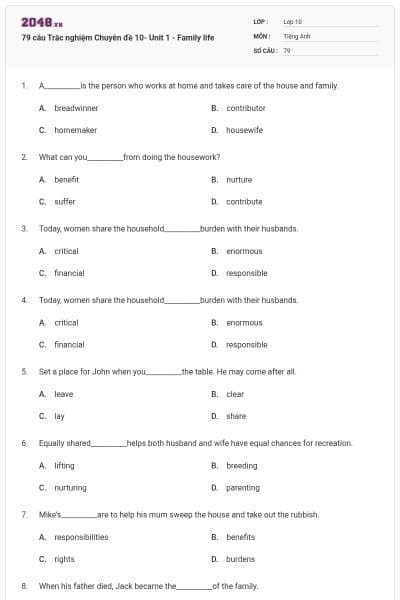
79 câu Trắc nghiệm Chuyên đề 10- Unit 1 - Family life

79 câu hỏi
A__________is the person who works at home and takes care of the house and family.
breadwinner
contributor
homemaker
housewife
What can you__________from doing the housework?
benefit
nurture
suffer
contribute
Today, women share the household__________burden with their husbands.
critical
enormous
financial
responsible
Today, women share the household__________burden with their husbands.
critical
enormous
financial
responsible
Set a place for John when you__________the table. He may come after all.
leave
clear
lay
share
Equally shared__________helps both husband and wife have equal chances for recreation.
lifting
breeding
nurturing
parenting
Mike’s__________are to help his mum sweep the house and take out the rubbish.
responsibilities
benefits
rights
burdens
When his father died, Jack became the__________of the family.
breadwinner
producer
provider
employer
Mark needs to__________that shirt before he can wear it.
lay
iron
nurture
contribute
Buying a house places a great financial__________on young couples.
benefit
influence
burden
effect
A(n) __________family consists of two parents and their children.
extended
sole
nuclear
enormous
Mary’s grandmother her when her mother died.
fed
provided
brought
nurtured
She has a pain in back and can’t do any__________
chore
duty
reponsibility
heavy lifting
Mary likes to shop for__________when she has free time.
groceries
movies
chores
meals
Can you tell me some__________of doing the housework?
interests
activities
benefits
usages
If the household chores are equally divided, the__________is less.
burden
workforce
role
labour
Mum and Dad are not__________of each other when they do the housework together.
sociable
critical
vulnerable
respectful
He doesn’t want to become a__________burden to his children.
responsible
traditional
important
financial
Parents should__________to educating their children.
contribute
create
consider
concern
Comptete the following sentences using the given words in the box.
extended | homemaker | nurtured | laying | finances |
responsibility | sharing | nuclear family | iron | heavy lifting |
E.g. My aunt__nurtured__an orphan boy two years ago.
1. Minh has a__________to do the washing-up after meals.
2. It took her five minutes to__________this dress yesterday.
3. My mother is the person who manages household__________.
4. Family life today is likely to be influenced by the__________family.
5. __________household chores is good for the relationships Within the family.
6. Mark often does the__________when his dad is away.
7. Linda is responsible for__________the table before each meal.
8. Nancy became a__________after her husband left her.
9. I live in a(n) __________family and my parents are enough modern.
Write the words in the correct column.
cry | brilliant | craftsman | triangle | trendy |
broom | truck | crunch | breed | tragically |
/tr/ | /kr/ | /br/ |
E.g.: triangle
|
|
|
The__________ain is crowded at this hour.
This beer has been brewed using__________aditional methods.
Her brother made her__________y.
You should__________y some traditional__________itish dishes.
Tracy is not only__________ight but also creative.
Bruce is a dangerous__________iminal.
Tracy often__________ushes her teeth twice a day.
The__________uck which crashed into my car was stopped by the police.
Matt has ice-cream and__________own__________ead for__________eakfast.
She is planting a big__________ee near my__________other’s house.
Hoa sometimes__________the cooking when her mum is busy.
do
is doing
does
are doing
I am afraid Jack can’t talk to you now. He__________the dishes.
is washing
are washing
wash
washes
Huong can’t sweep the house today. She__________for her exams.
studies
study
are studying
is studying
Nick__________up his bedroom twice a week.
tidy
is tidying
tidies
are tidying
It’s now 7 p.m. and Tina__________dinner.
prepares
is preparing
prepare
are preparing
Nancy and her mum__________grocery shopping at the weekend.
do
does
is doing
are doing
Minh can’t answer the phone now. He__________the bathroom.
cleans
clean
are cleaning
is cleaning
Jenny__________the house twice a week.
is sweeping
sweep
sweeps
are sweeping
Whenever Nancy__________the dishes, she__________things.
wash - break
is washing - is breaking
washes - breaks
washes - is breaking
Where’s your mum?- She__________the plants in the garden.
water
waters
are watering
is watering
Doing household chores __________Nick very happy.
is making
makes
make
are making
She likes animals, so she__________the dog after school.
feed
is feeding
feeds
are feeding
Jack can’t go out with you now. He__________a report.
is writing
writes
are writing
write
I’m sorry for not meeting you now. I__________up the house.
tidy
am tidying
tidies
is tidying
Mark is lazy. He rarely__________the housework.
do
is doing
does
are doing
Complete the following sentences using the suitable verbs on the box in Present Simple or Present Continuous.
lay | iron | take out | not wash | water |
do | feed | clean | watch | mend |
E.g.: Jack often__mends__things around the house.
1. I often__________the cooking when I have free time.
2. Nancy__________the flowers upstairs at the moment.
3. George is busy now. He__________the clothes.
4. Minh__________the dishes now. He is listening to music.
5. Trang and her sister__________the house every day.
6. Nina__________the table in the dining room now.
7. I can’t talk to you now. I__________the rubbish.
8. Julia always__________the cat after school.
9. It’s 8 p.m now. Mark and his dad__________TV in the living room.
Be quiet! Hoang (do) __________the homework.
In Singapore, people (live) __________in nuclear families.
Your mum (cook) __________dinner in the kitchen now?
Mike (clean) __________the bathroom each day, so it is very clean.
Nga always (stop) __________to buy soy milk on her way to work.
Ben (shop) __________for groceries with his dad at the moment.
Where is your brother? - He (fix) __________the motorbike behind the house.
Long rarely (iron) __________, so his clothes are wrinkled.
Who__________Nick__________TV with right now?
Complete the conversation with the Present Continuous of the verbs in the box.
be | look | talk | help | try |
make | sit | build | look | phone |
Daniel: Hello Kirsty. This is Daniel. I__________am phoning__________to ask about the children. I’m glad that you (1) __________after them, but__________they (2) __________well?
Kirsty: Oh, yes. They (3) __________very good.
Daniel: What__________Jimmy (4) __________?
Kirsty: He (5) __________a tower on the floor with his lego.
Daniel: And__________Laura (6) __________him?
Kirsty: No, she (7) __________at the table. She (8) __________to draw a garden.
Laura: Who__________you (9) __________to, Kirsty?
Kirsty: It’s your father. Do you want to talk to him?
Laura: No, just tell him that I (10) __________for him to come home
Read the passage and fill in each blank with the appropriate word in the passage.
In the past, doing household chores was considered to be women’s duty, and it is obvious truth that they had to do all the housework without any help from other members, especially their husbands. However, nowadays, that conception is outmoded as there are more and more people realizing the marvelous benefits of sharing household chores.
In the first place, sharing household chores will reduce both physical and spiritual stress on the mother. We are living in the time that women’s roles have been dignified. Along with studying and going to work, females also have to take a lot of missions given by their bosses as well as take care of their children. If they are not given a hand, they can feel really depressed. As a result, mother’s health is negatively affected as well as the chores are not well done.
Secondly, children can benefit from doing housework. They will become more responsible to their parents and learn many practical skills such as cooking, fixing things and time-management.
Last but not least, splitting the housework equally helps the family become more close-knit as everyone can feel mutual caring from others. When household chores are divided, they will be done faster and the family members will have more free time for entertainment.
In a nutshell, nowadays, each member of the family should take part in doing housework to make most use of all advantages this action brings about.
1. The belief that doing household chores is women’s duty is__________today.
Women not only look after the children but also have to take a lot of__________given by their seniors.
Women will become really depressed without being given a__________.
One of the practical skills which children can get benefit from doing household chores is__________.
Dividing the housework equally helps family members get more__________.
Read the passage and choose the best answer to each of the following questions.
Why do parents have to get involved in their child’s education? Basically, parents’involvement in their child’s learning process offers many opportunities for success. According to Centre for Child Well-Being (2010), parental involvement in their children’s learning not only improves a child’s morale, attitude, and academic achievement across all subject areas, but it also promotes better behavior and social adjustment. It further says that family involvement in education helps children to grow up to be productive, responsible members of the society.
Regrettably, there are also some, if not many, parents who are quite passive in their child’s education. Some of them are not directly involved. Neither are they visible in the school premises and get involved in the desired goals of the school where their children are getting what they need most for life.
Several schools, both private and public sectors, have programs designed at intensifying parental participation such as boys and girls scouting, school-community socio-economic projects, disaster volunteer task force, and school-community work brigade. However, increasing parental involvement remains a tough challenge among school administrators and their teachers despite clear programs, concerted efforts, and strong motivations.
1. What is the main idea of the passage?
The importance of parents’ involvement in children’s education.
The necessity of parents and teachers in children’s education.
The crucial role of schools in children’s education.
The achievement of children in academic performance.
According to the passage, parental involvement has positive influence on the following aspects EXCEPT:
behavior
attitude
morale
enthusiasm
What does the word “grow up” in paragraph 1 mean?
to care a child until he/she is an adult
to happen or become available unexpectedly
to gradually become an adult
to cause something to happen faster
What is true about the parents who are passive in their child’s education?
They don’t get involved in the desired goals of the school.
They keep contact with teachers to discuss about their child’s performance.
They facilitate their child the best learning environment.
They often help their child finish the homework.
What programs do schools have to intensify parental participation?
school - community work brigade
boys and girls scouting
socio - economic projects
All the answers are correct
Listen to the information about nuclear family and fill in the blanks with ONE or TWO appropriate words.
Traditionally, a nuclear family consisted of a married husband and wife and their biological or__________living in the same house together.
It was not until the 1960s and__________that nuclear families became dominant.
Older family member were able to be more__________due to the accessibility of healthcare around the world.
Men were regarded as the strongest source of__________.
Women tended to stay at home and__________the children.
Talk about your household chores.
You can use the following questions as cues:
• What is the role of doing household chores?
• Which household chores do you do? How often?
• Which of the chores do you like doing most?
• Which of the chores do you dislike doing most?
Useful languages:
Useful vocabulary | Useful structures |
* do washing-up, cleaning the house, taking out the rubbish, cooking, feeding the cat, watering plants, shopping, sweeping the house,... * improving skills, being more responsible, building self discipline, being more active, | • In my opinion,... • I think... • I do ... once a day/ twice aday/... • I also ... in the morning/ in the afternoon. • I like ... because ... • I dislike ... because ... |
Complete the notes:
Structures of the talk | Your notes |
What is the role of doing household chores? | __________________________________________ __________________________________________ __________________________________________ |
Which household chores do you do? How often? | __________________________________________ __________________________________________ __________________________________________ |
Which of the chores do you like doing most? | __________________________________________ __________________________________________ __________________________________________ |
Which of the chores do you dislike doing most? | __________________________________________ __________________________________________ __________________________________________ |
Now you try!
Give your answer using the following cues. You should speak for 1-2 minutes.
1. In my opinion, doing housework is ... because ...
2. I do ... in the morning.
3. I also ... twice a day.
4. I like ... and ... because ...
5. I don’t like ... and ... because ...
Now you tick!
Did you ...
q answer all the questions in the task?
q give some details to each main point?
q speak slowly and fluently with only some hesitation?
q use vocabulary wide enough to talk about the topic?
q use various sentence structures (simple, compound, complex) accurately?
q pronounce correctly (vowels, consonants, stress, intonation)?
Let’s compare!
Nick/ usually/ help/ mum/ do/ housework/ free/ time.
→ ________________________________________________________
He/ be/ keen/ feed/ cat/ sweep/ house.
→ ________________________________________________________
He/ dislike/ cook/ because/ he/often/ cut/ his finger.
→ ________________________________________________________
Nick’s/ mum/ feel/ happy/ when/ see/ him/ do/ household chores.
→ ________________________________________________________
Nick’s/ dad/ busy/ work/ so/ he/ not/ have/ time/ housework.
→ ________________________________________________________
Write a short paragraph (120-150 words) about the household chores you often do In your free time.
You can use the following questions as cues:
• What are they?
• How often do you do them?
• Who do you do them with?
• How is doing household chores beneficial to you?
__________________________________________________________________
__________________________________________________________________
__________________________________________________________________
__________________________________________________________________
__________________________________________________________________
__________________________________________________________________
__________________________________________________________________
__________________________________________________________________
_________________________________________________________________