
75 câu Trắc nghiệm chuyên đề 10 Unit 7 - Cultural Diversity

75 câu hỏi
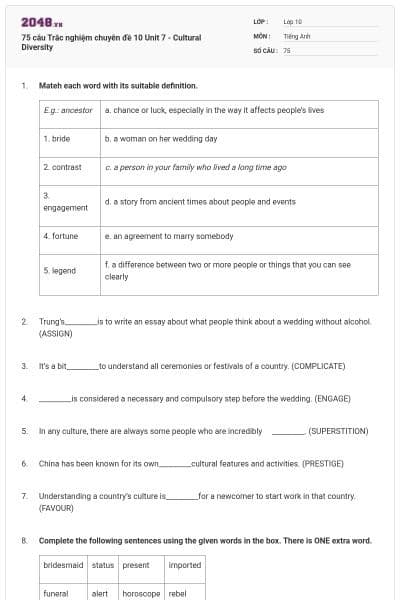
Mateh each word with its suitable definition.
E.g.: ancestor | a. chance or luck, especially in the way it affects people’s lives |
1. bride | b. a woman on her wedding day |
2. contrast | c. a person in your family who lived a long time ago |
3. engagement | d. a story from ancient times about people and events |
4. fortune | e. an agreement to marry somebody |
5. legend | f. a difference between two or more people or things that you can see clearly |
Trung’s_________is to write an essay about what people think about a wedding without alcohol. (ASSIGN)
It’s a bit_________to understand all ceremonies or festivals of a country. (COMPLICATE)
_________is considered a necessary and compulsory step before the wedding. (ENGAGE)
In any culture, there are always some people who are incredibly _________. (SUPERSTITION)
China has been known for its own_________cultural features and activities. (PRESTIGE)
Understanding a country’s culture is_________for a newcomer to start work in that country. (FAVOUR)
Complete the following sentences using the given words in the box. There is ONE extra word.
bridesmaid | status | present | imported |
funeral | alert | horoscope | rebel |
E.g.: Wedding of high-__status__people is often held in deluxe hotel.
1. _________ , which is used to predict people’s fortune, is popular in some countries.
2. Some cultural features like birthday party or wedding in the church are_________from other culture.
3. Most fathers wish to be_________at the birth of their child no matter what culture they are from.
4. It’s nowadays easy for most teenagers to find something to_________against.
5. A_________is an activity that is held officially and respectfully in every culture.
6. Does the wedding in Vietnam have a_________who helps the bride during the marriage ceremony?
Complete the following sentences using the given words in the box. There is ONE extra word.
ceremony | prestigious | complicated |
contrasts | diversity | protest |
1. The wedding_________varies from country to country with many meaningful activities.
2. This_________aspect of Japanese culture is hard for Westerners to properly understand.
3. Cultural_________is a form of appreciating the differences in individuals.
4. The research_________practice and customs in the two countries.
5. These_________newspapers sometimes have articles about cultural diversity.
Complete the following sentences using the given words in the box. There is ONE extra word.
sweeping | alert | honeymoon |
assignment | exported | superstitious |
1. Finding information and understanding culture of many countries in the world is an_________ .
2. Going on_________after the wedding is a popular custom in any culture nowadays.
3. _________elements and features are available in any culture.
4. _________the floor in the Lunar New Year is considered bringing bad luck in Vietnamese culture.
5. It’s said that South Korea has_________not only cars but also its culture to Vietnam.
Decide whether the underlined word in each sentence has stress on the first or second syllable by putting a tick (P) in the right column.
Sentence | Stress on 1st syllable | Stress on 2nd syllable |
E.g.: When he tried to protest, she insisted. 1. She speaks perfect English. 2. She used to present a gardening show on TV. 3. The two cities make an interesting contrast. 4. She secretly recorded the conversation. 5. I've always been the rebel of the family. 6. The value of annual imports rose rapidly. 7. If nobody objects, we’ll postpone the meeting till next week. 8. The slaves rebelled against their masters. 9. Profits show a steady increase. 10. It’s a present to us all from Granny. 11. The country exports sugar to Europe. 12. Marriage is still on the decrease. 13. They have perfected the art of winemaking. 14. The poem contrasts youth and age. 15. Glass and plastic objects lined the shelves. | ___________ ___________ ___________ ___________ ___________ ___________ ___________ ___________ ___________ ___________ ___________ ___________ ___________ ___________ ___________ ___________ | P ___________ ___________ ___________ ___________ ___________ ___________ ___________ ___________ ___________ ___________ ___________ ___________ ___________ ___________ ___________ ___________ |
I found this exercise a little (easy) _________than the last one.
That will be (important) _________lesson you have learnt in your life.
His new car is a lot (quiet) _________than my old one.
This book is (boring) _________than the book I gave you last week.
This summer is considerably much (hot) _________than last summer.
I think this museum is (interesting) _________than any places in the town.
Your lighter may be big, but I’ve got (big) _________lighter ever made.
That must be (weird) _________novel that has ever been written.
Kate is (polite) _________girl I have ever met.
That’s (good) _________film I have seen this month.
Nobody is taller than Huy, and he is (tall) _________student in his class.
Pho is considered one of (delicious) _________dishes of Vietnam.
It is (easy) _________for pupils today to learn English with the assistance of electronic devices?
Peter got a higher mark since he was (careful) _________than me when preparing lessons every day.
The flight from Dubai to Singapore has been my (long) _________journey by air so far.
That new building is even (tall) _________than the hotel next to it.
The little son is (young) _________family member in my home.
Life has become (convenient) _________thanks to Internet and social network.
Having to finish the essay in a very short time is (difficult)_________thing for him now.
It’s (tired) _________to work at night than to work in the daytime.
Put an article “a”, “an”, “the” or “∅” (for no article) in each blank.
1. We had to paint_________apartment before we sold it.
Could I have_________rice instead of potatoes with my fish?
_________weather was awful last summer.
That’s_________amazing bit of news.
The violin sounds different to_________viola.
We always celebrate our wedding anniversary with_________bottle of champagne.
_________life of a soldier is full of danger.
_________books are so important in my life.
_________computer must be the greatest invention ever.
He showed the price fluctuations in_________statistical table.
My boyfriend is_________Aries.
His_________ancestors had come to America from Ireland.
They fully intend to protest_________decision.
My star sign is_________Virgo.
It’s important to find_________good life partner.
He built_________altar to God and made a sacrifice.
_________coffee is the country’s biggest export.
He had_________profound influence on modern poets.
Where are you going on your_________ honeymoon?
The bride and groom walked down_________aisle together.
No books on the shelf is thinner than this one. (thin)
________________________________________________
No student in the class is as tall as than Huy. (tall)
________________________________________________
No pupil in the group is more intelligent than Trang (intelligent)
________________________________________________
No problem I have seen is more complicated than this (complicated)
________________________________________________
There is no easier way to solve the problem (easy)
________________________________________________
Find a mistake in each of the following sentences and correct it.
E.g.: I have visited Philippines for many times. 1. I think we have to try our best to protect the wild animals. 2. I like cuisine of many countries in the world, especially the Japanese food. 3. Maybe the strangest but most typical things on an altar are the sugar skulls. 4. On seeing the robbers, the police asked them to put their the hands up. 5. It’s good for health to sleep early, so I often go to a bed at ten most nights | Philipines → the Philipines _____________________ _____________________ _____________________ _____________________ _____________________ _____________________ |
Read the following passage and do the tasks below and choose the best answer to each of the following questions.
One custom that gives insight into people’s history and values is the way they greet one another. There is a wide range of greetings around the world. These range from the common handshake to other strange rituals found in some countries. Let’s take a look at how the simple action of greeting someone differs greatly from place to place.
In the United States and Canada, for example, a simple handshake or nod is the norm. The handshake has an interesting origin: it started long ago as a way of showing people that you weren’t carrying a weapon. Shaking the person’s right hand while looking him or her in the eye is the usual method. Handshakes are also common in other parts of the world, including Britain and Russia. In Russia, males grasp other men’s hands very strongly during the handshake. Handshakes are also how most people in New Zealand greet each other. However, the native Maori people of that country display more physical contact: they press their noses together in a sign of trust and closeness.
In other countries, such as France and Belgium, hugging and kissing are more common when two people meet. In those cultures, people kiss each other on the cheeks. The number of times varies depending on the particular country. In Saudi Arabia, men might hug and kiss each other (but not a woman) on the cheek. Men will also shake hands with other men there. In some Eastern countries, including Korea and Japan, bowing is the traditional greeting. In Japan, the deeper the bow, the deeper the respect shown. The strangest custom, though, is likely in Tibet. People there opt to stick out their tongue to greet others.
1. What is this reading mainly about?
The importance of handshakes all around the world
The origins and histories of various greetings
The strangest types of greetings on Earth
The wide range of greeting customs in the world
Which of the following is true?
People in Russia, but not England, shake hands.
The number of times people kiss on the cheek varies.
In the past, people nodded if they weren’t carrying a weapon.
You shouldn’t look at people when shaking their hands in the United States.
How do most people in New Zealand greet each other?
With a handshake
By pressing noses together
With a kiss on the cheek
By sticking out their tongues
The author assumes that the country which has the most weird greeting is__________ .
Saudi Arabia
France
Belgium
Tibet
What can be inferred about greeting customs in Saudi Arabia?
Men shake hands with women when meeting them for the first time.
It’s not proper for men to kiss women when they meet.
Women do not kiss other women when they meet.
Women can kiss men, but men can’t kiss women when they meet.
Read the passage and choose the best option to answer each of the following questions
In 2018, Jonathan Tudge, a professor at the University of North Carolina, and his colleagues published a series of studies examining how gratitude develops in children across seven countries: the United States, Brazil, Guatemala, Turkey, Russia, China, and South Korea. They found some similarities across cultures, as well as some differences - an initial glimpse at how our early steps toward gratefulness might be shaped by larger societal forces.
First, they asked a group of children from 7 to 14 years old, “What is your greatest wish?” and “What would you do for the person who granted you that wish?” Then, they grouped the kids’ answers into three categories:
• Verbal gratitude: Saying thank you in some way.
• Concrete gratitude: Reciprocating with something the child likes, such as offering the person some candy or a toy.
• Connective gratitude: Reciprocating with something the wish-granter would like, such as friendship or help.
In general, as you might expect, children were less likely to respond with concrete gratitude as they got older. Younger and older kids expressed verbal gratitude at similar rates—although there were exceptions to these trends. (Brazilian children showed more verbal gratitude as they got older, while concrete gratitude didn’t decline with age in Guatemala and China—where it was fairly rare to begin with). And as children grew older, they expressed more connective gratitude in the United States, China, and Brazil.
Despite these age-related similarities, differences were still seen between countries. Overall, children in China and South Korea tended to favor connective gratitude, while kids in the United States leaned toward concrete gratitude. Children in Guatemala—where it’s common to say “Thanks be to God” in everyday speech—were particularly partial to verbal gratitude.
Such variations in how children respond to kindness may set the stage for how they talk, act, and feel when they get older.
1. Which of the following is NOT concerned with Tudge’s study?
How children say thank-you worldwide
Cultural differences in gratitude
How adults show gratitude in different cultures
Some changes in expression of gratitude as children grow older
What is NOT true according to the passage?
Older children tend to say thank you more often than younger ones in Brazil.
Older children use concrete gratitude more often than younger ones in China
Children in the USA use concrete gratitude more often than those in South Korea.
Children in Guatemala are very keen on expressing gratitude verbally.
What does a child in the survey NOT offer to give the wish-granter?
the help if the granter wants
a toy
saying “thank-you”
a thank-you letter
What can be inferred from Tudge’s survey?
There are cultural reasons why we don’t express gratitude in the same way.
Children in Asia tend to grow into more grateful people.
Gratitude has little to do with how children will behave when they grow up.
American culture tends to support gratitude more than other cultures.
What does the phrase “the person” refer to?
a child in the survey
Tudge
the wish-granter
a parent
Listen to Polterabend custom in Germany and complete the following sentences.
1. There are lots of_________in a traditional German wedding.
2. The tradition of Polterabend takes place_________the wedding in the church.
3. It is believed that making noise can scare away_________drawn to brides.
4. China dishes are smashed the night before the church wedding to bring_________to the couple.
5. _________is never smashed in Polterabend as it is considered to give bad luck.
6. Working together to_________the shards symbolizes the couple’s harmony after marriage.
Talk about advantages and disadvantages of working in the environment of cultural diversity.
You can answer the following questions as cues:
* What are the advantages of cultural diversity?
*What are the disadvantages of cultural diversity?
*What is your opinion about cultural diversity?
Useful languages:
Useful vocabulary | Useful structures |
• increasing creativity, increasing adaptability, understanding more, work effectively • different language, different culture, different work style, discrimination | • Cultural diversity helps improve... • Another advantage is... • However, ... • ...may cause discrimination with others. • Cultural difference will also affect... • In my opinion, ... • As far as I am concerned, ... • I think... |
Complete the notes:
Structures of the talk | Your notes |
What are the advantages of cultural diversity? | __________________________________________ __________________________________________ __________________________________________ |
What are the disadvantages of cultural diversity? | __________________________________________ __________________________________________ __________________________________________ |
What is your opinion about cultural diversity? | __________________________________________ __________________________________________ __________________________________________ |
Now you try!
Give your answer using the following cues. You should speak for 1-2 minutes.
1. Cultural diversity helps improve...
2. Another advantage is...
3. However,...
4. Cultural difference will also affect...
5. I think...
Now you tick!
Did you ...
q answer all the questions in the task?
q give some details to each main point?
q speak slowly and fluently with only some hesitation?
q use vocabulary wide enough to talk about the topic?
q use various sentence structures (simple, compound, complex) accurately?
q pronounce correctly (vowels, consonants, stress, intonation)?
Japan/ have/ many/ interesting/ cultural feature/ which/ Kimono/ be/ most famous/ one.
→ ________________________________________________________
Kimono, which/ not make/ various sizes, be/ adjust/ suit/ any Japanese woman.
→ ________________________________________________________
Kimono/ be/ Japanese traditional/ costume, and it/ often use/ New Year festival.
→ ________________________________________________________
Each/ Japanese woman/ often have/ one set/ Kimono suitable/ her age/ wear/ important events.
→ ________________________________________________________
Basically, there/ be/ eight types/ Kimono, and Furisode/ be/ one/ I like/ best.
→ ________________________________________________________
Write a short paragraph (120 - 150 words) about a Vietnamese cultural feature you are most interested in.
You can answer the following questions as cues:
• What is the cultural feature?
• What are its characteristics?
• What is your opinion about it?
__________________________________________________________________
__________________________________________________________________
__________________________________________________________________
__________________________________________________________________
__________________________________________________________________
__________________________________________________________________