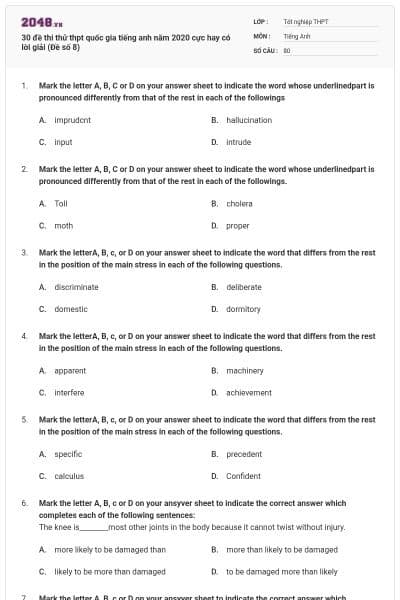
30 đề thi thử thpt quốc gia tiếng anh năm 2020 cực hay có lời giải (Đề số 8)

80 câu hỏi
Mark the letter A, B, C or D on your answer sheet to indicate the word whose underlinedpart is pronounced differently from that of the rest in each of the followings
imprudcnt
hallucination
input
intrude
Mark the letter A, B, C or D on your answer sheet to indicate the word whose underlinedpart is pronounced differently from that of the rest in each of the followings.
Toll
cholera
moth
proper
Mark the letterA, B, c, or D on your answer sheet to indicate the word that differs from the rest in the position of the main stress in each of the following questions.
discriminate
deliberate
domestic
dormitory
Mark the letterA, B, c, or D on your answer sheet to indicate the word that differs from the rest in the position of the main stress in each of the following questions.
apparent
machinery
interfere
achievement
Mark the letterA, B, c, or D on your answer sheet to indicate the word that differs from the rest in the position of the main stress in each of the following questions.
specific
precedent
calculus
Confident
Mark the letter A, B, c or D on your ansyver sheet to indicate the correct answer which completes each of the following sentences:
The knee is________most other joints in the body because it cannot twist without injury.
more likely to be damaged than
more than likely to be damaged
likely to be more than damaged
to be damaged more than likely
Mark the letter A, B, c or D on your ansyver sheet to indicate the correct answer which completes each of the following sentences
Written to be performed on a________, Thomton Wilder’s play Our Town depicts life in a small New England community.
stage barc of scenery
stage scenery of bare
bare of stage scenery
scenery bare of stage
Mark the letter A, B, c or D on your ansyver sheet to indicate the correct answer which completes each of the following sentences
According to some educators, the goal of teaching is to help students leam what________to know to live a well-adjusted and successtul life.
they need
they are needed
as the may need
do they need
Mark the letter A, B, c or D on your ansyver sheet to indicate the correct answer which completes each of the following sentences
The temperature_______takes place varies widely ửom material to material.
at which they melt
which melting
which they melt
at which melting
Mark the letter A, B, c or D on your ansyver sheet to indicate the correct answer which completes each of the following sentences
________ Not until Kentucky’s Mammoth Cave had been completely explored in 1972
when was its full extent realized
was its full extent realized
that its fiill extent was realized
the realization of its full extent
Mark the letter A, B, c, or D on your answer sheet to show the underlined part that needs correction in each of the following questions.
The best (A) wav to eliminate a pest is control (B) the food accessible (C) to it (D).
The best
control
food accessible
to it
Mark the letter A, B, c, or D on your answer sheet to show the underlined part that needs correction in each of the following questions.
The atmosphere of friendliness in Andalucia (A) is open, warm and gives a welcome feeling_(B) to all who (C) have the good (D) fortune to visit there.
in Andalucia
welcome
who
the good
Mark the letter A, B, c, or D on your answer sheet to show the underlined part that needs correction in each of the following questions.
With their compound eves (A). dragonflies cam see move insects (B) approximately (C) 18 feet (D) away.
compound eves
move insects
approximately
feet
Mark the letter A, B, c, or D on your answer sheet to show the underlined part that needs correction in each of the following questions.
As (A) the Asian economic miracle spreads (B) throughout the Pacific, wage increases everywhere is(C) affecting millions (D) of consumers.
As
spreads
is
millions
Mark the letter A, B, c, or D on your answer sheet to show the underlined part that needs correction in each of the following questions.
Artificial (A) intelligence is concemed with designing (B) Computer Systems that perform such tasks as reason (C) and learning (D) new skills.
Artificial
designing
reason
learning
Mark the letter A, B, c, or D on your answer sheet to indicate the correct answer to each of the following questions.
Within an area of only 100 miles, Death Valley sinks to 282 feet below sea level, while Mount Whitney________to a height of 14,494 feet.
soared
soars
soar
Soaring
Mark the letter A, B, c, or D on your answer sheet to indicate the correct answer to each of the following questions.
My mother works________a nurse in a big hospital. She cxamincs the patients.
for
in
as
at
Mark the letter A, B, c, or D on your answer sheet to indicate the correct answer to each of the following questions.
Sleeping, resting, and_____arc the best ways to carc for a cold.
one drink fluids
to drink fluids
drank fluids
drinking fluids
Mark the letter A, B, c, or D on your answer sheet to indicate the correct answer to each of the following questions.
Birds all over the world migrate distances up to________of miles.
a thousand
some thousand
thousand
thousands
Mark the letter A, B, c, or D on your answer sheet to indicate the correct answer to each of the following questions.
He was going to ask her but he________and said nothing.
got his feet wet
had feet of clay
got cold feet
put his feet up
Mark the letter A, B, c, or D on your answer sheet to indicate the correct answer to each of the following questions.
________human beings have relatively constant body temperature.
Alike all mammal
Like all mammals
Like all marnmal
Alike all mammals
Mark the letter A, B, c, or D on your answer sheet to indicate the correct answer to each of the following questions.
So far there is no vaccine________in sight for the common cold.
or curing
having cured
has cured
or cure
Mark the letter A, B, c, or D on your answer sheet to indicate the correct answer to each of the following questions.
The Louisiana Territory, an area________the size of France, was bought by the United States from France for $15,000,000 in 1803.
is four times as large as
four times as large as
more than four times
than more four times
Mark the letter A, B, c, or D on your answer sheet to indicate the correct answer to each of the following questions.
Despite claims that filters and low-tar tobacco make smoking somewhat safer, in fact,they only marginally reduce,________eliminate, the hazards.
none
not
no
Nor
Mark the letter A, B, c, or D on your answer sheet to indicate the correct answer to each of the following questions.
________many of the designs for the new Capital were considered lost forever,Benjamin Banneker helped reproduce the original plans
If as
When
How
During
Mark the letter A, B, c, or D on your answer sheet to indicate the correct answer to each of the following questions.
Jill: “No one but you stole my money” Jack: “________”
Keep silent.
Mind your words!
Me too.
It’s your fault.
Mark the letter A, B, c, or D on your answer sheet to indicate the correct answer to each of the following questions.
William Bonney________Billy The Kid, was a famous Wild West gunman.
alias
ergo
bogus
Versus
Mark the letter A, B, c, or D on your answer sheet to indicate the correct answer to each of the following questions.
Our plans to start our own busincss sccm________to failure!
fated
compelled
designed
doomed
Mark the letter A, B, c, or D on your answer sheet to indicate the correct answer to each of the following questions.
Peter: “I think we should go to Hawaii for our honeymoon” Mary: “________”
I’m glad you like it.
The samc to you.
By all means.
You are welcome.
Mark the letter A, B, c, or D on your answer sheet to indicate the correct answer to each of the following questions.
Today there arc weather satellites that bcam down information about the earth’s atmosphere. In the last two decades, space explortion________great contributions to weather forecasting.
is making
made
has made
makes
Mark the letter A, B, c, or D on your answer sheet to indicate the correct answer to each of the following questions
He wrapped all his possessions up in a sheet and carried the________on his back.
rucksack
case
bag
bundle
Mark the letter A, B, c, or D on your answer sheet to indicate the correct answer to each of the following questions.
Jim: “Thank you very much for your precious help” Jane:“________”
Here you are.
Congratulations!
Good luck.
It was the least I could do.
Mark the letter A, B, c, or D on your answer sheet to indicate the correct answer to each of the following questions.
In your teens, peer-group friendships may________from parents as the major influence on you.
take back
tack out
take over
take in
Mark the letter A, B, c, or D on your answer sheet to indicate the correct answer to each of the following questions.
I hate________formal examinations. I find it so difficult to organise my thoughts in a limited time.
sitting
passing
making
Writing
Mark the letter A, B, c, or D on your answer sheet to indicate the correct answer to each of the following questions.
John tried to eat a large piece of meat too fast and bcgan to________.
gauge
lash
exploit
choke
Mark the letter A, B, c, or D on your answer sheet to indicate the correct answer to each of the following questions.
You haven’t eaten anything since yesterday aftemoon. You________be really hungry!
will
must
might
Can
Mark the letter A, B, c, or D on your answer sheet to indicate the correct answer to each of the following questions.
The Pyramids are perhaps the most famous of the seven_____ of the ancient world.
wonders
structures
constmctions
Spectacles
Mark the letter A, B, c, or D on your answer sheet to indicate the correct answer to each of the following questions.
Jenny is________of the mistakes of others.
cordial
acceptable
co-operative
tolerant
Mark the letter A, B, c, or D on your answer sheet to indicate the correct answer to each of the following questions.
The word processor________of a keyboard, a monitor and a printer.
composes
constitutes
consists
Comprises
Mark the letter A, B, c, or D on your answer sheet to indicate the correct answer to each of the following questions.
You’re not supposed to park on the hard________except in an emergency.
lance
shoulder
leg
Area
Read the following passage taken from the Oxford Advanced Leamer's Dictionary 8th edition and mark the letter A, B, C, or D on your answer sheet to indicate the correct word for each of the blanks from 41 to 50.
The Thames is the longest and best-known river in Britain. It is 210 miles/338 kilometres________(41)________and flows from the Cotswolds in Central England to the North Sea after through London. Other famous towns on the river________(42)________Oxford, Windsor 1, Henley and Greenwich.________(43)________bridges across the Thames in London are London Bridge, Tower Bridge and Westminster Bridge.
Large ships can sail________(44)________the Thames________(45)________London and smaller ones a further 86 miles/138 kilometres. A large area in the east of London was formerly a major port on the river, but in recent times this Docklands area has been________(46) x.
The Thamcs Barrier is a large barrier________(47)________across the River Thames at Woolwich, east of London, to prevent London from being tlooded. It was completed in 1982 and________(48)________opened in 1984. It consists of ten gates, which________(49)________on the bottom of the river when the barrier is not required. If there is a danger of tlooding, the gates rise to form a solid________(50)________50 feet/15 metres high.
Question 41:
longevity
long
length
lengthen
Read the following passage taken from the Oxford Advanced Leamer's Dictionary 8th edition and mark the letter A, B, C, or D on your answer sheet to indicate the correct word for each of the blanks from 41 to 50.
The Thames is the longest and best-known river in Britain. It is 210 miles/338 kilometres________(41)________and flows from the Cotswolds in Central England to the North Sea after through London. Other famous towns on the river________(42)________Oxford, Windsor 1, Henley and Greenwich.________(43)________bridges across the Thames in London are London Bridge, Tower Bridge and Westminster Bridge.
Large ships can sail________(44)________the Thames________(45)________London and smaller ones a further 86 miles/138 kilometres. A large area in the east of London was formerly a major port on the river, but in recent times this Docklands area has been________(46) x.
The Thamcs Barrier is a large barrier________(47)________across the River Thames at Woolwich, east of London, to prevent London from being tlooded. It was completed in 1982 and________(48)________opened in 1984. It consists of ten gates, which________(49)________on the bottom of the river when the barrier is not required. If there is a danger of tlooding, the gates rise to form a solid________(50)________50 feet/15 metres high.
Question 42:
consist
involve
contain
include
Read the following passage taken from the Oxford Advanced Leamer's Dictionary 8th edition and mark the letter A, B, C, or D on your answer sheet to indicate the correct word for each of the blanks from 41 to 50.
The Thames is the longest and best-known river in Britain. It is 210 miles/338 kilometres________(41)________and flows from the Cotswolds in Central England to the North Sea after through London. Other famous towns on the river________(42)________Oxford, Windsor 1, Henley and Greenwich.________(43)________bridges across the Thames in London are London Bridge, Tower Bridge and Westminster Bridge.
Large ships can sail________(44)________the Thames________(45)________London and smaller ones a further 86 miles/138 kilometres. A large area in the east of London was formerly a major port on the river, but in recent times this Docklands area has been________(46) x.
The Thamcs Barrier is a large barrier________(47)________across the River Thames at Woolwich, east of London, to prevent London from being tlooded. It was completed in 1982 and________(48)________opened in 1984. It consists of ten gates, which________(49)________on the bottom of the river when the barrier is not required. If there is a danger of tlooding, the gates rise to form a solid________(50)________50 feet/15 metres high.
Question 43:
Well-known
Unknown
Knowing
Knowledgeable
Read the following passage taken from the Oxford Advanced Leamer's Dictionary 8th edition and mark the letter A, B, C, or D on your answer sheet to indicate the correct word for each of the blanks from 41 to 50.
The Thames is the longest and best-known river in Britain. It is 210 miles/338 kilometres________(41)________and flows from the Cotswolds in Central England to the North Sea after through London. Other famous towns on the river________(42)________Oxford, Windsor 1, Henley and Greenwich.________(43)________bridges across the Thames in London are London Bridge, Tower Bridge and Westminster Bridge.
Large ships can sail________(44)________the Thames________(45)________London and smaller ones a further 86 miles/138 kilometres. A large area in the east of London was formerly a major port on the river, but in recent times this Docklands area has been________(46) x.
The Thamcs Barrier is a large barrier________(47)________across the River Thames at Woolwich, east of London, to prevent London from being tlooded. It was completed in 1982 and________(48)________opened in 1984. It consists of ten gates, which________(49)________on the bottom of the river when the barrier is not required. If there is a danger of tlooding, the gates rise to form a solid________(50)________50 feet/15 metres high.
Question 44:
to
on
up
around
Read the following passage taken from the Oxford Advanced Leamer's Dictionary 8th edition and mark the letter A, B, C, or D on your answer sheet to indicate the correct word for each of the blanks from 41 to 50.
The Thames is the longest and best-known river in Britain. It is 210 miles/338 kilometres________(41)________and flows from the Cotswolds in Central England to the North Sea after through London. Other famous towns on the river________(42)________Oxford, Windsor 1, Henley and Greenwich.________(43)________bridges across the Thames in London are London Bridge, Tower Bridge and Westminster Bridge.
Large ships can sail________(44)________the Thames________(45)________London and smaller ones a further 86 miles/138 kilometres. A large area in the east of London was formerly a major port on the river, but in recent times this Docklands area has been________(46) x.
The Thamcs Barrier is a large barrier________(47)________across the River Thames at Woolwich, east of London, to prevent London from being tlooded. It was completed in 1982 and________(48)________opened in 1984. It consists of ten gates, which________(49)________on the bottom of the river when the barrier is not required. If there is a danger of tlooding, the gates rise to form a solid________(50)________50 feet/15 metres high.
Question45
as long as
as soon as
as muchas
as far as
Read the following passage taken from the Oxford Advanced Leamer's Dictionary 8th edition and mark the letter A, B, C, or D on your answer sheet to indicate the correct word for each of the blanks from 41 to 50.
The Thames is the longest and best-known river in Britain. It is 210 miles/338 kilometres________(41)________and flows from the Cotswolds in Central England to the North Sea after through London. Other famous towns on the river________(42)________Oxford, Windsor 1, Henley and Greenwich.________(43)________bridges across the Thames in London are London Bridge, Tower Bridge and Westminster Bridge.
Large ships can sail________(44)________the Thames________(45)________London and smaller ones a further 86 miles/138 kilometres. A large area in the east of London was formerly a major port on the river, but in recent times this Docklands area has been________(46) x.
The Thamcs Barrier is a large barrier________(47)________across the River Thames at Woolwich, east of London, to prevent London from being tlooded. It was completed in 1982 and________(48)________opened in 1984. It consists of ten gates, which________(49)________on the bottom of the river when the barrier is not required. If there is a danger of tlooding, the gates rise to form a solid________(50)________50 feet/15 metres high.
Question 46
revitalized
revamped
reintroduced
redeveloped
Read the following passage taken from the Oxford Advanced Leamer's Dictionary 8th edition and mark the letter A, B, C, or D on your answer sheet to indicate the correct word for each of the blanks from 41 to 50.
The Thames is the longest and best-known river in Britain. It is 210 miles/338 kilometres________(41)________and flows from the Cotswolds in Central England to the North Sea after through London. Other famous towns on the river________(42)________Oxford, Windsor 1, Henley and Greenwich.________(43)________bridges across the Thames in London are London Bridge, Tower Bridge and Westminster Bridge.
Large ships can sail________(44)________the Thames________(45)________London and smaller ones a further 86 miles/138 kilometres. A large area in the east of London was formerly a major port on the river, but in recent times this Docklands area has been________(46) x.
The Thamcs Barrier is a large barrier________(47)________across the River Thames at Woolwich, east of London, to prevent London from being tlooded. It was completed in 1982 and________(48)________opened in 1984. It consists of ten gates, which________(49)________on the bottom of the river when the barrier is not required. If there is a danger of tlooding, the gates rise to form a solid________(50)________50 feet/15 metres high.
Question 47
built
building
to build
to be built
Read the following passage taken from the Oxford Advanced Leamer's Dictionary 8th edition and mark the letter A, B, C, or D on your answer sheet to indicate the correct word for each of the blanks from 41 to 50.
The Thames is the longest and best-known river in Britain. It is 210 miles/338 kilometres________(41)________and flows from the Cotswolds in Central England to the North Sea after through London. Other famous towns on the river________(42)________Oxford, Windsor 1, Henley and Greenwich.________(43)________bridges across the Thames in London are London Bridge, Tower Bridge and Westminster Bridge.
Large ships can sail________(44)________the Thames________(45)________London and smaller ones a further 86 miles/138 kilometres. A large area in the east of London was formerly a major port on the river, but in recent times this Docklands area has been________(46) x.
The Thamcs Barrier is a large barrier________(47)________across the River Thames at Woolwich, east of London, to prevent London from being tlooded. It was completed in 1982 and________(48)________opened in 1984. It consists of ten gates, which________(49)________on the bottom of the river when the barrier is not required. If there is a danger of tlooding, the gates rise to form a solid________(50)________50 feet/15 metres high.
Question 48
legitimately
formerly
ceremoniously
officially
Read the following passage taken from the Oxford Advanced Leamer's Dictionary 8th edition and mark the letter A, B, C, or D on your answer sheet to indicate the correct word for each of the blanks from 41 to 50.
The Thames is the longest and best-known river in Britain. It is 210 miles/338 kilometres________(41)________and flows from the Cotswolds in Central England to the North Sea after through London. Other famous towns on the river________(42)________Oxford, Windsor 1, Henley and Greenwich.________(43)________bridges across the Thames in London are London Bridge, Tower Bridge and Westminster Bridge.
Large ships can sail________(44)________the Thames________(45)________London and smaller ones a further 86 miles/138 kilometres. A large area in the east of London was formerly a major port on the river, but in recent times this Docklands area has been________(46) x.
The Thamcs Barrier is a large barrier________(47)________across the River Thames at Woolwich, east of London, to prevent London from being tlooded. It was completed in 1982 and________(48)________opened in 1984. It consists of ten gates, which________(49)________on the bottom of the river when the barrier is not required. If there is a danger of tlooding, the gates rise to form a solid________(50)________50 feet/15 metres high.
Question 49:
lie
lay
lain
laid
Read the following passage taken from the Oxford Advanced Leamer's Dictionary 8th edition and mark the letter A, B, C, or D on your answer sheet to indicate the correct word for each of the blanks from 41 to 50.
The Thames is the longest and best-known river in Britain. It is 210 miles/338 kilometres________(41)________and flows from the Cotswolds in Central England to the North Sea after through London. Other famous towns on the river________(42)________Oxford, Windsor 1, Henley and Greenwich.________(43)________bridges across the Thames in London are London Bridge, Tower Bridge and Westminster Bridge.
Large ships can sail________(44)________the Thames________(45)________London and smaller ones a further 86 miles/138 kilometres. A large area in the east of London was formerly a major port on the river, but in recent times this Docklands area has been________(46) x.
The Thamcs Barrier is a large barrier________(47)________across the River Thames at Woolwich, east of London, to prevent London from being tlooded. It was completed in 1982 and________(48)________opened in 1984. It consists of ten gates, which________(49)________on the bottom of the river when the barrier is not required. If there is a danger of tlooding, the gates rise to form a solid________(50)________50 feet/15 metres high.
Question 50
fence
boundary
periphery
wall
Read the following passage and mark the letter A, B, C, or D on your answer sheet to indicate the correct answer to each of the questions from 51 to 60.
As many as one thousand years ago in the Southwest, the Hopi and Zuni Indians of North America were building with adobe-sun-baked brick plastered with mud. Their homes looked remarkably like
modem apartment houscs. Some were four stories high and contained quarters for perhaps a thousand people, along with storerooms for grain and other goods. These buildings were usually put up against cliffs, both to make construction easier and for defense against enemies. They were really villages in themselves, as later Spanish explorers must have realized since they called them “pueblos”, which is Spanish for towns. The people of the pueblos raised what are called “the three sisterscom, beans, and squash. They made excellent pottery and wove marvelous baskets, some so fine that they could hold water. The Southwest has ahvays been a dry country, where water is scarce. The Hopi and Zuni brought water from streams to their fields and gardens through irrigation ditches. Water was so important that it played a major role in theừ religion. They developed elaborate ceremonies and religious rituals to bring rain. The way of life of less - settled groups was simpler and more strongly influenced by nature. Small tribes such as the Shoshone and Ute wandered the dry and mountainous lands between the Rocky Mountains and the Pacific Ocean. They gathered seeds and hunted small animals such as rabbits and snakes. In the Far North the ancestors of today’s Inuit hunted seals, walruses, and the great whales. They lived right on the frozen seas in shelters called igloos built of blocks of packed snow. When sumnier came, they fished for salmon and hunted the lordly caribou. The Cheyenne, Pawnee and Sioux tribes, known as the Plains Indians, lived on the grasslands between the Rocky Mountains and the Mississippi River. They hunted bison, commonly called the buffalo. Its meat was the chief food of these tribes, and its hide was used to make theừ clothing and the covering of their tents and tips.
Question:What does the passage mainly discuss?
The way of life of American Indian tribes in early North America
Ceremonies and rituals of American Indians
The architecture of early America Indian buildings
The movement of American Indians across North America
Read the following passage and mark the letter A, B, C, or D on your answer sheet to indicate the correct answer to each of the questions from 51 to 60.
As many as one thousand years ago in the Southwest, the Hopi and Zuni Indians of North America were building with adobe-sun-baked brick plastered with mud. Their homes looked remarkably like
modem apartment houscs. Some were four stories high and contained quarters for perhaps a thousand people, along with storerooms for grain and other goods. These buildings were usually put up against cliffs, both to make construction easier and for defense against enemies. They were really villages in themselves, as later Spanish explorers must have realized since they called them “pueblos”, which is Spanish for towns. The people of the pueblos raised what are called “the three sisterscom, beans, and squash. They made excellent pottery and wove marvelous baskets, some so fine that they could hold water. The Southwest has ahvays been a dry country, where water is scarce. The Hopi and Zuni brought water from streams to their fields and gardens through irrigation ditches. Water was so important that it played a major role in theừ religion. They developed elaborate ceremonies and religious rituals to bring rain. The way of life of less - settled groups was simpler and more strongly influenced by nature. Small tribes such as the Shoshone and Ute wandered the dry and mountainous lands between the Rocky Mountains and the Pacific Ocean. They gathered seeds and hunted small animals such as rabbits and snakes. In the Far North the ancestors of today’s Inuit hunted seals, walruses, and the great whales. They lived right on the frozen seas in shelters called igloos built of blocks of packed snow. When sumnier came, they fished for salmon and hunted the lordly caribou. The Cheyenne, Pawnee and Sioux tribes, known as the Plains Indians, lived on the grasslands between the Rocky Mountains and the Mississippi River. They hunted bison, commonly called the buffalo. Its meat was the chief food of these tribes, and its hide was used to make theừ clothing and the covering of their tents and tips.
Question:According to the passage, the Hopi and Zuni typically built their homes________.
against cliffs
next to streams
in valleys
on open plains
Read the following passage and mark the letter A, B, C, or D on your answer sheet to indicate the correct answer to each of the questions from 51 to 60.
As many as one thousand years ago in the Southwest, the Hopi and Zuni Indians of North America were building with adobe-sun-baked brick plastered with mud. Their homes looked remarkably like
modem apartment houscs. Some were four stories high and contained quarters for perhaps a thousand people, along with storerooms for grain and other goods. These buildings were usually put up against cliffs, both to make construction easier and for defense against enemies. They were really villages in themselves, as later Spanish explorers must have realized since they called them “pueblos”, which is Spanish for towns. The people of the pueblos raised what are called “the three sisterscom, beans, and squash. They made excellent pottery and wove marvelous baskets, some so fine that they could hold water. The Southwest has ahvays been a dry country, where water is scarce. The Hopi and Zuni brought water from streams to their fields and gardens through irrigation ditches. Water was so important that it played a major role in theừ religion. They developed elaborate ceremonies and religious rituals to bring rain. The way of life of less - settled groups was simpler and more strongly influenced by nature. Small tribes such as the Shoshone and Ute wandered the dry and mountainous lands between the Rocky Mountains and the Pacific Ocean. They gathered seeds and hunted small animals such as rabbits and snakes. In the Far North the ancestors of today’s Inuit hunted seals, walruses, and the great whales. They lived right on the frozen seas in shelters called igloos built of blocks of packed snow. When sumnier came, they fished for salmon and hunted the lordly caribou. The Cheyenne, Pawnee and Sioux tribes, known as the Plains Indians, lived on the grasslands between the Rocky Mountains and the Mississippi River. They hunted bison, commonly called the buffalo. Its meat was the chief food of these tribes, and its hide was used to make theừ clothing and the covering of their tents and tips.
Question:The word “They” refers to________.
cliffs
goods
enemies
buildings
Read the following passage and mark the letter A, B, C, or D on your answer sheet to indicate the correct answer to each of the questions from 51 to 60.
As many as one thousand years ago in the Southwest, the Hopi and Zuni Indians of North America were building with adobe-sun-baked brick plastered with mud. Their homes looked remarkably like
modem apartment houscs. Some were four stories high and contained quarters for perhaps a thousand people, along with storerooms for grain and other goods. These buildings were usually put up against cliffs, both to make construction easier and for defense against enemies. They were really villages in themselves, as later Spanish explorers must have realized since they called them “pueblos”, which is Spanish for towns. The people of the pueblos raised what are called “the three sisterscom, beans, and squash. They made excellent pottery and wove marvelous baskets, some so fine that they could hold water. The Southwest has ahvays been a dry country, where water is scarce. The Hopi and Zuni brought water from streams to their fields and gardens through irrigation ditches. Water was so important that it played a major role in theừ religion. They developed elaborate ceremonies and religious rituals to bring rain. The way of life of less - settled groups was simpler and more strongly influenced by nature. Small tribes such as the Shoshone and Ute wandered the dry and mountainous lands between the Rocky Mountains and the Pacific Ocean. They gathered seeds and hunted small animals such as rabbits and snakes. In the Far North the ancestors of today’s Inuit hunted seals, walruses, and the great whales. They lived right on the frozen seas in shelters called igloos built of blocks of packed snow. When sumnier came, they fished for salmon and hunted the lordly caribou. The Cheyenne, Pawnee and Sioux tribes, known as the Plains Indians, lived on the grasslands between the Rocky Mountains and the Mississippi River. They hunted bison, commonly called the buffalo. Its meat was the chief food of these tribes, and its hide was used to make theừ clothing and the covering of their tents and tips.
Question:It can be inferred from the passage that the dwellings of the Hopi and Zuni were________.
quickly constmcted
difficult to defend
highly advanced
very small
Read the following passage and mark the letter A, B, C, or D on your answer sheet to indicate the correct answer to each of the questions from 51 to 60.
As many as one thousand years ago in the Southwest, the Hopi and Zuni Indians of North America were building with adobe-sun-baked brick plastered with mud. Their homes looked remarkably like
modem apartment houscs. Some were four stories high and contained quarters for perhaps a thousand people, along with storerooms for grain and other goods. These buildings were usually put up against cliffs, both to make construction easier and for defense against enemies. They were really villages in themselves, as later Spanish explorers must have realized since they called them “pueblos”, which is Spanish for towns. The people of the pueblos raised what are called “the three sisterscom, beans, and squash. They made excellent pottery and wove marvelous baskets, some so fine that they could hold water. The Southwest has ahvays been a dry country, where water is scarce. The Hopi and Zuni brought water from streams to their fields and gardens through irrigation ditches. Water was so important that it played a major role in theừ religion. They developed elaborate ceremonies and religious rituals to bring rain. The way of life of less - settled groups was simpler and more strongly influenced by nature. Small tribes such as the Shoshone and Ute wandered the dry and mountainous lands between the Rocky Mountains and the Pacific Ocean. They gathered seeds and hunted small animals such as rabbits and snakes. In the Far North the ancestors of today’s Inuit hunted seals, walruses, and the great whales. They lived right on the frozen seas in shelters called igloos built of blocks of packed snow. When sumnier came, they fished for salmon and hunted the lordly caribou. The Cheyenne, Pawnee and Sioux tribes, known as the Plains Indians, lived on the grasslands between the Rocky Mountains and the Mississippi River. They hunted bison, commonly called the buffalo. Its meat was the chief food of these tribes, and its hide was used to make theừ clothing and the covering of their tents and tips.
Question:The author uses the phrase “the three sisters” refers to________.
important crops
rain ceremonies
family members
Hopi women
Read the following passage and mark the letter A, B, C, or D on your answer sheet to indicate the correct answer to each of the questions from 51 to 60.
As many as one thousand years ago in the Southwest, the Hopi and Zuni Indians of North America were building with adobe-sun-baked brick plastered with mud. Their homes looked remarkably like
modem apartment houscs. Some were four stories high and contained quarters for perhaps a thousand people, along with storerooms for grain and other goods. These buildings were usually put up against cliffs, both to make construction easier and for defense against enemies. They were really villages in themselves, as later Spanish explorers must have realized since they called them “pueblos”, which is Spanish for towns. The people of the pueblos raised what are called “the three sisterscom, beans, and squash. They made excellent pottery and wove marvelous baskets, some so fine that they could hold water. The Southwest has ahvays been a dry country, where water is scarce. The Hopi and Zuni brought water from streams to their fields and gardens through irrigation ditches. Water was so important that it played a major role in theừ religion. They developed elaborate ceremonies and religious rituals to bring rain. The way of life of less - settled groups was simpler and more strongly influenced by nature. Small tribes such as the Shoshone and Ute wandered the dry and mountainous lands between the Rocky Mountains and the Pacific Ocean. They gathered seeds and hunted small animals such as rabbits and snakes. In the Far North the ancestors of today’s Inuit hunted seals, walruses, and the great whales. They lived right on the frozen seas in shelters called igloos built of blocks of packed snow. When sumnier came, they fished for salmon and hunted the lordly caribou. The Cheyenne, Pawnee and Sioux tribes, known as the Plains Indians, lived on the grasslands between the Rocky Mountains and the Mississippi River. They hunted bison, commonly called the buffalo. Its meat was the chief food of these tribes, and its hide was used to make theừ clothing and the covering of their tents and tips.
Question:Which of the foilowing is true of the Shoshone and Ute?
They hunted caribou.
They did not have many religious ceremonies.
They were not as settled as the Hopi and Zuni.
They built their homes with adobe.
Read the following passage and mark the letter A, B, C, or D on your answer sheet to indicate the correct answer to each of the questions from 51 to 60.
As many as one thousand years ago in the Southwest, the Hopi and Zuni Indians of North America were building with adobe-sun-baked brick plastered with mud. Their homes looked remarkably like
modem apartment houscs. Some were four stories high and contained quarters for perhaps a thousand people, along with storerooms for grain and other goods. These buildings were usually put up against cliffs, both to make construction easier and for defense against enemies. They were really villages in themselves, as later Spanish explorers must have realized since they called them “pueblos”, which is Spanish for towns. The people of the pueblos raised what are called “the three sisterscom, beans, and squash. They made excellent pottery and wove marvelous baskets, some so fine that they could hold water. The Southwest has ahvays been a dry country, where water is scarce. The Hopi and Zuni brought water from streams to their fields and gardens through irrigation ditches. Water was so important that it played a major role in theừ religion. They developed elaborate ceremonies and religious rituals to bring rain. The way of life of less - settled groups was simpler and more strongly influenced by nature. Small tribes such as the Shoshone and Ute wandered the dry and mountainous lands between the Rocky Mountains and the Pacific Ocean. They gathered seeds and hunted small animals such as rabbits and snakes. In the Far North the ancestors of today’s Inuit hunted seals, walruses, and the great whales. They lived right on the frozen seas in shelters called igloos built of blocks of packed snow. When sumnier came, they fished for salmon and hunted the lordly caribou. The Cheyenne, Pawnee and Sioux tribes, known as the Plains Indians, lived on the grasslands between the Rocky Mountains and the Mississippi River. They hunted bison, commonly called the buffalo. Its meat was the chief food of these tribes, and its hide was used to make theừ clothing and the covering of their tents and tips.
Question:According to the passage, which of the following ừibes lived in the grasslands?
The Shoshone and Ute
The Pawnee find Inuit
The Cheyenne
The Hopi and Zuni
Read the following passage and mark the letter A, B, C, or D on your answer sheet to indicate the correct answer to each of the questions from 51 to 60.
As many as one thousand years ago in the Southwest, the Hopi and Zuni Indians of North America were building with adobe-sun-baked brick plastered with mud. Their homes looked remarkably like
modem apartment houscs. Some were four stories high and contained quarters for perhaps a thousand people, along with storerooms for grain and other goods. These buildings were usually put up against cliffs, both to make construction easier and for defense against enemies. They were really villages in themselves, as later Spanish explorers must have realized since they called them “pueblos”, which is Spanish for towns. The people of the pueblos raised what are called “the three sisterscom, beans, and squash. They made excellent pottery and wove marvelous baskets, some so fine that they could hold water. The Southwest has ahvays been a dry country, where water is scarce. The Hopi and Zuni brought water from streams to their fields and gardens through irrigation ditches. Water was so important that it played a major role in theừ religion. They developed elaborate ceremonies and religious rituals to bring rain. The way of life of less - settled groups was simpler and more strongly influenced by nature. Small tribes such as the Shoshone and Ute wandered the dry and mountainous lands between the Rocky Mountains and the Pacific Ocean. They gathered seeds and hunted small animals such as rabbits and snakes. In the Far North the ancestors of today’s Inuit hunted seals, walruses, and the great whales. They lived right on the frozen seas in shelters called igloos built of blocks of packed snow. When sumnier came, they fished for salmon and hunted the lordly caribou. The Cheyenne, Pawnee and Sioux tribes, known as the Plains Indians, lived on the grasslands between the Rocky Mountains and the Mississippi River. They hunted bison, commonly called the buffalo. Its meat was the chief food of these tribes, and its hide was used to make theừ clothing and the covering of their tents and tips.
Question:Which of the foilowing animals was the most important to the Plains Indians?
The buffalo
The salmon
The caribou
The Seal
Read the following passage and mark the letter A, B, C, or D on your answer sheet to indicate the correct answer to each of the questions from 51 to 60.
As many as one thousand years ago in the Southwest, the Hopi and Zuni Indians of North America were building with adobe-sun-baked brick plastered with mud. Their homes looked remarkably like
modem apartment houscs. Some were four stories high and contained quarters for perhaps a thousand people, along with storerooms for grain and other goods. These buildings were usually put up against cliffs, both to make construction easier and for defense against enemies. They were really villages in themselves, as later Spanish explorers must have realized since they called them “pueblos”, which is Spanish for towns. The people of the pueblos raised what are called “the three sisterscom, beans, and squash. They made excellent pottery and wove marvelous baskets, some so fine that they could hold water. The Southwest has ahvays been a dry country, where water is scarce. The Hopi and Zuni brought water from streams to their fields and gardens through irrigation ditches. Water was so important that it played a major role in theừ religion. They developed elaborate ceremonies and religious rituals to bring rain. The way of life of less - settled groups was simpler and more strongly influenced by nature. Small tribes such as the Shoshone and Ute wandered the dry and mountainous lands between the Rocky Mountains and the Pacific Ocean. They gathered seeds and hunted small animals such as rabbits and snakes. In the Far North the ancestors of today’s Inuit hunted seals, walruses, and the great whales. They lived right on the frozen seas in shelters called igloos built of blocks of packed snow. When sumnier came, they fished for salmon and hunted the lordly caribou. The Cheyenne, Pawnee and Sioux tribes, known as the Plains Indians, lived on the grasslands between the Rocky Mountains and the Mississippi River. They hunted bison, commonly called the buffalo. Its meat was the chief food of these tribes, and its hide was used to make theừ clothing and the covering of their tents and tips.
Question:The author gives an explanation for all of the following words EXCEPT________.
bison
pueblos
adobe
Caribou
Read the following passage and mark the letter A, B, C, or D on your answer sheet to indicate the correct answer to each of the questions from 51 to 60.
As many as one thousand years ago in the Southwest, the Hopi and Zuni Indians of North America were building with adobe-sun-baked brick plastered with mud. Their homes looked remarkably like
modem apartment houscs. Some were four stories high and contained quarters for perhaps a thousand people, along with storerooms for grain and other goods. These buildings were usually put up against cliffs, both to make construction easier and for defense against enemies. They were really villages in themselves, as later Spanish explorers must have realized since they called them “pueblos”, which is Spanish for towns. The people of the pueblos raised what are called “the three sisterscom, beans, and squash. They made excellent pottery and wove marvelous baskets, some so fine that they could hold water. The Southwest has ahvays been a dry country, where water is scarce. The Hopi and Zuni brought water from streams to their fields and gardens through irrigation ditches. Water was so important that it played a major role in theừ religion. They developed elaborate ceremonies and religious rituals to bring rain. The way of life of less - settled groups was simpler and more strongly influenced by nature. Small tribes such as the Shoshone and Ute wandered the dry and mountainous lands between the Rocky Mountains and the Pacific Ocean. They gathered seeds and hunted small animals such as rabbits and snakes. In the Far North the ancestors of today’s Inuit hunted seals, walruses, and the great whales. They lived right on the frozen seas in shelters called igloos built of blocks of packed snow. When sumnier came, they fished for salmon and hunted the lordly caribou. The Cheyenne, Pawnee and Sioux tribes, known as the Plains Indians, lived on the grasslands between the Rocky Mountains and the Mississippi River. They hunted bison, commonly called the buffalo. Its meat was the chief food of these tribes, and its hide was used to make theừ clothing and the covering of their tents and tips.
Question:The author groups North American Indians according to their________.
arts and crafts
date of appearance on the continent
tribes and geographical regions
rituals and ceremonies
Read the followingpassage and mark the letter A, B, C, or D on your answer sheet to indicate the correct answer to each of the questions from 61 to 70.
Harvard University, today recognized as part of ửie top echelon of the world’s universities, came from very inauspicious and humble beginnings.
This oldest of American universities was founded in 1636, just sixteen years after The Pilgrims landed at Plymouth. Included in the Puritan emigrants to the Massachusetts colony during this period were more than 100 graduates of England’s prestigious Oxford and Cambridge universities, and these university graduates in the New World were determined that their sons would have the same educational opportunities that thev themselves had had. Because of this support in the colony for an institution of higher leaming, the General Court of Massachusetts appropriated 400 pounds for a college in October of 1636 and early the following ycar decided on a parcel of land for the school; this land was in an area called Newtown, which was later renamed Cambridge after its Ensiish cousitt and is the site of the present - day university.
When a young minister namcd John Harvard, who came from the neighboring town of Charlestown, died from tuberculosis in 1638, he willed half of his estate of 1,700 pounds to the Aedslins college. In spite of the fact that only half of the bequest was actually paid, the General Court named the college after the minister in appreciation for what he had done. The amount of the bequest may not have been large, particularly by today’s standards, but it was more than the General Court had found it necessary to appropriate in order to open the college.
Henry Dunster was appointed the first president of Harvard in 1640, and it should be noted that in addition to serving as president, he was also the entire faculty, with an entering freshman class of four students. Although the staff did expand somewhat, for the first century of its existence the entừe teaching staff consisted of the president and three or four tutors.
Question:The main idea of this passage is that________!
John Harvard was key to the development of a great University
What is today a great university started out small
Harvard University developed under the auspices of the General Court of Massachusetts
Harvard is one of the world’s most prestigious universities
Read the followingpassage and mark the letter A, B, C, or D on your answer sheet to indicate the correct answer to each of the questions from 61 to 70.
Harvard University, today recognized as part of ửie top echelon of the world’s universities, came from very inauspicious and humble beginnings.
This oldest of American universities was founded in 1636, just sixteen years after The Pilgrims landed at Plymouth. Included in the Puritan emigrants to the Massachusetts colony during this period were more than 100 graduates of England’s prestigious Oxford and Cambridge universities, and these university graduates in the New World were determined that their sons would have the same educational opportunities that thev themselves had had. Because of this support in the colony for an institution of higher leaming, the General Court of Massachusetts appropriated 400 pounds for a college in October of 1636 and early the following ycar decided on a parcel of land for the school; this land was in an area called Newtown, which was later renamed Cambridge after its Ensiish cousitt and is the site of the present - day university.
When a young minister namcd John Harvard, who came from the neighboring town of Charlestown, died from tuberculosis in 1638, he willed half of his estate of 1,700 pounds to the Aedslins college. In spite of the fact that only half of the bequest was actually paid, the General Court named the college after the minister in appreciation for what he had done. The amount of the bequest may not have been large, particularly by today’s standards, but it was more than the General Court had found it necessary to appropriate in order to open the college.
Henry Dunster was appointed the first president of Harvard in 1640, and it should be noted that in addition to serving as president, he was also the entire faculty, with an entering freshman class of four students. Although the staff did expand somewhat, for the first century of its existence the entừe teaching staff consisted of the president and three or four tutors.
Question:The passage indicates that Harvard is________.
the oldest university in America
one of the oldest universities in the world
one of the oldest universities in America
the oldest university in the world
Read the followingpassage and mark the letter A, B, C, or D on your answer sheet to indicate the correct answer to each of the questions from 61 to 70.
Harvard University, today recognized as part of ửie top echelon of the world’s universities, came from very inauspicious and humble beginnings.
This oldest of American universities was founded in 1636, just sixteen years after The Pilgrims landed at Plymouth. Included in the Puritan emigrants to the Massachusetts colony during this period were more than 100 graduates of England’s prestigious Oxford and Cambridge universities, and these university graduates in the New World were determined that their sons would have the same educational opportunities that thev themselves had had. Because of this support in the colony for an institution of higher leaming, the General Court of Massachusetts appropriated 400 pounds for a college in October of 1636 and early the following ycar decided on a parcel of land for the school; this land was in an area called Newtown, which was later renamed Cambridge after its Ensiish cousitt and is the site of the present - day university.
When a young minister namcd John Harvard, who came from the neighboring town of Charlestown, died from tuberculosis in 1638, he willed half of his estate of 1,700 pounds to the Aedslins college. In spite of the fact that only half of the bequest was actually paid, the General Court named the college after the minister in appreciation for what he had done. The amount of the bequest may not have been large, particularly by today’s standards, but it was more than the General Court had found it necessary to appropriate in order to open the college.
Henry Dunster was appointed the first president of Harvard in 1640, and it should be noted that in addition to serving as president, he was also the entire faculty, with an entering freshman class of four students. Although the staff did expand somewhat, for the first century of its existence the entừe teaching staff consisted of the president and three or four tutors.
Question:It can be inferred from the passage that the Puritans who traveled to the Massachusetts colony were________.
rather undemocratic
rather rich
rather well educated
rather supportive of the English govemment
Read the followingpassage and mark the letter A, B, C, or D on your answer sheet to indicate the correct answer to each of the questions from 61 to 70.
Harvard University, today recognized as part of ửie top echelon of the world’s universities, came from very inauspicious and humble beginnings.
This oldest of American universities was founded in 1636, just sixteen years after The Pilgrims landed at Plymouth. Included in the Puritan emigrants to the Massachusetts colony during this period were more than 100 graduates of England’s prestigious Oxford and Cambridge universities, and these university graduates in the New World were determined that their sons would have the same educational opportunities that thev themselves had had. Because of this support in the colony for an institution of higher leaming, the General Court of Massachusetts appropriated 400 pounds for a college in October of 1636 and early the following ycar decided on a parcel of land for the school; this land was in an area called Newtown, which was later renamed Cambridge after its Ensiish cousitt and is the site of the present - day university.
When a young minister namcd John Harvard, who came from the neighboring town of Charlestown, died from tuberculosis in 1638, he willed half of his estate of 1,700 pounds to the Aedslins college. In spite of the fact that only half of the bequest was actually paid, the General Court named the college after the minister in appreciation for what he had done. The amount of the bequest may not have been large, particularly by today’s standards, but it was more than the General Court had found it necessary to appropriate in order to open the college.
Henry Dunster was appointed the first president of Harvard in 1640, and it should be noted that in addition to serving as president, he was also the entire faculty, with an entering freshman class of four students. Although the staff did expand somewhat, for the first century of its existence the entừe teaching staff consisted of the president and three or four tutors.
Question:The underlined pronoun “they” refer to________.
sons
educational opportunities
university graduates
Oxford and Cambridge universities
Read the followingpassage and mark the letter A, B, C, or D on your answer sheet to indicate the correct answer to each of the questions from 61 to 70.
Harvard University, today recognized as part of ửie top echelon of the world’s universities, came from very inauspicious and humble beginnings.
This oldest of American universities was founded in 1636, just sixteen years after The Pilgrims landed at Plymouth. Included in the Puritan emigrants to the Massachusetts colony during this period were more than 100 graduates of England’s prestigious Oxford and Cambridge universities, and these university graduates in the New World were determined that their sons would have the same educational opportunities that thev themselves had had. Because of this support in the colony for an institution of higher leaming, the General Court of Massachusetts appropriated 400 pounds for a college in October of 1636 and early the following ycar decided on a parcel of land for the school; this land was in an area called Newtown, which was later renamed Cambridge after its Ensiish cousitt and is the site of the present - day university.
When a young minister namcd John Harvard, who came from the neighboring town of Charlestown, died from tuberculosis in 1638, he willed half of his estate of 1,700 pounds to the Aedslins college. In spite of the fact that only half of the bequest was actually paid, the General Court named the college after the minister in appreciation for what he had done. The amount of the bequest may not have been large, particularly by today’s standards, but it was more than the General Court had found it necessary to appropriate in order to open the college.
Henry Dunster was appointed the first president of Harvard in 1640, and it should be noted that in addition to serving as president, he was also the entire faculty, with an entering freshman class of four students. Although the staff did expand somewhat, for the first century of its existence the entừe teaching staff consisted of the president and three or four tutors.
Question: The “poimds” are probably________.
school campuses
types of books
college student
units of money
Read the followingpassage and mark the letter A, B, C, or D on your answer sheet to indicate the correct answer to each of the questions from 61 to 70.
Harvard University, today recognized as part of ửie top echelon of the world’s universities, came from very inauspicious and humble beginnings.
This oldest of American universities was founded in 1636, just sixteen years after The Pilgrims landed at Plymouth. Included in the Puritan emigrants to the Massachusetts colony during this period were more than 100 graduates of England’s prestigious Oxford and Cambridge universities, and these university graduates in the New World were determined that their sons would have the same educational opportunities that thev themselves had had. Because of this support in the colony for an institution of higher leaming, the General Court of Massachusetts appropriated 400 pounds for a college in October of 1636 and early the following ycar decided on a parcel of land for the school; this land was in an area called Newtown, which was later renamed Cambridge after its Ensiish cousitt and is the site of the present - day university.
When a young minister namcd John Harvard, who came from the neighboring town of Charlestown, died from tuberculosis in 1638, he willed half of his estate of 1,700 pounds to the Aedslins college. In spite of the fact that only half of the bequest was actually paid, the General Court named the college after the minister in appreciation for what he had done. The amount of the bequest may not have been large, particularly by today’s standards, but it was more than the General Court had found it necessary to appropriate in order to open the college.
Henry Dunster was appointed the first president of Harvard in 1640, and it should be noted that in addition to serving as president, he was also the entire faculty, with an entering freshman class of four students. Although the staff did expand somewhat, for the first century of its existence the entừe teaching staff consisted of the president and three or four tutors.
Question:The “English cousin” refers to a________.
relative
city
court
person
Read the followingpassage and mark the letter A, B, C, or D on your answer sheet to indicate the correct answer to each of the questions from 61 to 70.
Harvard University, today recognized as part of ửie top echelon of the world’s universities, came from very inauspicious and humble beginnings.
This oldest of American universities was founded in 1636, just sixteen years after The Pilgrims landed at Plymouth. Included in the Puritan emigrants to the Massachusetts colony during this period were more than 100 graduates of England’s prestigious Oxford and Cambridge universities, and these university graduates in the New World were determined that their sons would have the same educational opportunities that thev themselves had had. Because of this support in the colony for an institution of higher leaming, the General Court of Massachusetts appropriated 400 pounds for a college in October of 1636 and early the following ycar decided on a parcel of land for the school; this land was in an area called Newtown, which was later renamed Cambridge after its Ensiish cousitt and is the site of the present - day university.
When a young minister namcd John Harvard, who came from the neighboring town of Charlestown, died from tuberculosis in 1638, he willed half of his estate of 1,700 pounds to the Aedslins college. In spite of the fact that only half of the bequest was actually paid, the General Court named the college after the minister in appreciation for what he had done. The amount of the bequest may not have been large, particularly by today’s standards, but it was more than the General Court had found it necessary to appropriate in order to open the college.
Henry Dunster was appointed the first president of Harvard in 1640, and it should be noted that in addition to serving as president, he was also the entire faculty, with an entering freshman class of four students. Although the staff did expand somewhat, for the first century of its existence the entừe teaching staff consisted of the president and three or four tutors.
Question:Which of the following is NOT mentioned about John Harvard?
How much he bequeathed to Harvard.
Where he came from.
Where he was buried.
What he died of.
Read the followingpassage and mark the letter A, B, C, or D on your answer sheet to indicate the correct answer to each of the questions from 61 to 70.
Harvard University, today recognized as part of ửie top echelon of the world’s universities, came from very inauspicious and humble beginnings.
This oldest of American universities was founded in 1636, just sixteen years after The Pilgrims landed at Plymouth. Included in the Puritan emigrants to the Massachusetts colony during this period were more than 100 graduates of England’s prestigious Oxford and Cambridge universities, and these university graduates in the New World were determined that their sons would have the same educational opportunities that thev themselves had had. Because of this support in the colony for an institution of higher leaming, the General Court of Massachusetts appropriated 400 pounds for a college in October of 1636 and early the following ycar decided on a parcel of land for the school; this land was in an area called Newtown, which was later renamed Cambridge after its Ensiish cousitt and is the site of the present - day university.
When a young minister namcd John Harvard, who came from the neighboring town of Charlestown, died from tuberculosis in 1638, he willed half of his estate of 1,700 pounds to the Aedslins college. In spite of the fact that only half of the bequest was actually paid, the General Court named the college after the minister in appreciation for what he had done. The amount of the bequest may not have been large, particularly by today’s standards, but it was more than the General Court had found it necessary to appropriate in order to open the college.
Henry Dunster was appointed the first president of Harvard in 1640, and it should be noted that in addition to serving as president, he was also the entire faculty, with an entering freshman class of four students. Although the staff did expand somewhat, for the first century of its existence the entừe teaching staff consisted of the president and three or four tutors.
Question:The underlined word “fledgling” could best be replaced by which of the following?
winged
newbom
established
flying
Read the followingpassage and mark the letter A, B, C, or D on your answer sheet to indicate the correct answer to each of the questions from 61 to 70.
Harvard University, today recognized as part of ửie top echelon of the world’s universities, came from very inauspicious and humble beginnings.
This oldest of American universities was founded in 1636, just sixteen years after The Pilgrims landed at Plymouth. Included in the Puritan emigrants to the Massachusetts colony during this period were more than 100 graduates of England’s prestigious Oxford and Cambridge universities, and these university graduates in the New World were determined that their sons would have the same educational opportunities that thev themselves had had. Because of this support in the colony for an institution of higher leaming, the General Court of Massachusetts appropriated 400 pounds for a college in October of 1636 and early the following ycar decided on a parcel of land for the school; this land was in an area called Newtown, which was later renamed Cambridge after its Ensiish cousitt and is the site of the present - day university.
When a young minister namcd John Harvard, who came from the neighboring town of Charlestown, died from tuberculosis in 1638, he willed half of his estate of 1,700 pounds to the Aedslins college. In spite of the fact that only half of the bequest was actually paid, the General Court named the college after the minister in appreciation for what he had done. The amount of the bequest may not have been large, particularly by today’s standards, but it was more than the General Court had found it necessary to appropriate in order to open the college.
Henry Dunster was appointed the first president of Harvard in 1640, and it should be noted that in addition to serving as president, he was also the entire faculty, with an entering freshman class of four students. Although the staff did expand somewhat, for the first century of its existence the entừe teaching staff consisted of the president and three or four tutors.
Question:The passage implied that________.
Henry Dunster spent much of his time as president managing the Harvard faculty
Henry Dunster was an effective president
Someone else really served as president of Harvard before Henry Dunster
The position of president of Harvard was not merely an administrative position in the early years
Read the followingpassage and mark the letter A, B, C, or D on your answer sheet to indicate the correct answer to each of the questions from 61 to 70.
Harvard University, today recognized as part of ửie top echelon of the world’s universities, came from very inauspicious and humble beginnings.
This oldest of American universities was founded in 1636, just sixteen years after The Pilgrims landed at Plymouth. Included in the Puritan emigrants to the Massachusetts colony during this period were more than 100 graduates of England’s prestigious Oxford and Cambridge universities, and these university graduates in the New World were determined that their sons would have the same educational opportunities that thev themselves had had. Because of this support in the colony for an institution of higher leaming, the General Court of Massachusetts appropriated 400 pounds for a college in October of 1636 and early the following ycar decided on a parcel of land for the school; this land was in an area called Newtown, which was later renamed Cambridge after its Ensiish cousitt and is the site of the present - day university.
When a young minister namcd John Harvard, who came from the neighboring town of Charlestown, died from tuberculosis in 1638, he willed half of his estate of 1,700 pounds to the Aedslins college. In spite of the fact that only half of the bequest was actually paid, the General Court named the college after the minister in appreciation for what he had done. The amount of the bequest may not have been large, particularly by today’s standards, but it was more than the General Court had found it necessary to appropriate in order to open the college.
Henry Dunster was appointed the first president of Harvard in 1640, and it should be noted that in addition to serving as president, he was also the entire faculty, with an entering freshman class of four students. Although the staff did expand somewhat, for the first century of its existence the entừe teaching staff consisted of the president and three or four tutors.
Question:Theunderlinedword“somewhat”couldbestreplacedby________.
side by side
more or less
to and from
back and forth
Mark the letterA, B, C, or D on your ansyver sheet to indicate the sentence that is CLOSEST in meaning to each of the following questions.
Somebody repaired her bicycle last week.
She had her bicycle repaired last week.
She had her bicycle to repaired last week.
She had to repair her bicycle last week.
She had her bicycle repaired last week.
Mark the letterA, B, C, or D on your ansyver sheet to indicate the sentence that is CLOSEST in meaning to each of the following questions.
The carpet still needs cleaning.
The carpet has clcancd.
The carpet hasn’t been clcancd yet.
The carpet has been cleaned.
The carpet hasn’t cleaned yet.
Mark the letterA, B, C, or D on your ansyver sheet to indicate the sentence that is CLOSEST in meaning to each of the following questions.
They finished their tea and then they left.
After they had finished their tea, they left.
After they had left, they finished their tea.
They had left before they finishcd their tea.
They fmished their tea after they had left.
Mark the letterA, B, C, or D on your ansyver sheet to indicate the sentence that is CLOSEST in meaning to each of the following questions.
The sandwiches were too stale to eat.
The sandwiches were so stale in order to eat.
The sandvviches were very stale to be eaten.
The sandvviches weren’t fresh enough to eat.
The sandwiches weren’t enough ữesh to eat.
Mark the letterA, B, C, or D on your ansyver sheet to indicate the sentence that is CLOSEST in meaning to each of the following questions
If only I had takcn that job in the bank.
I regret not take that job in the bank.
I regret not taking that job in the bank.
I wish I look that job in the bank.
I wish I have takcn that.
Mark the letter A, B, C, or D on your answer sheet to indicate the word or phrase that is CLOSEST in meaning to the underlinedpart in each of the following questions.
The 1908 Siberian meteorite explosion brought about considerable depletion of the northem hemisphere's ozone layer.
brought back
resulted in
was initiated by
was caused by
Mark the letter A, B, C, or D on your answer sheet to indicate the word or phrase that is CLOSEST in meaning to the underlinedpart in each of the following questions.
A two-thirds majority in Congress is required if a bill is to become law.
desirable
necessary
acquired
optional
Mark the letter A, B, C, or D on your answer sheet to indicate the word or phrase that is CLOSEST in meaning to the underlinedpart in each of the following questions.
The Chinese peoole worship their ancestors.
fossils
elders
forefathers
heirs
Mark the letter A, B, C, or D on your answer sheet to indicate the word or phrase that is OPPOSITE in meaning to the underlinedpart in each of the following questions
We tried to emphasize a System where you put things in place and hire smart, industrious people.
slothful
hardworking
busy
fruitful
Mark the letter A, B, C, or D on your answer sheet to indicate the word or phrase that is OPPOSITE in meaning to the underlinedpart in each of the following questions.
Constant correction by a teacher is often counterproductive, as the student may become afraid to speak at all.
desolate
unproductive
barren
effective