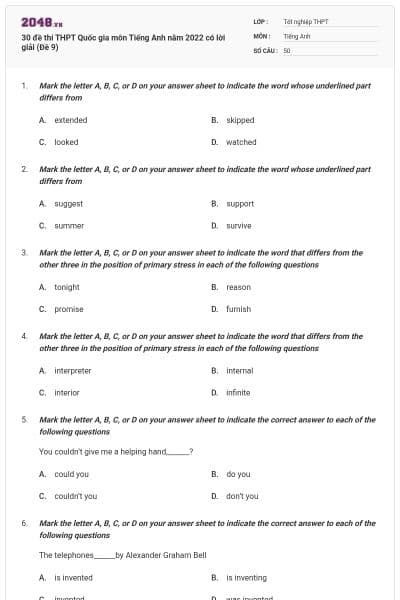
30 đề thi THPT Quốc gia môn Tiếng Anh năm 2022 có lời giải (Đề 9)

50 câu hỏi
Mark the letter A, B, C, or D on your answer sheet to indicate the word whose underlined part differs from
extended
skipped
looked
watched
Mark the letter A, B, C, or D on your answer sheet to indicate the word whose underlined part differs from
suggest
support
summer
survive
Mark the letter A, B, C, or D on your answer sheet to indicate the word that differs from the other three in the position of primary stress in each of the following questions
tonight
reason
promise
furnish
Mark the letter A, B, C, or D on your answer sheet to indicate the word that differs from the other three in the position of primary stress in each of the following questions
interpreter
internal
interior
infinite
Mark the letter A, B, C, or D on your answer sheet to indicate the correct answer to each of the following questions
You couldn’t give me a helping hand,______?
could you
do you
couldn’t you
don’t you
Mark the letter A, B, C, or D on your answer sheet to indicate the correct answer to each of the following questions
The telephones______by Alexander Graham Bell
is invented
is inventing
invented
was invented
Mark the letter A, B, C, or D on your answer sheet to indicate the correct answer to each of the following questions
We should make full use _____the Internet as it is an endless source of information
of
in
with
from
Mark the letter A, B, C, or D on your answer sheet to indicate the correct answer to each of the following questions
Air pollution is getting serious in big cities in the world
more and more
the more and themore
the most andthe most
most andmost
Mark the letter A, B, C, or D on your answer sheet to indicate the correct answer to each of the following questions
There is in my bedroom
an old square wooden table
a square wooden oldtable
an old woodensquaretable
a wooden old squaretable
Mark the letter A, B, C, or D on your answer sheet to indicate the correct answer to each of the following questions
When we came in, they the meal for us
prepared
prepare
preparing
were preparing
Mark the letter A, B, C, or D on your answer sheet to indicate the correct answer to each of the following questions
The house felt terribly cold the fact that the central heating had been on all day
because of
inspiteof
because
although
Mark the letter A, B, C, or D on your answer sheet to indicate the correct answer to each of the following questions
, he will tell us about the match
When he arrives
After he arrived
Until he was arriving
While he had arrived
Mark the letter A, B, C, or D on your answer sheet to indicate the correct answer to each of the following questions
for 4 hours, they decided to stop to have lunch at a cheap restaurant
Having been walked
Havingwalked
Walking
Walked
Mark the letter A, B, C, or D on your answer sheet to indicate the correct answer to each of the following questions
As an Mr. Pike is very worried about the increasing of juvenile delinquency
educate
education
educator
educative
Mark the letter A, B, C, or D on your answer sheet to indicate the correct answer to each of the following questions
Many parents tend to make their children study hard in the belief that good education will enable them to in the future
get on
turnup
turnaway
getout
Mark the letter A, B, C, or D on your answer sheet to indicate the correct answer to each of the following questions
Several measures have been proposed to the problem of unemployment among university graduates
create.
address.
pose.
admit.
Mark the letter A, B, C, or D on your answer sheet to indicate the correct answer to each of the following questions
You must not any step in the process; otherwise, you would not be able to cook the dish properly
leave.
quit.
skip.
hide.
Mark the letter A, B, C, or D on your answer sheet to indicate the correct answer to each of the following questions
I'd like to speak to the person in_______please
duty
responsibility
obligation
charge
Mark the letter A, B, C, or D on your answer sheet to indicate the correct answer to each of the following questions
The image of Vietnamese women with creativeness, dynamism, success has become popular in Vietnam’s society
contemporary
temporary
permanent
conventional
Mark the letter A, B, C, or D on your answer sheet to indicate the word(s) CLOSEST in meaning to the underlined word(s) in each of the following questions
The charming old buildings and cottages are a throwback to the colonial past
cunning
exciting
interesting
fascinating
Mark the letter A, B, C, or D on your answer sheet to indicate the word(s) CLOSEST in meaning to the underlined word(s) in each of the following questions
The 1960s building boom in Zürich completely changed the rural landscape.
thoroughly
quickly
easily
highly
Mark the letter A, B, C, or D on your answer sheet to indicate the word(s) OPPOSITE in meaning to the underlined word(s) in each of the following questions
Overpopulation in big cities has severely affected the air and water quality
seriously
insignificantly
largely
commonly
Mark the letter A, B, C, or D on your answer sheet to indicate the word(s) OPPOSITE in meaning to the underlined word(s) in each of the following questions
I'm sure it won't rain, but I'll take an umbrella just to be on the safe side .
careful
easy
careless
difficult
Mark the letter A, B, C, or D on your answer sheet to indicate the option that best completes each of the following exchanges
Daisy wants to invite her classmate, Joe, to her birthday party.
- Daisy: “Listen, I am having a birthday party next Friday. Do you want to come?”
- Joe: “______ What time does it start?”
Sure, I’d love to.
Sorry. I’m busy then.
I can’t agree with you.
I like a party.
Mark the letter A, B, C, or D on your answer sheet to indicate the option that best completes each of the following exchanges
Hana and Jenifer are talking about a book they have just read.
- Hana: “The book is really interesting and educational.” - Jenifer: “______”
That’s nice of you to say so.
I’d love it.
Don’t mention it.
I couldn’t agree more.
Read the following passage and mark the letter A, B, C, or D on your answer sheet to indicate the correct word or phrase that best fits each of the numbered blanks from 26 to 30
Wind is a clean source of renewable energy that produces no air or water pollution. And since the wind is free, operational costs are nearly zero (26) ______ a turbine is erected. Mass production and technology advances are making turbines cheaper, and (27) ______ governments offer tax incentives to spur wind-energy development.
Drawbacks include complaints from (28) ______ that wind turbines are ugly and noisy. The slowly rotating blades can also kill birds and bats, but not nearly as many as cars, power lines, and high-rise buildings do. The wind is also variable: If it's not blowing, there's no electricity generated.
Nevertheless, the wind energy industry is (29) ______ . Thanks to global efforts to combat climate change, such as the Paris Agreement, renewable energy is seeing a boom in growth, in (30) ______ wind energy has led the way. From 2000 to 2015, cumulative wind capacity around the world increased from 17,000 megawatts to more than 430,000 megawatts. In 2015, China also surpassed the EU in the number of installed wind turbines and continues to lead installation efforts.
(Adapted from https://www.nationalgeographic.com/)
Điền vào ô 26
so that
though
therefore
once
Read the following passage and mark the letter A, B, C, or D on your answer sheet to indicate the correct word or phrase that best fits each of the numbered blanks from 26 to 30
Wind is a clean source of renewable energy that produces no air or water pollution. And since the wind is free, operational costs are nearly zero (26) ______ a turbine is erected. Mass production and technology advances are making turbines cheaper, and (27) ______ governments offer tax incentives to spur wind-energy development.
Drawbacks include complaints from (28) ______ that wind turbines are ugly and noisy. The slowly rotating blades can also kill birds and bats, but not nearly as many as cars, power lines, and high-rise buildings do. The wind is also variable: If it's not blowing, there's no electricity generated.
Nevertheless, the wind energy industry is (29) ______ . Thanks to global efforts to combat climate change, such as the Paris Agreement, renewable energy is seeing a boom in growth, in (30) ______ wind energy has led the way. From 2000 to 2015, cumulative wind capacity around the world increased from 17,000 megawatts to more than 430,000 megawatts. In 2015, China also surpassed the EU in the number of installed wind turbines and continues to lead installation efforts.
(Adapted from https://www.nationalgeographic.com/)
Điền vào ô 27
many
little
much
a little
Read the following passage and mark the letter A, B, C, or D on your answer sheet to indicate the correct word or phrase that best fits each of the numbered blanks from 26 to 30
Wind is a clean source of renewable energy that produces no air or water pollution. And since the wind is free, operational costs are nearly zero (26) ______ a turbine is erected. Mass production and technology advances are making turbines cheaper, and (27) ______ governments offer tax incentives to spur wind-energy development.
Drawbacks include complaints from (28) ______ that wind turbines are ugly and noisy. The slowly rotating blades can also kill birds and bats, but not nearly as many as cars, power lines, and high-rise buildings do. The wind is also variable: If it's not blowing, there's no electricity generated.
Nevertheless, the wind energy industry is (29) ______ . Thanks to global efforts to combat climate change, such as the Paris Agreement, renewable energy is seeing a boom in growth, in (30) ______ wind energy has led the way. From 2000 to 2015, cumulative wind capacity around the world increased from 17,000 megawatts to more than 430,000 megawatts. In 2015, China also surpassed the EU in the number of installed wind turbines and continues to lead installation efforts.
(Adapted from https://www.nationalgeographic.com/)
Điền vào ô 28
foreigners
masters
locals
levels
Read the following passage and mark the letter A, B, C, or D on your answer sheet to indicate the correct word or phrase that best fits each of the numbered blanks from 26 to 30
Wind is a clean source of renewable energy that produces no air or water pollution. And since the wind is free, operational costs are nearly zero (26) ______ a turbine is erected. Mass production and technology advances are making turbines cheaper, and (27) ______ governments offer tax incentives to spur wind-energy development.
Drawbacks include complaints from (28) ______ that wind turbines are ugly and noisy. The slowly rotating blades can also kill birds and bats, but not nearly as many as cars, power lines, and high-rise buildings do. The wind is also variable: If it's not blowing, there's no electricity generated.
Nevertheless, the wind energy industry is (29) ______ . Thanks to global efforts to combat climate change, such as the Paris Agreement, renewable energy is seeing a boom in growth, in (30) ______ wind energy has led the way. From 2000 to 2015, cumulative wind capacity around the world increased from 17,000 megawatts to more than 430,000 megawatts. In 2015, China also surpassed the EU in the number of installed wind turbines and continues to lead installation efforts.
(Adapted from https://www.nationalgeographic.com/)
Điền vào ô 29
worrying
booming
informing
relating
Read the following passage and mark the letter A, B, C, or D on your answer sheet to indicate the correct word or phrase that best fits each of the numbered blanks from 26 to 30
Wind is a clean source of renewable energy that produces no air or water pollution. And since the wind is free, operational costs are nearly zero (26) ______ a turbine is erected. Mass production and technology advances are making turbines cheaper, and (27) ______ governments offer tax incentives to spur wind-energy development.
Drawbacks include complaints from (28) ______ that wind turbines are ugly and noisy. The slowly rotating blades can also kill birds and bats, but not nearly as many as cars, power lines, and high-rise buildings do. The wind is also variable: If it's not blowing, there's no electricity generated.
Nevertheless, the wind energy industry is (29) ______ . Thanks to global efforts to combat climate change, such as the Paris Agreement, renewable energy is seeing a boom in growth, in (30) ______ wind energy has led the way. From 2000 to 2015, cumulative wind capacity around the world increased from 17,000 megawatts to more than 430,000 megawatts. In 2015, China also surpassed the EU in the number of installed wind turbines and continues to lead installation efforts.
(Adapted from https://www.nationalgeographic.com/)
Điền vào ô 30
who
when
why
which
Read the following passage and mark the letter A, B, C, or D on your answer sheet to indicate the correct answer to each of the questions from 30 to 35
The coronavirus is usually transmitted by droplets, such as those produced when coughing and sneezing, and by direct or indirect contact with secretions infected by the virus. The virus may also shed in blood, urine and faeces, and, therefore, there is potential for transmission through contact with a wide range of bodily fluids. Certainly, person-to-person spread has been confirmed in community and healthcare settings across Asia and into Europe. There is also a possibility that asymptomatic carriers may be able to infect people. Public Health England (PHE) has classified the COVID-19 infection as an airborne, high consequence infectious disease (HCID) in the UK.
The application of infection prevention and control (IPC) principles are already widely used by healthcare professionals within hospital and community settings to both prevent the spread of infections and to control outbreaks when they do occur. The WHO has issued interim guidance regarding IPC when COVID-19 is suspected. This advice is echoed by guidance issued by PHE.
PHE suggests the coronavirus may pose complications, such as illness pneumonia or severe acute respiratory infection. They also suggest that patients with long-term conditions or are immunocompromised are at risk of these complications. It is important that as first-line staff, midwives are also familiar with the recommended IPC principles and measures, and ensure they have the appropriate personal protective equipment (PPE) when caring for a patient with suspected COVID-19.
What is the main idea of the passage?
the problems related to the coronavirus
epidemic situation in England caused by coronavirus
advice for those who infected with coronavirus
how the coronavirus is transmitted and ways to prevent infectio
Read the following passage and mark the letter A, B, C, or D on your answer sheet to indicate the correct answer to each of the questions from 30 to 35
The coronavirus is usually transmitted by droplets, such as those produced when coughing and sneezing, and by direct or indirect contact with secretions infected by the virus. The virus may also shed in blood, urine and faeces, and, therefore, there is potential for transmission through contact with a wide range of bodily fluids. Certainly, person-to-person spread has been confirmed in community and healthcare settings across Asia and into Europe. There is also a possibility that asymptomatic carriers may be able to infect people. Public Health England (PHE) has classified the COVID-19 infection as an airborne, high consequence infectious disease (HCID) in the UK.
The application of infection prevention and control (IPC) principles are already widely used by healthcare professionals within hospital and community settings to both prevent the spread of infections and to control outbreaks when they do occur. The WHO has issued interim guidance regarding IPC when COVID-19 is suspected. This advice is echoed by guidance issued by PHE.
PHE suggests the coronavirus may pose complications, such as illness pneumonia or severe acute respiratory infection. They also suggest that patients with long-term conditions or are immunocompromised are at risk of these complications. It is important that as first-line staff, midwives are also familiar with the recommended IPC principles and measures, and ensure they have the appropriate personal protective equipment (PPE) when caring for a patient with suspected COVID-19.
The coronavirus can be found in all of the following EXCEPT ______.
blood
clothes
urine
faeces
Read the following passage and mark the letter A, B, C, or D on your answer sheet to indicate the correct answer to each of the questions from 30 to 35
The coronavirus is usually transmitted by droplets, such as those produced when coughing and sneezing, and by direct or indirect contact with secretions infected by the virus. The virus may also shed in blood, urine and faeces, and, therefore, there is potential for transmission through contact with a wide range of bodily fluids. Certainly, person-to-person spread has been confirmed in community and healthcare settings across Asia and into Europe. There is also a possibility that asymptomatic carriers may be able to infect people. Public Health England (PHE) has classified the COVID-19 infection as an airborne, high consequence infectious disease (HCID) in the UK.
The application of infection prevention and control (IPC) principles are already widely used by healthcare professionals within hospital and community settings to both prevent the spread of infections and to control outbreaks when they do occur. The WHO has issued interim guidance regarding IPC when COVID-19 is suspected. This advice is echoed by guidance issued by PHE.
PHE suggests the coronavirus may pose complications, such as illness pneumonia or severe acute respiratory infection. They also suggest that patients with long-term conditions or are immunocompromised are at risk of these complications. It is important that as first-line staff, midwives are also familiar with the recommended IPC principles and measures, and ensure they have the appropriate personal protective equipment (PPE) when caring for a patient with suspected COVID-19.
The word “interim” in paragraph 2 mostly means ______.
temporary
everlasting
permanent
effective
Read the following passage and mark the letter A, B, C, or D on your answer sheet to indicate the correct answer to each of the questions from 30 to 35
The coronavirus is usually transmitted by droplets, such as those produced when coughing and sneezing, and by direct or indirect contact with secretions infected by the virus. The virus may also shed in blood, urine and faeces, and, therefore, there is potential for transmission through contact with a wide range of bodily fluids. Certainly, person-to-person spread has been confirmed in community and healthcare settings across Asia and into Europe. There is also a possibility that asymptomatic carriers may be able to infect people. Public Health England (PHE) has classified the COVID-19 infection as an airborne, high consequence infectious disease (HCID) in the UK.
The application of infection prevention and control (IPC) principles are already widely used by healthcare professionals within hospital and community settings to both prevent the spread of infections and to control outbreaks when they do occur. The WHO has issued interim guidance regarding IPC when COVID-19 is suspected. This advice is echoed by guidance issued by PHE.
PHE suggests the coronavirus may pose complications, such as illness pneumonia or severe acute respiratory infection. They also suggest that patients with long-term conditions or are immunocompromised are at risk of these complications. It is important that as first-line staff, midwives are also familiar with the recommended IPC principles and measures, and ensure they have the appropriate personal protective equipment (PPE) when caring for a patient with suspected COVID-19.
According to the last paragraph, who are at risk of illness pneumonia or severe acute respiratory infection?
- people working in the WHO B. employees of Public Health England
C. those with long-term conditions D. first-line staff like midwives
people working in the WHO
employees of Public Health England
those with long-term conditions
first-line staff like midwives
Read the following passage and mark the letter A, B, C, or D on your answer sheet to indicate the correct answer to each of the questions from 30 to 35
The coronavirus is usually transmitted by droplets, such as those produced when coughing and sneezing, and by direct or indirect contact with secretions infected by the virus. The virus may also shed in blood, urine and faeces, and, therefore, there is potential for transmission through contact with a wide range of bodily fluids. Certainly, person-to-person spread has been confirmed in community and healthcare settings across Asia and into Europe. There is also a possibility that asymptomatic carriers may be able to infect people. Public Health England (PHE) has classified the COVID-19 infection as an airborne, high consequence infectious disease (HCID) in the UK.
The application of infection prevention and control (IPC) principles are already widely used by healthcare professionals within hospital and community settings to both prevent the spread of infections and to control outbreaks when they do occur. The WHO has issued interim guidance regarding IPC when COVID-19 is suspected. This advice is echoed by guidance issued by PHE.
PHE suggests the coronavirus may pose complications, such as illness pneumonia or severe acute respiratory infection. They also suggest that patients with long-term conditions or are immunocompromised are at risk of these complications. It is important that as first-line staff, midwives are also familiar with the recommended IPC principles and measures, and ensure they have the appropriate personal protective equipment (PPE) when caring for a patient with suspected COVID-19.
What does the word “They” in the last paragraph refer to?
IPC
WHO
PHE
COVID-19
Read the following passage and mark the letter A, B, C, or D on your answer sheet to indicate the correct answer to each of the questions from 36 to 42
The authors noted that while other forms of pollution are decreasing, noise pollution has been increasing. This conclusion is reinforced by the fact that there has been an increase in the number of people who have been complaining about excessive noise in the WHO region. Populations that are exposed to high noise levels can be afflicted by other symptoms such as: stress reactions, sleep-stage changes, and clinical symptoms like hypertension and cardiovascular diseases. All these impacts can contribute to premature mortality. It is important to note that these adverse health problems impact all age groups including children and adolescents. In fact, it has been reported that children who live and or study in an area afflicted with noise pollution tend to suffer from stress, impairments in memory and attention as well as difficulty reading.
“In Western Europe, the guidelines say, traffic noise results in an annual loss of at least one million healthy years”. Traffic noise is currently ranked second among environmental threats to public health.
The danger of noise pollution is more present to us when we are asleep. Because the human ear is so sensitive, it never rests, it is always working, picking up and transmitting sounds for our brains to interpret. This always on working process is where the danger lies, though you may be sleeping, sounds are still being picked up and processed. The most common side effects of this phenomenon are sleep disturbance and tiredness, impaired memory, judgment, and psychomotor skills. The other more serious outcomes of this can be the triggering of the body’s acute stress response, which raises blood pressure and heart rate as the body and brain go into a state of hyperarousal. According to the European Environment Agency, at least 10,000 cases of premature deaths from noise exposure occur each year, although incomplete data mean this number is significantly underestimated.
(Adapted from https://www.encida.dk/)
Which of the following best serves as the title for the article?
Noise in the WHO region
Increase in noise, Increase in risk
Health problems and Age groups
Side effects of tiredness
Read the following passage and mark the letter A, B, C, or D on your answer sheet to indicate the correct answer to each of the questions from 36 to 42
The authors noted that while other forms of pollution are decreasing, noise pollution has been increasing. This conclusion is reinforced by the fact that there has been an increase in the number of people who have been complaining about excessive noise in the WHO region. Populations that are exposed to high noise levels can be afflicted by other symptoms such as: stress reactions, sleep-stage changes, and clinical symptoms like hypertension and cardiovascular diseases. All these impacts can contribute to premature mortality. It is important to note that these adverse health problems impact all age groups including children and adolescents. In fact, it has been reported that children who live and or study in an area afflicted with noise pollution tend to suffer from stress, impairments in memory and attention as well as difficulty reading.
“In Western Europe, the guidelines say, traffic noise results in an annual loss of at least one million healthy years”. Traffic noise is currently ranked second among environmental threats to public health.
The danger of noise pollution is more present to us when we are asleep. Because the human ear is so sensitive, it never rests, it is always working, picking up and transmitting sounds for our brains to interpret. This always on working process is where the danger lies, though you may be sleeping, sounds are still being picked up and processed. The most common side effects of this phenomenon are sleep disturbance and tiredness, impaired memory, judgment, and psychomotor skills. The other more serious outcomes of this can be the triggering of the body’s acute stress response, which raises blood pressure and heart rate as the body and brain go into a state of hyperarousal. According to the European Environment Agency, at least 10,000 cases of premature deaths from noise exposure occur each year, although incomplete data mean this number is significantly underestimated.
(Adapted from https://www.encida.dk/)
The word “afflicted” in paragraph 1 most probably means ______.
assumed
illustrated
described
affected
Read the following passage and mark the letter A, B, C, or D on your answer sheet to indicate the correct answer to each of the questions from 36 to 42
The authors noted that while other forms of pollution are decreasing, noise pollution has been increasing. This conclusion is reinforced by the fact that there has been an increase in the number of people who have been complaining about excessive noise in the WHO region. Populations that are exposed to high noise levels can be afflicted by other symptoms such as: stress reactions, sleep-stage changes, and clinical symptoms like hypertension and cardiovascular diseases. All these impacts can contribute to premature mortality. It is important to note that these adverse health problems impact all age groups including children and adolescents. In fact, it has been reported that children who live and or study in an area afflicted with noise pollution tend to suffer from stress, impairments in memory and attention as well as difficulty reading.
“In Western Europe, the guidelines say, traffic noise results in an annual loss of at least one million healthy years”. Traffic noise is currently ranked second among environmental threats to public health.
The danger of noise pollution is more present to us when we are asleep. Because the human ear is so sensitive, it never rests, it is always working, picking up and transmitting sounds for our brains to interpret. This always on working process is where the danger lies, though you may be sleeping, sounds are still being picked up and processed. The most common side effects of this phenomenon are sleep disturbance and tiredness, impaired memory, judgment, and psychomotor skills. The other more serious outcomes of this can be the triggering of the body’s acute stress response, which raises blood pressure and heart rate as the body and brain go into a state of hyperarousal. According to the European Environment Agency, at least 10,000 cases of premature deaths from noise exposure occur each year, although incomplete data mean this number is significantly underestimated.
(Adapted from https://www.encida.dk/)
Which is NOT mentioned in the article as a symptoms caused by exposure to high noise levels?
stress reactions
hypertension
staying highly alert
cardiovascular diseases
Read the following passage and mark the letter A, B, C, or D on your answer sheet to indicate the correct answer to each of the questions from 36 to 42
The authors noted that while other forms of pollution are decreasing, noise pollution has been increasing. This conclusion is reinforced by the fact that there has been an increase in the number of people who have been complaining about excessive noise in the WHO region. Populations that are exposed to high noise levels can be afflicted by other symptoms such as: stress reactions, sleep-stage changes, and clinical symptoms like hypertension and cardiovascular diseases. All these impacts can contribute to premature mortality. It is important to note that these adverse health problems impact all age groups including children and adolescents. In fact, it has been reported that children who live and or study in an area afflicted with noise pollution tend to suffer from stress, impairments in memory and attention as well as difficulty reading.
“In Western Europe, the guidelines say, traffic noise results in an annual loss of at least one million healthy years”. Traffic noise is currently ranked second among environmental threats to public health.
The danger of noise pollution is more present to us when we are asleep. Because the human ear is so sensitive, it never rests, it is always working, picking up and transmitting sounds for our brains to interpret. This always on working process is where the danger lies, though you may be sleeping, sounds are still being picked up and processed. The most common side effects of this phenomenon are sleep disturbance and tiredness, impaired memory, judgment, and psychomotor skills. The other more serious outcomes of this can be the triggering of the body’s acute stress response, which raises blood pressure and heart rate as the body and brain go into a state of hyperarousal. According to the European Environment Agency, at least 10,000 cases of premature deaths from noise exposure occur each year, although incomplete data mean this number is significantly underestimated.
(Adapted from https://www.encida.dk/)
The word “premature” in paragraph 1 is closest in meaning to ______.
early
quick
late
slow
Read the following passage and mark the letter A, B, C, or D on your answer sheet to indicate the correct answer to each of the questions from 36 to 42
The authors noted that while other forms of pollution are decreasing, noise pollution has been increasing. This conclusion is reinforced by the fact that there has been an increase in the number of people who have been complaining about excessive noise in the WHO region. Populations that are exposed to high noise levels can be afflicted by other symptoms such as: stress reactions, sleep-stage changes, and clinical symptoms like hypertension and cardiovascular diseases. All these impacts can contribute to premature mortality. It is important to note that these adverse health problems impact all age groups including children and adolescents. In fact, it has been reported that children who live and or study in an area afflicted with noise pollution tend to suffer from stress, impairments in memory and attention as well as difficulty reading.
“In Western Europe, the guidelines say, traffic noise results in an annual loss of at least one million healthy years”. Traffic noise is currently ranked second among environmental threats to public health.
The danger of noise pollution is more present to us when we are asleep. Because the human ear is so sensitive, it never rests, it is always working, picking up and transmitting sounds for our brains to interpret. This always on working process is where the danger lies, though you may be sleeping, sounds are still being picked up and processed. The most common side effects of this phenomenon are sleep disturbance and tiredness, impaired memory, judgment, and psychomotor skills. The other more serious outcomes of this can be the triggering of the body’s acute stress response, which raises blood pressure and heart rate as the body and brain go into a state of hyperarousal. According to the European Environment Agency, at least 10,000 cases of premature deaths from noise exposure occur each year, although incomplete data mean this number is significantly underestimated.
(Adapted from https://www.encida.dk/)
In Western Europe, an annual loss of at least one million healthy years is resulted from ______
guidelines
public health
environmental threats
traffic noise
Read the following passage and mark the letter A, B, C, or D on your answer sheet to indicate the correct answer to each of the questions from 36 to 42
The authors noted that while other forms of pollution are decreasing, noise pollution has been increasing. This conclusion is reinforced by the fact that there has been an increase in the number of people who have been complaining about excessive noise in the WHO region. Populations that are exposed to high noise levels can be afflicted by other symptoms such as: stress reactions, sleep-stage changes, and clinical symptoms like hypertension and cardiovascular diseases. All these impacts can contribute to premature mortality. It is important to note that these adverse health problems impact all age groups including children and adolescents. In fact, it has been reported that children who live and or study in an area afflicted with noise pollution tend to suffer from stress, impairments in memory and attention as well as difficulty reading.
“In Western Europe, the guidelines say, traffic noise results in an annual loss of at least one million healthy years”. Traffic noise is currently ranked second among environmental threats to public health.
The danger of noise pollution is more present to us when we are asleep. Because the human ear is so sensitive, it never rests, it is always working, picking up and transmitting sounds for our brains to interpret. This always on working process is where the danger lies, though you may be sleeping, sounds are still being picked up and processed. The most common side effects of this phenomenon are sleep disturbance and tiredness, impaired memory, judgment, and psychomotor skills. The other more serious outcomes of this can be the triggering of the body’s acute stress response, which raises blood pressure and heart rate as the body and brain go into a state of hyperarousal. According to the European Environment Agency, at least 10,000 cases of premature deaths from noise exposure occur each year, although incomplete data mean this number is significantly underestimated.
(Adapted from https://www.encida.dk/)
Which of the following is infered according to the article?
Many forms of pollution, except for noise pollution, are decreasing.
Adverse health problems impact children and adolescents only.
The danger of noise pollution is less serious when we are asleep.
At least 100,000 cases of premature deaths from noise exposure occur each year.
Read the following passage and mark the letter A, B, C, or D on your answer sheet to indicate the correct answer to each of the questions from 36 to 42
The authors noted that while other forms of pollution are decreasing, noise pollution has been increasing. This conclusion is reinforced by the fact that there has been an increase in the number of people who have been complaining about excessive noise in the WHO region. Populations that are exposed to high noise levels can be afflicted by other symptoms such as: stress reactions, sleep-stage changes, and clinical symptoms like hypertension and cardiovascular diseases. All these impacts can contribute to premature mortality. It is important to note that these adverse health problems impact all age groups including children and adolescents. In fact, it has been reported that children who live and or study in an area afflicted with noise pollution tend to suffer from stress, impairments in memory and attention as well as difficulty reading.
“In Western Europe, the guidelines say, traffic noise results in an annual loss of at least one million healthy years”. Traffic noise is currently ranked second among environmental threats to public health.
The danger of noise pollution is more present to us when we are asleep. Because the human ear is so sensitive, it never rests, it is always working, picking up and transmitting sounds for our brains to interpret. This always on working process is where the danger lies, though you may be sleeping, sounds are still being picked up and processed. The most common side effects of this phenomenon are sleep disturbance and tiredness, impaired memory, judgment, and psychomotor skills. The other more serious outcomes of this can be the triggering of the body’s acute stress response, which raises blood pressure and heart rate as the body and brain go into a state of hyperarousal. According to the European Environment Agency, at least 10,000 cases of premature deaths from noise exposure occur each year, although incomplete data mean this number is significantly underestimated.
(Adapted from https://www.encida.dk/)
The word “This” in paragraph 3 refers to ______.
side effect
sound
human ear
the danger
Mark the letter A, B, C, or D on your answer sheet to indicate the underlined part that needs correction in each of the following questions
(A)His parents (B) are satisfied (C) with his result when he (D) was at high school yesterday
His
are
with
was
Mark the letter A, B, C, or D on your answer sheet to indicate the underlined part that needs correction in each of the following questions
(A) Her weight has increased (B) remarkably since (C) they began (D) receiving treatment
Her weight
remarkably
they
receiving
Mark the letter A, B, C, or D on your answer sheet to indicate the underlined part that needs correction in each of the following questions
The sign (A) says that we (B) should read (C) the constructions carefully before (D) proceeding
says
should
the constructions
proceeding
Mark the letter A, B, C, or D on your answer sheet to indicate the sentence that is closest in meaning to each of the following questions
It started to rain at 2 o’clock and it is still raining
It has been raining at 2o’clock.
It has been raining since 2o’clock.
It has been raining for 2o’clock.
It has been raining in 2o’clock.
Mark the letter A, B, C, or D on your answer sheet to indicate the sentence that is closest in meaning to each of the following questions
“Mum, please don’t tell Dad my mistake!” the boy said.
The boy insisted his mother not tell his father his mistake.
The boy told his mother not to mention his mistake any more.
The boy asked his mother not to tell his father his mistake.
The boy wanted his mother to keep his mistake in her heart.
Mark the letter A, B, C, or D on your answer sheet to indicate the sentence that is closest in meaning to each of the following questions
You are able to go out with your friend this evening
You musn’t go out with your friend this evening.
You should go out with your friend this evening.
You needn’t go out with your friend this evening.
You can go out with your friend this evening.
Mark the letter A, B, C, or D on your answer sheet to indicate the sentence that best combines each pair of sentences in the following questions
Julian dropped out of college after his first year. Now he regrets it
Julian regretted having dropped out of college after his first year.
Julian wishes he didn’t drop out of college after his first year.
Julian regrets having dropped out of college after his first year.
Only if Julian had dropped out of college after his first year.
Mark the letter A, B, C, or D on your answer sheet to indicate the sentence that best combines each pair of sentences in the following questions
Right after the boy got out of his house, it started to rain heavily
It had rained heavily before the boy got out of his house.
No sooner had the boy got out of his house than it started to rain heavily.
Not until it started to rain heavily did the boy got out of his house.
Hardly had it started to rain heavily when the boy got out of his house.