30 đề thi THPT Quốc gia môn Tiếng Anh năm 2022 có lời giải (Đề 7)

50 câu hỏi
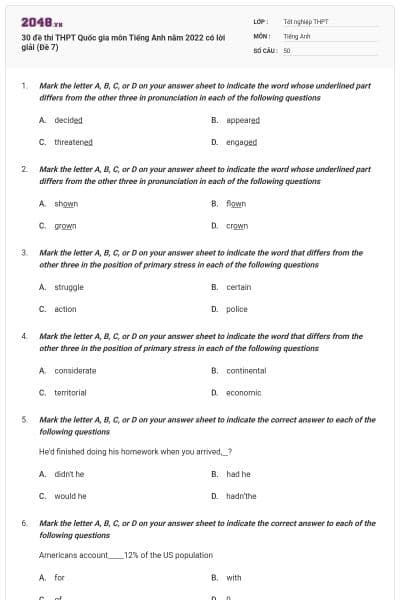
Mark the letter A, B, C, or D on your answer sheet to indicate the word whose underlined part differs from the other three in pronunciation in each of the following questions
decided
appeared
threatened
engaged
Mark the letter A, B, C, or D on your answer sheet to indicate the word whose underlined part differs from the other three in pronunciation in each of the following questions
shown
flown
grown
crown
Mark the letter A, B, C, or D on your answer sheet to indicate the word that differs from the other three in the position of primary stress in each of the following questions
struggle
certain
action
police
Mark the letter A, B, C, or D on your answer sheet to indicate the word that differs from the other three in the position of primary stress in each of the following questions
considerate
continental
territorial
economic
Mark the letter A, B, C, or D on your answer sheet to indicate the correct answer to each of the following questions
He'd finished doing his homework when you arrived, ?
didn't he
had he
would he
hadn’the
Mark the letter A, B, C, or D on your answer sheet to indicate the correct answer to each of the following questions
Americans account 12% of the US population
for
with
of
0
Mark the letter A, B, C, or D on your answer sheet to indicate the correct answer to each of the following questions
The more you study during this semester, the week before the exam
you have to study the less
the less you have tostudy
the least you havetostudy
the study less youhave
Mark the letter A, B, C, or D on your answer sheet to indicate the correct answer to each of the following questions
Something funny in class yesterday
happened
was happened
happens
is happened
Mark the letter A, B, C, or D on your answer sheet to indicate the correct answer to each of the following questions
John lost the bicycle he bought last week and his parents were very angry with him
new beautiful blue Japanese
beautiful blue Japanesenew
beautiful newblueJapanese
Japanese beautiful newblue
Mark the letter A, B, C, or D on your answer sheet to indicate the correct answer to each of the following questions
We ________ TV when it started to rain
are watching
have watched
had watched
were watching
Mark the letter A, B, C, or D on your answer sheet to indicate the correct answer to each of the following questions
The building work is still on schedule...........a problem in digging the foundation
due to
despite
soas
onlyif
Mark the letter A, B, C, or D on your answer sheet to indicate the correct answer to each of the following questions
He will take the dog out for a walk dinner
as soon as he finishes
as soonashe finish
Whilehewillfinish
before heshall havefinished
Mark the letter A, B, C, or D on your answer sheet to indicate the correct answer to each of the following questions
, Joe was annoyed to find that he had left his key at the coffee shop
After returned to his office
To have just returned to hisoffice
Upon returning tohisoffice
Having been returned to hisoffice
Mark the letter A, B, C, or D on your answer sheet to indicate the correct answer to each of the following questions
Email and instant messaging services have global communication
revolutionised
revolutionary
revolution
revolutionarily
Mark the letter A, B, C, or D on your answer sheet to indicate the correct answer to each of the following questions
My mother often complains, “You’re so messy. I always have to _______ after you.”
put on
go up
clean up
keep on
Mark the letter A, B, C, or D on your answer sheet to indicate the correct answer to each of the following questions
Make sure you us a visit when you are in town again
give
do
pay
have
Mark the letter A, B, C, or D on your answer sheet to indicate the correct answer to each of the following questions
I gave the waiter a $50 note and waited for my .
supply
change
cost
cash
Mark the letter A, B, C, or D on your answer sheet to indicate the correct answer to each of the following questions
Unluckily, David's dangerous and incredible journey in search of the Blue Fairy is in_______.
advance
danger
end
vain
Mark the letter A, B, C, or D on your answer sheet to indicate the correct answer to each of the following questions
Jenny has an command of Japanese cuisine.
intensive
utter
impressive
extreme
Mark the letter A, B, C, or D on your answer sheet to indicate the word(s) CLOSEST in meaning to the underlined word(s) in each of the following questions
The most important thing is to keep yourself occupied
busy
comfortable
free
relaxed
Mark the letter A, B, C, or D on your answer sheet to indicate the word(s) CLOSEST in meaning to the underlined word(s) in each of the following questions
It is our case that he was reckless and negligent in the way he drove
inharmonious
ingenious
intangible
incautious
Mark the letter A, B, C, or D on your answer sheet to indicate the word(s) OPPOSITE in meaning to the underlined word(s) in each of the following questions
With the final examinations coming very soon his anxiety was rising to almost unbearable limits
joy
confidence
boredom
apprehension
Mark the letter A, B, C, or D on your answer sheet to indicate the word(s) OPPOSITE in meaning to the underlined word(s) in each of the following questions
The captain ordered the soldiers to gather on the double even though they were sleeping
willingly
immediately
slowly
intensively
Mark the letter A, B, C, or D on your answer sheet to indicate the option that best completes each of the following exchanges
- Customer: “Can I try this jumper on?” - Salesgirl: “______”
No, the shop is closed in half an hour.
Sorry, only cash is accepted here.
Yes, it costs one hundred and fifty dollars.
Sure, the changing rooms are over there.
Mark the letter A, B, C, or D on your answer sheet to indicate the option that best completes each of the following exchanges
Tom and Linda are talking about jobs they would like to choose.
- Tom: “I think working as a doctor is a challenging job.”
- Linda: “______”
It’s a good idea.
Not at all.
I’m sorry, but I agree with you.
That’s exactly what I think.
Read the following passage and mark the letter A, B, C, or D on your answer sheet to indicate the correct word or phrase that best fits each of the numbered blanks from 26 to 30
The United States of America, due to its immense size and diverse heritage, has one of the most complex cultural identities in the world. Millions of immigrants from all over the globe have journeyed to America (26) ______ the Europeans discovered and colonised the land back in the 17th and 18th centuries. The blending of cultural (27) ______ and ethnicities in America led to the country becoming known as a “melting pot.” As the third largest country in both area and population, America’s size has enabled the formation of subcultures within the country. These subcultures are often geographical as a result of settlement (28) ______ by non-natives as well as regional weather and landscape differences. While there are countless ways to divide the U.S. into regions, here we have referenced the four regions that are West, Midwest, North East and South. People from (29) ______ region may have different lifestyles, cultural values, business practices and dialects. While there are qualities and values (30) ______ most Americans commonly share, it is important not to generalise or assume that all Americans think or act the same way.
(Adapted from https://www.londonschool.com/)
Điền vào ô 26
because
as
for
since
Read the following passage and mark the letter A, B, C, or D on your answer sheet to indicate the correct word or phrase that best fits each of the numbered blanks from 26 to 30
The United States of America, due to its immense size and diverse heritage, has one of the most complex cultural identities in the world. Millions of immigrants from all over the globe have journeyed to America (26) ______ the Europeans discovered and colonised the land back in the 17th and 18th centuries. The blending of cultural (27) ______ and ethnicities in America led to the country becoming known as a “melting pot.” As the third largest country in both area and population, America’s size has enabled the formation of subcultures within the country. These subcultures are often geographical as a result of settlement (28) ______ by non-natives as well as regional weather and landscape differences. While there are countless ways to divide the U.S. into regions, here we have referenced the four regions that are West, Midwest, North East and South. People from (29) ______ region may have different lifestyles, cultural values, business practices and dialects. While there are qualities and values (30) ______ most Americans commonly share, it is important not to generalise or assume that all Americans think or act the same way.
(Adapted from https://www.londonschool.com/)
Điền vào ô 27
backgrounds
reference
reference
importance
Read the following passage and mark the letter A, B, C, or D on your answer sheet to indicate the correct word or phrase that best fits each of the numbered blanks from 26 to 30
The United States of America, due to its immense size and diverse heritage, has one of the most complex cultural identities in the world. Millions of immigrants from all over the globe have journeyed to America (26) ______ the Europeans discovered and colonised the land back in the 17th and 18th centuries. The blending of cultural (27) ______ and ethnicities in America led to the country becoming known as a “melting pot.” As the third largest country in both area and population, America’s size has enabled the formation of subcultures within the country. These subcultures are often geographical as a result of settlement (28) ______ by non-natives as well as regional weather and landscape differences. While there are countless ways to divide the U.S. into regions, here we have referenced the four regions that are West, Midwest, North East and South. People from (29) ______ region may have different lifestyles, cultural values, business practices and dialects. While there are qualities and values (30) ______ most Americans commonly share, it is important not to generalise or assume that all Americans think or act the same way.
(Adapted from https://www.londonschool.com/)
Điền vào ô 28
chapter
revenue
patterns
unions
Read the following passage and mark the letter A, B, C, or D on your answer sheet to indicate the correct word or phrase that best fits each of the numbered blanks from 26 to 30
The United States of America, due to its immense size and diverse heritage, has one of the most complex cultural identities in the world. Millions of immigrants from all over the globe have journeyed to America (26) ______ the Europeans discovered and colonised the land back in the 17th and 18th centuries. The blending of cultural (27) ______ and ethnicities in America led to the country becoming known as a “melting pot.” As the third largest country in both area and population, America’s size has enabled the formation of subcultures within the country. These subcultures are often geographical as a result of settlement (28) ______ by non-natives as well as regional weather and landscape differences. While there are countless ways to divide the U.S. into regions, here we have referenced the four regions that are West, Midwest, North East and South. People from (29) ______ region may have different lifestyles, cultural values, business practices and dialects. While there are qualities and values (30) ______ most Americans commonly share, it is important not to generalise or assume that all Americans think or act the same way.
(Adapted from https://www.londonschool.com/)
Điền vào ô 29
each
other
all
another
Read the following passage and mark the letter A, B, C, or D on your answer sheet to indicate the correct word or phrase that best fits each of the numbered blanks from 26 to 30
The United States of America, due to its immense size and diverse heritage, has one of the most complex cultural identities in the world. Millions of immigrants from all over the globe have journeyed to America (26) ______ the Europeans discovered and colonised the land back in the 17th and 18th centuries. The blending of cultural (27) ______ and ethnicities in America led to the country becoming known as a “melting pot.” As the third largest country in both area and population, America’s size has enabled the formation of subcultures within the country. These subcultures are often geographical as a result of settlement (28) ______ by non-natives as well as regional weather and landscape differences. While there are countless ways to divide the U.S. into regions, here we have referenced the four regions that are West, Midwest, North East and South. People from (29) ______ region may have different lifestyles, cultural values, business practices and dialects. While there are qualities and values (30) ______ most Americans commonly share, it is important not to generalise or assume that all Americans think or act the same way.
(Adapted from https://www.londonschool.com/)
Điền vào ô 30
when
that
why
who
Read the following passage and mark the letter A, B, C, or D on your answer sheet to indicate the correct answer to each of the questions from 31 to 35
GIRLS' EDUCATION
Improving girls' educational levels has been demonstrated to have clear impacts on the health and economic future of young women, which in turn improves the prospect of their entire community. Research shows that every extra year of school for girls increases their lifetime income by 15%. Improving female education, and thus the earning potential of women improves the standard of living for their own children.
Yet, many barriers to education for girls remain. In some African countries, such as Burkina Faso, girls are unlikely to attend school for such basic reasons as a lack of private toilet facilities for girls. Higher attendance rates of high schools and university education among women, particularly in developing countries, have helped them make inroads into professional careers with better-paying salaries and wages.
Education increases a woman's (and her partner's and the family's) level of health and health awareness. Furthering women's levels of education and advanced training also tends to lead to later ages of initiation of sexual activity, later ages at first marriage, and later ages at first childbirth, as well as an increased likelihood to remain single, have no children, or have no formal marriage and alternatively, have increasing levels of long-term partnerships. It can lead to higher rates of barrier and chemical contraceptive use (and a lower level of sexually transmitted infections among women and their partners and children), and can increase the level of resources available to women who divorce or are in a situation of domestic violence. It has been shown, in addition, to increase women's communication with their partners and their employers, and to improve rates of civic participation such as voting or the holding of office
What can be the best title for the reading passage?
Education and Violence Against Women
Women's Rights to Lifelong Education
Female Education and its Social Benefits
Education and Women's Empowerment
Read the following passage and mark the letter A, B, C, or D on your answer sheet to indicate the correct answer to each of the questions from 31 to 35
GIRLS' EDUCATION
Improving girls' educational levels has been demonstrated to have clear impacts on the health and economic future of young women, which in turn improves the prospect of their entire community. Research shows that every extra year of school for girls increases their lifetime income by 15%. Improving female education, and thus the earning potential of women improves the standard of living for their own children.
Yet, many barriers to education for girls remain. In some African countries, such as Burkina Faso, girls are unlikely to attend school for such basic reasons as a lack of private toilet facilities for girls. Higher attendance rates of high schools and university education among women, particularly in developing countries, have helped them make inroads into professional careers with better-paying salaries and wages.
Education increases a woman's (and her partner's and the family's) level of health and health awareness. Furthering women's levels of education and advanced training also tends to lead to later ages of initiation of sexual activity, later ages at first marriage, and later ages at first childbirth, as well as an increased likelihood to remain single, have no children, or have no formal marriage and alternatively, have increasing levels of long-term partnerships. It can lead to higher rates of barrier and chemical contraceptive use (and a lower level of sexually transmitted infections among women and their partners and children), and can increase the level of resources available to women who divorce or are in a situation of domestic violence. It has been shown, in addition, to increase women's communication with their partners and their employers, and to improve rates of civic participation such as voting or the holding of office
It is stated in the first paragraph that
women's educational levels have an influence on the prospect of their community
it is the children's schooling that helps their mothers increase their lifetime income
women who have little schooling often have no idea of raising their children
earning their own living, women take the responsibility of running the household
Read the following passage and mark the letter A, B, C, or D on your answer sheet to indicate the correct answer to each of the questions from 31 to 35
GIRLS' EDUCATION
Improving girls' educational levels has been demonstrated to have clear impacts on the health and economic future of young women, which in turn improves the prospect of their entire community. Research shows that every extra year of school for girls increases their lifetime income by 15%. Improving female education, and thus the earning potential of women improves the standard of living for their own children.
Yet, many barriers to education for girls remain. In some African countries, such as Burkina Faso, girls are unlikely to attend school for such basic reasons as a lack of private toilet facilities for girls. Higher attendance rates of high schools and university education among women, particularly in developing countries, have helped them make inroads into professional careers with better-paying salaries and wages.
Education increases a woman's (and her partner's and the family's) level of health and health awareness. Furthering women's levels of education and advanced training also tends to lead to later ages of initiation of sexual activity, later ages at first marriage, and later ages at first childbirth, as well as an increased likelihood to remain single, have no children, or have no formal marriage and alternatively, have increasing levels of long-term partnerships. It can lead to higher rates of barrier and chemical contraceptive use (and a lower level of sexually transmitted infections among women and their partners and children), and can increase the level of resources available to women who divorce or are in a situation of domestic violence. It has been shown, in addition, to increase women's communication with their partners and their employers, and to improve rates of civic participation such as voting or the holding of office
The word "barriers" in paragraph 2 is closest in meaning to ______
strains
challenges
stresses
obstacles
Read the following passage and mark the letter A, B, C, or D on your answer sheet to indicate the correct answer to each of the questions from 31 to 35
GIRLS' EDUCATION
Improving girls' educational levels has been demonstrated to have clear impacts on the health and economic future of young women, which in turn improves the prospect of their entire community. Research shows that every extra year of school for girls increases their lifetime income by 15%. Improving female education, and thus the earning potential of women improves the standard of living for their own children.
Yet, many barriers to education for girls remain. In some African countries, such as Burkina Faso, girls are unlikely to attend school for such basic reasons as a lack of private toilet facilities for girls. Higher attendance rates of high schools and university education among women, particularly in developing countries, have helped them make inroads into professional careers with better-paying salaries and wages.
Education increases a woman's (and her partner's and the family's) level of health and health awareness. Furthering women's levels of education and advanced training also tends to lead to later ages of initiation of sexual activity, later ages at first marriage, and later ages at first childbirth, as well as an increased likelihood to remain single, have no children, or have no formal marriage and alternatively, have increasing levels of long-term partnerships. It can lead to higher rates of barrier and chemical contraceptive use (and a lower level of sexually transmitted infections among women and their partners and children), and can increase the level of resources available to women who divorce or are in a situation of domestic violence. It has been shown, in addition, to increase women's communication with their partners and their employers, and to improve rates of civic participation such as voting or the holding of office
The phrase “make inroads into” in paragraph 2 can be best replaced by______
celebrate achievement in
succeed in taking
make progress in
take the chance in
Read the following passage and mark the letter A, B, C, or D on your answer sheet to indicate the correct answer to each of the questions from 31 to 35
GIRLS' EDUCATION
Improving girls' educational levels has been demonstrated to have clear impacts on the health and economic future of young women, which in turn improves the prospect of their entire community. Research shows that every extra year of school for girls increases their lifetime income by 15%. Improving female education, and thus the earning potential of women improves the standard of living for their own children.
Yet, many barriers to education for girls remain. In some African countries, such as Burkina Faso, girls are unlikely to attend school for such basic reasons as a lack of private toilet facilities for girls. Higher attendance rates of high schools and university education among women, particularly in developing countries, have helped them make inroads into professional careers with better-paying salaries and wages.
Education increases a woman's (and her partner's and the family's) level of health and health awareness. Furthering women's levels of education and advanced training also tends to lead to later ages of initiation of sexual activity, later ages at first marriage, and later ages at first childbirth, as well as an increased likelihood to remain single, have no children, or have no formal marriage and alternatively, have increasing levels of long-term partnerships. It can lead to higher rates of barrier and chemical contraceptive use (and a lower level of sexually transmitted infections among women and their partners and children), and can increase the level of resources available to women who divorce or are in a situation of domestic violence. It has been shown, in addition, to increase women's communication with their partners and their employers, and to improve rates of civic participation such as voting or the holding of office
The word "It" in paragraph 3 refers to ______
higher attendance rates of high schools and university education
increasing levels of long-term partnerships
a woman's level of health and health awareness
furthering women's levels of education and advanced training
Read the following passage and mark the letter A, B, C, or D on your answer sheet to indicate the correct answer to each of the questions from 36 to 42
In science, a theory is a reasonable explanation of observed events that are related. A theory often involves an imaginary model that helps scientists picture the way an observed event could be produced. A good example of this is found in the kinetic molecular theory, in which gases are pictured as being made up of many small particles that are in constant motion.
A useful theory, in addition to explaining past observations, helps to predict events that have not as yet been observed. After a theory has been publicized, scientists design experiments to test the theory. If observations confirm the scientists' predictions, the theory is supported. If observations do not confirm the predictions, the scientists must search further. There may be a fault in the experiment, or the theory may have to be revised or rejected.
Science involves imagination and creative thinking as well as collecting information and performing experiments. Facts by themselves are not science. As the mathematician Jules Henri Poincare said: "Science is built with facts just as a house is built with bricks, but a collection of facts cannot be called science any more than a pile of bricks can be called a house."
Most scientists start an investigation by finding out what other scientists have learned about a particular problem. After known facts have been gathered, the scientist comes to the part of the investigation that requires considerable imagination. Possible solutions to the problem are formulated. These possible solutions are called hypotheses. In a way, any hypothesis is a leap into the unknown. It extends the scientist's thinking beyond the known facts. The scientist plans experiments, performs calculations and makes observations to test hypotheses. For without hypotheses, further investigation lacks purpose and direction. When hypotheses are confirmed, they are incorporated into theories
In the fourth paragraph, the author implies that imagination is most important to scientists when they ________
gather known facts.
formulate possible solutions to a problem.
evaluate previous work on a problem.
close an investigation.
Read the following passage and mark the letter A, B, C, or D on your answer sheet to indicate the correct answer to each of the questions from 36 to 42
In science, a theory is a reasonable explanation of observed events that are related. A theory often involves an imaginary model that helps scientists picture the way an observed event could be produced. A good example of this is found in the kinetic molecular theory, in which gases are pictured as being made up of many small particles that are in constant motion.
A useful theory, in addition to explaining past observations, helps to predict events that have not as yet been observed. After a theory has been publicized, scientists design experiments to test the theory. If observations confirm the scientists' predictions, the theory is supported. If observations do not confirm the predictions, the scientists must search further. There may be a fault in the experiment, or the theory may have to be revised or rejected.
Science involves imagination and creative thinking as well as collecting information and performing experiments. Facts by themselves are not science. As the mathematician Jules Henri Poincare said: "Science is built with facts just as a house is built with bricks, but a collection of facts cannot be called science any more than a pile of bricks can be called a house."
Most scientists start an investigation by finding out what other scientists have learned about a particular problem. After known facts have been gathered, the scientist comes to the part of the investigation that requires considerable imagination. Possible solutions to the problem are formulated. These possible solutions are called hypotheses. In a way, any hypothesis is a leap into the unknown. It extends the scientist's thinking beyond the known facts. The scientist plans experiments, performs calculations and makes observations to test hypotheses. For without hypotheses, further investigation lacks purpose and direction. When hypotheses are confirmed, they are incorporated into theories
The word "this" in line 3 refers to ______
the kinetic molecular theory
an observed event
an imaginary model
a good example
Read the following passage and mark the letter A, B, C, or D on your answer sheet to indicate the correct answer to each of the questions from 36 to 42
In science, a theory is a reasonable explanation of observed events that are related. A theory often involves an imaginary model that helps scientists picture the way an observed event could be produced. A good example of this is found in the kinetic molecular theory, in which gases are pictured as being made up of many small particles that are in constant motion.
A useful theory, in addition to explaining past observations, helps to predict events that have not as yet been observed. After a theory has been publicized, scientists design experiments to test the theory. If observations confirm the scientists' predictions, the theory is supported. If observations do not confirm the predictions, the scientists must search further. There may be a fault in the experiment, or the theory may have to be revised or rejected.
Science involves imagination and creative thinking as well as collecting information and performing experiments. Facts by themselves are not science. As the mathematician Jules Henri Poincare said: "Science is built with facts just as a house is built with bricks, but a collection of facts cannot be called science any more than a pile of bricks can be called a house."
Most scientists start an investigation by finding out what other scientists have learned about a particular problem. After known facts have been gathered, the scientist comes to the part of the investigation that requires considerable imagination. Possible solutions to the problem are formulated. These possible solutions are called hypotheses. In a way, any hypothesis is a leap into the unknown. It extends the scientist's thinking beyond the known facts. The scientist plans experiments, performs calculations and makes observations to test hypotheses. For without hypotheses, further investigation lacks purpose and direction. When hypotheses are confirmed, they are incorporated into theories
According to the second paragraph, a useful theory is one that helps scientists to ______
find errors in past experiments.
publicize new findings.
observe events.
make predictions.
Read the following passage and mark the letter A, B, C, or D on your answer sheet to indicate the correct answer to each of the questions from 36 to 42
In science, a theory is a reasonable explanation of observed events that are related. A theory often involves an imaginary model that helps scientists picture the way an observed event could be produced. A good example of this is found in the kinetic molecular theory, in which gases are pictured as being made up of many small particles that are in constant motion.
A useful theory, in addition to explaining past observations, helps to predict events that have not as yet been observed. After a theory has been publicized, scientists design experiments to test the theory. If observations confirm the scientists' predictions, the theory is supported. If observations do not confirm the predictions, the scientists must search further. There may be a fault in the experiment, or the theory may have to be revised or rejected.
Science involves imagination and creative thinking as well as collecting information and performing experiments. Facts by themselves are not science. As the mathematician Jules Henri Poincare said: "Science is built with facts just as a house is built with bricks, but a collection of facts cannot be called science any more than a pile of bricks can be called a house."
Most scientists start an investigation by finding out what other scientists have learned about a particular problem. After known facts have been gathered, the scientist comes to the part of the investigation that requires considerable imagination. Possible solutions to the problem are formulated. These possible solutions are called hypotheses. In a way, any hypothesis is a leap into the unknown. It extends the scientist's thinking beyond the known facts. The scientist plans experiments, performs calculations and makes observations to test hypotheses. For without hypotheses, further investigation lacks purpose and direction. When hypotheses are confirmed, they are incorporated into theories
The word "related" in line 1 is closest in meaning to _______.
completed
identified
described
connected
Read the following passage and mark the letter A, B, C, or D on your answer sheet to indicate the correct answer to each of the questions from 36 to 42
In science, a theory is a reasonable explanation of observed events that are related. A theory often involves an imaginary model that helps scientists picture the way an observed event could be produced. A good example of this is found in the kinetic molecular theory, in which gases are pictured as being made up of many small particles that are in constant motion.
A useful theory, in addition to explaining past observations, helps to predict events that have not as yet been observed. After a theory has been publicized, scientists design experiments to test the theory. If observations confirm the scientists' predictions, the theory is supported. If observations do not confirm the predictions, the scientists must search further. There may be a fault in the experiment, or the theory may have to be revised or rejected.
Science involves imagination and creative thinking as well as collecting information and performing experiments. Facts by themselves are not science. As the mathematician Jules Henri Poincare said: "Science is built with facts just as a house is built with bricks, but a collection of facts cannot be called science any more than a pile of bricks can be called a house."
Most scientists start an investigation by finding out what other scientists have learned about a particular problem. After known facts have been gathered, the scientist comes to the part of the investigation that requires considerable imagination. Possible solutions to the problem are formulated. These possible solutions are called hypotheses. In a way, any hypothesis is a leap into the unknown. It extends the scientist's thinking beyond the known facts. The scientist plans experiments, performs calculations and makes observations to test hypotheses. For without hypotheses, further investigation lacks purpose and direction. When hypotheses are confirmed, they are incorporated into theories
The word "supported" is closest in meaning to _______.
upheld
investigated
finished
adjusted
Read the following passage and mark the letter A, B, C, or D on your answer sheet to indicate the correct answer to each of the questions from 36 to 42
In science, a theory is a reasonable explanation of observed events that are related. A theory often involves an imaginary model that helps scientists picture the way an observed event could be produced. A good example of this is found in the kinetic molecular theory, in which gases are pictured as being made up of many small particles that are in constant motion.
A useful theory, in addition to explaining past observations, helps to predict events that have not as yet been observed. After a theory has been publicized, scientists design experiments to test the theory. If observations confirm the scientists' predictions, the theory is supported. If observations do not confirm the predictions, the scientists must search further. There may be a fault in the experiment, or the theory may have to be revised or rejected.
Science involves imagination and creative thinking as well as collecting information and performing experiments. Facts by themselves are not science. As the mathematician Jules Henri Poincare said: "Science is built with facts just as a house is built with bricks, but a collection of facts cannot be called science any more than a pile of bricks can be called a house."
Most scientists start an investigation by finding out what other scientists have learned about a particular problem. After known facts have been gathered, the scientist comes to the part of the investigation that requires considerable imagination. Possible solutions to the problem are formulated. These possible solutions are called hypotheses. In a way, any hypothesis is a leap into the unknown. It extends the scientist's thinking beyond the known facts. The scientist plans experiments, performs calculations and makes observations to test hypotheses. For without hypotheses, further investigation lacks purpose and direction. When hypotheses are confirmed, they are incorporated into theories
In the last paragraph, what does the author imply a major function of hypotheses?
Communicating a scientist's thoughts to others.
Sifting through known facts.
Linking together different theories.
Providing direction for scientific research.
Read the following passage and mark the letter A, B, C, or D on your answer sheet to indicate the correct answer to each of the questions from 36 to 42
In science, a theory is a reasonable explanation of observed events that are related. A theory often involves an imaginary model that helps scientists picture the way an observed event could be produced. A good example of this is found in the kinetic molecular theory, in which gases are pictured as being made up of many small particles that are in constant motion.
A useful theory, in addition to explaining past observations, helps to predict events that have not as yet been observed. After a theory has been publicized, scientists design experiments to test the theory. If observations confirm the scientists' predictions, the theory is supported. If observations do not confirm the predictions, the scientists must search further. There may be a fault in the experiment, or the theory may have to be revised or rejected.
Science involves imagination and creative thinking as well as collecting information and performing experiments. Facts by themselves are not science. As the mathematician Jules Henri Poincare said: "Science is built with facts just as a house is built with bricks, but a collection of facts cannot be called science any more than a pile of bricks can be called a house."
Most scientists start an investigation by finding out what other scientists have learned about a particular problem. After known facts have been gathered, the scientist comes to the part of the investigation that requires considerable imagination. Possible solutions to the problem are formulated. These possible solutions are called hypotheses. In a way, any hypothesis is a leap into the unknown. It extends the scientist's thinking beyond the known facts. The scientist plans experiments, performs calculations and makes observations to test hypotheses. For without hypotheses, further investigation lacks purpose and direction. When hypotheses are confirmed, they are incorporated into theories
Which of the following statements is supported by the passage?
A good scientist needs to be creative.
It is better to revise a hypothesis than to reject it.
Theories are simply imaginary models of past events.
A scientist's most difficult task is testing hypotheses.
Mark the letter A, B, C or D to indicate the underlined part that needs correction in each of the following questions
(A) The man (B) is invited (C) to the Clambake (D) by Mary last night
The
is
to
by
Mark the letter A, B, C or D to indicate the underlined part that needs correction in each of the following questions
(A) Opening the letter (B) from his boyfriend, she (C) felt extremely (D) excited
Opening
from his
felt
excited
Mark the letter A, B, C or D to indicate the underlined part that needs correction in each of the following questions
They have carried out (A) exhausting research (B) into the effects of smartphones on schoolchildren’s (C) behaviour and their (D) academic performance
exhausting
into
behavior
academic performance
Mark the letter A, B, C, or D to indicate the sentence that is closest in meaning to each of the following questions
We last went to that cinema 2 months ago
We have been to the cinema for 2months.
We haven't been to the cinema for 2months.
We didn't want to go to the cinemaanymore.
We didn't go to the cinema for 2months.
Mark the letter A, B, C, or D to indicate the sentence that is closest in meaning to each of the following questions
“Would you like to go to the show with me?” Anna said to Bella
Anna reminded Bella to go to the show with her.
Anna persuaded Bella to go to the show with her.
Anna invited Bella to go to the show with her.
Anna encouraged Bella to go to the show with her.
Mark the letter A, B, C, or D to indicate the sentence that is closest in meaning to each of the following questions
You shouldn't have allowed them to watch too much TV
You were wrong to let them watch too muchTV.
You allowed them to watch too much TV which iswrong.
It was not necessary to allow them to watch too muchTV.
Watching too much TV is not good forthem.
Mark the letter A, B, C, or D to indicate the sentence that best combines each pair of sentences in the following questions
Nam was so rude to them last night. Now he feels regretful.
Nam regrets to have been so rude to them last night.
Nam regrets having so rude to them last night.
Nam wishes he hadn’t been so rude to them last night.
Nam wishes he weren’t so rude to them last night.
Mark the letter A, B, C, or D to indicate the sentence that best combines each pair of sentences in the following questions
We arrived at the cinema. Then we realized our tickets were still at home
No sooner had we realized that our tickets were still at home than we arrived at the cinema.
Not until we arrived at the cinema that we realized that our tickets were still at home.
Only after we had arrived at the cinema did we realize that our tickets were at home.
Hardly had we arrived at the cinema than we realized that our tickets were still at home.