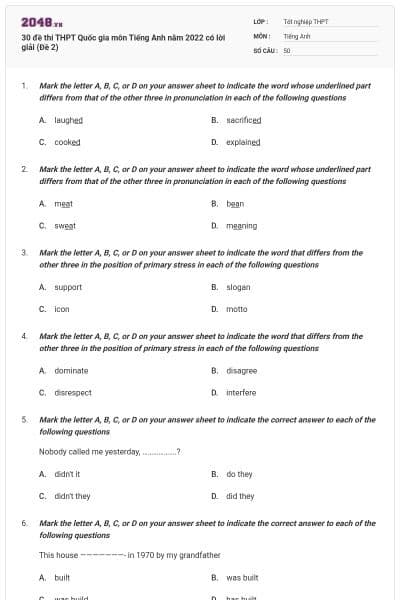
30 đề thi THPT Quốc gia môn Tiếng Anh năm 2022 có lời giải (Đề 2)

50 câu hỏi
Mark the letter A, B, C, or D on your answer sheet to indicate the word whose underlined part differs from that of the other three in pronunciation in each of the following questions
laughed
sacrificed
cooked
explained
Mark the letter A, B, C, or D on your answer sheet to indicate the word whose underlined part differs from that of the other three in pronunciation in each of the following questions
meat
bean
sweat
meaning
Mark the letter A, B, C, or D on your answer sheet to indicate the word that differs from the other three in the position of primary stress in each of the following questions
support
slogan
icon
motto
Mark the letter A, B, C, or D on your answer sheet to indicate the word that differs from the other three in the position of primary stress in each of the following questions
dominate
disagree
disrespect
interfere
Mark the letter A, B, C, or D on your answer sheet to indicate the correct answer to each of the following questions
Nobody called me yesterday, ……………….?
didn't it
do they
didn't they
did they
Mark the letter A, B, C, or D on your answer sheet to indicate the correct answer to each of the following questions
This house ———————- in 1970 by my grandfather
built
was built
was build
has built
Mark the letter A, B, C, or D on your answer sheet to indicate the correct answer to each of the following questions
What do you know .......... him?
on
about
with
for
Mark the letter A, B, C, or D on your answer sheet to indicate the correct answer to each of the following questions
The more I tried my best to help her, ……….she became
less lazy
the lazier
the more lazy
lazier
Mark the letter A, B, C, or D on your answer sheet to indicate the correct answer to each of the following questions
She has just bought
an interesting French old painting
an old interesting Frenchpainting
a French interestingoldpainting
an interesting old Frenchpainting
Mark the letter A, B, C, or D on your answer sheet to indicate the correct answer to each of the following questions
When the boss walked into the office, his secretary _______
has been typing
was typing
is typing
had typed
Mark the letter A, B, C, or D on your answer sheet to indicate the correct answer to each of the following questions
She got the job the fact that she had very little experience
although
because of
despite
because
Mark the letter A, B, C, or D on your answer sheet to indicate the correct answer to each of the following questions
________ to help, we will have finished the work
By the time John comes
Since John comes
When John comes
Until John comes
Mark the letter A, B, C, or D on your answer sheet to indicate the correct answer to each of the following questions
the distance was too far and the time was short, we decided to fly there instead of going there by train
To discover
Discovered
To have discovered
Discovering
Mark the letter A, B, C, or D on your answer sheet to indicate the correct answer to each of the following questions
She was pleased that things were going on _______
satisfied
satisfactorily
satisfying
satisfactio
Mark the letter A, B, C, or D on your answer sheet to indicate the correct answer to each of the following questions
I was late for work because my alarm clock did not _______
turn off
put off
send off
go off
Mark the letter A, B, C, or D on your answer sheet to indicate the correct answer to each of the following questions
Peter______ a better understanding of Algebra than we do
makes
has
takes
gives
Mark the letter A, B, C, or D on your answer sheet to indicate the correct answer to each of the following questions
The sight of his pale face brought ________ to me how ill he really was
place
house
life
home
Mark the letter A, B, C, or D on your answer sheet to indicate the correct answer to each of the following questions
Ihe children had to___________in the principal’s office after they took part in a fight
hit the right notes
beat around the bush
play second fiddle
face the music
Mark the letter A, B, C, or D on your answer sheet to indicate the correct answer to each of the following questions
In the formal interview, it is essential to maintain good eye with the interviewers
contact
touch
link
connection
Mark the letter A, B, C, or D on your answer sheet to indicate the word(s) CLOSEST in meaning to the underlined word(s) in each of the following questions
The factory is fined for discharging dangerous chemicals into the river
releasing
increasing
decreasing
keeping
Mark the letter A, B, C, or D on your answer sheet to indicate the word(s) CLOSEST in meaning to the underlined word(s) in each of the following questions
The new college is intended to improve the life chances of children in the inner city
productions
communities
opportunities
questions
Mark the letter A, B, C, or D on your answer sheet to indicate the word(s) OPPOSITE in meaning to the underlined word(s) in each of the following questions
Children brought up in a caring environment tend to grow more sympathetic towards others
loving
dishonest
healthy
hateful
Mark the letter A, B, C, or D on your answer sheet to indicate the word(s) OPPOSITE in meaning to the underlined word(s) in each of the following questions
It’s quite disappointing that some people still turn a blind eye to acts of injustice they witness in the street
take no notice of
have no feeling for
show respect for
pay attention to
Mark the letter A, B, C, or D on your answer sheet to indicate the option that best completes each of the following exchanges
Janet wants to invite Susan to go to the cinema.
- Janet: “Do you feel like going to the cinema this evening?” - Susan: “______.”
I don’t agree, I’m afraid
You’re welcome
That would be great
I feel very bored
Mark the letter A, B, C, or D on your answer sheet to indicate the option that best completes each of the following exchanges
- Baker: “In my opinion, women often drive more carefully than men.”
- Barbara: “______.”
Never mind
What nonsense
Absolutely
Yes, please
Read the following passage and mark the letter A, B, C, or D on your answer sheet to indicate the correct word or phrase that best fits each of the numbered blanks from 26 to 30
Urban development is having a direct impact on the weather in (26) ______ cities worldwide. It has been noticed that the difference in temperature is usually greater at night and the phenomenon occurs in both winter and summer. Experts agree that this is due to urban development, when open green spaces are replaced with asphalt roads and tall brick or concrete buildings. These materials retain heat generated by the Sun and release it through the night. In Atlanta, in the US, this has even led to thunderstorms (27) ______ occur in the morning rather than, as is more common, in the afternoon.
Large cities around the world are adopting strategies to combat this issue, (28) ______ it is not uncommon to find plants growing on top of roofs or down the walls of large buildings. In Singapore, the government has (29) ______ to transform it into a "city within a garden" and, in 2006, they held an international competition calling for entries to develop a master plan to help bring this about. One outcome was the creation of 18 "Supertrees" – metal constructions resembling very tall trees. Each one is a vertical freestanding garden and is (30) ______ to exotic plants and ferns. They also contain solar panels used to light the trees at night and also containers to collect rainwater, making them truly self-sufficient
Điền vào ô 26
one
many
each
much
Read the following passage and mark the letter A, B, C, or D on your answer sheet to indicate the correct word or phrase that best fits each of the numbered blanks from 26 to 30
Urban development is having a direct impact on the weather in (26) ______ cities worldwide. It has been noticed that the difference in temperature is usually greater at night and the phenomenon occurs in both winter and summer. Experts agree that this is due to urban development, when open green spaces are replaced with asphalt roads and tall brick or concrete buildings. These materials retain heat generated by the Sun and release it through the night. In Atlanta, in the US, this has even led to thunderstorms (27) ______ occur in the morning rather than, as is more common, in the afternoon.
Large cities around the world are adopting strategies to combat this issue, (28) ______ it is not uncommon to find plants growing on top of roofs or down the walls of large buildings. In Singapore, the government has (29) ______ to transform it into a "city within a garden" and, in 2006, they held an international competition calling for entries to develop a master plan to help bring this about. One outcome was the creation of 18 "Supertrees" – metal constructions resembling very tall trees. Each one is a vertical freestanding garden and is (30) ______ to exotic plants and ferns. They also contain solar panels used to light the trees at night and also containers to collect rainwater, making them truly self-sufficient
Điền vào ô 27
which
where
what
when
Read the following passage and mark the letter A, B, C, oar D on your answer sheet to indicate the correct word or phrase that best fits each of the numbered blanks from 26 to 30
Urban development is having a direct impact on the weather in (26) ______ cities worldwide. It has been noticed that the difference in temperature is usually greater at night and the phenomenon occurs in both winter and summer. Experts agree that this is due to urban development, when open green spaces are replaced with asphalt roads and tall brick or concrete buildings. These materials retain heat generated by the Sun and release it through the night. In Atlanta, in the US, this has even led to thunderstorms (27) ______ occur in the morning rather than, as is more common, in the afternoon.
Large cities around the world are adopting strategies to combat this issue, (28) ______ it is not uncommon to find plants growing on top of roofs or down the walls of large buildings. In Singapore, the government has (29) ______ to transform it into a "city within a garden" and, in 2006, they held an international competition calling for entries to develop a master plan to help bring this about. One outcome was the creation of 18 "Supertrees" – metal constructions resembling very tall trees. Each one is a vertical freestanding garden and is (30) ______ to exotic plants and ferns. They also contain solar panels used to light the trees at night and also containers to collect rainwater, making them truly self-sufficient
Điền vào ô 28
however
for
otherwise
and
Read the following passage and mark the letter A, B, C, oar D on your answer sheet to indicate the correct word or phrase that best fits each of the numbered blanks from 26 to 30
Urban development is having a direct impact on the weather in (26) ______ cities worldwide. It has been noticed that the difference in temperature is usually greater at night and the phenomenon occurs in both winter and summer. Experts agree that this is due to urban development, when open green spaces are replaced with asphalt roads and tall brick or concrete buildings. These materials retain heat generated by the Sun and release it through the night. In Atlanta, in the US, this has even led to thunderstorms (27) ______ occur in the morning rather than, as is more common, in the afternoon.
Large cities around the world are adopting strategies to combat this issue, (28) ______ it is not uncommon to find plants growing on top of roofs or down the walls of large buildings. In Singapore, the government has (29) ______ to transform it into a "city within a garden" and, in 2006, they held an international competition calling for entries to develop a master plan to help bring this about. One outcome was the creation of 18 "Supertrees" – metal constructions resembling very tall trees. Each one is a vertical freestanding garden and is (30) ______ to exotic plants and ferns. They also contain solar panels used to light the trees at night and also containers to collect rainwater, making them truly self-sufficient
Điền vào ô 29
committed
pledged
confessed
required
Read the following passage and mark the letter A, B, C, oar D on your answer sheet to indicate the correct word or phrase that best fits each of the numbered blanks from 26 to 30
Urban development is having a direct impact on the weather in (26) ______ cities worldwide. It has been noticed that the difference in temperature is usually greater at night and the phenomenon occurs in both winter and summer. Experts agree that this is due to urban development, when open green spaces are replaced with asphalt roads and tall brick or concrete buildings. These materials retain heat generated by the Sun and release it through the night. In Atlanta, in the US, this has even led to thunderstorms (27) ______ occur in the morning rather than, as is more common, in the afternoon.
Large cities around the world are adopting strategies to combat this issue, (28) ______ it is not uncommon to find plants growing on top of roofs or down the walls of large buildings. In Singapore, the government has (29) ______ to transform it into a "city within a garden" and, in 2006, they held an international competition calling for entries to develop a master plan to help bring this about. One outcome was the creation of 18 "Supertrees" – metal constructions resembling very tall trees. Each one is a vertical freestanding garden and is (30) ______ to exotic plants and ferns. They also contain solar panels used to light the trees at night and also containers to collect rainwater, making them truly self-sufficient
Điền vào ô 30
land
house
place
home
Read the following passage and mark the letter A, B, C, or D on your answer sheet to indicate the correct answer to each of the questions from 31 to 35
Edward Patrick Eagan was born on April 26th 1897 in Denver, Colorado, and his father died in a railroad accident when Eagan was only one year old. He and his four brothers were raised by his mother, who earned a small income from teaching foreign languages.
Inspired by Frank Marriwell, the hero of a series of popular novels for boys, Eagan pursued an education for himself and an interest in boxing. He attended the University of Denver for a year before serving in the U.S. army as an artillery lieutenant during World War I. After the war, he entered Yale University and while studying there, won the US national amateur heavyweight boxing title. He graduated from Yale in 1921, attended Harvard Law School, and received a Rhodes scholarship to the University of Oxford where he received his A.M. in 1928.
While studying at Oxford, Eagan became the first American to win the British amateur boxing championship. Eagan won his first gold medal as a light heavyweight boxer at the 1920 Olympic Games in Antwerp, Belgium. Eagan also fought at the 1924 Olympics in Paris as a heavyweight but failed to get a medal. Though he had taken up the sport just three weeks before the competition, he managed to win a second gold medal as a member of four-man bobsled team at the 1932 Olympics in Lake Placid, New York. Thus, he became the only athlete to win gold medals at both the Summer and Winter Olympics.
(Adapted from "Peteson's Master TOEFL Reading Skills)
What is the main idea of the passage?
Eagan's life shows that a man can be an athlete and a well-educated person.
Eagan's life shows that military experiences make athletes great.
Eagan's life shows how a wealthy student can achieve as much as a poor one.
Eagan's life shows how easy it is to win two gold medals in different Olympic sports.
Read the following passage and mark the letter A, B, C, or D on your answer sheet to indicate the correct answer to each of the questions from 31 to 35
Edward Patrick Eagan was born on April 26th 1897 in Denver, Colorado, and his father died in a railroad accident when Eagan was only one year old. He and his four brothers were raised by his mother, who earned a small income from teaching foreign languages.
Inspired by Frank Marriwell, the hero of a series of popular novels for boys, Eagan pursued an education for himself and an interest in boxing. He attended the University of Denver for a year before serving in the U.S. army as an artillery lieutenant during World War I. After the war, he entered Yale University and while studying there, won the US national amateur heavyweight boxing title. He graduated from Yale in 1921, attended Harvard Law School, and received a Rhodes scholarship to the University of Oxford where he received his A.M. in 1928.
While studying at Oxford, Eagan became the first American to win the British amateur boxing championship. Eagan won his first gold medal as a light heavyweight boxer at the 1920 Olympic Games in Antwerp, Belgium. Eagan also fought at the 1924 Olympics in Paris as a heavyweight but failed to get a medal. Though he had taken up the sport just three weeks before the competition, he managed to win a second gold medal as a member of four-man bobsled team at the 1932 Olympics in Lake Placid, New York. Thus, he became the only athlete to win gold medals at both the Summer and Winter Olympics.
(Adapted from "Peteson's Master TOEFL Reading Skills)
According to the passage, who was Frank Merriwell?
A teacher at Yale
A student at Oxford
A fictional character
A bobsledder at the Olympics
Read the following passage and mark the letter A, B, C, or D on your answer sheet to indicate the correct answer to each of the questions from 31 to 35
Edward Patrick Eagan was born on April 26th 1897 in Denver, Colorado, and his father died in a railroad accident when Eagan was only one year old. He and his four brothers were raised by his mother, who earned a small income from teaching foreign languages.
Inspired by Frank Marriwell, the hero of a series of popular novels for boys, Eagan pursued an education for himself and an interest in boxing. He attended the University of Denver for a year before serving in the U.S. army as an artillery lieutenant during World War I. After the war, he entered Yale University and while studying there, won the US national amateur heavyweight boxing title. He graduated from Yale in 1921, attended Harvard Law School, and received a Rhodes scholarship to the University of Oxford where he received his A.M. in 1928.
While studying at Oxford, Eagan became the first American to win the British amateur boxing championship. Eagan won his first gold medal as a light heavyweight boxer at the 1920 Olympic Games in Antwerp, Belgium. Eagan also fought at the 1924 Olympics in Paris as a heavyweight but failed to get a medal. Though he had taken up the sport just three weeks before the competition, he managed to win a second gold medal as a member of four-man bobsled team at the 1932 Olympics in Lake Placid, New York. Thus, he became the only athlete to win gold medals at both the Summer and Winter Olympics.
(Adapted from "Peteson's Master TOEFL Reading Skills)
The word "Inspired" in paragraph 2 in CLOSEST in meaning to _____
stopped
challenged
calmed
stimulated
Read the following passage and mark the letter A, B, C, or D on your answer sheet to indicate the correct answer to each of the questions from 31 to 35
Edward Patrick Eagan was born on April 26th 1897 in Denver, Colorado, and his father died in a railroad accident when Eagan was only one year old. He and his four brothers were raised by his mother, who earned a small income from teaching foreign languages.
Inspired by Frank Marriwell, the hero of a series of popular novels for boys, Eagan pursued an education for himself and an interest in boxing. He attended the University of Denver for a year before serving in the U.S. army as an artillery lieutenant during World War I. After the war, he entered Yale University and while studying there, won the US national amateur heavyweight boxing title. He graduated from Yale in 1921, attended Harvard Law School, and received a Rhodes scholarship to the University of Oxford where he received his A.M. in 1928.
While studying at Oxford, Eagan became the first American to win the British amateur boxing championship. Eagan won his first gold medal as a light heavyweight boxer at the 1920 Olympic Games in Antwerp, Belgium. Eagan also fought at the 1924 Olympics in Paris as a heavyweight but failed to get a medal. Though he had taken up the sport just three weeks before the competition, he managed to win a second gold medal as a member of four-man bobsled team at the 1932 Olympics in Lake Placid, New York. Thus, he became the only athlete to win gold medals at both the Summer and Winter Olympics.
(Adapted from "Peteson's Master TOEFL Reading Skills)
According to the passage, Eagan won all of the following EXCEPT ______
British amateur boxing championship
U.S. national amateur heavyweight boxing title
Heavyweight boxing, Olympic gold medal
Light heavyweight boxing, Olympic gold medal
Read the following passage and mark the letter A, B, C, or D on your answer sheet to indicate the correct answer to each of the questions from 31 to 35
Edward Patrick Eagan was born on April 26th 1897 in Denver, Colorado, and his father died in a railroad accident when Eagan was only one year old. He and his four brothers were raised by his mother, who earned a small income from teaching foreign languages.
Inspired by Frank Marriwell, the hero of a series of popular novels for boys, Eagan pursued an education for himself and an interest in boxing. He attended the University of Denver for a year before serving in the U.S. army as an artillery lieutenant during World War I. After the war, he entered Yale University and while studying there, won the US national amateur heavyweight boxing title. He graduated from Yale in 1921, attended Harvard Law School, and received a Rhodes scholarship to the University of Oxford where he received his A.M. in 1928.
While studying at Oxford, Eagan became the first American to win the British amateur boxing championship. Eagan won his first gold medal as a light heavyweight boxer at the 1920 Olympic Games in Antwerp, Belgium. Eagan also fought at the 1924 Olympics in Paris as a heavyweight but failed to get a medal. Though he had taken up the sport just three weeks before the competition, he managed to win a second gold medal as a member of four-man bobsled team at the 1932 Olympics in Lake Placid, New York. Thus, he became the only athlete to win gold medals at both the Summer and Winter Olympics.
(Adapted from "Peteson's Master TOEFL Reading Skills)
According to the passage, Eagan won all of the following EXCEPT ______
sport
1932 Olympics
gold medals
Summer Olympics
Read the following passage and mark the letter A, B, C, or D on your answer sheet to indicate the correct answer to each of the questions from 36 to 42
It is estimated that by 2050 more than two-thirds of the world's population will live in cities, up from about 54 percent today. While the many benefits of organized and efficient cities are well understood, we need to recognize that this rapid, often unplanned urbanization brings risks of profound social instability, risks to critical infrastructure, potential water crises and the potential for devastating spread of disease. These risks can only be further exacerbated as this unprecedented transition from rural to urban areas continues.
How effectively these risks can be addressed will increasingly be determined by how well cities are governed. The increased concentration of people, physical assets, infrastructure and economic activities mean that the risks materializing at the city level will have far greater potential to disrupt society than ever before.
Urbanization is by no means bad by itself. It brings important benefits for economic, cultural and societal development. Well managed cities are both efficient and effective, enabling economies of scale and network effects while reducing the impact on the climate of transportation. As such, an urban model can make economic activity more environmentally-friendly. Further, the proximity and diversity of people can spark innovation and create employment as exchanging ideas breeds new ideas.
But these utopian concepts are threatened by some of the factors driving rapid urbanization. For example, one of the main factors is rural-urban migration, driven by the prospect of greater employment opportunities and the hope of a better life in cities. But rapidly increasing population density can create severe problems, especially if planning efforts are not sufficient to cope with the influx of new inhabitants. The result may, in extreme cases, be widespread poverty. Estimates suggest that 40% of the world's urban expansion is taking place in slums, exacerbating socio-economic disparities and creating unsanitary conditions that facilitate the spread of disease.
The Global Risks 2015 Report looks at four areas that face particularly daunting challenges in the face of rapid and unplanned urbanization: infrastructure, health, climate change, and social instability. In each of these areas we find new risks that can best be managed or, in some cases, transferred through the mechanism of insurance.
The word “that" in paragraph 4 refers to __________
urban expansion
socio-economic disparities
disease
unsanitary conditions
Read the following passage and mark the letter A, B, C, or D on your answer sheet to indicate the correct answer to each of the questions from 36 to 42
It is estimated that by 2050 more than two-thirds of the world's population will live in cities, up from about 54 percent today. While the many benefits of organized and efficient cities are well understood, we need to recognize that this rapid, often unplanned urbanization brings risks of profound social instability, risks to critical infrastructure, potential water crises and the potential for devastating spread of disease. These risks can only be further exacerbated as this unprecedented transition from rural to urban areas continues.
How effectively these risks can be addressed will increasingly be determined by how well cities are governed. The increased concentration of people, physical assets, infrastructure and economic activities mean that the risks materializing at the city level will have far greater potential to disrupt society than ever before.
Urbanization is by no means bad by itself. It brings important benefits for economic, cultural and societal development. Well managed cities are both efficient and effective, enabling economies of scale and network effects while reducing the impact on the climate of transportation. As such, an urban model can make economic activity more environmentally-friendly. Further, the proximity and diversity of people can spark innovation and create employment as exchanging ideas breeds new ideas.
But these utopian concepts are threatened by some of the factors driving rapid urbanization. For example, one of the main factors is rural-urban migration, driven by the prospect of greater employment opportunities and the hope of a better life in cities. But rapidly increasing population density can create severe problems, especially if planning efforts are not sufficient to cope with the influx of new inhabitants. The result may, in extreme cases, be widespread poverty. Estimates suggest that 40% of the world's urban expansion is taking place in slums, exacerbating socio-economic disparities and creating unsanitary conditions that facilitate the spread of disease.
The Global Risks 2015 Report looks at four areas that face particularly daunting challenges in the face of rapid and unplanned urbanization: infrastructure, health, climate change, and social instability. In each of these areas we find new risks that can best be managed or, in some cases, transferred through the mechanism of insurance.
According to paragraph 3, what is one of the advantages of urbanization?
It minimizes risks for economic, cultural and societal development.
It makes water supply system both efficient and effective.
Weather and climate in the city will be much improved.
People may come up with new ideas for innovation.
Read the following passage and mark the letter A, B, C, or D on your answer sheet to indicate the correct answer to each of the questions from 36 to 42
It is estimated that by 2050 more than two-thirds of the world's population will live in cities, up from about 54 percent today. While the many benefits of organized and efficient cities are well understood, we need to recognize that this rapid, often unplanned urbanization brings risks of profound social instability, risks to critical infrastructure, potential water crises and the potential for devastating spread of disease. These risks can only be further exacerbated as this unprecedented transition from rural to urban areas continues.
How effectively these risks can be addressed will increasingly be determined by how well cities are governed. The increased concentration of people, physical assets, infrastructure and economic activities mean that the risks materializing at the city level will have far greater potential to disrupt society than ever before.
Urbanization is by no means bad by itself. It brings important benefits for economic, cultural and societal development. Well managed cities are both efficient and effective, enabling economies of scale and network effects while reducing the impact on the climate of transportation. As such, an urban model can make economic activity more environmentally-friendly. Further, the proximity and diversity of people can spark innovation and create employment as exchanging ideas breeds new ideas.
But these utopian concepts are threatened by some of the factors driving rapid urbanization. For example, one of the main factors is rural-urban migration, driven by the prospect of greater employment opportunities and the hope of a better life in cities. But rapidly increasing population density can create severe problems, especially if planning efforts are not sufficient to cope with the influx of new inhabitants. The result may, in extreme cases, be widespread poverty. Estimates suggest that 40% of the world's urban expansion is taking place in slums, exacerbating socio-economic disparities and creating unsanitary conditions that facilitate the spread of disease.
The Global Risks 2015 Report looks at four areas that face particularly daunting challenges in the face of rapid and unplanned urbanization: infrastructure, health, climate change, and social instability. In each of these areas we find new risks that can best be managed or, in some cases, transferred through the mechanism of insurance.
Which statement is TRUE, according to the passage?
Urbanization brings important benefits for development as well.
54% of the world's population will live in cities by 2050.
Risks cannot be addressed effectively no matter how well cities are governed.
Rapidly increasing population density can help solve poverty.
Read the following passage and mark the letter A, B, C, or D on your answer sheet to indicate the correct answer to each of the questions from 36 to 42
It is estimated that by 2050 more than two-thirds of the world's population will live in cities, up from about 54 percent today. While the many benefits of organized and efficient cities are well understood, we need to recognize that this rapid, often unplanned urbanization brings risks of profound social instability, risks to critical infrastructure, potential water crises and the potential for devastating spread of disease. These risks can only be further exacerbated as this unprecedented transition from rural to urban areas continues.
How effectively these risks can be addressed will increasingly be determined by how well cities are governed. The increased concentration of people, physical assets, infrastructure and economic activities mean that the risks materializing at the city level will have far greater potential to disrupt society than ever before.
Urbanization is by no means bad by itself. It brings important benefits for economic, cultural and societal development. Well managed cities are both efficient and effective, enabling economies of scale and network effects while reducing the impact on the climate of transportation. As such, an urban model can make economic activity more environmentally-friendly. Further, the proximity and diversity of people can spark innovation and create employment as exchanging ideas breeds new ideas.
But these utopian concepts are threatened by some of the factors driving rapid urbanization. For example, one of the main factors is rural-urban migration, driven by the prospect of greater employment opportunities and the hope of a better life in cities. But rapidly increasing population density can create severe problems, especially if planning efforts are not sufficient to cope with the influx of new inhabitants. The result may, in extreme cases, be widespread poverty. Estimates suggest that 40% of the world's urban expansion is taking place in slums, exacerbating socio-economic disparities and creating unsanitary conditions that facilitate the spread of disease.
The Global Risks 2015 Report looks at four areas that face particularly daunting challenges in the face of rapid and unplanned urbanization: infrastructure, health, climate change, and social instability. In each of these areas we find new risks that can best be managed or, in some cases, transferred through the mechanism of insurance.
The word "addressed" in paragraph 2 is closest in meaning to _________
aimed at
dealt with
added to
agreed on
Read the following passage and mark the letter A, B, C, or D on your answer sheet to indicate the correct answer to each of the questions from 36 to 42
It is estimated that by 2050 more than two-thirds of the world's population will live in cities, up from about 54 percent today. While the many benefits of organized and efficient cities are well understood, we need to recognize that this rapid, often unplanned urbanization brings risks of profound social instability, risks to critical infrastructure, potential water crises and the potential for devastating spread of disease. These risks can only be further exacerbated as this unprecedented transition from rural to urban areas continues.
How effectively these risks can be addressed will increasingly be determined by how well cities are governed. The increased concentration of people, physical assets, infrastructure and economic activities mean that the risks materializing at the city level will have far greater potential to disrupt society than ever before.
Urbanization is by no means bad by itself. It brings important benefits for economic, cultural and societal development. Well managed cities are both efficient and effective, enabling economies of scale and network effects while reducing the impact on the climate of transportation. As such, an urban model can make economic activity more environmentally-friendly. Further, the proximity and diversity of people can spark innovation and create employment as exchanging ideas breeds new ideas.
But these utopian concepts are threatened by some of the factors driving rapid urbanization. For example, one of the main factors is rural-urban migration, driven by the prospect of greater employment opportunities and the hope of a better life in cities. But rapidly increasing population density can create severe problems, especially if planning efforts are not sufficient to cope with the influx of new inhabitants. The result may, in extreme cases, be widespread poverty. Estimates suggest that 40% of the world's urban expansion is taking place in slums, exacerbating socio-economic disparities and creating unsanitary conditions that facilitate the spread of disease.
The Global Risks 2015 Report looks at four areas that face particularly daunting challenges in the face of rapid and unplanned urbanization: infrastructure, health, climate change, and social instability. In each of these areas we find new risks that can best be managed or, in some cases, transferred through the mechanism of insurance.
What can be inferred from the passage?
Poverty may be a foregone conclusion of unplanned urbanization.
Diseases are caused by people migrating to cities.
Urbanization can solve the problem of environmental pollution in cities.
The increasing number of people in cities can create more employment.
Read the following passage and mark the letter A, B, C, or D on your answer sheet to indicate the correct answer to each of the questions from 36 to 42
It is estimated that by 2050 more than two-thirds of the world's population will live in cities, up from about 54 percent today. While the many benefits of organized and efficient cities are well understood, we need to recognize that this rapid, often unplanned urbanization brings risks of profound social instability, risks to critical infrastructure, potential water crises and the potential for devastating spread of disease. These risks can only be further exacerbated as this unprecedented transition from rural to urban areas continues.
How effectively these risks can be addressed will increasingly be determined by how well cities are governed. The increased concentration of people, physical assets, infrastructure and economic activities mean that the risks materializing at the city level will have far greater potential to disrupt society than ever before.
Urbanization is by no means bad by itself. It brings important benefits for economic, cultural and societal development. Well managed cities are both efficient and effective, enabling economies of scale and network effects while reducing the impact on the climate of transportation. As such, an urban model can make economic activity more environmentally-friendly. Further, the proximity and diversity of people can spark innovation and create employment as exchanging ideas breeds new ideas.
But these utopian concepts are threatened by some of the factors driving rapid urbanization. For example, one of the main factors is rural-urban migration, driven by the prospect of greater employment opportunities and the hope of a better life in cities. But rapidly increasing population density can create severe problems, especially if planning efforts are not sufficient to cope with the influx of new inhabitants. The result may, in extreme cases, be widespread poverty. Estimates suggest that 40% of the world's urban expansion is taking place in slums, exacerbating socio-economic disparities and creating unsanitary conditions that facilitate the spread of disease.
The Global Risks 2015 Report looks at four areas that face particularly daunting challenges in the face of rapid and unplanned urbanization: infrastructure, health, climate change, and social instability. In each of these areas we find new risks that can best be managed or, in some cases, transferred through the mechanism of insurance.
Which is the most suitable title for the passage?
The Risks of Rapid Urbanization in Developing Countries
Infrastructure and Economic Activities in Cities
The Global Risks 2015 Report on Developing Urban Areas
Rapid Urbanization Put Cities in Jeopardy
Read the following passage and mark the letter A, B, C, or D on your answer sheet to indicate the correct answer to each of the questions from 36 to 42
It is estimated that by 2050 more than two-thirds of the world's population will live in cities, up from about 54 percent today. While the many benefits of organized and efficient cities are well understood, we need to recognize that this rapid, often unplanned urbanization brings risks of profound social instability, risks to critical infrastructure, potential water crises and the potential for devastating spread of disease. These risks can only be further exacerbated as this unprecedented transition from rural to urban areas continues.
How effectively these risks can be addressed will increasingly be determined by how well cities are governed. The increased concentration of people, physical assets, infrastructure and economic activities mean that the risks materializing at the city level will have far greater potential to disrupt society than ever before.
Urbanization is by no means bad by itself. It brings important benefits for economic, cultural and societal development. Well managed cities are both efficient and effective, enabling economies of scale and network effects while reducing the impact on the climate of transportation. As such, an urban model can make economic activity more environmentally-friendly. Further, the proximity and diversity of people can spark innovation and create employment as exchanging ideas breeds new ideas.
But these utopian concepts are threatened by some of the factors driving rapid urbanization. For example, one of the main factors is rural-urban migration, driven by the prospect of greater employment opportunities and the hope of a better life in cities. But rapidly increasing population density can create severe problems, especially if planning efforts are not sufficient to cope with the influx of new inhabitants. The result may, in extreme cases, be widespread poverty. Estimates suggest that 40% of the world's urban expansion is taking place in slums, exacerbating socio-economic disparities and creating unsanitary conditions that facilitate the spread of disease.
The Global Risks 2015 Report looks at four areas that face particularly daunting challenges in the face of rapid and unplanned urbanization: infrastructure, health, climate change, and social instability. In each of these areas we find new risks that can best be managed or, in some cases, transferred through the mechanism of insurance.
The word “spark” in paragraph 3 is closest in meaning to ___________
need
start
encourage
design
Mark the letter A, B, C, or D on your answer sheet to indicate the underlined part that needs correction in each of the following questions
(A) The passengers, tired after a (B) very long trip, (C) was relaxing in every (D) available seat in the airport
The
very
was relaxing
available
Mark the letter A, B, C, or D on your answer sheet to indicate the underlined part that needs correction in each of the following questions
He (A) didn’t meet her (B) even (C) one time since they (D) said good bye together
didn't meet
even
one time
said
Mark the letter A, B, C, or D on your answer sheet to indicate the underlined part that needs correction in each of the following questions
He was (A) so (B) exhausted that he (C) felt asleep (D) at his desk
so
B exhausted
feel asleep
at
Mark the letter A, B, C, or D on your answer sheet to indicate the sentence that is closest in meaning to each of the following questions
She began to play the piano three years ago
She has played the piano since three years.
She has played the piano for three years.
She doesn’t play the piano now.
She stops playing the piano now.
Mark the letter A, B, C, or D on your answer sheet to indicate the sentence that is closest in meaning to each of the following questions
"Don't forget to submit your assignments by Thursday," said the teacher to the students.
The teacher reminded the students to submit their assignments by Thursday.
The teacher allowed the students to submit their assignments by Thursday.
The teacher ordered the students to submit their assignments by Thursday.
The teacher encouraged the students to submit their assignments by Thursday.
Mark the letter A, B, C, or D on your answer sheet to indicate the sentence that is closest in meaning to each of the following questions
It’s very likely that the company will accept his application.
The company needs accept his application.
The company might accept his application.
The company must accept his application.
The company should accept his application.
Mark the letter A, B, C, or D on your answer sheet to indicate the sentence that best combines each pair of sentences in the following questions
Marie didn’t turn up at John’s birthday party. I feel so sorry for that
If only Marie turn up at John’s birthday party.
I wish Marie had turned up at Johns birthday party.
I wished Marie wouldn’t turn up at John’s birthday party.
It’s a shame Marie had turned up at John’s birthday party.
Mark the letter A, B, C, or D on your answer sheet to indicate the sentence that best combines each pair of sentences in the following questions
The government does not know what to do with household rubbish in large cities
Little does the government know what to do with household rubbish in large cities.
It is unknown what to do with household rubbish in large cities by the government.
Rarely the government knows what to do with household rubbish in large cities.
Hardly any government knows what to do with household rubbish in large cities.