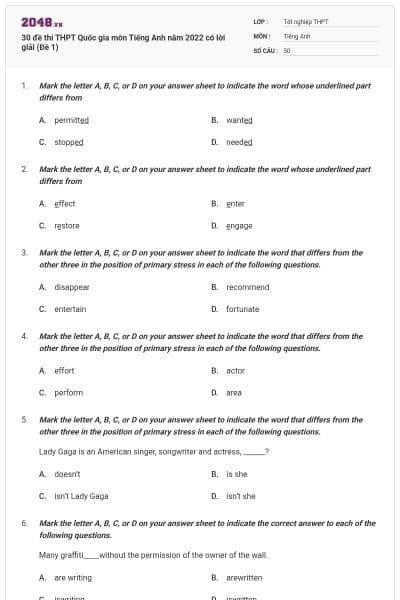
30 đề thi THPT Quốc gia môn Tiếng Anh năm 2022 có lời giải (Đề 1)

50 câu hỏi
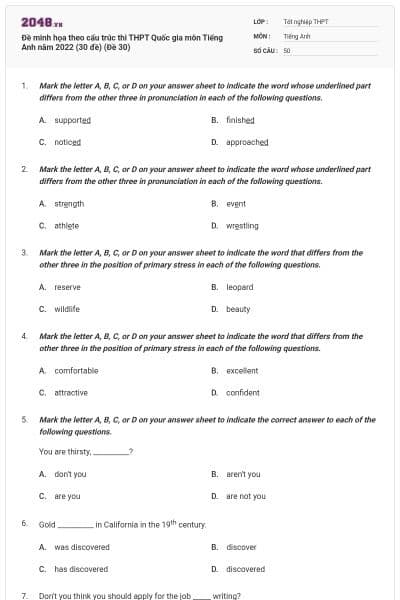
Mark the letter A, B, C, or D on your answer sheet to indicate the word whose underlined part differs from
permitted
wanted
stopped
needed
Mark the letter A, B, C, or D on your answer sheet to indicate the word whose underlined part differs from
effect
enter
restore
engage
Mark the letter A, B, C, or D on your answer sheet to indicate the word that differs from the other three in the position of primary stress in each of the following questions.
disappear
recommend
entertain
fortunate
Mark the letter A, B, C, or D on your answer sheet to indicate the word that differs from the other three in the position of primary stress in each of the following questions.
effort
actor
perform
area
Mark the letter A, B, C, or D on your answer sheet to indicate the word that differs from the other three in the position of primary stress in each of the following questions.
Lady Gaga is an American singer, songwriter and actress, ______?
doesn’t
is she
isn’t Lady Gaga
isn’t she
Mark the letter A, B, C, or D on your answer sheet to indicate the correct answer to each of the following questions.
Many graffiti without the permission of the owner of the wall.
are writing
arewritten
iswriting
iswritten
Mark the letter A, B, C, or D on your answer sheet to indicate the correct answer to each of the following questions.
She likes reading books ______ the library.
on
at
in
from
Mark the letter A, B, C, or D on your answer sheet to indicate the correct answer to each of the following questions.
The more cigarettes you smoke, you will die.
the easier
moresooner
thesooner
faster
Mark the letter A, B, C, or D on your answer sheet to indicate the correct answer to each of the following questions.
It's silly of him to spend a lot of money buying .
a thick wooden old table
a thick old woodentable
an old woodenthicktable
a wooden thick oldtable
Mark the letter A, B, C, or D on your answer sheet to indicate the correct answer to each of the following questions
When he came, I_______ in the kitchen
cooked
am cooking
has cooked
was cooking
Mark the letter A, B, C, or D on your answer sheet to indicate the correct answer to each of the following questions.
________ he was the most prominent candidate, he was not chosen.
Though
Because
As
Since
Mark the letter A, B, C, or D on your answer sheet to indicate the correct answer to each of the following questions.
________ the destination, he will have been walking for about three hours.
When John will get
By the time John gets
After John has got
until John is getting
Mark the letter A, B, C, or D on your answer sheet to indicate the correct answer to each of the following questions.
On he had won, he jumped for joy.
he was told
havingtold
being told
get fined
Mark the letter A, B, C, or D on your answer sheet to indicate the correct answer to each of the following questions.
His______of the generator is very famous.
invent
inventive
invention
inventor
The government hopes to______its plans for introducing cable TV
turn out
carry out
carry on
keepon
Mark the letter A, B, C, or D on your answer sheet to indicate the correct answer to each of the following questions.
The jury______her compliments on her excellent knowledge of the subject.
paid
gave
made
said
Mark the letter A, B, C, or D on your answer sheet to indicate the correct answer to each of the following questions
Nobody took any______of the warning and they went swimming in the contaminated water
information
attention
sight
notice
Mark the letter A, B, C, or D on your answer sheet to indicate the correct answer to each of the following questions
I had a ______ chat with my manager and gave him an update on the project.
brief
short
quick
lull
Mark the letter A, B, C, or D on your answer sheet to indicate the correct answer to each of the following questions
There has been a hot debate among the scientists relating to the______of using robotic probes to study distant objects in space.
problems and solutions
pros and cons
solutions and limitations
causes and effects
Mark the letter A, B, C, or D on your answer sheet to indicate the word(s) CLOSEST in meaning to the underlined word(s) in each of the following questions
The new air conditioner was installed yesterday.
inspected thoroughly
put in position
well repaired
delivered to the customer
Mark the letter A, B, C, or D on your answer sheet to indicate the word(s) CLOSEST in meaning to the underlined word(s) in each of the following questions
We were pretty disappointed with the quality of the food
highly
rather
extremely
very
Mark the letter A, B, C, or D on your answer sheet to indicate the word(s) OPPOSITE in meaning to the underlined word(s) in each of the following questions
Many women prefer to use cosmetics to enhance their beauty and make them look younger
improve
maximize
worsen
enrich
Mark the letter A, B, C, or D on your answer sheet to indicate the word(s) OPPOSITE in meaning to the underlined word(s) in each of the following questions
I think we cannot purchase this device this time as it costs an arm and a leg
is cheap
is painful
is confusing
is expensive
Mark the letter A, B, C, or D on your answer sheet to indicate the option that best completes each of the following exchanges
Nam and Mai are having a party at Nam’s house.
- Nam: “Would you like to have some more dessert, Mai?” - Mai: “______. I’m full.”
That would be great
Yes, I like your party
Yes, please
No, thanks
Mark the letter A, B, C, or D on your answer sheet to indicate the option that best completes each of the following exchanges
Tim and Peter had a quarrel last week and now Tom is giving Tim advice.
- Tom: “I think the best way to solve that problem is to keep silent.”
- Tim: “______. Silence may kill our friendship.”
That’s a great idea
That’s not a good idea
I’m not wrong
Yes, I think much
Read the following passage and mark the letter A, B, C, or D on your answer sheet to indicate the correct word or phrase that best fits each of the numbered blanks from 26 to 30
Have you ever had the feeling that people older than you are hard to understand? Or, have you felt like people from younger generations just don't get it? Maybe you find it easier to connect with people (26) ______ are closer to your age than those who are older or younger than you. You can probably thank the generation gap for these feelings.
There are currently six generations living in the United States: the Greatest Generation, Silent Generation, Baby Boomers, Generation X, Millennials, and Generation Z. (27) ______ generation has its own unique set of characteristics and norms. For (28) ______ , the Greatest Generation (born 1901-1924) is known for its patriotism, hard workers, and loyalty to institutions. The Millennials (born 1980-2000) are characterized by their dependence on technology, detachment from traditional institutions, optimism, and open-mindedness. It is no (29) ______ that many people from different generations have a hard time understanding each other.
Generation gap refers to differences in actions, beliefs, interests, and opinions that (30) ______ between individuals from different generations. So, what causes these differences?
(Adapted from https://study.com/)
Điền vào ô 26
who
which
when
what
Read the following passage and mark the letter A, B, C, or D on your answer sheet to indicate the correct word or phrase that best fits each of the numbered blanks from 26 to 30
Have you ever had the feeling that people older than you are hard to understand? Or, have you felt like people from younger generations just don't get it? Maybe you find it easier to connect with people (26) ______ are closer to your age than those who are older or younger than you. You can probably thank the generation gap for these feelings.
There are currently six generations living in the United States: the Greatest Generation, Silent Generation, Baby Boomers, Generation X, Millennials, and Generation Z. (27) ______ generation has its own unique set of characteristics and norms. For (28) ______ , the Greatest Generation (born 1901-1924) is known for its patriotism, hard workers, and loyalty to institutions. The Millennials (born 1980-2000) are characterized by their dependence on technology, detachment from traditional institutions, optimism, and open-mindedness. It is no (29) ______ that many people from different generations have a hard time understanding each other.
Generation gap refers to differences in actions, beliefs, interests, and opinions that (30) ______ between individuals from different generations. So, what causes these differences?
(Adapted from https://study.com/)
Điền vào ô 27
Another
Very
All
Each
Read the following passage and mark the letter A, B, C, or D on your answer sheet to indicate the correct word or phrase that best fits each of the numbered blanks from 26 to 30
Have you ever had the feeling that people older than you are hard to understand? Or, have you felt like people from younger generations just don't get it? Maybe you find it easier to connect with people (26) ______ are closer to your age than those who are older or younger than you. You can probably thank the generation gap for these feelings.
There are currently six generations living in the United States: the Greatest Generation, Silent Generation, Baby Boomers, Generation X, Millennials, and Generation Z. (27) ______ generation has its own unique set of characteristics and norms. For (28) ______ , the Greatest Generation (born 1901-1924) is known for its patriotism, hard workers, and loyalty to institutions. The Millennials (born 1980-2000) are characterized by their dependence on technology, detachment from traditional institutions, optimism, and open-mindedness. It is no (29) ______ that many people from different generations have a hard time understanding each other.
Generation gap refers to differences in actions, beliefs, interests, and opinions that (30) ______ between individuals from different generations. So, what causes these differences?
(Adapted from https://study.com/)
Điền vào ô 28
answer
process
example
study
Read the following passage and mark the letter A, B, C, or D on your answer sheet to indicate the correct word or phrase that best fits each of the numbered blanks from 26 to 30
Have you ever had the feeling that people older than you are hard to understand? Or, have you felt like people from younger generations just don't get it? Maybe you find it easier to connect with people (26) ______ are closer to your age than those who are older or younger than you. You can probably thank the generation gap for these feelings.
There are currently six generations living in the United States: the Greatest Generation, Silent Generation, Baby Boomers, Generation X, Millennials, and Generation Z. (27) ______ generation has its own unique set of characteristics and norms. For (28) ______ , the Greatest Generation (born 1901-1924) is known for its patriotism, hard workers, and loyalty to institutions. The Millennials (born 1980-2000) are characterized by their dependence on technology, detachment from traditional institutions, optimism, and open-mindedness. It is no (29) ______ that many people from different generations have a hard time understanding each other.
Generation gap refers to differences in actions, beliefs, interests, and opinions that (30) ______ between individuals from different generations. So, what causes these differences?
(Adapted from https://study.com/)
Điền vào ô 29
wonder
picture
business
training
Read the following passage and mark the letter A, B, C, or D on your answer sheet to indicate the correct word or phrase that best fits each of the numbered blanks from 26 to 30
Have you ever had the feeling that people older than you are hard to understand? Or, have you felt like people from younger generations just don't get it? Maybe you find it easier to connect with people (26) ______ are closer to your age than those who are older or younger than you. You can probably thank the generation gap for these feelings.
There are currently six generations living in the United States: the Greatest Generation, Silent Generation, Baby Boomers, Generation X, Millennials, and Generation Z. (27) ______ generation has its own unique set of characteristics and norms. For (28) ______ , the Greatest Generation (born 1901-1924) is known for its patriotism, hard workers, and loyalty to institutions. The Millennials (born 1980-2000) are characterized by their dependence on technology, detachment from traditional institutions, optimism, and open-mindedness. It is no (29) ______ that many people from different generations have a hard time understanding each other.
Generation gap refers to differences in actions, beliefs, interests, and opinions that (30) ______ between individuals from different generations. So, what causes these differences?
(Adapted from https://study.com/)
Điền vào ô 29
trade
exist
credit
target
Read the following passage and mark the letter A, B, C, or D on your answer sheet to indicate the correct answer to each of the questions from 31 to 35.
Stars have been significant features in the design of many United States coins and their number has varied from one to forty-eight stars. Most of the coins issued from about 1799 to the early years of the twentieth century bore thirteen stars representing the thirteen original colonies.
Curiously enough, the first American silver coins, issued in 1794, had fifteen stars because by that time Vermont and Kentucky have joined the Union. At that time it was apparently the intention of mint officials to add a star for each new state. Following the admission of Tennessee in 1796, for example, some varieties of half dimes, dimes, and half dollars were produced with sixteen stars.
As more states were admitted to the Union, however, it quickly became apparent that this scheme would not prove practical and the coins from 1798 were issued with only thirteen Stars - one for each of the original colonies. Due to an error at the mint, one variety of the 1828 half-cent was issued with only twelve stars. There is also a variety of the large cent with only 12 stars, but this is the result of a die break and is not a true error.
What is the main topic of the passage?
Stars on American coins
The teaching of astronomy in state universities
Colonial stamps and coins
The star as national symbol of the United States
Read the following passage and mark the letter A, B, C, or D on your answer sheet to indicate the correct answer to each of the questions from 31 to 35.
Stars have been significant features in the design of many United States coins and their number has varied from one to forty-eight stars. Most of the coins issued from about 1799 to the early years of the twentieth century bore thirteen stars representing the thirteen original colonies.
Curiously enough, the first American silver coins, issued in 1794, had fifteen stars because by that time Vermont and Kentucky have joined the Union. At that time it was apparently the intention of mint officials to add a star for each new state. Following the admission of Tennessee in 1796, for example, some varieties of half dimes, dimes, and half dollars were produced with sixteen stars.
As more states were admitted to the Union, however, it quickly became apparent that this scheme would not prove practical and the coins from 1798 were issued with only thirteen Stars - one for each of the original colonies. Due to an error at the mint, one variety of the 1828 half-cent was issued with only twelve stars. There is also a variety of the large cent with only 12 stars, but this is the result of a die break and is not a true error.
The expression "Curiously enough" is used because the author finds it strange that _____.
Tennessee was the first state to use half dimes
Vermont and Kentucky joined the Union in 1794
silver coins with fifteen stars appeared before coins with thirteen
no silver coins were issued until 1794
Read the following passage and mark the letter A, B, C, or D on your answer sheet to indicate the correct answer to each of the questions from 31 to 35.
Stars have been significant features in the design of many United States coins and their number has varied from one to forty-eight stars. Most of the coins issued from about 1799 to the early years of the twentieth century bore thirteen stars representing the thirteen original colonies.
Curiously enough, the first American silver coins, issued in 1794, had fifteen stars because by that time Vermont and Kentucky have joined the Union. At that time it was apparently the intention of mint officials to add a star for each new state. Following the admission of Tennessee in 1796, for example, some varieties of half dimes, dimes, and half dollars were produced with sixteen stars.
As more states were admitted to the Union, however, it quickly became apparent that this scheme would not prove practical and the coins from 1798 were issued with only thirteen Stars - one for each of the original colonies. Due to an error at the mint, one variety of the 1828 half-cent was issued with only twelve stars. There is also a variety of the large cent with only 12 stars, but this is the result of a die break and is not a true error.
Why was a coin produced in 1828 with only twelve stars?
Tennessee had left the Union.
The mint made a mistake.
There were twelve states at the time.
There is a change in design policy.
Read the following passage and mark the letter A, B, C, or D on your answer sheet to indicate the correct answer to each of the questions from 31 to 35.
Stars have been significant features in the design of many United States coins and their number has varied from one to forty-eight stars. Most of the coins issued from about 1799 to the early years of the twentieth century bore thirteen stars representing the thirteen original colonies.
Curiously enough, the first American silver coins, issued in 1794, had fifteen stars because by that time Vermont and Kentucky have joined the Union. At that time it was apparently the intention of mint officials to add a star for each new state. Following the admission of Tennessee in 1796, for example, some varieties of half dimes, dimes, and half dollars were produced with sixteen stars.
As more states were admitted to the Union, however, it quickly became apparent that this scheme would not prove practical and the coins from 1798 were issued with only thirteen Stars - one for each of the original colonies. Due to an error at the mint, one variety of the 1828 half-cent was issued with only twelve stars. There is also a variety of the large cent with only 12 stars, but this is the result of a die break and is not a true error.
Which of the following is NOT mentioned as the denomination of an American coin?
Half nickel
Half-dollar
Hall cent
Half dime
Read the following passage and mark the letter A, B, C, or D on your answer sheet to indicate the correct answer to each of the questions from 31 to 35.
Stars have been significant features in the design of many United States coins and their number has varied from one to forty-eight stars. Most of the coins issued from about 1799 to the early years of the twentieth century bore thirteen stars representing the thirteen original colonies.
Curiously enough, the first American silver coins, issued in 1794, had fifteen stars because by that time Vermont and Kentucky have joined the Union. At that time it was apparently the intention of mint officials to add a star for each new state. Following the admission of Tennessee in 1796, for example, some varieties of half dimes, dimes, and half dollars were produced with sixteen stars.
As more states were admitted to the Union, however, it quickly became apparent that this scheme would not prove practical and the coins from 1798 were issued with only thirteen Stars - one for each of the original colonies. Due to an error at the mint, one variety of the 1828 half-cent was issued with only twelve stars. There is also a variety of the large cent with only 12 stars, but this is the result of a die break and is not a true error.
Which of the following is NOT mentioned as the denomination of an American coin?
features
coins
stars
colonies
Read the following passage and mark the letter A, B, C, or D on your answer sheet to indicate the correct answer to each of the questions from 36 to 42.
Do you feel like your teenager is spending most of the day glued to a phone screen? You're not too far off. A new survey from the Pew Research Center reveals the surprising ways that technology intersects with teen friendships – and the results show that 57 percent of teens have made at least one new friend online. Even more surprisingly, only 20 percent of those digital friends ever meet in person.
While teens do connect with their friends face-to-face outside of school, they spend 55 percent of their day texting with friends, and only 25 percent of teens are spending actual time with their friends on a daily basis (outside of school hallways). These new forms of communication are key in maintaining friendships day-to-day – 27 percent of teens instant message their friends every day, 23 percent connect through social media every day, and 7 percent even video chat daily. Text messaging remains the main form of communication – almost half of survey respondents say it's their chosen method of communication with their closest friend.
While girls are more likely to text with their close friends, boys are meeting new friends (and maintaining friendships) in the gaming world – 89 percent play with friends they know, and 54 percent play with online-only friends. Whether they're close with their teammates or not, online gamers say that playing makes them feel "more connected" to friends they know, or garners they've never met.
When making new friends, social media has also become a major part of the teenage identity – 62 percent of teens are quick to share their social media usernames when connecting with a new friend (although 80 percent still consider their phone number the best method of contact). Despite the negative consequences-21 percent of teenage users feel worse about their lives because of posts they see on social media – teens also have found support and connection through various platforms. In fact, 68 percent of teens received support during a challenging time in their lives via social media platforms.
Just as technology has become a gateway for new friendships, or a channel to stay connected with current friends, it can also make a friendship breakup more public. The study reveals that girls are more likely to block or unfriend former allies, and 68 percent of all teenage users report experiencing "drama among their friends on social media."
(Source: https://www.realsimple.com)
The word "digital" in the first paragraph is closest in meaning to _____
analogue
numeracy
numerous
online
Read the following passage and mark the letter A, B, C, or D on your answer sheet to indicate the correct answer to each of the questions from 36 to 42.
Do you feel like your teenager is spending most of the day glued to a phone screen? You're not too far off. A new survey from the Pew Research Center reveals the surprising ways that technology intersects with teen friendships – and the results show that 57 percent of teens have made at least one new friend online. Even more surprisingly, only 20 percent of those digital friends ever meet in person.
While teens do connect with their friends face-to-face outside of school, they spend 55 percent of their day texting with friends, and only 25 percent of teens are spending actual time with their friends on a daily basis (outside of school hallways). These new forms of communication are key in maintaining friendships day-to-day – 27 percent of teens instant message their friends every day, 23 percent connect through social media every day, and 7 percent even video chat daily. Text messaging remains the main form of communication – almost half of survey respondents say it's their chosen method of communication with their closest friend.
While girls are more likely to text with their close friends, boys are meeting new friends (and maintaining friendships) in the gaming world – 89 percent play with friends they know, and 54 percent play with online-only friends. Whether they're close with their teammates or not, online gamers say that playing makes them feel "more connected" to friends they know, or garners they've never met.
When making new friends, social media has also become a major part of the teenage identity – 62 percent of teens are quick to share their social media usernames when connecting with a new friend (although 80 percent still consider their phone number the best method of contact). Despite the negative consequences-21 percent of teenage users feel worse about their lives because of posts they see on social media – teens also have found support and connection through various platforms. In fact, 68 percent of teens received support during a challenging time in their lives via social media platforms.
Just as technology has become a gateway for new friendships, or a channel to stay connected with current friends, it can also make a friendship breakup more public. The study reveals that girls are more likely to block or unfriend former allies, and 68 percent of all teenage users report experiencing "drama among their friends on social media."
(Source: https://www.realsimple.com)
The word "they" in paragraph 3 refers to _____
friends
online-only friends
online gamers
their teammates
Read the following passage and mark the letter A, B, C, or D on your answer sheet to indicate the correct answer to each of the questions from 36 to 42.
Do you feel like your teenager is spending most of the day glued to a phone screen? You're not too far off. A new survey from the Pew Research Center reveals the surprising ways that technology intersects with teen friendships – and the results show that 57 percent of teens have made at least one new friend online. Even more surprisingly, only 20 percent of those digital friends ever meet in person.
While teens do connect with their friends face-to-face outside of school, they spend 55 percent of their day texting with friends, and only 25 percent of teens are spending actual time with their friends on a daily basis (outside of school hallways). These new forms of communication are key in maintaining friendships day-to-day – 27 percent of teens instant message their friends every day, 23 percent connect through social media every day, and 7 percent even video chat daily. Text messaging remains the main form of communication – almost half of survey respondents say it's their chosen method of communication with their closest friend.
While girls are more likely to text with their close friends, boys are meeting new friends (and maintaining friendships) in the gaming world – 89 percent play with friends they know, and 54 percent play with online-only friends. Whether they're close with their teammates or not, online gamers say that playing makes them feel "more connected" to friends they know, or garners they've never met.
When making new friends, social media has also become a major part of the teenage identity – 62 percent of teens are quick to share their social media usernames when connecting with a new friend (although 80 percent still consider their phone number the best method of contact). Despite the negative consequences-21 percent of teenage users feel worse about their lives because of posts they see on social media – teens also have found support and connection through various platforms. In fact, 68 percent of teens received support during a challenging time in their lives via social media platforms.
Just as technology has become a gateway for new friendships, or a channel to stay connected with current friends, it can also make a friendship breakup more public. The study reveals that girls are more likely to block or unfriend former allies, and 68 percent of all teenage users report experiencing "drama among their friends on social media."
(Source: https://www.realsimple.com)
According to the passage, what percentage of teens spend actual time with their friends?
23%
25%
27%
55%
Read the following passage and mark the letter A, B, C, or D on your answer sheet to indicate the correct answer to each of the questions from 36 to 42.
Do you feel like your teenager is spending most of the day glued to a phone screen? You're not too far off. A new survey from the Pew Research Center reveals the surprising ways that technology intersects with teen friendships – and the results show that 57 percent of teens have made at least one new friend online. Even more surprisingly, only 20 percent of those digital friends ever meet in person.
While teens do connect with their friends face-to-face outside of school, they spend 55 percent of their day texting with friends, and only 25 percent of teens are spending actual time with their friends on a daily basis (outside of school hallways). These new forms of communication are key in maintaining friendships day-to-day – 27 percent of teens instant message their friends every day, 23 percent connect through social media every day, and 7 percent even video chat daily. Text messaging remains the main form of communication – almost half of survey respondents say it's their chosen method of communication with their closest friend.
While girls are more likely to text with their close friends, boys are meeting new friends (and maintaining friendships) in the gaming world – 89 percent play with friends they know, and 54 percent play with online-only friends. Whether they're close with their teammates or not, online gamers say that playing makes them feel "more connected" to friends they know, or garners they've never met.
When making new friends, social media has also become a major part of the teenage identity – 62 percent of teens are quick to share their social media usernames when connecting with a new friend (although 80 percent still consider their phone number the best method of contact). Despite the negative consequences-21 percent of teenage users feel worse about their lives because of posts they see on social media – teens also have found support and connection through various platforms. In fact, 68 percent of teens received support during a challenging time in their lives via social media platforms.
Just as technology has become a gateway for new friendships, or a channel to stay connected with current friends, it can also make a friendship breakup more public. The study reveals that girls are more likely to block or unfriend former allies, and 68 percent of all teenage users report experiencing "drama among their friends on social media."
(Source: https://www.realsimple.com)
The following sentences are true, EXCEPT _____
Most teenagers use video chat to maintain relationship with friends
New forms of communication play an important role in keeping friendships
According to the survey, more than half of teens have ever made new friends online
Teens only meet face-to-face one fifth of online friends they have made
Read the following passage and mark the letter A, B, C, or D on your answer sheet to indicate the correct answer to each of the questions from 36 to 42.
Do you feel like your teenager is spending most of the day glued to a phone screen? You're not too far off. A new survey from the Pew Research Center reveals the surprising ways that technology intersects with teen friendships – and the results show that 57 percent of teens have made at least one new friend online. Even more surprisingly, only 20 percent of those digital friends ever meet in person.
While teens do connect with their friends face-to-face outside of school, they spend 55 percent of their day texting with friends, and only 25 percent of teens are spending actual time with their friends on a daily basis (outside of school hallways). These new forms of communication are key in maintaining friendships day-to-day – 27 percent of teens instant message their friends every day, 23 percent connect through social media every day, and 7 percent even video chat daily. Text messaging remains the main form of communication – almost half of survey respondents say it's their chosen method of communication with their closest friend.
While girls are more likely to text with their close friends, boys are meeting new friends (and maintaining friendships) in the gaming world – 89 percent play with friends they know, and 54 percent play with online-only friends. Whether they're close with their teammates or not, online gamers say that playing makes them feel "more connected" to friends they know, or garners they've never met.
When making new friends, social media has also become a major part of the teenage identity – 62 percent of teens are quick to share their social media usernames when connecting with a new friend (although 80 percent still consider their phone number the best method of contact). Despite the negative consequences-21 percent of teenage users feel worse about their lives because of posts they see on social media – teens also have found support and connection through various platforms. In fact, 68 percent of teens received support during a challenging time in their lives via social media platforms.
Just as technology has become a gateway for new friendships, or a channel to stay connected with current friends, it can also make a friendship breakup more public. The study reveals that girls are more likely to block or unfriend former allies, and 68 percent of all teenage users report experiencing "drama among their friends on social media."
(Source: https://www.realsimple.com)
What can be inferred from the passage?
The majority of teenage users agree that social media has negative consequences in their lives.
Thanks to social media, more than two thirds of teens are supported when they face with challenges in their lives.
Boys are more likely to meet new friends than girls.
Most teens are not easy to give others their usernames when making new friends.
Read the following passage and mark the letter A, B, C, or D on your answer sheet to indicate the correct answer to each of the questions from 36 to 42.
Do you feel like your teenager is spending most of the day glued to a phone screen? You're not too far off. A new survey from the Pew Research Center reveals the surprising ways that technology intersects with teen friendships – and the results show that 57 percent of teens have made at least one new friend online. Even more surprisingly, only 20 percent of those digital friends ever meet in person.
While teens do connect with their friends face-to-face outside of school, they spend 55 percent of their day texting with friends, and only 25 percent of teens are spending actual time with their friends on a daily basis (outside of school hallways). These new forms of communication are key in maintaining friendships day-to-day – 27 percent of teens instant message their friends every day, 23 percent connect through social media every day, and 7 percent even video chat daily. Text messaging remains the main form of communication – almost half of survey respondents say it's their chosen method of communication with their closest friend.
While girls are more likely to text with their close friends, boys are meeting new friends (and maintaining friendships) in the gaming world – 89 percent play with friends they know, and 54 percent play with online-only friends. Whether they're close with their teammates or not, online gamers say that playing makes them feel "more connected" to friends they know, or garners they've never met.
When making new friends, social media has also become a major part of the teenage identity – 62 percent of teens are quick to share their social media usernames when connecting with a new friend (although 80 percent still consider their phone number the best method of contact). Despite the negative consequences-21 percent of teenage users feel worse about their lives because of posts they see on social media – teens also have found support and connection through various platforms. In fact, 68 percent of teens received support during a challenging time in their lives via social media platforms.
Just as technology has become a gateway for new friendships, or a channel to stay connected with current friends, it can also make a friendship breakup more public. The study reveals that girls are more likely to block or unfriend former allies, and 68 percent of all teenage users report experiencing "drama among their friends on social media."
(Source: https://www.realsimple.com)
What is the synonym of the word "breakup” in the last paragraph?
commencing
popularity
termination
divorce
Read the following passage and mark the letter A, B, C, or D on your answer sheet to indicate the correct answer to each of the questions from 36 to 42.
Do you feel like your teenager is spending most of the day glued to a phone screen? You're not too far off. A new survey from the Pew Research Center reveals the surprising ways that technology intersects with teen friendships – and the results show that 57 percent of teens have made at least one new friend online. Even more surprisingly, only 20 percent of those digital friends ever meet in person.
While teens do connect with their friends face-to-face outside of school, they spend 55 percent of their day texting with friends, and only 25 percent of teens are spending actual time with their friends on a daily basis (outside of school hallways). These new forms of communication are key in maintaining friendships day-to-day – 27 percent of teens instant message their friends every day, 23 percent connect through social media every day, and 7 percent even video chat daily. Text messaging remains the main form of communication – almost half of survey respondents say it's their chosen method of communication with their closest friend.
While girls are more likely to text with their close friends, boys are meeting new friends (and maintaining friendships) in the gaming world – 89 percent play with friends they know, and 54 percent play with online-only friends. Whether they're close with their teammates or not, online gamers say that playing makes them feel "more connected" to friends they know, or garners they've never met.
When making new friends, social media has also become a major part of the teenage identity – 62 percent of teens are quick to share their social media usernames when connecting with a new friend (although 80 percent still consider their phone number the best method of contact). Despite the negative consequences-21 percent of teenage users feel worse about their lives because of posts they see on social media – teens also have found support and connection through various platforms. In fact, 68 percent of teens received support during a challenging time in their lives via social media platforms.
Just as technology has become a gateway for new friendships, or a channel to stay connected with current friends, it can also make a friendship breakup more public. The study reveals that girls are more likely to block or unfriend former allies, and 68 percent of all teenage users report experiencing "drama among their friends on social media."
(Source: https://www.realsimple.com)
What is the main idea of the passage?
The difference of making new friends between girls and boys.
Social media connects friendship.
Social media affects friendship too much.
Teenagers are making and keeping friends in a surprising way.
Mark the letter A, B, C, or D on your answer sheet to indicate the underlined part that needs correction in each of the following questions
(A) What I told her a few days ago (B) is not the solution (C) to (D) most of her problems
What I told her
is
to
most of
Mark the letter A, B, C, or D on your answer sheet to indicate the underlined part that needs correction in each of the following questions
Tom’s jokes are (A) inappropriate but we have to put up with (B) it just (C) because he’s (D) the boss
inappropriate
it
because
the
Mark the letter A, B, C, or D on your answer sheet to indicate the underlined part that needs correction in each of the following questions
Modern (A) office buildings have (B) false floors under (C) which computer and phone wires (D) can be lain.
office buildings
false floors
which
can be lain
Mark the letter A, B, C, or D on your answer sheet to indicate the sentence that is closest in meaning to each of the following questions
The last time I saw her was three years ago.
I have not seen her for three years.
About three years ago, I used to meet her.
I have often seen her for the last three years.
I saw her three years ago and will never meet her.
Mark the letter A, B, C, or D on your answer sheet to indicate the sentence that is closest in meaning to each of the following questions
She said, "John, I'll show you round my city when you're here."
She made a trip round her city with John.
She planned to show John round her city.
She promised to show John round her city.
She organized a trip round her city for John.
Mark the letter A, B, C, or D on your answer sheet to indicate the sentence that is closest in meaning to each of the following questions
It is unnecessary for you to finish the report until tomorrow afternoon
You needn’t finish the report until tomorrow afternoon.
You have to finish the report unitl tomorrow afternoon.
You may finish the report after tomorrow afternoon.
You should finish the report until tomorrow afternoon.
Mark the letter A, B, C, or D on your answer sheet to indicate the sentence that best combines each pair of sentences in the following questions
Susan didn’t apply for the summer job in the cafe. She now regrets it
Susan wishes that she applied for the summer job in the cafe.
Susan feels regret because she didn’t apply for the summer job in the cafe.
If only Susan didn’t apply for the summer job in the cafe.
Susan wishes that she had applied for the summer job in the cafe.
Mark the letter A, B, C, or D on your answer sheet to indicate the sentence that best combines each pair of sentences in the following questions
She had only just put the telephone down when the boss rang
She put the telephone down and the boss rang.
Hardly had she put the telephone down when the boss rang.
The boss rang back, but she put the telephone down.
She had put the telephone down, so she let it ring when the boss rang.