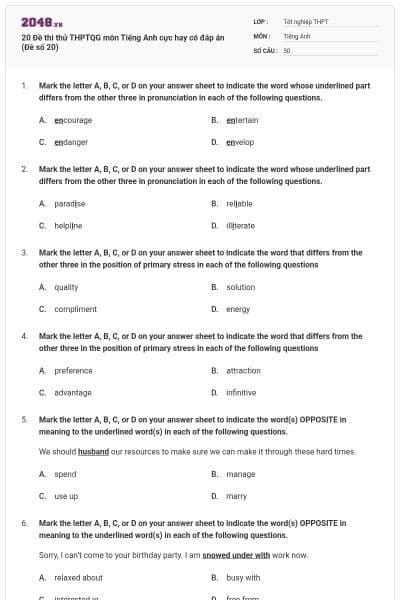
20 Đề thi thử THPTQG môn Tiếng Anh cực hay có đáp án (Đề số 20)

50 câu hỏi
Mark the letter A, B, C, or D on your answer sheet to indicate the word whose underlined part differs from the other three in pronunciation in each of the following questions.
encourage
entertain
endanger
envelop
Mark the letter A, B, C, or D on your answer sheet to indicate the word whose underlined part differs from the other three in pronunciation in each of the following questions.
paradise
reliable
helpline
illiterate
Mark the letter A, B, C, or D on your answer sheet to indicate the word that differs from the other three in the position of primary stress in each of the following questions
quality
solution
compliment
energy
Mark the letter A, B, C, or D on your answer sheet to indicate the word that differs from the other three in the position of primary stress in each of the following questions
preference
attraction
advantage
infinitive
Mark the letter A, B, C, or D on your answer sheet to indicate the word(s) OPPOSITE in meaning to the underlined word(s) in each of the following questions.
We should husband our resources to make sure we can make it through these hard times.
spend
manage
use up
marry
Mark the letter A, B, C, or D on your answer sheet to indicate the word(s) OPPOSITE in meaning to the underlined word(s) in each of the following questions.
Sorry, I can’t come to your birthday party. I am snowed under with work now.
relaxed about
busy with
interested in
free from
Mark the letter A, B, C, or D on your answer sheet to indicate the word(s) CLOSEST in meaning to the underlined word(s) in each of the following questions.
All the students were all ears when the teacher started talking about the changes in the next exam.
attentive
restless
silent
smiling
Mark the letter A, B, C, or D on your answer sheet to indicate the word(s) CLOSEST in meaning to the underlined word(s) in each of the following questions.
The augmentation in the population has created a fuel shortage.
increase
necessity
demand
decrease
- Mark: “You stepped on my toes!” - Mike: “ _________.”
Are you sure? It’s understandable.
I’m sorry but I meant it.
Really? I’m glad.
I’m terribly sorry. I didn’t mean it.
Customer: “Can I try this sweater on?”
Salesgirl: “ _________.”
No, the shop is closed in half an hour
Sorry, only cash is accepted here
Yes, it is quite cheap. It costs one hundred dollars
Sure, the changing rooms are over there
You look upset. Have you and Kelly _________again?
gone out
gone grey
fallen out
let off
All _________ we had been told turned out to be untrue.
that
which
what
where
My aunt used to be a woman of great _________, but now she gets old and looks pale.
beauty
beautiful
beautifully
beautify
_________no taxi, they had to walk home.
There was
There being
Because there being
There is
There has been little rain in this region for several months, _________?
has it
has there
hasn’t it
hasn’t there
Tim was _________ to the court for jury duty, but took a doctor's sick note with him and was excused.
pulled
assembled
summoned
requeste
She was ill for six weeks and _________with her schoolwork.
picked up
told off
turned out
fell behind
Her car needs ______
be fixed
fixing
to fix
fixed
I’m afraid that I can’t give you the answer off the top of my _________, but I’ll find it out for you.
tongue
hand
mind
head
To _________ should I write if I want to make a complaint?
which
what
who
whom
Three wolves ran through the forest in _________ of a deer.
following
chase
hunting
pursuit
_________ his good work and manners, he didn’t get a promotion.
Because of
In spite of
Even though
As a result of
Read the following passage and mark the letter A, B, C, or D on your answer sheet to indicate the correct word or phrase that best fits each of the numbered blanks from 23 to 27.
No one can know when sports began. Since it is impossible to imagine a time when children did not spontaneously run races or wrestle, it is clear that children have always included sports in their play, but one can only speculate about the (23) _________of sports as autotelic physical contests for adults. Hunters are depicted in prehistoric art, but it cannot be known (24) _____ the hunters pursued their prey in a mood of grim necessity or with the joyful abandon of sportsmen. It is certain, (25) _________, from the rich literary and iconographic evidence of all ancient civilizations that hunting soon became an end in itself at least for royalty and nobility. Archaeological evidence also indicates that ball games were common among ancient peoples as different as the Chinese and the like those recommended for health by the Greek physician Galen in the 2nd century AD.
Điền vào số (23)
emergence
emerge
emergency
immersion
Read the following passage and mark the letter A, B, C, or D on your answer sheet to indicate the correct word or phrase that best fits each of the numbered blanks from 23 to 27.
No one can know when sports began. Since it is impossible to imagine a time when children did not spontaneously run races or wrestle, it is clear that children have always included sports in their play, but one can only speculate about the (23) _________of sports as autotelic physical contests for adults. Hunters are depicted in prehistoric art, but it cannot be known (24) _____ the hunters pursued their prey in a mood of grim necessity or with the joyful abandon of sportsmen. It is certain, (25) _________, from the rich literary and iconographic evidence of all ancient civilizations that hunting soon became an end in itself at least for royalty and nobility. Archaeological evidence also indicates that ball games were common among ancient peoples as different as the Chinese and the like those recommended for health by the Greek physician Galen in the 2nd century AD.
Điền vào số (24)
when
whether
how
why
Read the following passage and mark the letter A, B, C, or D on your answer sheet to indicate the correct word or phrase that best fits each of the numbered blanks from 23 to 27.
No one can know when sports began. Since it is impossible to imagine a time when children did not spontaneously run races or wrestle, it is clear that children have always included sports in their play, but one can only speculate about the (23) _________of sports as autotelic physical contests for adults. Hunters are depicted in prehistoric art, but it cannot be known (24) _____ the hunters pursued their prey in a mood of grim necessity or with the joyful abandon of sportsmen. It is certain, (25) _________, from the rich literary and iconographic evidence of all ancient civilizations that hunting soon became an end in itself at least for royalty and nobility. Archaeological evidence also indicates that ball games were common among ancient peoples as different as the Chinese and the like those recommended for health by the Greek physician Galen in the 2nd century AD.
Điền vào số (25)
therefore
so
consequently
however
Read the following passage and mark the letter A, B, C, or D on your answer sheet to indicate the correct word or phrase that best fits each of the numbered blanks from 23 to 27.
No one can know when sports began. Since it is impossible to imagine a time when children did not spontaneously run races or wrestle, it is clear that children have always included sports in their play, but one can only speculate about the (23) _________of sports as autotelic physical contests for adults. Hunters are depicted in prehistoric art, but it cannot be known (24) _____ the hunters pursued their prey in a mood of grim necessity or with the joyful abandon of sportsmen. It is certain, (25) _________, from the rich literary and iconographic evidence of all ancient civilizations that hunting soon became an end in itself at least for royalty and nobility. Archaeological evidence also indicates that ball games were common among ancient peoples as different as the Chinese and the like those recommended for health by the Greek physician Galen in the 2nd century AD.
Điền vào số (26)
competitive
competitively
noncompetitive
competition
Read the following passage and mark the letter A, B, C, or D on your answer sheet to indicate the correct word or phrase that best fits each of the numbered blanks from 23 to 27.
No one can know when sports began. Since it is impossible to imagine a time when children did not spontaneously run races or wrestle, it is clear that children have always included sports in their play, but one can only speculate about the (23) _________of sports as autotelic physical contests for adults. Hunters are depicted in prehistoric art, but it cannot be known (24) _____ the hunters pursued their prey in a mood of grim necessity or with the joyful abandon of sportsmen. It is certain, (25) _________, from the rich literary and iconographic evidence of all ancient civilizations that hunting soon became an end in itself at least for royalty and nobility. Archaeological evidence also indicates that ball games were common among ancient peoples as different as the Chinese and the like those recommended for health by the Greek physician Galen in the 2nd century AD.
Điền vào số (27)
definite
defined
definitive
defin
Read the following passage and mark the letter A, B, C, or D on your answer sheet to indicate the correct answer to each of the questions from 28 to 34.
Very few people in the modem world obtain their food supply by hunting and gathering in the natural environment surrounding their homes. This method of harvesting from nature s provision is the oldest subsistence strategy, and has been practiced for at least two million years. It was, indeed, the only way to obtain food until rudimentary farming and the domestication of animals were introduced about 10,000 years ago.
Because hunter-gathers have fared poorly in comparison with their agricultural cousins, their numbers have dwindled, and they have been forced to live in marginal environments such as deserts forests or arctic wasteland. In higher latitudes, the shorter growing season has restricted the availability of plant life. Such conditions have caused a greater independence on hunting, and along the coasts and waterways, on fishing. The abundance of vegetation in the lower latitudes of the tropics, on the other hand, has provided a greater opportunity for gathering a variety of plants. In short, the environmental differences have restricted the diet and have limited possibilities for the development of subsistence societies. Contemporary hunter-gathers may help us understand our prehistoric ancestors. We know from observation of modem hunter- gathers in both Africa and Alaska that society based on hunting and gathering must be very mobile. While the entire community camps in a central location, a smaller party harvests the food within a reasonable distance from the camp. When the food in the area is exhausted, the community moves on to exploit another site. We also notice a seasonal migration on pattern evolving for most hunter gathers, along with a restrict division of labor between sexes. These patterns of behavior may be similar to those practiced by mankind during the Paleolithic Period.
With which of the following topics is the passage primarily concerned?
The Paleolithic period
Subsistence farming
Hunter- gatherers
Marginal environment
Read the following passage and mark the letter A, B, C, or D on your answer sheet to indicate the correct answer to each of the questions from 28 to 34.
Very few people in the modem world obtain their food supply by hunting and gathering in the natural environment surrounding their homes. This method of harvesting from nature s provision is the oldest subsistence strategy, and has been practiced for at least two million years. It was, indeed, the only way to obtain food until rudimentary farming and the domestication of animals were introduced about 10,000 years ago.
Because hunter-gathers have fared poorly in comparison with their agricultural cousins, their numbers have dwindled, and they have been forced to live in marginal environments such as deserts forests or arctic wasteland. In higher latitudes, the shorter growing season has restricted the availability of plant life. Such conditions have caused a greater independence on hunting, and along the coasts and waterways, on fishing. The abundance of vegetation in the lower latitudes of the tropics, on the other hand, has provided a greater opportunity for gathering a variety of plants. In short, the environmental differences have restricted the diet and have limited possibilities for the development of subsistence societies. Contemporary hunter-gathers may help us understand our prehistoric ancestors. We know from observation of modem hunter- gathers in both Africa and Alaska that society based on hunting and gathering must be very mobile. While the entire community camps in a central location, a smaller party harvests the food within a reasonable distance from the camp. When the food in the area is exhausted, the community moves on to exploit another site. We also notice a seasonal migration on pattern evolving for most hunter gathers, along with a restrict division of labor between sexes. These patterns of behavior may be similar to those practiced by mankind during the Paleolithic Period.
The word “rudimentary” is closest in meaning to _________.
rough
preliminary
ancient
backward
Read the following passage and mark the letter A, B, C, or D on your answer sheet to indicate the correct answer to each of the questions from 28 to 34.
Very few people in the modem world obtain their food supply by hunting and gathering in the natural environment surrounding their homes. This method of harvesting from nature s provision is the oldest subsistence strategy, and has been practiced for at least two million years. It was, indeed, the only way to obtain food until rudimentary farming and the domestication of animals were introduced about 10,000 years ago.
Because hunter-gathers have fared poorly in comparison with their agricultural cousins, their numbers have dwindled, and they have been forced to live in marginal environments such as deserts forests or arctic wasteland. In higher latitudes, the shorter growing season has restricted the availability of plant life. Such conditions have caused a greater independence on hunting, and along the coasts and waterways, on fishing. The abundance of vegetation in the lower latitudes of the tropics, on the other hand, has provided a greater opportunity for gathering a variety of plants. In short, the environmental differences have restricted the diet and have limited possibilities for the development of subsistence societies. Contemporary hunter-gathers may help us understand our prehistoric ancestors. We know from observation of modem hunter- gathers in both Africa and Alaska that society based on hunting and gathering must be very mobile. While the entire community camps in a central location, a smaller party harvests the food within a reasonable distance from the camp. When the food in the area is exhausted, the community moves on to exploit another site. We also notice a seasonal migration on pattern evolving for most hunter gathers, along with a restrict division of labor between sexes. These patterns of behavior may be similar to those practiced by mankind during the Paleolithic Period.
The word “abundance” is closest in meaning to _________.
plenty
amount
density
majority
Read the following passage and mark the letter A, B, C, or D on your answer sheet to indicate the correct answer to each of the questions from 28 to 34.
Very few people in the modem world obtain their food supply by hunting and gathering in the natural environment surrounding their homes. This method of harvesting from nature s provision is the oldest subsistence strategy, and has been practiced for at least two million years. It was, indeed, the only way to obtain food until rudimentary farming and the domestication of animals were introduced about 10,000 years ago.
Because hunter-gathers have fared poorly in comparison with their agricultural cousins, their numbers have dwindled, and they have been forced to live in marginal environments such as deserts forests or arctic wasteland. In higher latitudes, the shorter growing season has restricted the availability of plant life. Such conditions have caused a greater independence on hunting, and along the coasts and waterways, on fishing. The abundance of vegetation in the lower latitudes of the tropics, on the other hand, has provided a greater opportunity for gathering a variety of plants. In short, the environmental differences have restricted the diet and have limited possibilities for the development of subsistence societies. Contemporary hunter-gathers may help us understand our prehistoric ancestors. We know from observation of modem hunter- gathers in both Africa and Alaska that society based on hunting and gathering must be very mobile. While the entire community camps in a central location, a smaller party harvests the food within a reasonable distance from the camp. When the food in the area is exhausted, the community moves on to exploit another site. We also notice a seasonal migration on pattern evolving for most hunter gathers, along with a restrict division of labor between sexes. These patterns of behavior may be similar to those practiced by mankind during the Paleolithic Period.
When was hunting and gathering introduced?
1,000,000 years ago
2,000,000 years ago
10,000 years ago
2,000 years ago
Read the following passage and mark the letter A, B, C, or D on your answer sheet to indicate the correct answer to each of the questions from 28 to 34.
Very few people in the modem world obtain their food supply by hunting and gathering in the natural environment surrounding their homes. This method of harvesting from nature s provision is the oldest subsistence strategy, and has been practiced for at least two million years. It was, indeed, the only way to obtain food until rudimentary farming and the domestication of animals were introduced about 10,000 years ago.
Because hunter-gathers have fared poorly in comparison with their agricultural cousins, their numbers have dwindled, and they have been forced to live in marginal environments such as deserts forests or arctic wasteland. In higher latitudes, the shorter growing season has restricted the availability of plant life. Such conditions have caused a greater independence on hunting, and along the coasts and waterways, on fishing. The abundance of vegetation in the lower latitudes of the tropics, on the other hand, has provided a greater opportunity for gathering a variety of plants. In short, the environmental differences have restricted the diet and have limited possibilities for the development of subsistence societies. Contemporary hunter-gathers may help us understand our prehistoric ancestors. We know from observation of modem hunter- gathers in both Africa and Alaska that society based on hunting and gathering must be very mobile. While the entire community camps in a central location, a smaller party harvests the food within a reasonable distance from the camp. When the food in the area is exhausted, the community moves on to exploit another site. We also notice a seasonal migration on pattern evolving for most hunter gathers, along with a restrict division of labor between sexes. These patterns of behavior may be similar to those practiced by mankind during the Paleolithic Period.
What conditions exist in the lower latitude?
Greater dependence on hunting
More coasts and waterways for fishing
A shorter growing season
A large variety of plant life
Read the following passage and mark the letter A, B, C, or D on your answer sheet to indicate the correct answer to each of the questions from 28 to 34.
Very few people in the modem world obtain their food supply by hunting and gathering in the natural environment surrounding their homes. This method of harvesting from nature s provision is the oldest subsistence strategy, and has been practiced for at least two million years. It was, indeed, the only way to obtain food until rudimentary farming and the domestication of animals were introduced about 10,000 years ago.
Because hunter-gathers have fared poorly in comparison with their agricultural cousins, their numbers have dwindled, and they have been forced to live in marginal environments such as deserts forests or arctic wasteland. In higher latitudes, the shorter growing season has restricted the availability of plant life. Such conditions have caused a greater independence on hunting, and along the coasts and waterways, on fishing. The abundance of vegetation in the lower latitudes of the tropics, on the other hand, has provided a greater opportunity for gathering a variety of plants. In short, the environmental differences have restricted the diet and have limited possibilities for the development of subsistence societies. Contemporary hunter-gathers may help us understand our prehistoric ancestors. We know from observation of modem hunter- gathers in both Africa and Alaska that society based on hunting and gathering must be very mobile. While the entire community camps in a central location, a smaller party harvests the food within a reasonable distance from the camp. When the food in the area is exhausted, the community moves on to exploit another site. We also notice a seasonal migration on pattern evolving for most hunter gathers, along with a restrict division of labor between sexes. These patterns of behavior may be similar to those practiced by mankind during the Paleolithic Period.
How cun we know more about the hunter- gathers of prehistoric time?
By studying the remains of their camp sites
By studying similar contemporary societies
By studying the prehistoric environment
By practicing hunting and gathering
Read the following passage and mark the letter A, B, C, or D on your answer sheet to indicate the correct answer to each of the questions from 28 to 34.
Very few people in the modem world obtain their food supply by hunting and gathering in the natural environment surrounding their homes. This method of harvesting from nature s provision is the oldest subsistence strategy, and has been practiced for at least two million years. It was, indeed, the only way to obtain food until rudimentary farming and the domestication of animals were introduced about 10,000 years ago.
Because hunter-gathers have fared poorly in comparison with their agricultural cousins, their numbers have dwindled, and they have been forced to live in marginal environments such as deserts forests or arctic wasteland. In higher latitudes, the shorter growing season has restricted the availability of plant life. Such conditions have caused a greater independence on hunting, and along the coasts and waterways, on fishing. The abundance of vegetation in the lower latitudes of the tropics, on the other hand, has provided a greater opportunity for gathering a variety of plants. In short, the environmental differences have restricted the diet and have limited possibilities for the development of subsistence societies. Contemporary hunter-gathers may help us understand our prehistoric ancestors. We know from observation of modem hunter- gathers in both Africa and Alaska that society based on hunting and gathering must be very mobile. While the entire community camps in a central location, a smaller party harvests the food within a reasonable distance from the camp. When the food in the area is exhausted, the community moves on to exploit another site. We also notice a seasonal migration on pattern evolving for most hunter gathers, along with a restrict division of labor between sexes. These patterns of behavior may be similar to those practiced by mankind during the Paleolithic Period.
Which of the following is not true according the passage?
More and more people in the modern time live on the food they gather in the natural environment around their homes.
The more vegetable in the lower latitude in the tropics there is, the greater opportunity forgathering plants there are.
Because of the shorter growing season in higher latitude, the availability of plants is limited
The environmental differences result in restricted diet.
Read the following passage and mark the letter A, B, C, or D on your answer sheet to indicate the correct answer to each of the questions from 35 to 42.
It may seem as if the art of music by its nature would not lend itself to the exploration and expression of reality characteristic of Romanticism, but that is not so. True, music does not tell stories or paint pictures, but it stirs feelings and evokes moods, through both of which various kinds of reality can be suggested or expressed. It was in the rationalist 18"1 century that musicians rather mechanically attempted to reproduce stories and subjects in sound. These literal renderings naturally tailed, and the Romanticists profited from the error. Their discovery of new realms of experience proved communicable in the first place because they were in touch with the spirit of renovation, particularly through poetry. What Goethe meant to Beethoven and Berlioz and what Gennan folk tales and contemporary lyricists meant to Weber, Schumann, and Schubert are familiar to all who are acquainted with the music of these men.
There is, of course, no way to demonstrate that Beethoven’s Egrnont music or, indeed, its overture alone corresponds to Goethe’s drama and thereby enlarges the hearer’s consciousness of it; but it cannot be an accident or an aberration that the greatest composers of the period employed the resources of their art for the creation of works expressly related to such lyrical and dramatic subjects. Similarly, the love of nature stirred Beethoven, Weber, and Berlioz, and here too the correspondence is felt and persuades the fit listener that his own experience is being expanded. The words of-the creators themselves record this new comprehensiveness. Beethoven referred to his activity of mingled contemplation and composition as dichten, making a poem; and Berlioz tells in his Memoires of the impetus given to his genius by the music of Beethoven and Weber, by the poetry of Goethe and Shakespeare, and not least by the spectacle of nature. Nor did the public that ultimately understood their works gainsay their claims.
It must be added that the Romantic musicians including Chopin, Mendelssohn, Glinka, and Liszt-had at their disposal greatly improved instruments. The beginning of the 19th century produced the modem piano, of greater range and dynamics than theretfore, and made all wind instruments more exact and powerful by the use of keys and valves. The modem full orchestra was the result. Berlioz, whose classic treatise on instrumentation and orchestration helped to give it definitive form, was also the first to exploit its resources to the full, in the Symphonic fantastique of 1830. This work, besides its technical significance just mentioned, can also be regarded as uniting the characteristics of Romanticism in music, it is both lyrical and dramatic, and, although it makes use of a “story,” that use is not to describe the scenes but to connect them; its slow movement is a “nature poem” in the Beethovenian manner; the second, fourth, and fifth movements include “realistic” detail of the most vivid kind; and the opening one is an introspective reverie.
Music can suggest or express various kinds of reality by _________.
telling stories or minting pictures
stirring feelings and evoking moods
exploring and expressing reality
depicting nature and reality
Read the following passage and mark the letter A, B, C, or D on your answer sheet to indicate the correct answer to each of the questions from 35 to 42.
It may seem as if the art of music by its nature would not lend itself to the exploration and expression of reality characteristic of Romanticism, but that is not so. True, music does not tell stories or paint pictures, but it stirs feelings and evokes moods, through both of which various kinds of reality can be suggested or expressed. It was in the rationalist 18"1 century that musicians rather mechanically attempted to reproduce stories and subjects in sound. These literal renderings naturally tailed, and the Romanticists profited from the error. Their discovery of new realms of experience proved communicable in the first place because they were in touch with the spirit of renovation, particularly through poetry. What Goethe meant to Beethoven and Berlioz and what Gennan folk tales and contemporary lyricists meant to Weber, Schumann, and Schubert are familiar to all who are acquainted with the music of these men.
There is, of course, no way to demonstrate that Beethoven’s Egrnont music or, indeed, its overture alone corresponds to Goethe’s drama and thereby enlarges the hearer’s consciousness of it; but it cannot be an accident or an aberration that the greatest composers of the period employed the resources of their art for the creation of works expressly related to such lyrical and dramatic subjects. Similarly, the love of nature stirred Beethoven, Weber, and Berlioz, and here too the correspondence is felt and persuades the fit listener that his own experience is being expanded. The words of-the creators themselves record this new comprehensiveness. Beethoven referred to his activity of mingled contemplation and composition as dichten, making a poem; and Berlioz tells in his Memoires of the impetus given to his genius by the music of Beethoven and Weber, by the poetry of Goethe and Shakespeare, and not least by the spectacle of nature. Nor did the public that ultimately understood their works gainsay their claims.
It must be added that the Romantic musicians including Chopin, Mendelssohn, Glinka, and Liszt-had at their disposal greatly improved instruments. The beginning of the 19th century produced the modem piano, of greater range and dynamics than theretfore, and made all wind instruments more exact and powerful by the use of keys and valves. The modem full orchestra was the result. Berlioz, whose classic treatise on instrumentation and orchestration helped to give it definitive form, was also the first to exploit its resources to the full, in the Symphonic fantastique of 1830. This work, besides its technical significance just mentioned, can also be regarded as uniting the characteristics of Romanticism in music, it is both lyrical and dramatic, and, although it makes use of a “story,” that use is not to describe the scenes but to connect them; its slow movement is a “nature poem” in the Beethovenian manner; the second, fourth, and fifth movements include “realistic” detail of the most vivid kind; and the opening one is an introspective reverie.
The word “error” in paragraph 1 refers to _________.
the feelings and moods of the Romanticist musicians
the exploration and expression of reality of Romanticism
the works of the Romanticist musicians in the 18th century
musicians’mechanica! reproduction of stories and subjects
Read the following passage and mark the letter A, B, C, or D on your answer sheet to indicate the correct answer to each of the questions from 35 to 42.
It may seem as if the art of music by its nature would not lend itself to the exploration and expression of reality characteristic of Romanticism, but that is not so. True, music does not tell stories or paint pictures, but it stirs feelings and evokes moods, through both of which various kinds of reality can be suggested or expressed. It was in the rationalist 18"1 century that musicians rather mechanically attempted to reproduce stories and subjects in sound. These literal renderings naturally tailed, and the Romanticists profited from the error. Their discovery of new realms of experience proved communicable in the first place because they were in touch with the spirit of renovation, particularly through poetry. What Goethe meant to Beethoven and Berlioz and what Gennan folk tales and contemporary lyricists meant to Weber, Schumann, and Schubert are familiar to all who are acquainted with the music of these men.
There is, of course, no way to demonstrate that Beethoven’s Egrnont music or, indeed, its overture alone corresponds to Goethe’s drama and thereby enlarges the hearer’s consciousness of it; but it cannot be an accident or an aberration that the greatest composers of the period employed the resources of their art for the creation of works expressly related to such lyrical and dramatic subjects. Similarly, the love of nature stirred Beethoven, Weber, and Berlioz, and here too the correspondence is felt and persuades the fit listener that his own experience is being expanded. The words of-the creators themselves record this new comprehensiveness. Beethoven referred to his activity of mingled contemplation and composition as dichten, making a poem; and Berlioz tells in his Memoires of the impetus given to his genius by the music of Beethoven and Weber, by the poetry of Goethe and Shakespeare, and not least by the spectacle of nature. Nor did the public that ultimately understood their works gainsay their claims.
It must be added that the Romantic musicians including Chopin, Mendelssohn, Glinka, and Liszt-had at their disposal greatly improved instruments. The beginning of the 19th century produced the modem piano, of greater range and dynamics than theretfore, and made all wind instruments more exact and powerful by the use of keys and valves. The modem full orchestra was the result. Berlioz, whose classic treatise on instrumentation and orchestration helped to give it definitive form, was also the first to exploit its resources to the full, in the Symphonic fantastique of 1830. This work, besides its technical significance just mentioned, can also be regarded as uniting the characteristics of Romanticism in music, it is both lyrical and dramatic, and, although it makes use of a “story,” that use is not to describe the scenes but to connect them; its slow movement is a “nature poem” in the Beethovenian manner; the second, fourth, and fifth movements include “realistic” detail of the most vivid kind; and the opening one is an introspective reverie.
It is stated in the passage that the Romanticists were influenced by _________.
the works of the rationalist musicians in the 18th century
Goethe, German folk tales and contemporary lyricists
the thoughts of Beethoven, Weber, and Berlioz
the art of music by the rationalist musicians
Read the following passage and mark the letter A, B, C, or D on your answer sheet to indicate the correct answer to each of the questions from 35 to 42.
It may seem as if the art of music by its nature would not lend itself to the exploration and expression of reality characteristic of Romanticism, but that is not so. True, music does not tell stories or paint pictures, but it stirs feelings and evokes moods, through both of which various kinds of reality can be suggested or expressed. It was in the rationalist 18"1 century that musicians rather mechanically attempted to reproduce stories and subjects in sound. These literal renderings naturally tailed, and the Romanticists profited from the error. Their discovery of new realms of experience proved communicable in the first place because they were in touch with the spirit of renovation, particularly through poetry. What Goethe meant to Beethoven and Berlioz and what Gennan folk tales and contemporary lyricists meant to Weber, Schumann, and Schubert are familiar to all who are acquainted with the music of these men.
There is, of course, no way to demonstrate that Beethoven’s Egrnont music or, indeed, its overture alone corresponds to Goethe’s drama and thereby enlarges the hearer’s consciousness of it; but it cannot be an accident or an aberration that the greatest composers of the period employed the resources of their art for the creation of works expressly related to such lyrical and dramatic subjects. Similarly, the love of nature stirred Beethoven, Weber, and Berlioz, and here too the correspondence is felt and persuades the fit listener that his own experience is being expanded. The words of-the creators themselves record this new comprehensiveness. Beethoven referred to his activity of mingled contemplation and composition as dichten, making a poem; and Berlioz tells in his Memoires of the impetus given to his genius by the music of Beethoven and Weber, by the poetry of Goethe and Shakespeare, and not least by the spectacle of nature. Nor did the public that ultimately understood their works gainsay their claims.
It must be added that the Romantic musicians including Chopin, Mendelssohn, Glinka, and Liszt-had at their disposal greatly improved instruments. The beginning of the 19th century produced the modem piano, of greater range and dynamics than theretfore, and made all wind instruments more exact and powerful by the use of keys and valves. The modem full orchestra was the result. Berlioz, whose classic treatise on instrumentation and orchestration helped to give it definitive form, was also the first to exploit its resources to the full, in the Symphonic fantastique of 1830. This work, besides its technical significance just mentioned, can also be regarded as uniting the characteristics of Romanticism in music, it is both lyrical and dramatic, and, although it makes use of a “story,” that use is not to describe the scenes but to connect them; its slow movement is a “nature poem” in the Beethovenian manner; the second, fourth, and fifth movements include “realistic” detail of the most vivid kind; and the opening one is an introspective reverie.
The passage indicates that the Romanticist composers were inspired not only by lyrical and dramatic subjects but also by _________.
the rationalists
the creation of works
the love of nature
the poetry of Goethe
Read the following passage and mark the letter A, B, C, or D on your answer sheet to indicate the correct answer to each of the questions from 35 to 42.
It may seem as if the art of music by its nature would not lend itself to the exploration and expression of reality characteristic of Romanticism, but that is not so. True, music does not tell stories or paint pictures, but it stirs feelings and evokes moods, through both of which various kinds of reality can be suggested or expressed. It was in the rationalist 18"1 century that musicians rather mechanically attempted to reproduce stories and subjects in sound. These literal renderings naturally tailed, and the Romanticists profited from the error. Their discovery of new realms of experience proved communicable in the first place because they were in touch with the spirit of renovation, particularly through poetry. What Goethe meant to Beethoven and Berlioz and what Gennan folk tales and contemporary lyricists meant to Weber, Schumann, and Schubert are familiar to all who are acquainted with the music of these men.
There is, of course, no way to demonstrate that Beethoven’s Egrnont music or, indeed, its overture alone corresponds to Goethe’s drama and thereby enlarges the hearer’s consciousness of it; but it cannot be an accident or an aberration that the greatest composers of the period employed the resources of their art for the creation of works expressly related to such lyrical and dramatic subjects. Similarly, the love of nature stirred Beethoven, Weber, and Berlioz, and here too the correspondence is felt and persuades the fit listener that his own experience is being expanded. The words of-the creators themselves record this new comprehensiveness. Beethoven referred to his activity of mingled contemplation and composition as dichten, making a poem; and Berlioz tells in his Memoires of the impetus given to his genius by the music of Beethoven and Weber, by the poetry of Goethe and Shakespeare, and not least by the spectacle of nature. Nor did the public that ultimately understood their works gainsay their claims.
It must be added that the Romantic musicians including Chopin, Mendelssohn, Glinka, and Liszt-had at their disposal greatly improved instruments. The beginning of the 19th century produced the modem piano, of greater range and dynamics than theretfore, and made all wind instruments more exact and powerful by the use of keys and valves. The modem full orchestra was the result. Berlioz, whose classic treatise on instrumentation and orchestration helped to give it definitive form, was also the first to exploit its resources to the full, in the Symphonic fantastique of 1830. This work, besides its technical significance just mentioned, can also be regarded as uniting the characteristics of Romanticism in music, it is both lyrical and dramatic, and, although it makes use of a “story,” that use is not to describe the scenes but to connect them; its slow movement is a “nature poem” in the Beethovenian manner; the second, fourth, and fifth movements include “realistic” detail of the most vivid kind; and the opening one is an introspective reverie.
The Romantic musicians also made use of modem technologies such as _________.
improved wind instruments
powerful keys and valves
greater range and dynamics
instrumenation and orchestration
Read the following passage and mark the letter A, B, C, or D on your answer sheet to indicate the correct answer to each of the questions from 35 to 42.
It may seem as if the art of music by its nature would not lend itself to the exploration and expression of reality characteristic of Romanticism, but that is not so. True, music does not tell stories or paint pictures, but it stirs feelings and evokes moods, through both of which various kinds of reality can be suggested or expressed. It was in the rationalist 18"1 century that musicians rather mechanically attempted to reproduce stories and subjects in sound. These literal renderings naturally tailed, and the Romanticists profited from the error. Their discovery of new realms of experience proved communicable in the first place because they were in touch with the spirit of renovation, particularly through poetry. What Goethe meant to Beethoven and Berlioz and what Gennan folk tales and contemporary lyricists meant to Weber, Schumann, and Schubert are familiar to all who are acquainted with the music of these men.
There is, of course, no way to demonstrate that Beethoven’s Egrnont music or, indeed, its overture alone corresponds to Goethe’s drama and thereby enlarges the hearer’s consciousness of it; but it cannot be an accident or an aberration that the greatest composers of the period employed the resources of their art for the creation of works expressly related to such lyrical and dramatic subjects. Similarly, the love of nature stirred Beethoven, Weber, and Berlioz, and here too the correspondence is felt and persuades the fit listener that his own experience is being expanded. The words of-the creators themselves record this new comprehensiveness. Beethoven referred to his activity of mingled contemplation and composition as dichten, making a poem; and Berlioz tells in his Memoires of the impetus given to his genius by the music of Beethoven and Weber, by the poetry of Goethe and Shakespeare, and not least by the spectacle of nature. Nor did the public that ultimately understood their works gainsay their claims.
It must be added that the Romantic musicians including Chopin, Mendelssohn, Glinka, and Liszt-had at their disposal greatly improved instruments. The beginning of the 19th century produced the modem piano, of greater range and dynamics than theretfore, and made all wind instruments more exact and powerful by the use of keys and valves. The modem full orchestra was the result. Berlioz, whose classic treatise on instrumentation and orchestration helped to give it definitive form, was also the first to exploit its resources to the full, in the Symphonic fantastique of 1830. This work, besides its technical significance just mentioned, can also be regarded as uniting the characteristics of Romanticism in music, it is both lyrical and dramatic, and, although it makes use of a “story,” that use is not to describe the scenes but to connect them; its slow movement is a “nature poem” in the Beethovenian manner; the second, fourth, and fifth movements include “realistic” detail of the most vivid kind; and the opening one is an introspective reverie.
Romanticism in music is characterized as being _________.
exact and powerful
realistic and vivid
great and dynamic
lyrical and dramatic
Read the following passage and mark the letter A, B, C, or D on your answer sheet to indicate the correct answer to each of the questions from 35 to 42.
It may seem as if the art of music by its nature would not lend itself to the exploration and expression of reality characteristic of Romanticism, but that is not so. True, music does not tell stories or paint pictures, but it stirs feelings and evokes moods, through both of which various kinds of reality can be suggested or expressed. It was in the rationalist 18"1 century that musicians rather mechanically attempted to reproduce stories and subjects in sound. These literal renderings naturally tailed, and the Romanticists profited from the error. Their discovery of new realms of experience proved communicable in the first place because they were in touch with the spirit of renovation, particularly through poetry. What Goethe meant to Beethoven and Berlioz and what Gennan folk tales and contemporary lyricists meant to Weber, Schumann, and Schubert are familiar to all who are acquainted with the music of these men.
There is, of course, no way to demonstrate that Beethoven’s Egrnont music or, indeed, its overture alone corresponds to Goethe’s drama and thereby enlarges the hearer’s consciousness of it; but it cannot be an accident or an aberration that the greatest composers of the period employed the resources of their art for the creation of works expressly related to such lyrical and dramatic subjects. Similarly, the love of nature stirred Beethoven, Weber, and Berlioz, and here too the correspondence is felt and persuades the fit listener that his own experience is being expanded. The words of-the creators themselves record this new comprehensiveness. Beethoven referred to his activity of mingled contemplation and composition as dichten, making a poem; and Berlioz tells in his Memoires of the impetus given to his genius by the music of Beethoven and Weber, by the poetry of Goethe and Shakespeare, and not least by the spectacle of nature. Nor did the public that ultimately understood their works gainsay their claims.
It must be added that the Romantic musicians including Chopin, Mendelssohn, Glinka, and Liszt-had at their disposal greatly improved instruments. The beginning of the 19th century produced the modem piano, of greater range and dynamics than theretfore, and made all wind instruments more exact and powerful by the use of keys and valves. The modem full orchestra was the result. Berlioz, whose classic treatise on instrumentation and orchestration helped to give it definitive form, was also the first to exploit its resources to the full, in the Symphonic fantastique of 1830. This work, besides its technical significance just mentioned, can also be regarded as uniting the characteristics of Romanticism in music, it is both lyrical and dramatic, and, although it makes use of a “story,” that use is not to describe the scenes but to connect them; its slow movement is a “nature poem” in the Beethovenian manner; the second, fourth, and fifth movements include “realistic” detail of the most vivid kind; and the opening one is an introspective reverie.
All of the following are true about the Symphonic fantastique EXCEPT _________.
It is both lyrical and dramatic.
It was composed by Beethoven.
It was issued in 1830.
It unites the characteristics of Romanticism.
Read the following passage and mark the letter A, B, C, or D on your answer sheet to indicate the correct answer to each of the questions from 35 to 42.
It may seem as if the art of music by its nature would not lend itself to the exploration and expression of reality characteristic of Romanticism, but that is not so. True, music does not tell stories or paint pictures, but it stirs feelings and evokes moods, through both of which various kinds of reality can be suggested or expressed. It was in the rationalist 18"1 century that musicians rather mechanically attempted to reproduce stories and subjects in sound. These literal renderings naturally tailed, and the Romanticists profited from the error. Their discovery of new realms of experience proved communicable in the first place because they were in touch with the spirit of renovation, particularly through poetry. What Goethe meant to Beethoven and Berlioz and what Gennan folk tales and contemporary lyricists meant to Weber, Schumann, and Schubert are familiar to all who are acquainted with the music of these men.
There is, of course, no way to demonstrate that Beethoven’s Egrnont music or, indeed, its overture alone corresponds to Goethe’s drama and thereby enlarges the hearer’s consciousness of it; but it cannot be an accident or an aberration that the greatest composers of the period employed the resources of their art for the creation of works expressly related to such lyrical and dramatic subjects. Similarly, the love of nature stirred Beethoven, Weber, and Berlioz, and here too the correspondence is felt and persuades the fit listener that his own experience is being expanded. The words of-the creators themselves record this new comprehensiveness. Beethoven referred to his activity of mingled contemplation and composition as dichten, making a poem; and Berlioz tells in his Memoires of the impetus given to his genius by the music of Beethoven and Weber, by the poetry of Goethe and Shakespeare, and not least by the spectacle of nature. Nor did the public that ultimately understood their works gainsay their claims.
It must be added that the Romantic musicians including Chopin, Mendelssohn, Glinka, and Liszt-had at their disposal greatly improved instruments. The beginning of the 19th century produced the modem piano, of greater range and dynamics than theretfore, and made all wind instruments more exact and powerful by the use of keys and valves. The modem full orchestra was the result. Berlioz, whose classic treatise on instrumentation and orchestration helped to give it definitive form, was also the first to exploit its resources to the full, in the Symphonic fantastique of 1830. This work, besides its technical significance just mentioned, can also be regarded as uniting the characteristics of Romanticism in music, it is both lyrical and dramatic, and, although it makes use of a “story,” that use is not to describe the scenes but to connect them; its slow movement is a “nature poem” in the Beethovenian manner; the second, fourth, and fifth movements include “realistic” detail of the most vivid kind; and the opening one is an introspective reverie.
According to the passage, Romanticism in music extended over _________.
the 18th and 19th centuries
the late 18th century
the early 19th century
the beginning of the 20th century
Mark the tetter A, B, C, or D on your answer sheet to indicate the sentence that is closest in meaning to each of the following questions.
“I’m sorry for being late again.” said Mai.
I felt sorry for Mai as she was late again.
Mai was sorry for my being late again.
Mai excused for my being late again.
Mai apologized for being late again.
Mark the tetter A, B, C, or D on your answer sheet to indicate the sentence that is closest in meaning to each of the following questions.
She must have had a blackout after the accident.
She must have lost consciousness after the accident.
She must have been depressed after the accident.
Her body was all covered with bruises after the accident.
There must have been no power in the neighbourhood after the accident because the car had hit a lamp post.
Mark the tetter A, B, C, or D on your answer sheet to indicate the sentence that is closest in meaning to each of the following questions.
Tom no longer smokes a lot.
Tom now smokes a lot.
Tom used to smoke a lot.
Tom didn’t use to smoke a lot.
Tom rarely smoked a lot.
Mark the letter A, B, C, or D on your answer sheet to indicate the underlined part that needs correction in each of the following questions.
The (A) science and technology industries (B) have grown up (C) steadily over the (D) last decade.
science
have grown up
steasily
last decade
Mark the letter A, B, C, or D on your answer sheet to indicate the underlined part that needs correction in each of the following questions.
(A) Read the letter (B) from my father, I (C) feel very (D) happy.
Read
from
fell
happy
Mark the letter A, B, C, or D on your answer sheet to indicate the underlined part that needs correction in each of the following questions.
They thought that children (A) will learn (B) better through participating (C) in activities rather than through (D) listening to lectures.
will learn
better
in
listening to
Mark the letter A, B, C, or D on your answer sheet to indicate the sentence that best combines each pair of sentences in the following questions.
The company director decided to raise the workers’ wages. He did not want them to leave.
The company director decided to raise the workers’ wages in order not to want them to leave.
The company director decided to raise the workers’ wages though he wanted them to leave.
The company director decided to raise the workers’ wages so that he did not want them to leave.
The company director decided to raise the workers’ wages because he did not want them to leave.
Mark the letter A, B, C, or D on your answer sheet to indicate the sentence that best combines each pair of sentences in the following questions.
My father does a lot of exercise. He’s still very fat.
Despite the fact that doing a lot of exercise, my father is still very fat.
My father does a lot of exercise, so he’s very fat.
Even though my father does a lot of exercise, he’s very fat.
My father is very fat, but he does a lot of exercise.