
20 câu trắc nghiệm Tiếng Anh 12 Unit 9. Career paths - Reading - Global Success có đáp án

20 câu hỏi
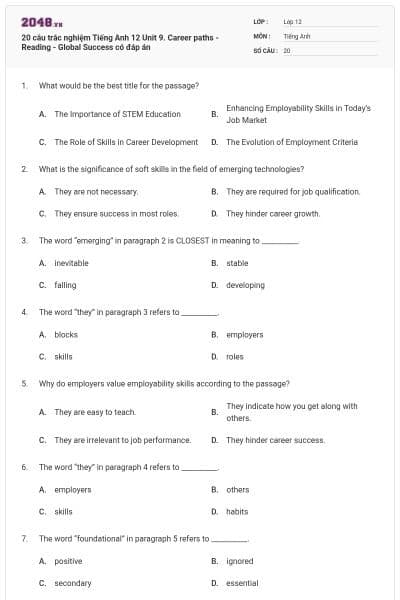
What would be the best title for the passage?
The Importance of STEM Education
Enhancing Employability Skills in Today’s Job Market
The Role of Skills in Career Development
The Evolution of Employment Criteria
What is the significance of soft skills in the field of emerging technologies?
They are not necessary.
They are required for job qualification.
They ensure success in most roles.
They hinder career growth.
The word “emerging” in paragraph 2 is CLOSEST in meaning to __________.
inevitable
stable
falling
developing
The word “they” in paragraph 3 refers to __________.
blocks
employers
skills
roles
Why do employers value employability skills according to the passage?
They are easy to teach.
They indicate how you get along with others.
They are irrelevant to job performance.
They hinder career success.
The word “they” in paragraph 4 refers to __________.
employers
others
skills
habits
The word “foundational” in paragraph 5 refers to __________.
positive
ignored
secondary
essential
What is the current trend in hiring practices mentioned in the passage?
Employers focus solely on technical expertise.
Enterprises invest less in soft skills development.
Jobs are abundant, leading to fewer options for employers.
Employers prefer candidates with both technical and employability skills.
What would be the best title for the passage?
The Global Impact of Vocational Education
The Advantages of Vocational Training
The Misconceptions Surrounding Vocational Education
How to Apply for Vocational Courses
The word “confronted” in paragraph 1 is CLOSEST in meaning to __________.
seen
defined
ignored
encountered
What misconception about vocational training is addressed in the passage?
Vocational training offers lower quality education than higher education.
Vocational graduates are less likely to find high-paying jobs.
Vocational training programs are longer and more expensive than university courses.
Vocational training does not lead to any career opportunities.
The word “they” in paragraph 4 refers to __________.
jobs
graduates
employers
courses
What advantage do vocational courses offer in terms of job readiness?
They provide more theoretical knowledge than university courses.
They require extensive on-the-job training.
They offer lower employability rates compared to university courses.
They provide onsite training, reducing the need for on-the-job training.
Why does the passage suggest that vocational graduates have a higher employability rate?
because they receive higher salaries than university graduates
because they have more academic qualifications than university graduates
because they can start working immediately without additional training
because they are more experienced than university graduates
Which can be inferred from the passage?
People commonly choose to pursue higher education.
People who choose vocational training cannot earn as much as university graduates.
The number of people who go into vocational training has declined for the past two decades.
University graduates can find jobs immediately even though they do not have experience.
What would be the best title for the passage?
Benefits of College and University Education
Making Choices After Leaving School
Advantages of Studying for Career Development
Learning Skills in Universities and Colleges
The word “it” in paragraph 2 refers to __________.
career
course
foundation
yourself
The word “rigour” in paragraph 3 is CLOSEST in meaning to __________.
study
story
qualification
strictness
What is the focus of college and university education?
developing vocational skills
encouraging exploration and critical thinking
providing limited subject choices
offering job-specific training
Which of the following is NOT true according to the passage?
College and university courses focus on developing broad education in various subjects.
Pursuing a course at a well-ranking university or college can limit career opportunities.
Studying at a top university provides access to excellent resources and industry connections.
Studying in university requires more theory-based knowledge than vocational courses.