
20 câu trắc nghiệm Tiếng Anh 12 Unit 7. The world of mass media - Reading - Global Success có đáp án

20 câu hỏi
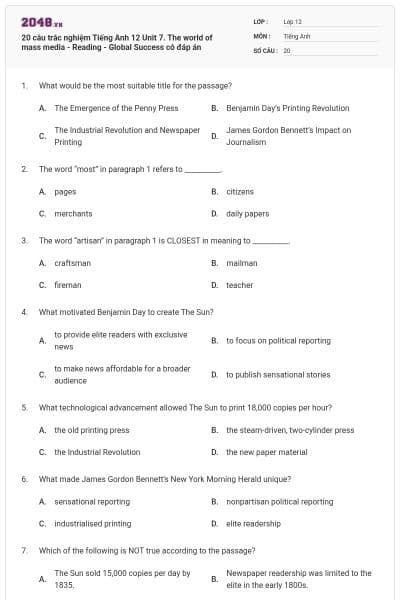
What would be the most suitable title for the passage?
The Emergence of the Penny Press
Benjamin Day’s Printing Revolution
The Industrial Revolution and Newspaper Printing
James Gordon Bennett’s Impact on Journalism
The word “most” in paragraph 1 refers to __________.
pages
citizens
merchants
daily papers
The word “artisan” in paragraph 1 is CLOSEST in meaning to __________.
craftsman
mailman
fireman
teacher
What motivated Benjamin Day to create The Sun?
to provide elite readers with exclusive news
to focus on political reporting
to make news affordable for a broader audience
to publish sensational stories
What technological advancement allowed The Sun to print 18,000 copies per hour?
the old printing press
the steam-driven, two-cylinder press
the Industrial Revolution
the new paper material
What made James Gordon Bennett’s New York Morning Herald unique?
sensational reporting
nonpartisan political reporting
industrialised printing
elite readership
Which of the following is NOT true according to the passage?
The Sun sold 15,000 copies per day by 1835.
Newspaper readership was limited to the elite in the early 1800s.
The Herald did not cover sensational news from the beginning.
Day left large room for advertisements in his newspaper.
The word “sensational” in paragraph 4 is CLOSEST in meaning to __________.
outstanding
exciting
recent
shocking
The word “it” in paragraph 4 refers to __________.
reporter
investigation
The Herald
news
Which can be inferred from the passage?
Working-class citizens could not afford papers until 1833.
The new technology could not make the printing process faster.
The Herald newspaper is not respected in the country.
The Sun did not print a motto in his newspaper.
The first large-format billboard was introduced in 1835 by Jared Bell.
True
False
Billboard associations were created to prevent people from advertising outdoors.
True
False
Billboards became more effective when highways and roads were developed.
True
False
Billboards are used only for commercial purposes today.
True
False
Television once posed a challenge to billboard advertising in the 21st century.
True
False
Digital billboards became successful even though they had low screen resolution at first.
True
False
Digital billboards require more labour and printing costs than traditional ones.
True
False
Businesses can now buy specific time slots instead of renting billboard space all day.
True
False
Digital billboards were considered successful even when their screen resolution was low.
True
False
Digital billboards provide easier ways to track and measure advertisement performance.
True
False