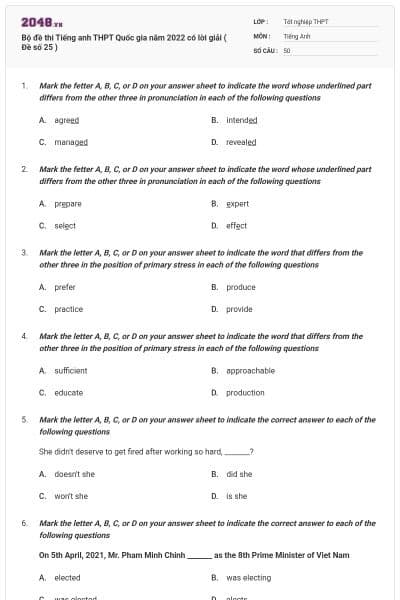
Bộ đề thi Tiếng anh THPT Quốc gia năm 2022 có lời giải ( Đề số 25 )
50 câu hỏi
Mark the fetter A, B, C, or D on your answer sheet to indicate the word whose underlined part differs from the other three in pronunciation in each of the following questions
agreed
intended
managed
revealed
Mark the fetter A, B, C, or D on your answer sheet to indicate the word whose underlined part differs from the other three in pronunciation in each of the following questions
prepare
expert
select
effect
Mark the letter A, B, C, or D on your answer sheet to indicate the word that differs from the other three in the position of primary stress in each of the following questions
prefer
produce
practice
provide
Mark the letter A, B, C, or D on your answer sheet to indicate the word that differs from the other three in the position of primary stress in each of the following questions
sufficient
approachable
educate
production
Mark the letter A, B, C, or D on your answer sheet to indicate the correct answer to each of the following questions
She didn't deserve to get fired after working so hard, _______?
doesn't she
did she
won't she
is she
Mark the letter A, B, C, or D on your answer sheet to indicate the correct answer to each of the following questions
On 5th April, 2021, Mr. Pham Minh Chinh _______ as the 8th Prime Minister of Viet Nam
elected
was electing
was elected
elects
Mark the letter A, B, C, or D on your answer sheet to indicate the correct answer to each of the following questions
Many wild animals are _______ threat _______ extinction
at – of
on – with
under – of
in – with
Mark the letter A, B, C, or D on your answer sheet to indicate the correct answer to each of the following questions
The more time he spends with his children, _______ he is.
the more happy
happier
more happy
the happier
Mark the letter A, B, C, or D on your answer sheet to indicate the correct answer to each of the following questions
They cook a _______ meal for their children
delicious traditional Vietnamese
Vietnamese delicious traditional
traditional delicious Vietnamese
delicious Vietnamese traditional
Mark the letter A, B, C, or D on your answer sheet to indicate the correct answer to each of the following questions
_______ his poor English, he managed to communicate his problem very clearly
In spite of
Even though
Because of
Because
Mark the letter A, B, C, or D on your answer sheet to indicate the correct answer to each of the following questions
He came when I _______ the film "Man from the star”.
has watched
watched
was watching
am watching
Mark the letter A, B, C, or D on your answer sheet to indicate the correct answer to each of the following questions
He will have moved to England _______.
until we finished the project
by the time we finish the project
before we will finish the project
when we had finished the project
Mark the letter A, B, C, or D on your answer sheet to indicate the correct answer to each of the following questions
University students __________ in linguistics may take courses including phonetics, semantics, and pragmatics
major
to major
majored
majoring
Mark the letter A, B, C, or D on your answer sheet to indicate the correct answer to each of the following questions
Sports can be an effective way to foster blood circulation, burn extra fat as well as improve our stamina and _______.
flexible
flexile
flexibility
flextime
Mark the letter A, B, C, or D on your answer sheet to indicate the correct answer to each of the following questions
Some high school students often _______ helping the disadvantaged or handicapped children
look after
clean up
make out
participate in
Mark the letter A, B, C, or D on your answer sheet to indicate the correct answer to each of the following questions
TV companies _______ their programmes across the country or even across the world
broadcast
refresh
connect
publish
Mark the letter A, B, C, or D on your answer sheet to indicate the correct answer to each of the following questions
_______ people are those who share the same interests, or points of view.
Light-hearted
Like-minded
Even-handed
Open-minded
Mark the letter A, B, C, or D on your answer sheet to indicate the correct answer to each of the following questions
My cousin was nervous about being interviewed on television, but he _______ to the occasion wonderfully
rose
raised
fell
faced
Mark the letter A, B, C, or D on your answer sheet to indicate the correct answer to each of the following questions
She will have to _______ if she wants to pass the final exam
pull up her socks
work miracles
take the trouble
keep her hand in
Mark the letter A, B, C, or D on your answer sheet to indicate the word(s) CLOSEST in meaning to the underlined word(s) in each of the following questions
Mother Teresa devoted herself to caring for the sick and the poor
spent
contributed
gave up
dedicated
Mark the letter A, B, C, or D on your answer sheet to indicate the word(s) CLOSEST in meaning to the underlined word(s) in each of the following questions
Everyone agreed with Janice's point that the accounts could have been falsified.
forged
innovated
revealed
improvised
Mark the letter A, B, C, or D on your answer sheet to indicate the word(s) OPPOSITE in meaning to the underlined word(s) in each of the following questions
In the early 21st century, with the explosion of mobile communication technology, the mobile phone has emerged as a new and unique channel.
disappearance
destruction
exploitation
exploration
Mark the letter A, B, C, or D on your answer sheet to indicate the word(s) OPPOSITE in meaning to the underlined word(s) in each of the following questions
Her career ground to a halt when the twins were born
stopped suddenly
was interrupted
made her tired
developed quickly
Mark the letter A, B, C, or D on your answer sheet to indicate the option that best completes each of the following exchanges
Ella is asking Eric about self-study.
- Ella: “Do you think people with self-education can succeed nowadays?"
- Eric: “________ because they tend to be very independent and self-disciplined."
I'm not so sure about that
That's what I was thinking
It's out of the question
I don't think it's right
Mark the letter A, B, C, or D on your answer sheet to indicate the option that best completes each of the following exchanges
Huy was asking Mai, his classmate, for her opinion about the book he had lent her.
- Huy: "What do you think about the book?"
- Mai: “____________________”
Yes, let's read it together
The best I've ever read!
I can't agree with you more
I wish I could buy one
Mark the letter A, B, C, or D on your answer sheet to indicate the sentence that is closest in meaning to each of the following questions
Friendly though she may seem, she's not to be trusted
However friendly she seems, she's not to be trusted
She's too friendly to be trusted
However she seems friendly, she's not to be trusted
She may have friends, but she's not to be trusted
Mark the letter A, B, C, or D on your answer sheet to indicate the sentence that is closest in meaning to each of the following questions
"Believe me. It's no use reading that book," Janet told her boyfriend.
Janet suggested to her boyfriend that reading the book was useful
Janet managed to persuade her boyfriend that reading the book was worthwhile
Janet tried to convince her boyfriend that the book was not worth reading
Janet opposed her boyfriend's idea that reading the book was not useful
Mark the letter A, B, C, or D on your answer sheet to indicate the sentence that is closest in meaning to each of the following questions
The last time I saw David was when I went to my friend's birthday party.
I haven't seen David since my friend's birthday party
When I last went to my friend's birthday party, I met David
It's long time ago when I last saw David at my friend's birthday party
I finally saw David when I was going to my friend's birthday party
Mark the letter A, B, C, or D on your answer sheet to indicate the sentence that best combines each pair of sentences in the following questions
Mary was not here yesterday. Perhaps she was ill
Mary needn't be here yesterday because she was ill
Because of her illness, Mary shouldn't have been here yesterday
Mary might have been ill yesterday, so she was not here
Mary must have been ill yesterday, so she was not here
Mark the letter A, B, C, or D on your answer sheet to indicate the sentence that best combines each pair of sentences in the following questions
I didn't know that you were at home. I didn't visit you
If I knew that you were at home, I would visit you
If I had known that you were at home, I would have visited you
If I knew that you had been at home, I would have visited you
If I would know that you were at home, I visited you
Read the following passage and mark the letter A, B, C, or D on your answer sheet to indicate the correct answer to each of the questions from 31 to 35.
People in the UK enjoy fewer years of good health before they die than the citizens of most comparable European countries as well as Australia and Canada, a major report shows. While life expectancy has improved by 4.2 years in the UK over the two decades, other countries have improved faster. In 2010, Spain topped the league. Its people could expect 70.9 years of healthy life - before disease and disability began to take a toll. Second came Italy, with 70.2 years and third was Australia, on 70.1 years. In the UK, we can expect 68.6 healthy years of life. Hunt said the UK was a long way behind its global counterparts and called for action by local health commissioners to tackle the five big killers - cancer, heart disease, stroke, respiratory and liver diseases. Drinking and drug use have been the main issues behind the worsening of the UK's ranking in early deaths among adults aged 20-54. In 2010, drugs were the sixth leading cause of death in this age group and alcohol was 18th - up from 32nd and 43rd place respectively 20 years earlier.
Hunt will on Tuesday announce a strategy to tackle cardiovascular disease, which he says could save 30,000 lives a year. “Despite real progress in cutting deaths, we remain a poor relative to our global cousins on many measures of health, something I want to change," he said. "For too long we have been lagging behind and I want the reformed health system to take up this challenge and turn this shocking underperformance around." However, the problem is only in part to do with hospital care - much of it is about the way we live. Our diet, our drinking and continuing smoking habits all play a part, which assumes its responsibilities on 1st April
The best title for this passage could be ________.
Life expectancy in the UK in comparison with other countries
The causes of early deaths in the UK
Life expectancy in the UK and its efforts to solve health problems
Five big killers in the UK
Read the following passage and mark the letter A, B, C, or D on your answer sheet to indicate the correct answer to each of the questions from 31 to 35.
People in the UK enjoy fewer years of good health before they die than the citizens of most comparable European countries as well as Australia and Canada, a major report shows. While life expectancy has improved by 4.2 years in the UK over the two decades, other countries have improved faster. In 2010, Spain topped the league. Its people could expect 70.9 years of healthy life - before disease and disability began to take a toll. Second came Italy, with 70.2 years and third was Australia, on 70.1 years. In the UK, we can expect 68.6 healthy years of life. Hunt said the UK was a long way behind its global counterparts and called for action by local health commissioners to tackle the five big killers - cancer, heart disease, stroke, respiratory and liver diseases. Drinking and drug use have been the main issues behind the worsening of the UK's ranking in early deaths among adults aged 20-54. In 2010, drugs were the sixth leading cause of death in this age group and alcohol was 18th - up from 32nd and 43rd place respectively 20 years earlier.
Hunt will on Tuesday announce a strategy to tackle cardiovascular disease, which he says could save 30,000 lives a year. “Despite real progress in cutting deaths, we remain a poor relative to our global cousins on many measures of health, something I want to change," he said. "For too long we have been lagging behind and I want the reformed health system to take up this challenge and turn this shocking underperformance around." However, the problem is only in part to do with hospital care - much of it is about the way we live. Our diet, our drinking and continuing smoking habits all play a part, which assumes its responsibilities on 1st April
The word "cardiovascular" in paragraph 2 could be best replaced by
respiratory
digestive
skeletal
cardiac
Read the following passage and mark the letter A, B, C, or D on your answer sheet to indicate the correct answer to each of the questions from 31 to 35.
People in the UK enjoy fewer years of good health before they die than the citizens of most comparable European countries as well as Australia and Canada, a major report shows. While life expectancy has improved by 4.2 years in the UK over the two decades, other countries have improved faster. In 2010, Spain topped the league. Its people could expect 70.9 years of healthy life - before disease and disability began to take a toll. Second came Italy, with 70.2 years and third was Australia, on 70.1 years. In the UK, we can expect 68.6 healthy years of life. Hunt said the UK was a long way behind its global counterparts and called for action by local health commissioners to tackle the five big killers - cancer, heart disease, stroke, respiratory and liver diseases. Drinking and drug use have been the main issues behind the worsening of the UK's ranking in early deaths among adults aged 20-54. In 2010, drugs were the sixth leading cause of death in this age group and alcohol was 18th - up from 32nd and 43rd place respectively 20 years earlier.
Hunt will on Tuesday announce a strategy to tackle cardiovascular disease, which he says could save 30,000 lives a year. “Despite real progress in cutting deaths, we remain a poor relative to our global cousins on many measures of health, something I want to change," he said. "For too long we have been lagging behind and I want the reformed health system to take up this challenge and turn this shocking underperformance around." However, the problem is only in part to do with hospital care - much of it is about the way we live. Our diet, our drinking and continuing smoking habits all play a part, which assumes its responsibilities on 1st April
According to the passage, what is NOT the cause of death in the UK?
drug
alcohol
drinking
food
Read the following passage and mark the letter A, B, C, or D on your answer sheet to indicate the correct answer to each of the questions from 31 to 35.
People in the UK enjoy fewer years of good health before they die than the citizens of most comparable European countries as well as Australia and Canada, a major report shows. While life expectancy has improved by 4.2 years in the UK over the two decades, other countries have improved faster. In 2010, Spain topped the league. Its people could expect 70.9 years of healthy life - before disease and disability began to take a toll. Second came Italy, with 70.2 years and third was Australia, on 70.1 years. In the UK, we can expect 68.6 healthy years of life. Hunt said the UK was a long way behind its global counterparts and called for action by local health commissioners to tackle the five big killers - cancer, heart disease, stroke, respiratory and liver diseases. Drinking and drug use have been the main issues behind the worsening of the UK's ranking in early deaths among adults aged 20-54. In 2010, drugs were the sixth leading cause of death in this age group and alcohol was 18th - up from 32nd and 43rd place respectively 20 years earlier.
Hunt will on Tuesday announce a strategy to tackle cardiovascular disease, which he says could save 30,000 lives a year. “Despite real progress in cutting deaths, we remain a poor relative to our global cousins on many measures of health, something I want to change," he said. "For too long we have been lagging behind and I want the reformed health system to take up this challenge and turn this shocking underperformance around." However, the problem is only in part to do with hospital care - much of it is about the way we live. Our diet, our drinking and continuing smoking habits all play a part, which assumes its responsibilities on 1st April.
According to the passage, Hunt is showing his attempt to ________.
lower death rates
better the health system in the UK
take up more challenge
change people's diet
Read the following passage and mark the letter A, B, C, or D on your answer sheet to indicate the correct answer to each of the questions from 31 to 35.
People in the UK enjoy fewer years of good health before they die than the citizens of most comparable European countries as well as Australia and Canada, a major report shows. While life expectancy has improved by 4.2 years in the UK over the two decades, other countries have improved faster. In 2010, Spain topped the league. Its people could expect 70.9 years of healthy life - before disease and disability began to take a toll. Second came Italy, with 70.2 years and third was Australia, on 70.1 years. In the UK, we can expect 68.6 healthy years of life. Hunt said the UK was a long way behind its global counterparts and called for action by local health commissioners to tackle the five big killers - cancer, heart disease, stroke, respiratory and liver diseases. Drinking and drug use have been the main issues behind the worsening of the UK's ranking in early deaths among adults aged 20-54. In 2010, drugs were the sixth leading cause of death in this age group and alcohol was 18th - up from 32nd and 43rd place respectively 20 years earlier.
Hunt will on Tuesday announce a strategy to tackle cardiovascular disease, which he says could save 30,000 lives a year. “Despite real progress in cutting deaths, we remain a poor relative to our global cousins on many measures of health, something I want to change," he said. "For too long we have been lagging behind and I want the reformed health system to take up this challenge and turn this shocking underperformance around." However, the problem is only in part to do with hospital care - much of it is about the way we live. Our diet, our drinking and continuing smoking habits all play a part, which assumes its responsibilities on 1st April
The word "it" in paragraph 2 refers to ________.
challenge
diet
problem
disease
Read the following passage and mark the letter A, B, C, or D on your answer sheet to indicate the correct answer to each of the questions from 36 to 42.
If you could travel back in time five centuries, you'd encounter a thriving Aztec empire in Central Mexico, a freshly painted "Mona Lisa" in Renaissance Europe and cooler temperatures across the Northern Hemisphere. This was a world in the midst of the Little Ice Age (A.D. 1300 to 1850) and a period of vast European exploration now known as the Age of Discovery. But what if we could look 500 years into the future and glimpse the Earth of the 26th century? Would the world seem as different to us as the 21st century would have seemed to residents of the 16th century? For starters, what will the weather be like?
Depending on whom you ask, the 26th century will either be a little chilly or infernally hot. Some solar output models suggest that by the 2500s, Earth's climate will have cooled back down to near Little Ice Age conditions. Other studies predict that ongoing climate change and fossil fuel use will render much of the planet too hot for human life by 2300.
Some experts date the beginning of human climate change back to the Industrial Revolution in the 1800s, others to slash-and-burn agricultural practices in prehistoric times. Either way, tool-wielding humans alter their environment - and our 26th century tools might be quite impressive indeed.
Theoretical physicist and futurist Michio Kaku predicts that in a mere 100 years, humanity will make the leap from a type zero civilization to a type I civilization on the Kardashev Scale. In other words, we'll become a species that can harness the entire sum of a planet's energy. Wielding such power, 26th-century humans will be masters of clean energy technologies such as fusion and solar power. Furthermore, they will be able to manipulate planetary energy in order to control global climate. Physicist Freeman Dyson, on the other hand, estimates the leap to a type 1 civilization would occur within roughly 200 years. Technology has improved exponentially since the 1500s, and this pace will likely continue in the centuries to come. Physicist Stephen Hawking proposes that by the year 2600, this growth would see 10 new theoretical physics papers published every 10 seconds. If Moore's Law holds true and both computer speed and complexity double every 18 months, then some of these studies may be the work of highly intelligent machines.
What other technologies will shape the world of the 26th century? Futurist and author Adrian Berry believes the average human life span will reach 140 years and that the digital storage of human personalities will enable a kind of computerized immortality. Humans will farm the oceans, travel in starships and reside in both lunar and Martian colonies while robots explore the outer cosmos.
Which of the following could be the main idea of the passage?
How would the world change in the next 500 years?
What would we do in the next five centuries?
What problems would happen in the 26th century?
How would technology improve the life in the far future?
Read the following passage and mark the letter A, B, C, or D on your answer sheet to indicate the correct answer to each of the questions from 36 to 42.
If you could travel back in time five centuries, you'd encounter a thriving Aztec empire in Central Mexico, a freshly painted "Mona Lisa" in Renaissance Europe and cooler temperatures across the Northern Hemisphere. This was a world in the midst of the Little Ice Age (A.D. 1300 to 1850) and a period of vast European exploration now known as the Age of Discovery. But what if we could look 500 years into the future and glimpse the Earth of the 26th century? Would the world seem as different to us as the 21st century would have seemed to residents of the 16th century? For starters, what will the weather be like?
Depending on whom you ask, the 26th century will either be a little chilly or infernally hot. Some solar output models suggest that by the 2500s, Earth's climate will have cooled back down to near Little Ice Age conditions. Other studies predict that ongoing climate change and fossil fuel use will render much of the planet too hot for human life by 2300.
Some experts date the beginning of human climate change back to the Industrial Revolution in the 1800s, others to slash-and-burn agricultural practices in prehistoric times. Either way, tool-wielding humans alter their environment - and our 26th century tools might be quite impressive indeed.
Theoretical physicist and futurist Michio Kaku predicts that in a mere 100 years, humanity will make the leap from a type zero civilization to a type I civilization on the Kardashev Scale. In other words, we'll become a species that can harness the entire sum of a planet's energy. Wielding such power, 26th-century humans will be masters of clean energy technologies such as fusion and solar power. Furthermore, they will be able to manipulate planetary energy in order to control global climate. Physicist Freeman Dyson, on the other hand, estimates the leap to a type 1 civilization would occur within roughly 200 years. Technology has improved exponentially since the 1500s, and this pace will likely continue in the centuries to come. Physicist Stephen Hawking proposes that by the year 2600, this growth would see 10 new theoretical physics papers published every 10 seconds. If Moore's Law holds true and both computer speed and complexity double every 18 months, then some of these studies may be the work of highly intelligent machines.
What other technologies will shape the world of the 26th century? Futurist and author Adrian Berry believes the average human life span will reach 140 years and that the digital storage of human personalities will enable a kind of computerized immortality. Humans will farm the oceans, travel in starships and reside in both lunar and Martian colonies while robots explore the outer cosmos.
The word "infernally" in paragraph 2 is closest in meaning to ________.
differently
extremely
permanently
contemporaneously
Read the following passage and mark the letter A, B, C, or D on your answer sheet to indicate the correct answer to each of the questions from 36 to 42.
If you could travel back in time five centuries, you'd encounter a thriving Aztec empire in Central Mexico, a freshly painted "Mona Lisa" in Renaissance Europe and cooler temperatures across the Northern Hemisphere. This was a world in the midst of the Little Ice Age (A.D. 1300 to 1850) and a period of vast European exploration now known as the Age of Discovery. But what if we could look 500 years into the future and glimpse the Earth of the 26th century? Would the world seem as different to us as the 21st century would have seemed to residents of the 16th century? For starters, what will the weather be like?
Depending on whom you ask, the 26th century will either be a little chilly or infernally hot. Some solar output models suggest that by the 2500s, Earth's climate will have cooled back down to near Little Ice Age conditions. Other studies predict that ongoing climate change and fossil fuel use will render much of the planet too hot for human life by 2300.
Some experts date the beginning of human climate change back to the Industrial Revolution in the 1800s, others to slash-and-burn agricultural practices in prehistoric times. Either way, tool-wielding humans alter their environment - and our 26th century tools might be quite impressive indeed.
Theoretical physicist and futurist Michio Kaku predicts that in a mere 100 years, humanity will make the leap from a type zero civilization to a type I civilization on the Kardashev Scale. In other words, we'll become a species that can harness the entire sum of a planet's energy. Wielding such power, 26th-century humans will be masters of clean energy technologies such as fusion and solar power. Furthermore, they will be able to manipulate planetary energy in order to control global climate. Physicist Freeman Dyson, on the other hand, estimates the leap to a type 1 civilization would occur within roughly 200 years. Technology has improved exponentially since the 1500s, and this pace will likely continue in the centuries to come. Physicist Stephen Hawking proposes that by the year 2600, this growth would see 10 new theoretical physics papers published every 10 seconds. If Moore's Law holds true and both computer speed and complexity double every 18 months, then some of these studies may be the work of highly intelligent machines.
What other technologies will shape the world of the 26th century? Futurist and author Adrian Berry believes the average human life span will reach 140 years and that the digital storage of human personalities will enable a kind of computerized immortality. Humans will farm the oceans, travel in starships and reside in both lunar and Martian colonies while robots explore the outer cosmos.
The word "harness" in paragraph 4 could best be replaced by ________.
renew
adjust
exploit
discover
Read the following passage and mark the letter A, B, C, or D on your answer sheet to indicate the correct answer to each of the questions from 36 to 42.
If you could travel back in time five centuries, you'd encounter a thriving Aztec empire in Central Mexico, a freshly painted "Mona Lisa" in Renaissance Europe and cooler temperatures across the Northern Hemisphere. This was a world in the midst of the Little Ice Age (A.D. 1300 to 1850) and a period of vast European exploration now known as the Age of Discovery. But what if we could look 500 years into the future and glimpse the Earth of the 26th century? Would the world seem as different to us as the 21st century would have seemed to residents of the 16th century? For starters, what will the weather be like?
Depending on whom you ask, the 26th century will either be a little chilly or infernally hot. Some solar output models suggest that by the 2500s, Earth's climate will have cooled back down to near Little Ice Age conditions. Other studies predict that ongoing climate change and fossil fuel use will render much of the planet too hot for human life by 2300.
Some experts date the beginning of human climate change back to the Industrial Revolution in the 1800s, others to slash-and-burn agricultural practices in prehistoric times. Either way, tool-wielding humans alter their environment - and our 26th century tools might be quite impressive indeed.
Theoretical physicist and futurist Michio Kaku predicts that in a mere 100 years, humanity will make the leap from a type zero civilization to a type I civilization on the Kardashev Scale. In other words, we'll become a species that can harness the entire sum of a planet's energy. Wielding such power, 26th-century humans will be masters of clean energy technologies such as fusion and solar power. Furthermore, they will be able to manipulate planetary energy in order to control global climate. Physicist Freeman Dyson, on the other hand, estimates the leap to a type 1 civilization would occur within roughly 200 years. Technology has improved exponentially since the 1500s, and this pace will likely continue in the centuries to come. Physicist Stephen Hawking proposes that by the year 2600, this growth would see 10 new theoretical physics papers published every 10 seconds. If Moore's Law holds true and both computer speed and complexity double every 18 months, then some of these studies may be the work of highly intelligent machines.
What other technologies will shape the world of the 26th century? Futurist and author Adrian Berry believes the average human life span will reach 140 years and that the digital storage of human personalities will enable a kind of computerized immortality. Humans will farm the oceans, travel in starships and reside in both lunar and Martian colonies while robots explore the outer cosmos
What does the word "they" in paragraph 4 refer to?
fusion and solar energy
clean energy technologies
masters
26th century humans
Read the following passage and mark the letter A, B, C, or D on your answer sheet to indicate the correct answer to each of the questions from 36 to 42.
If you could travel back in time five centuries, you'd encounter a thriving Aztec empire in Central Mexico, a freshly painted "Mona Lisa" in Renaissance Europe and cooler temperatures across the Northern Hemisphere. This was a world in the midst of the Little Ice Age (A.D. 1300 to 1850) and a period of vast European exploration now known as the Age of Discovery. But what if we could look 500 years into the future and glimpse the Earth of the 26th century? Would the world seem as different to us as the 21st century would have seemed to residents of the 16th century? For starters, what will the weather be like?
Depending on whom you ask, the 26th century will either be a little chilly or infernally hot. Some solar output models suggest that by the 2500s, Earth's climate will have cooled back down to near Little Ice Age conditions. Other studies predict that ongoing climate change and fossil fuel use will render much of the planet too hot for human life by 2300.
Some experts date the beginning of human climate change back to the Industrial Revolution in the 1800s, others to slash-and-burn agricultural practices in prehistoric times. Either way, tool-wielding humans alter their environment - and our 26th century tools might be quite impressive indeed.
Theoretical physicist and futurist Michio Kaku predicts that in a mere 100 years, humanity will make the leap from a type zero civilization to a type I civilization on the Kardashev Scale. In other words, we'll become a species that can harness the entire sum of a planet's energy. Wielding such power, 26th-century humans will be masters of clean energy technologies such as fusion and solar power. Furthermore, they will be able to manipulate planetary energy in order to control global climate. Physicist Freeman Dyson, on the other hand, estimates the leap to a type 1 civilization would occur within roughly 200 years. Technology has improved exponentially since the 1500s, and this pace will likely continue in the centuries to come. Physicist Stephen Hawking proposes that by the year 2600, this growth would see 10 new theoretical physics papers published every 10 seconds. If Moore's Law holds true and both computer speed and complexity double every 18 months, then some of these studies may be the work of highly intelligent machines.
What other technologies will shape the world of the 26th century? Futurist and author Adrian Berry believes the average human life span will reach 140 years and that the digital storage of human personalities will enable a kind of computerized immortality. Humans will farm the oceans, travel in starships and reside in both lunar and Martian colonies while robots explore the outer cosmos.
Which of the following is TRUE about the future predictions?
Michio Kaku believes that the progress from type 0 to type I civilization will take about two centuries
People in the 2500s are likely to control the energy of the Earth to limit the global climate
The speed of technology improvement will remain changeable in the far future
Solar energy will be the main power for the 26th century citizens
Read the following passage and mark the letter A, B, C, or D on your answer sheet to indicate the correct answer to each of the questions from 36 to 42.
If you could travel back in time five centuries, you'd encounter a thriving Aztec empire in Central Mexico, a freshly painted "Mona Lisa" in Renaissance Europe and cooler temperatures across the Northern Hemisphere. This was a world in the midst of the Little Ice Age (A.D. 1300 to 1850) and a period of vast European exploration now known as the Age of Discovery. But what if we could look 500 years into the future and glimpse the Earth of the 26th century? Would the world seem as different to us as the 21st century would have seemed to residents of the 16th century? For starters, what will the weather be like?
Depending on whom you ask, the 26th century will either be a little chilly or infernally hot. Some solar output models suggest that by the 2500s, Earth's climate will have cooled back down to near Little Ice Age conditions. Other studies predict that ongoing climate change and fossil fuel use will render much of the planet too hot for human life by 2300.
Some experts date the beginning of human climate change back to the Industrial Revolution in the 1800s, others to slash-and-burn agricultural practices in prehistoric times. Either way, tool-wielding humans alter their environment - and our 26th century tools might be quite impressive indeed.
Theoretical physicist and futurist Michio Kaku predicts that in a mere 100 years, humanity will make the leap from a type zero civilization to a type I civilization on the Kardashev Scale. In other words, we'll become a species that can harness the entire sum of a planet's energy. Wielding such power, 26th-century humans will be masters of clean energy technologies such as fusion and solar power. Furthermore, they will be able to manipulate planetary energy in order to control global climate. Physicist Freeman Dyson, on the other hand, estimates the leap to a type 1 civilization would occur within roughly 200 years. Technology has improved exponentially since the 1500s, and this pace will likely continue in the centuries to come. Physicist Stephen Hawking proposes that by the year 2600, this growth would see 10 new theoretical physics papers published every 10 seconds. If Moore's Law holds true and both computer speed and complexity double every 18 months, then some of these studies may be the work of highly intelligent machines.
What other technologies will shape the world of the 26th century? Futurist and author Adrian Berry believes the average human life span will reach 140 years and that the digital storage of human personalities will enable a kind of computerized immortality. Humans will farm the oceans, travel in starships and reside in both lunar and Martian colonies while robots explore the outer cosmos
According to Adrian Berry the following are what future humans can do, EXCEPT ________.
cultivating in the oceans
traveling between the stars
exploring the universe by robots
living as long as they want
Read the following passage and mark the letter A, B, C, or D on your answer sheet to indicate the correct answer to each of the questions from 36 to 42.
If you could travel back in time five centuries, you'd encounter a thriving Aztec empire in Central Mexico, a freshly painted "Mona Lisa" in Renaissance Europe and cooler temperatures across the Northern Hemisphere. This was a world in the midst of the Little Ice Age (A.D. 1300 to 1850) and a period of vast European exploration now known as the Age of Discovery. But what if we could look 500 years into the future and glimpse the Earth of the 26th century? Would the world seem as different to us as the 21st century would have seemed to residents of the 16th century? For starters, what will the weather be like?
Depending on whom you ask, the 26th century will either be a little chilly or infernally hot. Some solar output models suggest that by the 2500s, Earth's climate will have cooled back down to near Little Ice Age conditions. Other studies predict that ongoing climate change and fossil fuel use will render much of the planet too hot for human life by 2300.
Some experts date the beginning of human climate change back to the Industrial Revolution in the 1800s, others to slash-and-burn agricultural practices in prehistoric times. Either way, tool-wielding humans alter their environment - and our 26th century tools might be quite impressive indeed.
Theoretical physicist and futurist Michio Kaku predicts that in a mere 100 years, humanity will make the leap from a type zero civilization to a type I civilization on the Kardashev Scale. In other words, we'll become a species that can harness the entire sum of a planet's energy. Wielding such power, 26th-century humans will be masters of clean energy technologies such as fusion and solar power. Furthermore, they will be able to manipulate planetary energy in order to control global climate. Physicist Freeman Dyson, on the other hand, estimates the leap to a type 1 civilization would occur within roughly 200 years. Technology has improved exponentially since the 1500s, and this pace will likely continue in the centuries to come. Physicist Stephen Hawking proposes that by the year 2600, this growth would see 10 new theoretical physics papers published every 10 seconds. If Moore's Law holds true and both computer speed and complexity double every 18 months, then some of these studies may be the work of highly intelligent machines.
What other technologies will shape the world of the 26th century? Futurist and author Adrian Berry believes the average human life span will reach 140 years and that the digital storage of human personalities will enable a kind of computerized immortality. Humans will farm the oceans, travel in starships and reside in both lunar and Martian colonies while robots explore the outer cosmos
It can be inferred from the passage that ________.
no one could be sure what the life would be like in the 2500s
what we imagine about the life in the 26th century may be the same what the 16th-century people thought about the current life
the predictions of different scientists may draw the same world in the next 500 years
technology will affect most of the fields in the future life
Mark the letter A, B, C, or D on your answer sheet to indicate the underlined part that needs correction in each of the following questions
To everyone's surprising, it wasn't in Da Nang City that he made his fortune, although that's where he was born
Το
that
made
surprising
Mark the letter A, B, C, or D on your answer sheet to indicate the underlined part that needs correction in each of the following questions.
For many years, people have used some kinds of refrigerator cooling beverages and preserve edibles
have used
edibles
kinds
cooling
Mark the letter A, B, C, or D on your answer sheet to indicate the underlined part that needs correction in each of the following questions
The guest of honors, along with his wife and children, were sitting at the first table when we had a party yesterday
his wife
were
when
at
Read the following passage and mark the letter A, B, C, or D on your answer sheet to indicate the correct word or phrase that best fits each of the numbered blanks from 46 to 50.
Amy Tan was born on February 19, 1952 in Oakland, California. Tan grew up in Northern California, (46) _____ when her father and older brother both died from brain tumors in 1966, she moved with her mother and younger brother to Europe, where she attended high school in Montreux, Switzerland. She returned to the United States for college. After college, Tan worked as a language development consultant and as a corporate freelance writer. (47) _____ 1985, she wrote the "Rules of the Game” for a writing workshop, which laid the early foundation for her first novel The Joy Luck Club. Published in 1989, the book explored the (48) _____ between Chinese women and their Chinese-American daughters, and became the longest running New York Times bestseller for that year. The Joy Luck Club received numerous awards, including the Los Angeles Times Book Award. It has been translated into 25 languages, including Chinese, and was made into a major motion picture for (49) _____ Tan co-wrote the screenplay. Tan's (50) _____ works have also been adapted into several different forms of media
however
moreover
so
but
Read the following passage and mark the letter A, B, C, or D on your answer sheet to indicate the correct word or phrase that best fits each of the numbered blanks from 46 to 50. Amy Tan was born on February 19, 1952 in Oakland, California. Tan grew up in Northern California, (46) _____ when her father and older brother both died from brain tumors in 1966, she moved with her mother and younger brother to Europe, where she attended high school in Montreux, Switzerland. She returned to the United States for college. After college, Tan worked as a language development consultant and as a corporate freelance writer. (47) _____ 1985, she wrote the "Rules of the Game” for a writing workshop, which laid the early foundation for her first novel The Joy Luck Club. Published in 1989, the book explored the (48) _____ between Chinese women and their Chinese-American daughters, and became the longest running New York Times bestseller for that year. The Joy Luck Club received numerous awards, including the Los Angeles Times Book Award. It has been translated into 25 languages, including Chinese, and was made into a major motion picture for (49) _____ Tan co-wrote the screenplay. Tan's (50) _____ works have also been adapted into several different forms of media
Until
Before
Since
In
Read the following passage and mark the letter A, B, C, or D on your answer sheet to indicate the correct word or phrase that best fits each of the numbered blanks from 46 to 50.
Amy Tan was born on February 19, 1952 in Oakland, California. Tan grew up in Northern California, (46) _____ when her father and older brother both died from brain tumors in 1966, she moved with her mother and younger brother to Europe, where she attended high school in Montreux, Switzerland. She returned to the United States for college. After college, Tan worked as a language development consultant and as a corporate freelance writer. (47) _____ 1985, she wrote the "Rules of the Game” for a writing workshop, which laid the early foundation for her first novel The Joy Luck Club. Published in 1989, the book explored the (48) _____ between Chinese women and their Chinese-American daughters, and became the longest running New York Times bestseller for that year. The Joy Luck Club received numerous awards, including the Los Angeles Times Book Award. It has been translated into 25 languages, including Chinese, and was made into a major motion picture for (49) _____ Tan co-wrote the screenplay. Tan's (50) _____ works have also been adapted into several different forms of media
association
correspondence
relationship
solidarity
Read the following passage and mark the letter A, B, C, or D on your answer sheet to indicate the correct word or phrase that best fits each of the numbered blanks from 46 to 50. Amy Tan was born on February 19, 1952 in Oakland, California. Tan grew up in Northern California, (46) _____ when her father and older brother both died from brain tumors in 1966, she moved with her mother and younger brother to Europe, where she attended high school in Montreux, Switzerland. She returned to the United States for college. After college, Tan worked as a language development consultant and as a corporate freelance writer. (47) _____ 1985, she wrote the "Rules of the Game” for a writing workshop, which laid the early foundation for her first novel The Joy Luck Club. Published in 1989, the book explored the (48) _____ between Chinese women and their Chinese-American daughters, and became the longest running New York Times bestseller for that year. The Joy Luck Club received numerous awards, including the Los Angeles Times Book Award. It has been translated into 25 languages, including Chinese, and was made into a major motion picture for (49) _____ Tan co-wrote the screenplay. Tan's (50) _____ works have also been adapted into several different forms of media
whom
that
what
which
Read the following passage and mark the letter A, B, C, or D on your answer sheet to indicate the correct word or phrase that best fits each of the numbered blanks from 46 to 50. Amy Tan was born on February 19, 1952 in Oakland, California. Tan grew up in Northern California, (46) _____ when her father and older brother both died from brain tumors in 1966, she moved with her mother and younger brother to Europe, where she attended high school in Montreux, Switzerland. She returned to the United States for college. After college, Tan worked as a language development consultant and as a corporate freelance writer. (47) _____ 1985, she wrote the "Rules of the Game” for a writing workshop, which laid the early foundation for her first novel The Joy Luck Club. Published in 1989, the book explored the (48) _____ between Chinese women and their Chinese-American daughters, and became the longest running New York Times bestseller for that year. The Joy Luck Club received numerous awards, including the Los Angeles Times Book Award. It has been translated into 25 languages, including Chinese, and was made into a major motion picture for (49) _____ Tan co-wrote the screenplay. Tan's (50) _____ works have also been adapted into several different forms of media
another
other
the other
others