
123 câu Trắc nghiệm Chuyên đề 11 Unit 4. Caring for those in need

123 câu hỏi
Choose the best option to complete each of the following sentences.
1. People in my neighborhood have_________more than $400 to the charity.
coordinated
integrated
donated
cared
2.There should be no_________between disabled children and non-disabled ones.
respect
background
integration
discrimination
3. More and more young people are_________themselves in helping the needy in their country.
doing
involving
taking
looking after
4. Visually_________children need taking care of better.
impaired
integrated
involved
accessed
5. People should_________as a community regardless of their different backgrounds.
suffer
donate
treat
unite
6. The United Nations organizes campaigns every year to call for world-wide support for the_________of disabled people.
rights
solutions
talents
wheelchair
7. It is sad that there are still people who have negative attitudes toward_________people.
protective
disabled
visual
cognitive
8. People with cognitive impairments are still_________unfairly.
united
treated
accessed
involved
9. She loves to_________to the charity in her mother’s name.
access
donate
care
involve
10. Why is there still_________between disabled and non-disabled children?
discrimination
disrespect
respect
coordination
11. We want to know how to support people with_________.
attitudes
disabilities
barriers
integration
12. Australians with physical and mental disabilities have_________violence and abuse at workplaces for years.
supported
suffered
accessed
donated
13. Children from different backgrounds should be_________fairly.
treated
united
involved
integrated
14. A hearing aid is a great invention to those with_________loss.
visual
hearing
healthcare
physical
15. People with physical_________can contribute to the society like any other people.
solutions
wheelchairs
fractures
impairments
16. There should be no_________to children with disabilities.
barriers
talents
volunteers
supports
17. Regardless of different backgrounds, they_________to form a strong community.
treated
united
accessed
integrated
18. Instead of saying he is_________, you should say he is unable to speak.
dumb
blind
deaf
impaired
Choose the word or phrase that is CLOSEST in meaning to the underlined part in each of the following sentences.
1. A simple ankle fracture is almost completely healed in 4 weeks.
a bone
a crack in bones
an accident
a broken leg
2. Thev shouldn’t be treated unfairly like that.
supported
behaved
strived
coped
3.They are holding an auction to raise funds for a charity.
an organisation that has the purpose of providing money to help people who need it
a group of people who work together
a person who helps other people willingly and without being paid
a group of people with official responsibility for a particular area of activity
4.People should learn more about children with cognitive impairments.
emotional
recognisable
physical
mental
5.This entrance is specially designed for people using a wheelchair to access the building.
be able to get to or get inside a place
be able to get out of a place
leave a building
be allowed to enter a building
6.The theme of this year’s conference is removing barriers to create an inclusive and accessible society for all.
a fence that stops people from going somewhere
anything that prevents people from being together
a gate in some railway stations
a number or measurement
Complete the sentences, using the correct form of the words in brackets.
1.Hundreds of new schools are being created for_________with special needs. (CHILD)
2.Disability_________is when a person with a disability is treated less favourably than a person without the disability in the same or similar circumstances. (DISCRIMINATE)
3.Although they have physical_________, they can participate fully in our community’s life. (IMPAIR)
4.It is_________to use words like ‘dumb’, ‘blind’ and ‘deaf’ to the disabled. (RESPECT)
5.My grandfather is 80 and his_________is not very good. (HEAR)
6.The head of this company has agreed to donate $8000 in_________aid to people living in flooded areas. (HUMAN)
7.People of all ages can get_________in charity work. (INVOLVE)
Choose the word with the underlined part which can be elided.
family
still
milky
daffodil
Choose the word with the underlined part which can be elided.
alert
herb
interesting
prefer
Choose the word with the underlined part which can be elided.
morning
history
story
bored
Choose the word with the underlined part which can be elided.
rental
frightening
fence
mental
Choose the word with the underlined part which can be elided.
service
German
determine
battery
Choose the word with the underlined part which can be elided.
deafening
entertaining
endless
defend
Read the following sentences and underline words with elided vowels.
1.She rarely reads history books.
2.I need an English-Vietnamese dictionary to look up new words.
3.In general, reading books online is preferable to going to the library.
4.The new city library has a conference room on the ground level.
5.They were taken in by the police for questioning.
6.Could you turn down the television?
7.Smoking is not allowed in this restaurant.
8.We have a lovely evening.
9.The deafening noise is really annoying.
10. She waters the plants every afternoon.
11. There is no difference between us.
12. I have seen this film several times.
13. All you need for walking is comfortable clothes and shoes.
14. She loves reading modern literature.
15. Fruits and vegetables are good sources of vitamins.
16. He is one of the most successful businessmen I know.
17. The temperature in Hanoi today reached 40°C.
Choose the best option to complete each of the following sentences.
1.This non-profit organisation_________milk for hundreds of children in this remote area.
has provided
provided
provide
had provided
2. The Braille alphabet_________invented by a nineteenth-century man named Louis Braille, who was completely blind.
was
had been
is
has been
3.He_________blind. He became visually impaired after an accident.
isn’t born
wasn’t born
hasn’t been born
won’t be born
4.She_________300 gifts to the charity up to now.
donated
has donated
is donating
donates
5. She_________part in any voluntary work so far.
has never taken
never takes
never took
had never taken
6. At our last meeting, we_________to organize an event for the elderly in the neighbourhood.
have decided
decided
decide
were deciding
7. When I was a small girl, I_________much time helping disabled friends near my house.
have spent
spent
spend
am spending
8. He has been a volunteer for Youth Blood Donor Organisation_________.
last 5 years
for 5 years
in 5 years
5 years ago
9.He left the army in 1983 and_________as a guard in an orphanage.
has worked
worked
works
have worked
10. Alice_________to work the day before yesterday.
didn’t go
hasn’t gone
doesn’t go
wasn’t going
11. I first_________her when we were in secondary school.
meet
have met
am meeting
met
12. Up to now, more than 80 countries_________on the Convention.
agreed
have agreed
agree
are agreeing
13. International Day of Persons with disabilities_________since 1992.
has celebrated
has been celebrated
was celebrated
celebrated
14. The Youth Union in our school_________to launch a campaign to raise funds for the underprivileged.
was decided
has been decided
decided
has decided
15. My sister_________home late last night after attending a night party.
comes
has come
came
is coming
16. She_________four novels, and now she is writing the fifth one.
wrote
writes
has written
was writing
17. I don’t have enough time, so I_________my homework yet.
didn’t do
haven’t done
don’t do
am not doing
18. I_________him 5 years ago at our friend’s wedding.
met
have meet
was met
meet
19. The little girl_________a thousand paper cranes so far.
folded
has folded
is folding
folds
20. My class visited a special school_________.
Monday ago
since Monday
for Monday
last Monday
21. He_________blood 3 times since he attended university.
has donated
donated
donates
is donating
22. I know you are busy but you_________your homework yet?
have - finished
did - finish
do - finish
are - finishing
23. When I was a kid, I_________to share my bedroom with my sister, but now I need more privacy.
was loving
loved
love
have loved
24. Everyone noticed that he_________to be sympathetic in the last meeting.
pretend
pretended
is pretending
has pretended
25. When I was 5 years old, I_________to church for the first time.
took
was taken
have taken
have been taken
26. I have never told lies to you_________we became friends.
since
when
while
for
27. I_________for this organisation since I_________from university.
have worked - graduated
worked - graduated
worked - have graduated
have worked - have graduated
Choose the underlined part which needs correction.
1.The charity raises a fund of thousands of dollars for the underprivileged so far.
charity
raises
fund
the underprivileged
2.He lived with his grandparents since he was small.
lived
grandparents
since
was
3. It was Louis Braille that has invented a system of reading and writing for use by the blind or visually impaired.
was
has invented
the blind
visually impaired.
4.Edison has developed hearing problems at an early age.
has developed
hearing
at
early
5.People’s attitudes towards the disabled changed.
attitudes
towards
disabled
changed
Complete the following sentences, using the correct form of the verbs given in brackets.
1.She has used a wheelchair since her bones (fracture)__________in the car accident last year.
2.Up to the present, no decision (make) _________.
3.He (visit) _________the orphanage 3 times this week.
4.We (collect) _________more than a hundred gifts of all kinds in the past few weeks.
5.They (cancel) _________the meeting.
Complete the following sentences, using the past simple or present perfect form of the verbs given in the box.
1.The money_________by an anonymous businesswoman last Tuesday.
2.I_________several extracurricular activities for children so far.
3.Since I started working with children with disabilities, I_________kinder and more sympathetic.
4.Last year, she_________students who wanted to play tennis.
5. _________you ever_________in any voluntary work?
Rewrite each sentence so that the new sentence has a similar meaning to the original one, using the words in brackets.
1.The last time I saw her was 5 years ago. (for)
→____________________________________________
2. This is the first time I have visited Edinburgh, (never)
→____________________________________________
3. This campaign has been launched since 1999. (for 20 years)
→____________________________________________
4.He began to teach English for disabled children in 2002. (since)
→____________________________________________
5. I haven’t visited my grandmother for 2 months (ago)
→____________________________________________
1. There are_________modalities of dioxin exposure.
3
4
18
3,181
2.People could be affected by Agent Orange if they_________.
lived in villages
were born in wartime
ate dioxin-contaminated fish
had grandparents
3.Dioxin affects not only people who are directly exposed to it, but also those_________.
whose grandparents were exposed to Agent Orange
who were soldiers fighting in sprayed forests
who were living in sprayed villages
who are living in dioxin-contaminated areas
4. The population of_________during the years of herbicide spraying was approximately 18 million.
Viet Nam
South Viet Nam
North Viet Nam
Columbia
5.According to the passage, how many people died from illnesses associated with exposure to Agent Orange?
3,181 people
4.5 million
18 million
There is no exact number.
1.Giving has been scientifically proven to lead to greater happiness.
2. Those who spent money on themselves experienced greater happiness.
3.Giving brings you happiness which makes us give more
4.Human beings have evolved as a species living with others
5.Though some people are altruistic, they don’t have greater feelings of happiness
Listen to the story of a volunteer and decide whether the statements below are TRUE (T) or FALSE (F).
1.The speaker is from Colombia, and volunteered to teach English in Germany.
2. English is her first language.
3. She taught boys between 8-14 years old
4.She organized a drawing activity for students there
5.Before the trip, she thought she would receive a lot.
Talk about what you think you can do to help people in need.
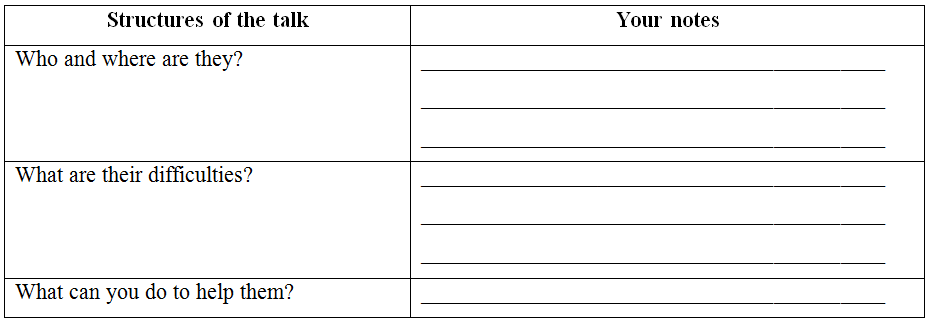
You can use the following questions as cues:
*Who and where are they?
*What are their difficulties?
*What can you do to help them?
Useful languages:
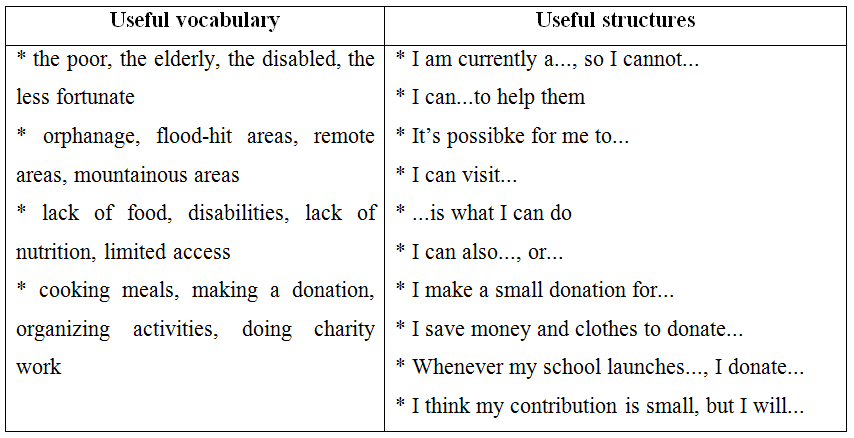
Complete the notes:
Now you try!
Give your answer using the following cues. You should speak for 1-2 minutes.
1.I am currently a..., so I cannot...
2.I can...to help them
3.I can visit...
4.I can also..., or...
5. I make a small donation for...
6.Whenever my school launches..., I donate...
7. I think my contribution is small, but I will...
Now you tick!
Did you ...
- answer all the questions in the task?
- give some details to each main point?
- speak slowly and fluently with only some hesitation?
- use vocabulary wide enough to talk about the topic?
- use various sentence structures (simple, compound, complex) accurately?
- pronounce correctly (vowels, consonants, stress, intonation)?
Let’s compare!
Finally, compare with the sample answer on page 190.
Complete each of the following sentences using the cues given. You can change the cues and use other words in addition to the cues to complete the sentences.
1. Viet Nam/ be/ multi-ethnic/ country/ 54 ethnic group.
→ ________________________________________________________
2. 87%/ Viet Nam/ population/ be/ Kinh people.
→ ________________________________________________________
3. There/ be/ lack/ school/ hospital/ some/ mountainous areas/ Viet Nam.
→ ________________________________________________________
4. They/ need/ 20 volunteer teacher/ boarding school/ Kon Turn.
→ ________________________________________________________
5. Underprivileged/ be/ those/ who/ have/ little/ no money/ possessions/ which/ average people/ have.
→ ________________________________________________________
Write an essay (150-180 words) about problems that people living in remote and mountainous areas in your country may face.
* You can use the following questions as cues:
* Who are they?
* What are their problems?
* Why do they have those problems?
__________________________________________________________________
__________________________________________________________________
__________________________________________________________________
__________________________________________________________________
__________________________________________________________________
__________________________________________________________________
__________________________________________________________________
__________________________________________________________________