Tập hợp tất cả các giá trị thực của tham số
7/38
Tập hợp tất cả các giá trị thực của tham số  để hàm số
  đồng biến trên khoảng
  là:
là:
 .
.
 .
.
 .
.
 .
.
Đáp án đúng là: B
Ta có: \(y = {x^3} - 3{x^2} + \left( {4 - m} \right)x\); \(y' = 3{x^2} - 6x + 4 - m\).
Để thỏa mãn yêu cầu bài toán thì \(y' \ge 0,\forall x \in \left( {2; + \infty } \right)\).
\( \Leftrightarrow 3{x^2} - 6x + 4 - m \ge 0,\forall x \in \left( {2; + \infty } \right).\)
\( \Leftrightarrow m \le 3{x^2} - 6x + 4,\forall x \in \left( {2; + \infty } \right).\)
\( \Leftrightarrow m \le \mathop {\min }\limits_{\left( {2; + \infty } \right)} g(x)\) với \(g(x) = 3{x^2} - 6x + 4.\)
Ta có: \(g'\left( x \right) = 6x - 6\)
\(g'\left( x \right) = 0 \Leftrightarrow 6x - 6 = 0 \Leftrightarrow x = 1\).
Ta có bảng biến thiên:
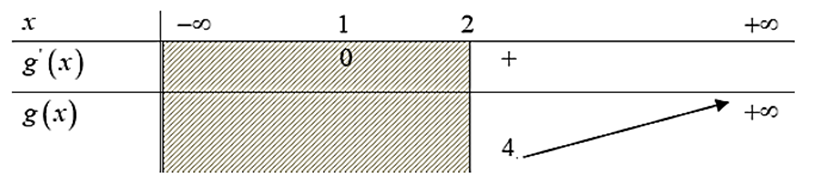
Dựa vào bảng biến thiên, suy ra \(m \le 4\) thỏa mãn yêu cầu bài toán.
Vậy \(m \in \left( { - \infty ;4} \right]\) thì hàm số đã cho đồng biến trên khoảng \(\left( {2; + \infty } \right)\).