Tang góc giữa hai vectơ −−→ B S và −−→ G C bằng √ 10 .
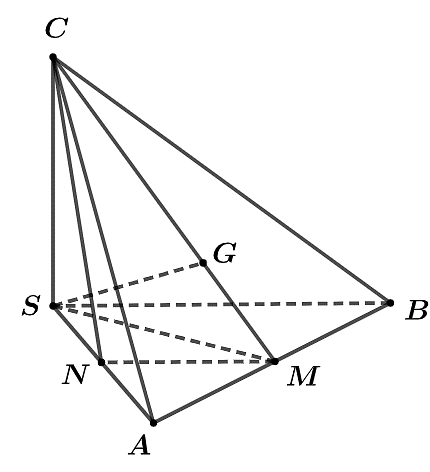
Điểm \(G\) là trọng tâm của tam giác \(ABC\) nên ta có: \(\overrightarrow {GA} + \overrightarrow {GB} + \overrightarrow {GC} = \overrightarrow 0 \).
Khi đó, \(\overrightarrow {SA} + \overrightarrow {SB} + \overrightarrow {SC} = \left( {\overrightarrow {SG} + \overrightarrow {GA} } \right) + \left( {\overrightarrow {SG} + \overrightarrow {GB} } \right) + \left( {\overrightarrow {SG} + \overrightarrow {GC} } \right) = 3\overrightarrow {SG} \).
Gọi \(M\) là trung điểm của \(AB\), ta có:
\(\overrightarrow {SA} \cdot \overrightarrow {CG} = \overrightarrow {SA} \cdot \frac{2}{3}\overrightarrow {CM} = \frac{2}{3}\overrightarrow {SA} \cdot \left( {\overrightarrow {CS} + \overrightarrow {SM} } \right) = \frac{2}{3}\overrightarrow {SA} \cdot \overrightarrow {CS} + \frac{2}{3}\overrightarrow {SA} \cdot \overrightarrow {SM} \).
Vì \(SA \bot SC\) nên \(\overrightarrow {SA} \cdot \overrightarrow {CS} = 0\).
Ta có \(\frac{2}{3}\overrightarrow {SA} \cdot \overrightarrow {SM} = \frac{2}{3}SA \cdot SM \cdot \cos \widehat {ASM} = \frac{2}{3} \cdot 2 \cdot \sqrt 2 \cdot \cos 45^\circ = \frac{4}{3}\).
Do đó, \(\overrightarrow {SA} \cdot \overrightarrow {CG} = \frac{4}{3}\).
Gọi \(N\) là trung điểm của \(SA\), ta có: \(\overrightarrow {BS} = 2\overrightarrow {MN} ,\,\overrightarrow {GC} = \frac{2}{3}\overrightarrow {MC} \Rightarrow \left( {\overrightarrow {BS} ,\,\overrightarrow {GC} } \right) = \left( {\overrightarrow {MN} ,\,\overrightarrow {MC} } \right) = \widehat {CMN}.\)
Ta có \(MN{\rm{//}}SB,\,SA \bot SB\) nên \(MN \bot SA\). Lại có \(MN \bot SC\,\,\left( {{\rm{do}}\,\,SC \bot \left( {SAB} \right)} \right)\).
Do đó, \(MN \bot \left( {SAC} \right)\). Suy ra \(MN \bot CN\).
Tam giác \(CNM\) vuông tại \(N\) nên \(\tan \widehat {CMN} = \frac{{CN}}{{MN}} = \frac{{\sqrt {10} }}{1} = \sqrt {10} \).
Đáp án: a) Đúng, b) Sai, c) Đúng, d) Đúng.