−→ R J = −−→ R A + −→ A J .
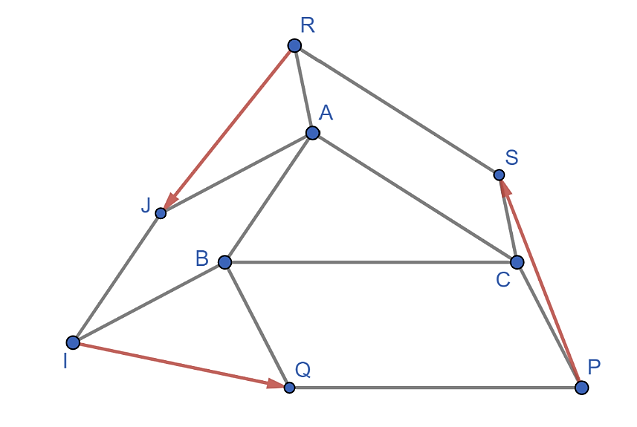
a) Đúng. Theo quy tắc ba điểm, ta có \(\overrightarrow {RJ} = \overrightarrow {RA} + \overrightarrow {AJ} \).
b) Sai. Ta có \(\overrightarrow {IQ} = \overrightarrow {IB} + \overrightarrow {BQ} \).
c) Sai. Ta có \(\overrightarrow {PS} = \overrightarrow {PC} + \overrightarrow {CS} \).
d) Đúng. Do \(CARS\) là hình bình hành nên \(\overrightarrow {RA} = \overrightarrow {SC} \).
Do \(ABIJ\) là hình bình hành nên \(\overrightarrow {AJ} = - \overrightarrow {IB} \).
Khi đó, \(\overrightarrow {RJ} = \overrightarrow {RA} + \overrightarrow {AJ} = \overrightarrow {SC} - \overrightarrow {IB} \).
Do \(BCPQ\) là hình bình hành nên \(\overrightarrow {BQ} = \overrightarrow {CP} \).
Khi đó, \(\overrightarrow {IQ} = \overrightarrow {IB} + \overrightarrow {BQ} = \overrightarrow {IB} + \overrightarrow {CP} \).
Vậy ta có \(\overrightarrow {RJ} + \overrightarrow {IQ} + \overrightarrow {PS} \)\[ = \left( {\overrightarrow {SC} - \overrightarrow {IB} } \right) + \left( {\overrightarrow {IB} + \overrightarrow {CP} } \right) + \left( {\overrightarrow {PC} + \overrightarrow {CS} } \right)\]\(\)
\( = \left( {\overrightarrow {SC} + \overrightarrow {CS} } \right) + \left( {\overrightarrow {IB} - \overrightarrow {IB} } \right) + \left( {\overrightarrow {CP} + \overrightarrow {PC} } \right) = \overrightarrow 0 \).
Vậy \(\overrightarrow {RJ} + \overrightarrow {IQ} + \overrightarrow {PS} = \vec 0\).