Khi m = 0 , ta có min ( 0 ; + ∞ ) y = − 2 .
a. S | b. Đ | c. Đ | d. Đ |
a) Khi \(m = 0\) thì giá trị nhỏ nhất của hàm số trên khoảng \(\left( {0; + \infty } \right)\) bằng \(2\).
Thay \(m = 0\)vào \(y = \frac{{{x^2} + mx + 1}}{{x + m}}\), ta có \(y = \frac{{{x^2} + 1}}{x} \Rightarrow y' = \frac{{{x^2} - 1}}{{{x^2}}} = 0 \Leftrightarrow {x^2} - 1 = 0\)\( \Leftrightarrow \left[ \begin{array}{l}x = 1\\x = - 1 \notin \left( {0; + \infty } \right)\end{array} \right.\).
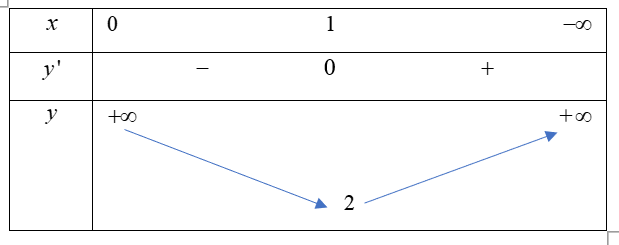
b) Ta có \(y = \frac{{{x^2} + mx + 1}}{{x + m}} \Rightarrow y' = \frac{{{x^2} + 2mx + {m^2} - 1}}{{{{(x + m)}^2}}}\).
\( + y' = 0\)\( \Leftrightarrow {x^2} + 2mx + {m^2} - 1 = 0 \Leftrightarrow \left[ \begin{array}{l}x = - m - 1;\,(\,x \ne - m)\\x = - m + 1;\,(\,x \ne - m)\end{array} \right.\).
\( \Rightarrow y' = 0\) luôn có 2 nghiệm phân biệt thỏa mãn \(x \ne - m,\,\,\forall m\). Vậy hàm số luôn có 2 cực trị.
c) \( + y' = 0\)\( \Leftrightarrow {x^2} + 2mx + {m^2} - 1 = 0 \Leftrightarrow \left[ \begin{array}{l}x = - m - 1\\x = - m + 1\end{array} \right.\).
Ta có bảng biến thiên:
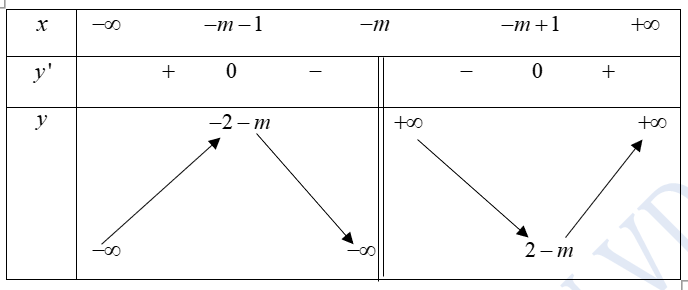
Từ bảng biến thiên ta có: \(\mathop {max}\limits_{\left( { - \infty ; - m} \right)} y = - 2 - m\,\,;\,\,\,\,\,\mathop {\min }\limits_{\left( { - m; + \infty } \right)} y = 2 - m \Rightarrow \mathop {\min }\limits_{\left( { - m; + \infty } \right)} y - \mathop {{\mathop{\rm m}\nolimits} ax}\limits_{\left( { - \infty ; - m} \right)} y = 4\).
d) Khi \(m = - 3\)thay vào \(y = \frac{{{x^2} + mx + 1}}{{x + m}}\), ta có \(y = \frac{{{x^2} - 3x + 1}}{{x - 3}}\).
+ Hàm số \(y = \frac{{{x^2} - 3x + 1}}{{x - 3}}\) là hàm phân thức hữu tỉ, liên tục trên các khoảng \(\left( { - \infty ;3} \right)\) và \(\left( {3; + \infty } \right)\).
Mặt khác \(\left[ { - 1;2} \right] \subset \left( { - \infty ;3} \right) \Rightarrow \)hàm số liên tục trên đoạn \(\left[ { - 1;2} \right]\).
+ Ta có \(y' = \frac{{{x^2} - 6x + 8}}{{{{(x - 3)}^2}}} > 0\,\,\forall x \in \left( { - 1;2} \right)\) và \(y(2) = 1\).
Vì hàm số tăng trên \(\left( { - 1;2} \right)\) nên hàm số đạt giá trị lớn nhất \(\mathop {max}\limits_{\left[ { - 1;2} \right]} y = y(2) = 1\).