Cho tam giác ABC có ba góc nhọn, \(AB < AC\) và nội tiếp đường tròn (O). Đường thẳng
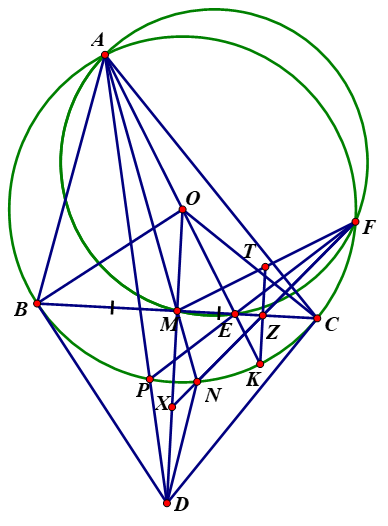
1. Xét đường tròn (O): \(BD \bot BO,\;CD \bot CO\) (tính chất tiếp tuyến)
\( \Rightarrow \widehat {DBO} = \widehat {DCO} = {90^\diamondsuit }\)\( \Rightarrow \widehat {DBO} + \widehat {DCO} = {180^\diamondsuit }\)
\( \Rightarrow \)Tứ giác OBDC nội tiếp
Lại có \(OB = OC,\;MB = MC,\;DB = DC\)
\( \Rightarrow O,\;M,\;D\) cùng thuộc trung trực của đoạn BC
Suy ra \(MO.MD = MB.MC\)
Mà tứ giác ABNC nội tiếp \( \Rightarrow MB.MC = MA.MN\)
\( \Rightarrow MO.MD = MA.MN\)\( \Rightarrow \) Tứ giác AOND nội tiếp
\( \Rightarrow DO\) là phân giác \(\widehat {ADN}\)
b) Xét \({\rm{\Delta }}DBP\) và \({\rm{\Delta }}DAB\) có
\(\widehat {BDP}\;\)chung; \(\widehat {DBP} = \widehat {DAB}\)
\( \Rightarrow {\rm{\Delta }}DBP \sim {\rm{\Delta }}DAB\) (g.g) \( \Rightarrow \frac{{AB}}{{BP}} = \frac{{AD}}{{DB}}\)
Tương tự ta có \({\rm{\Delta }}DCP \sim {\rm{\Delta }}DAC \Rightarrow \frac{{AC}}{{CP}} = \frac{{AD}}{{DC}}\)
\( \Rightarrow \frac{{AB}}{{BP}} = \frac{{AC}}{{CP}} \Rightarrow AB.CP = AC.BP\)
Áp dụng định lý Ptoleney cho tứ giác ABPC nội tiếp ta có
\(AP.BC = AB:CP + AC.BP\)
\( \Rightarrow 2AP.CM = 2AC.BP \Rightarrow \frac{{AP}}{{AC}} = \frac{{BP}}{{CM}}\)
\({\rm{\Delta }}ABP\) và \({\rm{\Delta }}AMC\) có \(\frac{{AP}}{{AC}} = \frac{{BP}}{{CM}}\;;\;\widehat {APB} = \widehat {ACM}\)
\( \Rightarrow {\rm{\Delta }}ABP \sim {\rm{\Delta }}AMC\) (c.g.c) \( \Rightarrow \widehat {ABP} = \widehat {AMC}\)
Lại có tứ giác ABPF nội tiếp nên \(\widehat {ABP} = {180^\diamondsuit } - \widehat {AFP}\)
Lại có tứ giác AMEF nội tiếp nên \(\widehat {AME} = {180^\diamondsuit } - \widehat {AFB}\)
\( \Rightarrow \widehat {AFP} = \widehat {AFE} \Rightarrow E,\;F,\;P\) thẳng hàng
c) Áp dụng hệ thức lượng cho \({\rm{\Delta }}OCD\) vuông tại C ta có
\(OM.OD = O{C^2} = O{F^2} \Rightarrow \frac{{OF}}{{OM}} = \frac{{OD}}{{OF}}\) \( \Rightarrow {\rm{\Delta }}OMF \sim {\rm{\Delta }}OFD\;\) (c.g.c)
\( \Rightarrow \widehat {OFD} = \widehat {OMF} = {90^\diamondsuit } - \widehat {CMF} = {90^\diamondsuit } - \widehat {FAE} = {90^\diamondsuit } - \widehat {AFO}\;\)
\( \Rightarrow AFD = {90^\diamondsuit } \Rightarrow AF \bot FD\) mà \(AF \bot FK\)
\( \Rightarrow DF = DK \Rightarrow D,\;F,\;K\) thẳng hàng
Gọi \(Z,\;X\) là giao \(FN\) với \(BC,\;DM\).
Gọi \(T\) là giao \(KZ\) với \(MF\).
Ta có \(D{C^2} = DK.DF = DM.DO \Rightarrow \) Tứ giác OMKF nội tiếp
\( \Rightarrow \widehat {KMF} = \widehat {KOF\;} = 2\widehat {OAF} = 2\widehat {FMS}\;\)
\( \Rightarrow \widehat {KME} = \widehat {FME} = \widehat {FAO} = \widehat {KNF}\)\( \Rightarrow \) Tứ giác MNKZ nội tiếp
\( \Rightarrow \widehat {KZM} = {180^\diamondsuit } - \widehat {MNK} = {90^\diamondsuit }\)
Lại có \({\rm{\Delta }}TMK\) có MZ là đường cao đồng thời là phân giác
\( \Rightarrow ZT = ZK\)
Do \(TK//DM \Rightarrow \frac{{ZT}}{{MX}} = \frac{{FZ}}{{FX}} = \frac{{ZK}}{{DX}}\)
\( \Rightarrow XD = XM \Rightarrow \) X là trung điểm của đoạn DM.
Vậy FN đi qua trung điểm của đoạn DM