a) \(\overrightarrow {AM} \cdot \,\overrightarrow {MC} = 0\). b) \(\left| {\overrightarrow {AD} + 2\overrightarrow {MC} } \right| = 10\).
Lời giải
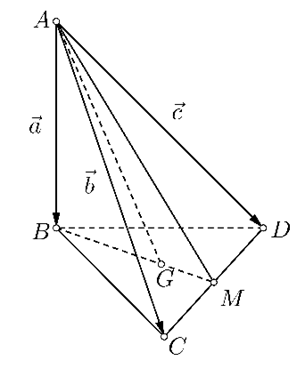
a) Đúng. \(AB \bot \left( {BCD} \right) \Rightarrow AB \bot BC \Rightarrow AC = \sqrt {A{B^2} + B{C^2}} = 5\), tương tự \(AD = 5\).
\(M\) là trung điểm \(CD\)\( \Rightarrow AM \bot MC\) (do \(\Delta ACD\) cân tại \(A\))\( \Rightarrow \overrightarrow {AM} \cdot \overrightarrow {MC} = 0\).
b) Sai. Ta có \(\left| {\overrightarrow {AD} + 2\overrightarrow {MC} } \right| = \left| {\overrightarrow {AD} + \overrightarrow {DC} } \right| = \left| {\overrightarrow {AC} } \right| = AC = 5\).
c) Đúng. Ta có \(G\) là trọng tâm tam giác \(BCD\)\( \Rightarrow \overrightarrow {GB} + \overrightarrow {GC} + \overrightarrow {GD} = \overrightarrow 0 \) .
\(\overrightarrow a + \overrightarrow b + \overrightarrow c = \overrightarrow {AB} + \overrightarrow {AC} + \overrightarrow {AD} = \overrightarrow {AG} + \overrightarrow {GB} + \overrightarrow {AG} + \overrightarrow {GC} + \overrightarrow {AG} + \overrightarrow {GD} \)
\( = 3\overrightarrow {AG} + \left( {\overrightarrow {GB} + \overrightarrow {GC} + \overrightarrow {GD} } \right) = 3\overrightarrow {AG} + \overrightarrow 0 = 3\overrightarrow {AG} \).
\( \Rightarrow \overrightarrow {AG} = \frac{1}{3}\left( {\overrightarrow a + \overrightarrow b + \overrightarrow c } \right)\).
d) Sai. Từ đẳng thức \(\overrightarrow {AG} = \frac{1}{3}\left( {\overrightarrow a + \overrightarrow b + \overrightarrow c } \right)\), ta suy ra\(AG < \frac{1}{3}\left( {\left| {\vec a} \right| + \left| {\vec b} \right| + \left| {\vec c} \right|} \right) = \frac{1}{3}\left( {4 + 5 + 5} \right) = \frac{{14}}{3}\).
Ngoài ra, ta có thể tính \(AG\) bằng định lý Pythagore.
Ta có \(BG = \frac{2}{3}BM = \frac{2}{3} \cdot \frac{{3\sqrt 3 }}{2} = \sqrt 3 \). Khi đó, \(AG = \sqrt {B{G^2} + A{B^2}} = \sqrt {19} < \frac{{14}}{3}\).